Being the Source AI Answer Engines Cite: A GEO Playbook
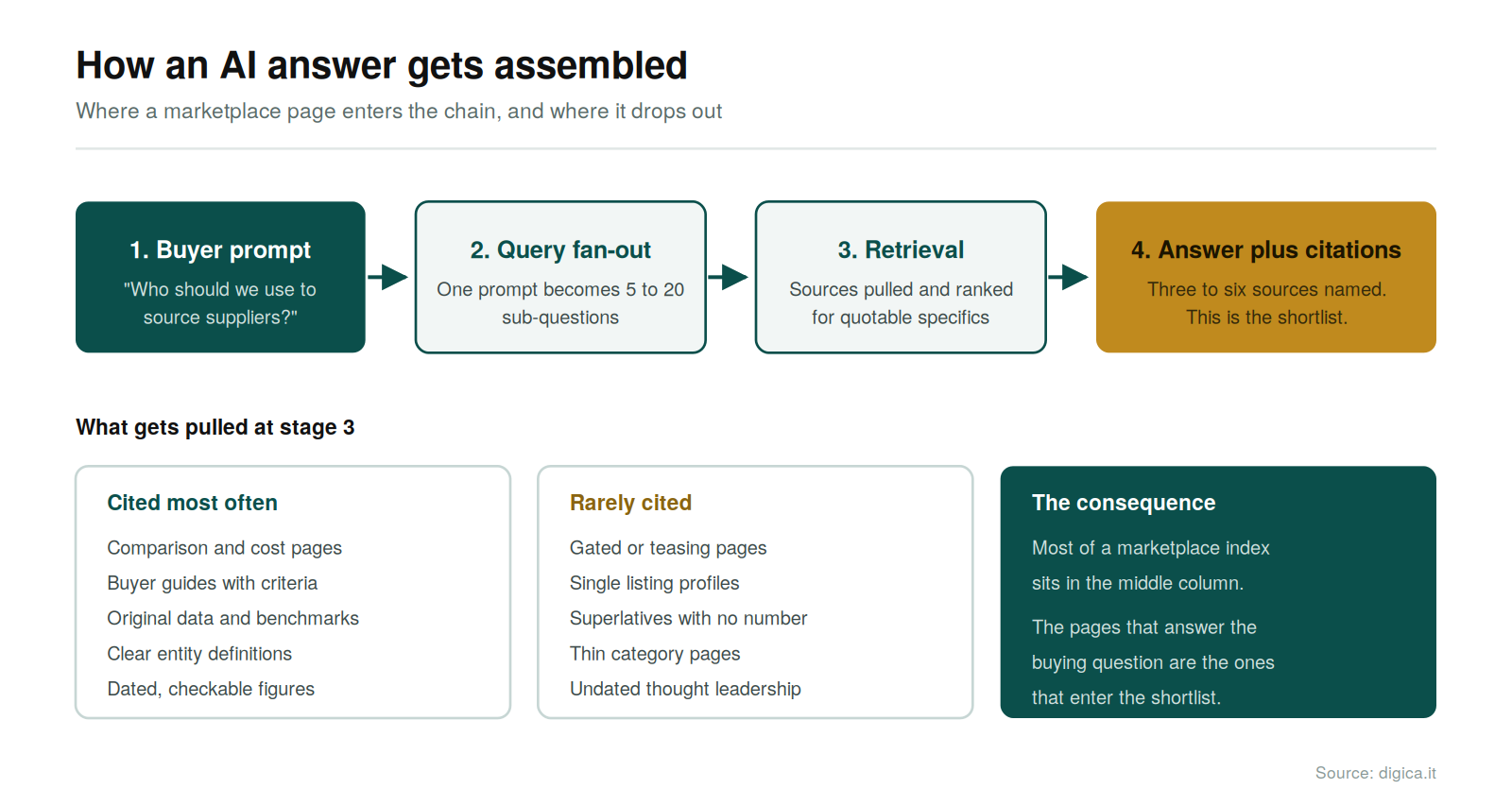
A buyer in your category now opens an assistant before they open a search engine. They ask who the credible providers are, what a fair price looks like, and which platform to run the process on. ChatGPT alone reached roughly 1.1 billion monthly users by June 2026, and a meaningful share of those sessions are commercial research. If your marketplace is not named in that answer, the click you have spent years optimising for never gets the chance to happen. Getting cited by AI answer engines has become the step before ranking, not a step after it.
The uncomfortable part is that the content built to convert is usually the content least likely to be cited. Pages that withhold the answer to force a form fill give a model nothing to quote. Pages that name a number, define a term, and finish the thought get lifted into the answer with attribution. That inversion is the whole of generative engine optimisation, and most marketplace content programmes are still pointed the other way.
This piece covers what citation is worth in revenue terms, what it costs to produce content that earns it, where the money is usually wasted, and how to measure any of it when the click never happens. It is written for platforms with an existing organic footprint that has stopped compounding.
What being cited by AI answer engines is worth
A citation is a named mention with a link inside a generated answer, and it does two jobs: it puts you in the consideration set, and it sends a small volume of unusually qualified traffic. Vendor studies through late 2025 put assistant referrals at roughly 1 percent of total sessions across large domain samples, while measuring conversion rates around four times standard organic. Low volume, high intent.
Treating that 1 percent as the business case is the mistake. The value sits in the 99 percent of assistant sessions that end without a click, because those sessions still produce a shortlist. A buyer who reads your name three times across three prompts arrives later as branded search, as a direct visit, or as an RFP that lands in your inbox with no traceable source.
The revenue framing that holds up in a board meeting is replacement cost. Commercial clicks in most B2B categories across Europe and North America price between $5 and $16, so buying 5,000 sessions a month costs $25,000 to $80,000. Being the cited default in your category is the only asset that keeps that number off the P&L permanently.
Why assistant-first research breaks the marketplace traffic model
Marketplace organic growth has always run on a simple trade: publish the category page, capture the query, monetise the click. Assistants break the third step by answering in place, and they break the first by drawing from a different pool of sources than the one you have been optimising against.
Published research on the overlap between AI citations and the traditional top ten results ranges from about 11 percent to roughly 60 percent depending on the engine, the query set and the methodology. The spread is the finding. Ranking is neither necessary nor sufficient for citation, which means a rank tracker now measures one retrieval system while your buyers use four or five.

Google's own position is narrower and worth reading directly, because it contradicts a lot of what is being sold as AI optimisation. Its guidance on generative AI features in Search states that AI Overviews and AI Mode run on the same index and ranking systems as organic results, and that special files or markup are not required to appear. Foundations still matter for the Google surface. The assistant surfaces are the ones playing by different rules.
The practical consequence for a two-sided platform is uncomfortable. Supply-side pages, the listings and profiles that make up most of a marketplace's index, are exactly the pages an assistant has least reason to quote. They describe one vendor. They rarely answer a question.
What AI answer engines actually reward
Three properties decide whether a page gets used: structure, attributability, and completeness. Structure means one question per section, answered in the first two sentences, with the supporting detail underneath. Attributability means a specific, checkable claim that can be quoted without distortion. Completeness means the page finishes the job rather than teasing a conversion.
Entity clarity is the foundation underneath all three. A model has to know what your platform is, which category it belongs to, who is on each side of it, and what makes it different, in language plain enough to reuse. "The leading marketplace for growth" is unusable. "A marketplace where 2,400 verified wastewater treatment suppliers respond to tender requests from European industrial buyers" can be lifted straight into an answer.
Original numbers are the cheapest defensible moat available. Marketplaces sit on proprietary data, including median quote ranges, response times, win rates and category demand curves, and almost none of them publish it. A single page carrying a real figure, sourced and dated, will be cited across dozens of prompts for a year. The vendor's job is to sell a listing. Your job is to be the reference point for the category, and those are not the same content strategy.
The five page types that get cited on a marketplace
Not all content is equally citable, and the ranking is fairly stable across verticals. Comparison pages come first, because a buying question almost always contains a comparison. Pricing and cost pages come second, because models are asked about cost constantly and most vendors refuse to answer.
Buyer guides that define selection criteria come third. Original data and benchmark reports come fourth, and they carry the highest citation-per-euro of anything on this list. Category pages come fifth, useful mainly when they are written as answers rather than as lists.
Thought leadership sits outside the ranking. It builds the brand, and it almost never gets cited, because there is nothing specific inside it to quote.
Not sure where your marketplace stands in AI answers? A growth audit maps the gap between what you rank for and what gets cited. Get in touch with us to find out more.
Thin category and listing pages. Cost to produce: $175 to $460 each. Time to first citation: rarely cited at all. Main risk: indexed, but invisible in answers. Best for: supply-side depth and crawl coverage. Shelf life: 12 months with refreshes.
Long-form thought leadership. Cost to produce: $460 to $1,040 each. Time to first citation: 6 months or more, inconsistent. Main risk: spend with no attributable return. Best for: founder profile and press pickup. Shelf life: 3 to 6 months.
Structured answer pages. Cost to produce: $810 to $2,080 each. Time to first citation: 6 to 14 weeks. Main risk: higher unit cost and slower output. Best for: owning the buying question. Shelf life: 18 to 36 months with a data refresh.
A procurement lead should be able to read those three options alone and see where the budget belongs. The unit cost of a structured answer page is three to five times a thin page. The citation rate is not three to five times higher. It is the difference between a page that is quoted and a page that is not. Thin pages still earn their place for crawl coverage and supply-side depth, so the answer is a ratio rather than a purge: roughly one structured answer page for every ten listing pages is a workable starting split.
What citable content costs, and when it pays back
Building a citable core of 25 to 40 pages runs $23,000 to $64,000 across two quarters, depending on how much original data has to be produced rather than assembled. Retrofitting an existing page costs far less, typically $230 to $580, and for platforms with real traffic it is where the work should start.
Running cost after the build is smaller than most teams expect. Budget $2,300 to $6,900 a month for refreshes, new answer pages and monitoring, plus $230 to $690 a month for prompt-tracking tooling. Amortised across a working programme, the cost per 1,000 incremental organic sessions per month settles between $290 and $920 in year two, against $5,000 to $16,000 for the same 1,000 sessions bought on paid search.
Payback lands between 9 and 16 months for platforms with an existing index, and closer to 18 to 24 months for a cold start. That is slower than paid and considerably more durable. The assistant surfaces are growing faster than any channel in the last decade; scale of use is visible in ChatGPT's monthly active user trajectory, which moved from about 358 million in January 2025 to roughly 1.1 billion by June 2026.
The mistake in the business case is comparing this to SEO spend. The correct comparison is to the paid budget that will otherwise be defending the same demand forever. Framed that way, the question stops being whether the content budget is affordable and starts being how long the paid line stays at its current size.
Three ways marketplaces lose the citation
The teasing category page. A platform ranks page one for its head term, then withholds pricing and selection criteria behind a contact form. The assistant cites a competitor's guide instead, because the competitor answered. Rebuilding those pages after the fact costs $13,900 to $34,700 and gives up two quarters of compounding, which is the expensive part.

The volume play. A team ships 200 generated posts at $350 to $690 each, spending $70,000 to $138,000 over four to seven months. Nothing carries original data, so nothing gets quoted, and the thin pages dilute the crawl budget that the good pages need. This pattern recurs across platforms of this size, and it is almost always a response to a traffic target rather than a buying question. The tell is the brief: it names a keyword and a word count, and it never names the decision the reader is trying to make. Half that budget spent on eight pages carrying real platform data would have produced citations that were still working two years later.
The unattributable claim. Superlatives with no number attached cannot be quoted safely, so they are skipped. "Trusted by thousands of buyers" gives a model nothing. "4,100 buyer requests processed in 2025, with a median first response inside 14 hours" gives it a sentence it can reuse with a link. The cost of this failure is invisible, which is why it survives so long: the pages rank, the traffic looks stable, and the consideration set is being formed somewhere else.
How to measure visibility when the click never happens
Traditional reporting cannot see any of this, because the decisive moment happens inside an interface you have no analytics on. The workaround is to measure the answer layer directly rather than waiting for it to show up in sessions. Start with a prompt panel: 50 to 100 real buying questions in your category, run monthly across the four engines your buyers actually use. Track how often you are named, how often you are linked, and which page gets pulled. This costs $230 to $690 a month in tooling and about half a day of someone's time.
Then track four numbers alongside it. Share of voice against your three named competitors on that panel, measured as the share of prompts where each platform is mentioned at all. Branded search volume, which is the clearest proxy for answers that ended without a click. Assistant referral sessions and their conversion rate, reported separately from organic. Direct traffic to deep pages, which almost always signals a remembered recommendation rather than a navigational visit to the homepage.
A growth audit shows which buying questions in your category you are currently absent from, and what it would take to be the cited answer.
Reporting AI visibility inside the organic line hides the effect completely, which is how a programme that is working quietly gets cut at the next budget review. Break the numbers out from the first month, even while they are small, so the trend is already on the record before anyone asks for it. A panel that shows mentions climbing from 6 to 19 out of 80 prompts in a quarter is a defensible result. The same movement buried inside an organic sessions chart is invisible, and invisible programmes lose their funding first.
Where to start: the decision framework
The sequence matters more than the volume. These thresholds hold across most B2B marketplaces.
If organic already exceeds 50,000 sessions a month, retrofit the 20 highest-traffic pages before commissioning anything new. At $230 to $580 per page, $11,600 buys the whole retrofit and usually moves citation rates inside a quarter.
If the head term in your category carries more than 2,000 monthly searches and you sit outside the top 10, build the comparison page and the cost page first. Category pages can wait.
If you have fewer than 30 active providers on the supply side, fix that before writing anything. An assistant will not recommend a marketplace it cannot describe as a functioning market, and no amount of content substitutes for depth.
If assistant referrals are already above 2 percent of sessions, install tracking before adding content. You are further along than you think, and you need the baseline.
If the budget is under $17,000, produce 8 to 12 pages properly rather than 40 thin ones. Partial coverage of the buying question beats full coverage of the keyword list.
Two variables decide the rest: how much proprietary data you can publish without harming the supply side, and whether anyone internally owns the buying question rather than the traffic number.
Rank for the answer, not just the query
The strategic shift is small to describe and hard to execute. Stop building pages that rank for a query and start building pages that are the answer to it, which means publishing the number, defining the entity, and finishing the thought on the page rather than behind a form.
Marketplaces are unusually well placed to win here, because they hold the data that answers the question and sit at the point where both sides of the market meet. That structural advantage is the reason a16z has argued that AI is reviving marketplace categories that previously failed on unit economics. The platforms that publish what they know will be quoted. The ones that guard it will be summarised out of the conversation.
If this is the year your category gets decided inside an assistant, it is worth a conversation. Get in touch with Digica.
Building a citable core of 30 pages costs $23,000 to $64,000 once, with refreshes at $2,300 to $6,900 a month, and typically pays back inside 9 to 16 months. Replacing the same 5,000 monthly sessions with paid search costs $25,000 to $80,000 every month, which is $300,000 to $960,000 a year that never stops. The cost of doing nothing is not a traffic dip. It is permanent rent on demand you used to own.
FAQ
What is generative engine optimisation?
Generative engine optimisation is the practice of structuring content so that AI assistants and AI search features cite it when answering a question. It overlaps with SEO on technical foundations and diverges on format: GEO rewards complete, attributable answers over pages designed to tease a click.
Does ranking on Google mean an assistant will cite me?
No. Published overlap between AI citations and the organic top ten ranges from roughly 11 percent to 60 percent depending on the engine and the study. Strong rankings make you eligible on Google's own AI surfaces, but assistants such as ChatGPT and Perplexity draw from a partly different source pool.
How long does it take to get cited by AI answer engines?
Structured answer pages on an established domain typically start appearing in citations within 6 to 14 weeks. New domains take longer, often two quarters, because entity recognition has to build before the content can be attributed confidently.
Is AI referral traffic big enough to justify the spend?
The referral volume is small, around 1 percent of sessions on most sites, but it converts at roughly four times standard organic. The stronger argument is the pre-click one: assistants build the shortlist, and replacing that consideration with paid media costs $25,000 to $80,000 per 5,000 sessions a month.
Do I need llms.txt or special schema markup?
Not for Google. Its documentation states that no special files or markup are required for AI Overviews or AI Mode, and that llms.txt is not used. Standard structured data still helps machines interpret the page, so implement it for the usual reasons rather than as an AI tactic.
What should a B2B marketplace publish first?
A comparison page for the main buying decision in your category, then a cost or pricing page, then one original data study drawn from platform activity. Those three cover the majority of high-intent prompts in most verticals.
How do you measure something that never produces a click?
Run a fixed panel of 50 to 100 buying prompts monthly, record mention and citation rates against named competitors, and read them alongside branded search volume and direct traffic to deep pages. Tooling for this runs $230 to $690 a month.