The best startup communities to join in 2026, ranked by members and who gets in
A startup community is the cheapest growth lever a founder has, and the easiest one to waste. The Global Entrepreneurship Monitor 2025/2026 Global Report, built on responses from over 160,000 people across 53 economies, finds fear of failure deterring 2 in 5 adults from starting at all, and a widening "Survival Gap" where too few startups become established firms. The right peers shrink both problems. The wrong room costs you an evening a week for nothing.
The usual advice is to join the biggest startup community you can find. Size and engagement pull in opposite directions. The largest community in this list says it reaches over 5 million entrepreneurs. The smallest has about 600 members, reviews every application by committee, and runs more than 100 events a year for them. A founder with $5 million in revenue gets little from the first and cannot get into some of the others yet.
So this guide ranks seven startup communities by the members they report, then shows what that number hides: how often members actually meet, and what you must prove to get in. Every figure comes from each organization's own pages, checked on October 14, 2026. It is the same members and engagement lens we use when we help B2B communities grow, because a community that cannot show both struggles to attract either.
Quick Navigation
- Seven startup communities, ranked by members
- 1. Startup Grind: the widest reach
- 2. YPO: the CEO club with an age limit
- 3. Entrepreneurs' Organization: the $1 million line
- 4. Founder Institute: a paid cohort in 95 countries
- 5 and 6. Hampton and Founders Network: small rooms
- 7. Y Combinator Startup School: free and online
- What the member count does not tell you
- Three ways founders waste a startup community
- Which startup community fits your stage
- The number to bring to your cofounder
- FAQ
- Related Articles
Seven startup communities, ranked by members
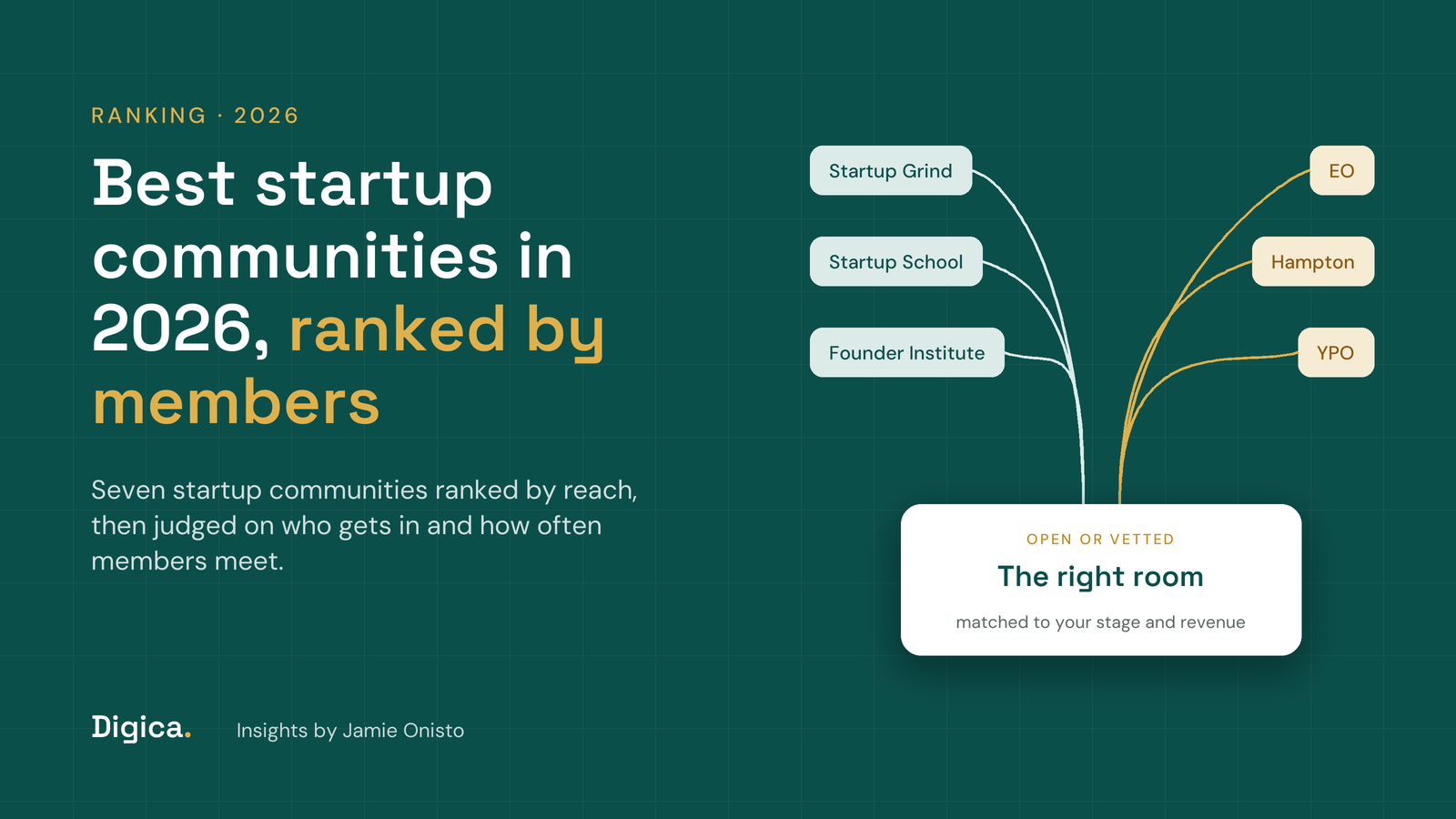
The short answer: Startup Grind is the largest startup community by a wide margin, YPO and EO are the largest vetted networks, and Hampton and Founders Network are the smallest and the most selective. The ranking below uses the member count each one publishes.
Seven startup communities compared on members, footprint, entry rules and how members meet
| Rank | Startup community | Members reported | Footprint | Who gets in | How members meet | Main risk | Best for |
|---|---|---|---|---|---|---|---|
| 1 | Startup Grind | Over 5 million entrepreneurs | 300+ chapters, 100+ countries | Anyone; separate paid memberships for startups and investors | 125+ events a month, plus an annual conference | Breadth without depth | Early founders building a local network |
| 2 | YPO | More than 38,000 chief executives | Global chapters | Under 45, top operational leader, 50 staff, $16M+ revenue (sales, service, manufacturing) | Chapter and peer forum meetings | The highest entry bar here | CEOs of established companies |
| 3 | Entrepreneurs' Organization (EO) | Nearly 20,000 members | 220+ chapters, 80+ countries | Founder or owner of a business with $1M+ revenue | Confidential Forum groups and chapter events | Little for pre-revenue founders | Owners past $1M a year |
| 4 | Founder Institute | Over 9,000 entrepreneurs | 200+ cities, 95 countries | Application, open at idea stage | A cohort of about 14 weeks | A course, not a lasting peer group | First-time founders who want structure |
| 5 | Hampton | Over 1,000 members | 18 chapter cities | Founder or CEO with $3M+ revenue or $3M+ raised, or a $10M+ exit | Monthly Core groups of about 8 to 10 | Must live in a chapter city | Funded or profitable tech founders |
| 6 | Founders Network | 600+ tech founders | SF, Silicon Valley, New York and beyond | Invitation, then committee review | 100+ events a year, 40+ webinars | Smallest pool of peers | Tech founders who want stage-matched peers |
| 7 | Y Combinator Startup School | Not published | Online | Anyone at an early stage | Self-paced course and co-founder matching | No in-person peer group | Solo founders looking for a co-founder |
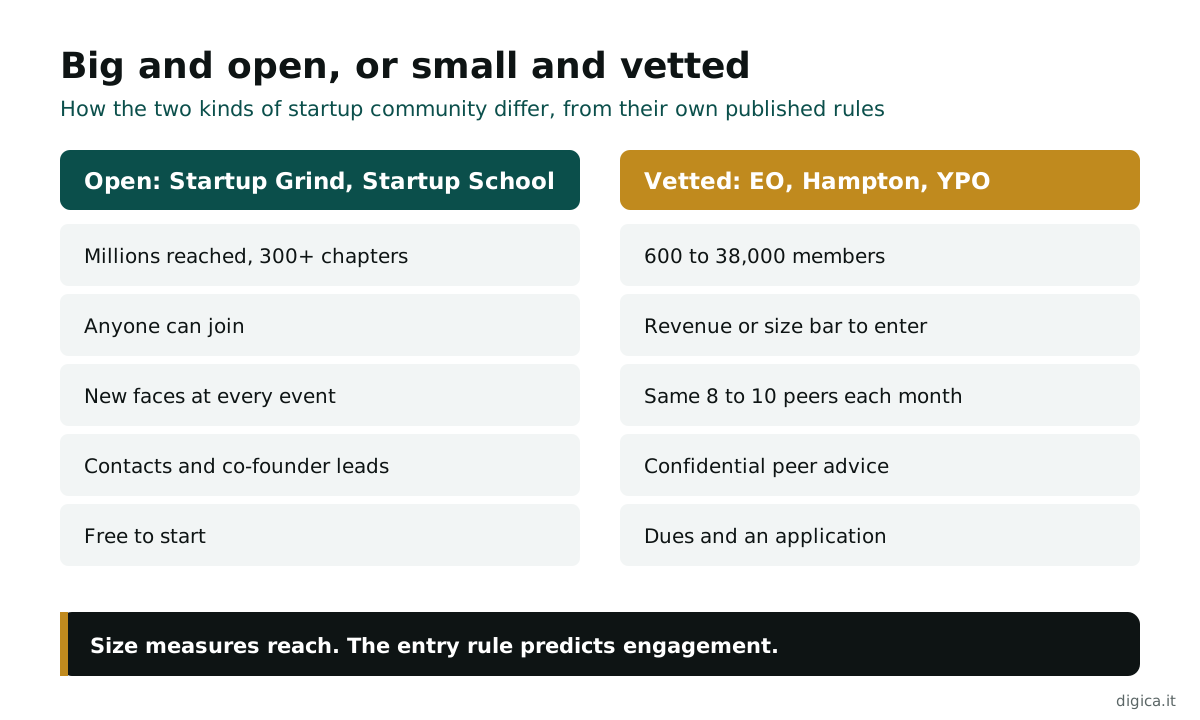
Read the table from the right. The "who gets in" column predicts engagement better than the member count does. Where the entry rule is strict, the meeting format is small, fixed and frequent. Where anyone can join, you get scale and you have to build the depth yourself.
1. Startup Grind: the widest reach
Startup Grind is the largest startup community in this ranking, and the most open. Its site says it reaches over 5 million entrepreneurs through more than 300 chapters in over 100 countries, and runs more than 125 events every month. Its flagship conference gathers more than 5,000 founders, builders and investors; the next edition is set for April 27 to 28, 2027, in Silicon Valley.
The chapter model is the engine. Local organizers run fireside chats and meetups, so a founder in a mid-size city can find a monthly room of other founders without applying to anything. Startup Grind sells separate memberships for startups and for investors on top of the free chapter network.
The trade-off is depth. A monthly event with a new crowd each time builds acquaintances, not the kind of peer who will read your board deck. Founders who get the most from it treat it as a filter: meet many people at events, then build a small private group from the few who match their stage.
The verdict: the best first startup community for an early founder who needs a local network fast. Plan to outgrow it once you need confidential advice rather than introductions.
2. YPO: the CEO club with an age limit
YPO says it has more than 38,000 chief executives as members and has operated since 1950. It is the second largest network here and by far the hardest to join.
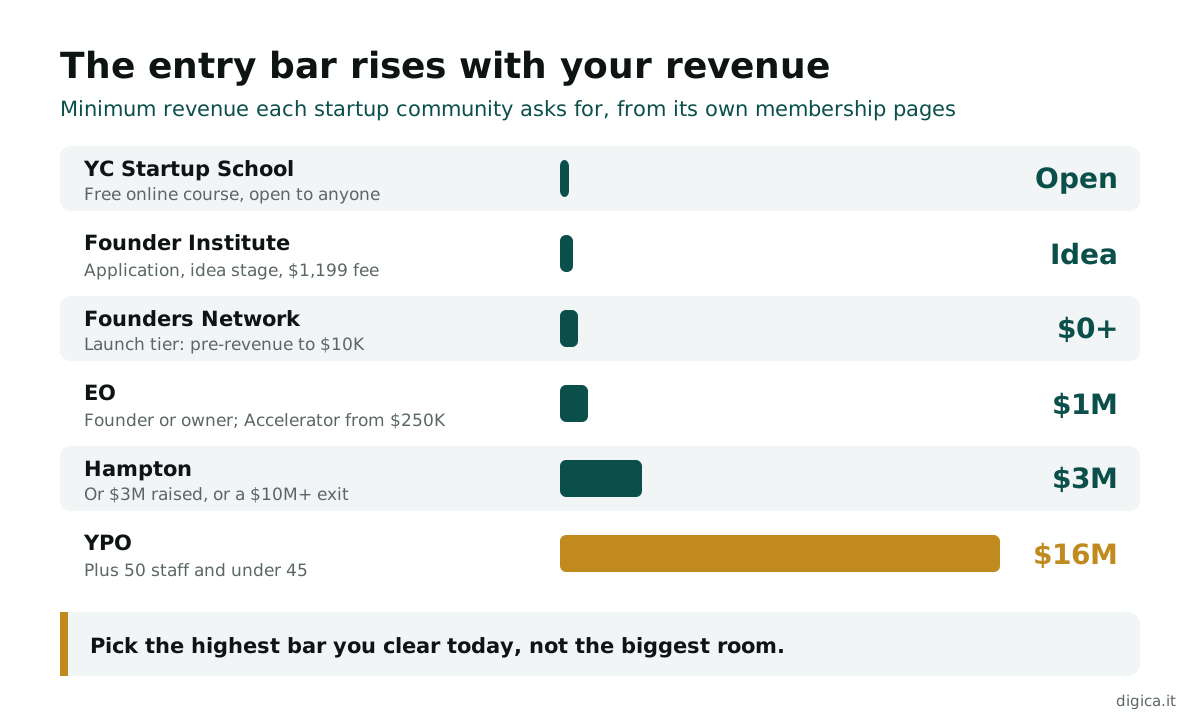
Its published criteria are specific. A member must be under 45, the top operational leader of the company or division, with final decision authority, full profit and loss accountability and the power to hire and fire. The company needs 50 full-time employees, or 15 or more with at least $2,750,000 in annual employee compensation. Revenue must reach $16,000,000 for sales, service and manufacturing companies, $13,000,000 for agencies, and $330,000,000 in assets under management or $27,000,000 in enterprise value for financial institutions.
Running a startup community or founder network?
In 30 minutes we look at how members find you today, and which growth channel would bring in the next thousand.
That filter is the product. Every person in a YPO room runs a company of real size, so the conversations are about leadership problems most founders have not reached yet. It also means YPO is not a startup community in the early-stage sense. Most founders reading this will qualify years from now, if ever.
The verdict: the right network for a young CEO who already clears every threshold. For anyone else, it is a target to plan toward, not a place to apply today.
3. Entrepreneurs' Organization: the $1 million line
EO says it has nearly 20,000 members in more than 220 chapters across more than 80 countries, and it has run since 1987. Its entry rule is the clearest in this list: you must be a founder, owner or controlling shareholder of a business with at least $1 million in gross annual revenue.
The core of EO is Forum, a small confidential group that meets regularly and works through business and personal decisions together. Chapters add events, and the Global Leadership Conference adds a yearly international meeting. For founders below the bar, EO Accelerator covers businesses with between $250,000 and $999,999 in revenue, which gives younger companies a structured path toward full membership.
EO's weakness is the mirror of YPO's. It is built for owners of real businesses, so a pre-revenue founder or a startup that has raised money but has little revenue gets little from it. Its strength is that the $1 million line catches founders at exactly the point where hiring, delegation and cash flow start to break.
The verdict: the best startup community for owners who have just crossed $1 million in revenue and need peers who have already solved the next problem.
4. Founder Institute: a paid cohort in 95 countries
Founder Institute says it has helped over 9,000 entrepreneurs launch companies since 2009, across more than 200 cities and 95 countries. Unlike the networks above, it is a program with a start and an end: the current cohort runs from November 19, 2026, to February 26, 2027, about 14 weeks.
Entry is by application and open at idea stage, and the published entrance fee is $1,199. Founders work through a fixed sequence of assignments with mentors from their local chapter, which suits a first-time founder who wants deadlines and feedback more than a social network.
The risk is what happens after week 14. A cohort creates a strong bond for a short time, and most of that bond fades unless founders keep meeting. The alumni network is large, but it is spread across 95 countries.
The verdict: the best choice for a first-time founder at idea stage who needs structure and accountability. Pair it with an ongoing peer group once the program ends.
5 and 6. Hampton and Founders Network: small rooms
Hampton and Founders Network are the two smallest startup communities in this ranking, and both say so as a feature. Each one limits who joins so the peers in a room are at the same stage.
Hampton says it has over 1,000 members in 18 chapter cities, from Austin and Boston to London, Toronto and Vancouver. To join, a founder or CEO needs a tech-enabled company with more than $3 million in revenue, or more than $3 million raised, or a prior exit above $10 million, and must live in a chapter city. Hampton says its members' companies average $23 million in revenue. The heart of it is the Core group: about 8 to 10 founders and a paid facilitator who meet in person every month for three hours, except in August and December. Hampton also runs more than 100 events a year.
Founders Network says it has more than 600 experienced tech founders, with chapters in San Francisco, Silicon Valley, New York and beyond. Membership is by invitation, then an application that a membership committee reviews every month. Members are placed in tiers by stage: Launch (pre-revenue to $10,000 in revenue, or up to $100,000 raised), Scale ($10,000 to $1 million, or $100,000 to $3 million raised) and Lead ($1 million or more, or $3 million or more raised). It runs more than 100 events and 40 webinars a year, and dues rise with the tier; no equity is taken.
Is your community growing members but not engagement?
A growth audit maps where your members come from, what keeps them active and which pages turn visitors into applicants.
The difference between the two is the starting point. Founders Network accepts founders from pre-revenue onward and sorts them by tier. Hampton starts at $3 million and puts every member in a fixed small group. Both cap the room on purpose: a group small enough that every member speaks at every meeting is the reason founders stay, and the reason neither will ever report a member count in the millions.
The verdict: Hampton for funded or profitable founders who want a standing monthly group in their city. Founders Network for tech founders earlier in the journey who still want a vetted, stage-matched room.
7. Y Combinator Startup School: free and online
Y Combinator does not publish a member count for Startup School, so it ranks last on this measure, not on value. It is a free online course for anyone at an early stage, built to take about 7 weeks at 1 to 2 hours a week, with a weekly progress update to keep founders moving.
The engagement number it does publish is unusual. Its co-founder matching service says it has made over 100,000 matches. For a solo founder, that is the single most useful feature in this whole list: no other startup community here is built to help you find the person you start the company with.
The limit is that it is online and self-paced. There is no chapter, no fixed group and no committee choosing who is in the room, so the peer value depends entirely on what a founder does with the matches and the forum.
The verdict: the best free starting point for solo founders and the best place to look for a co-founder. Add an in-person community once there is a team.
What the member count does not tell you
Member counts measure reach. They do not measure how often members meet, how alike their problems are, or whether anyone in the room has solved the problem you have now.
The stakes are rising. Startup Genome's Global Startup Ecosystem Report 2026, which analyzes data from more than 5.5 million companies across 350+ ecosystems, puts global ecosystem value at $10.9 trillion, up 40% in one year. More value means more founders and more communities competing for them, which makes the choice of room harder, not easier.
The pattern across the seven is consistent. The two largest numbers in the ranking belong to an open event network and a CEO organization with a revenue bar 16 times higher than EO's. The smallest belong to communities that meet monthly in fixed groups. Hampton's Core groups of 8 to 10 and EO's Forum groups are the engagement unit; the headline membership is the pool those groups are drawn from.
So compare three numbers, not one. First, the size of the group you would actually sit in. Second, how often that group meets. Third, the entry rule, because it decides who else is in that group. A community of 600 that meets you every month with founders at your stage can be worth more than one of 5 million that you see twice a year.
This is also the problem every community operator faces. A startup community has to show a large pool to attract new members, and a tight, active group to keep them. The communities on this list publish both kinds of numbers for that reason. Operators who only publish the first one usually find that members join, look around and drift away.
Three ways founders waste a startup community
Most founders who say a community did nothing for them made one of three mistakes. None of them is about the community.
- Joining above or below your stage. A pre-revenue founder in a room of $20 million companies hears advice that does not apply yet. A $10 million founder in an open meetup spends evenings answering other people's questions. The entry rule exists to prevent this; founders who join on a waiver or join a free network after outgrowing it lose the benefit.
- Collecting memberships. A founder joins four communities in a year, attends each one twice and builds no relationship anywhere. Engagement compounds inside one group. Spread across four, it never starts.
- Treating it as a sales channel. Founders who join to sell to other members tend to get politely ignored, and in vetted groups they can lose their place. The value is peer advice and introductions that follow trust, and trust takes months of showing up.
The common thread is time. Every community on this list rewards members who attend the same group repeatedly, and none rewards a founder who samples them all.
Which startup community fits your stage
Choose by your revenue and what you need from peers, using these thresholds.
- If you have no co-founder yet, start with Y Combinator Startup School and use its co-founder matching.
- If you are at idea stage and want structure, apply to Founder Institute and budget the $1,199 entrance fee.
- If you are pre-revenue or under $10,000 in revenue and want a local network, join your Startup Grind chapter, and consider the Launch tier at Founders Network if you are a tech founder.
- If you are between $250,000 and $1 million in revenue, look at EO Accelerator, then move into EO once you cross $1 million.
- If you have more than $3 million in revenue or raised and live in one of its 18 cities, Hampton gives you a fixed monthly group.
- If you are under 45, run a company of 50 people and clear $16 million in revenue, apply to YPO.
Building a B2B community or expert network?
We help B2B communities grow members and engagement through organic search, partnerships and earned placements.
Whichever you choose, commit to one community for a full year before judging it. Show up to the same group every time. The communities with small fixed groups make this easy by design; with an open network, you have to create that consistency yourself by returning to the same chapter and the same people. After a year you will know whether the room has the founders you need, and the entry rule of the next community up will tell you exactly what to grow into.
The number to bring to your cofounder
The US Census Bureau's Business Formation Statistics counted 531,728 business applications in August 2026, seasonally adjusted, and projected 28,501 business formations within four quarters from that month. That is a rough ratio of one projected formation for every 19 applications. The founders who get through are rarely the ones who went alone. A first-time founder can start with a free course or a $1,199 cohort, a few hours a month and less than one month of a junior salary. The biggest cost of doing nothing is making every hard hiring, pricing and fundraising decision without anyone who has made it before, and paying for each mistake in runway.
FAQ
What is a startup community? A startup community is a network of founders who meet to share advice, introductions and support. Some are open to anyone, such as Startup Grind and Y Combinator Startup School. Others vet members by revenue or company size, such as EO, Hampton and YPO.
What is the largest startup community? By reported reach, Startup Grind, which says it reaches over 5 million entrepreneurs through 300+ chapters in 100+ countries. Among vetted networks, YPO is the largest with more than 38,000 chief executives, followed by EO with nearly 20,000 members.
Which startup communities are free to join? Y Combinator Startup School is a free online course with co-founder matching. Startup Grind chapter events are open to anyone, with separate paid memberships for startups and investors. Vetted networks such as EO, YPO, Hampton and Founders Network charge dues.
How much revenue do you need to join EO or YPO? EO requires at least $1 million in gross annual revenue, with EO Accelerator for businesses between $250,000 and $999,999. YPO requires $16 million or more for sales, service and manufacturing companies, 50 full-time staff, and members under 45.
Is a startup community worth it for an early-stage founder? Yes, if it matches your stage and you attend the same group consistently. Open networks help early founders build contacts quickly. Vetted peer groups become more useful once revenue and team size create problems that peers at the same stage have already faced.
How do I find a co-founder through a startup community? Y Combinator Startup School runs a co-founder matching service that says it has made over 100,000 matches. Local Startup Grind chapter events and Founder Institute cohorts are other places founders meet future co-founders.
Related Articles
- B2B communities and expert networks
- Community SEO for B2B communities
- Best talent marketplaces in 2026: who vets hardest
- Marketplace liquidity: the metric that compounds
- Go-to-market when both sides are customers
This article is part of our B2B marketplace growth series. Browse more on the Digica blog.