The best talent marketplaces in 2026, judged on the quality of the hire
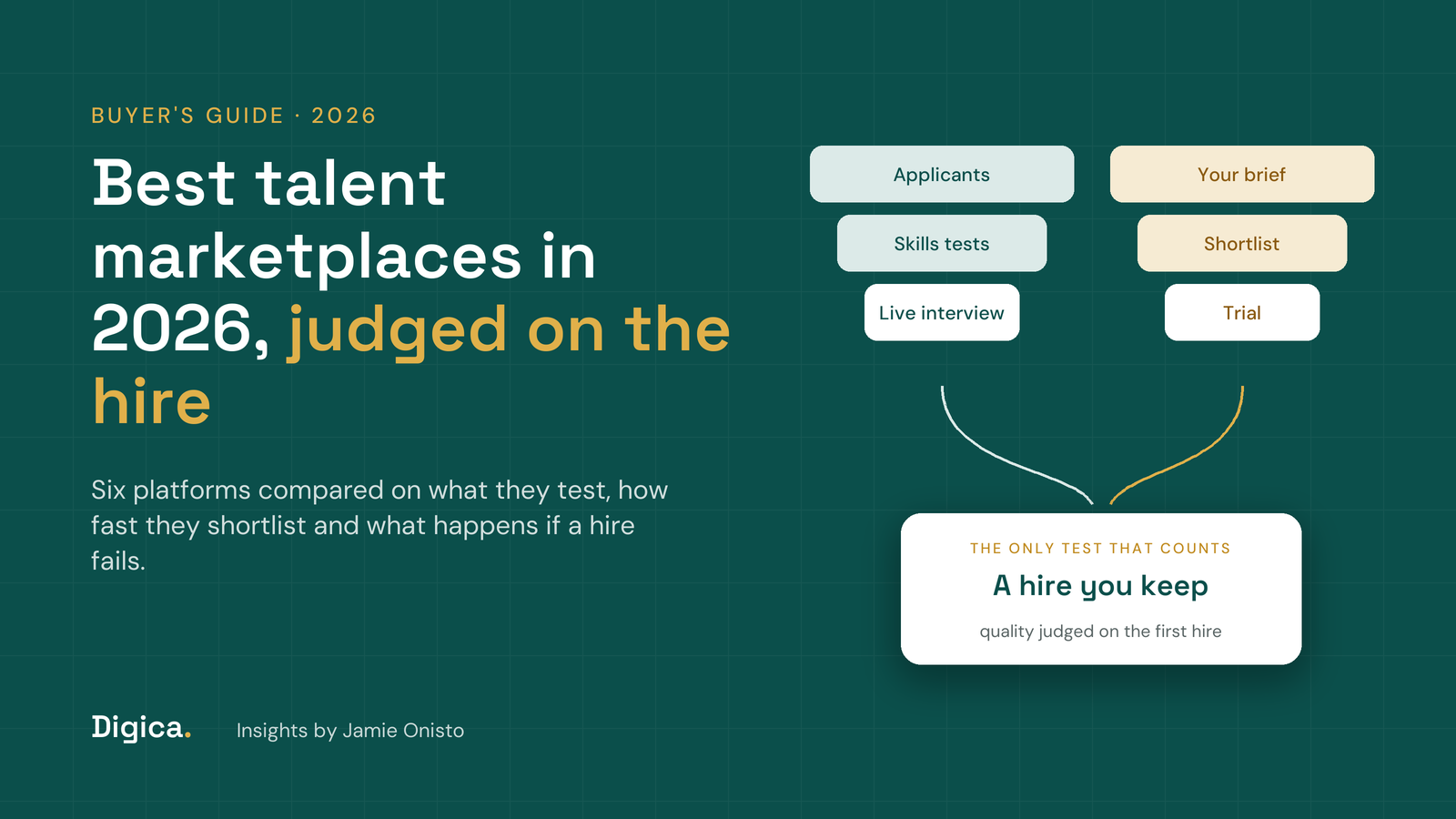
A talent marketplace earns its keep on one moment: the first person you hire through it. Get that wrong and the cost is not the platform fee. SHRM research on bad hires puts the total cost of replacing one at 50% to 200% of the role's salary, depending on seniority.
Every talent marketplace says it solves this. Toptal accepts fewer than 3% of applicants. Upwork reserves its Expert-Vetted badge for the top 1%. Braintrust says only the top 2% get through. Those three percentages sound comparable, and they are not. Toptal's screen runs three to eight weeks and ends with a paid test project. Braintrust's certification takes under two hours and centers on an AI voice interview. Malt runs identity and company checks, then leaves quality to reviews. What a platform tests matters far more than the percentage it advertises.
So this guide judges six talent marketplaces on the quality of the hire rather than the price of it: what each one tests, how selective it is, how fast a shortlist arrives and what happens if the hire does not work out. Facts come from each platform's own pages and filings, checked on October 12, 2026. It is the lens we apply when we help freelance and talent marketplaces grow, because quality is what makes a client hire twice.
Quick Navigation
- Talent marketplace: two meanings
- How we judged the quality of a hire
- The six talent marketplaces at a glance
- Best for senior hires: Toptal
- Best for hiring at volume: Upwork
- Best for defined deliverables: Fiverr Pro
- Best for hiring in Europe: Malt
- Best for engineering teams: Andela
- Best for attracting senior freelancers: Braintrust
- Who does the vetting: you or the platform
- Five mistakes that lead to a bad hire
- The question to ask every talent marketplace
- FAQ
- Related Articles
Talent marketplace: two meanings
"Talent marketplace" means two different things, and search results mix them. An external talent marketplace connects companies with freelance and contract talent, and earns a fee on the work. Toptal, Upwork and Malt are external talent marketplaces, and they are the subject of this guide.
An internal talent marketplace is HR software that matches a company's own employees to internal projects, gigs and roles. Gartner tracks it as a separate software category, with vendors such as Workday, SAP SuccessFactors, Gloat and Fuel50. Both match on skills rather than job titles, but only the external kind is a two-sided marketplace.
How we judged the quality of a hire
We judged each platform on four questions a hiring manager would ask before trusting a shortlist.
- What is tested? A review of a portfolio and work history is not the same as a live technical exercise or a paid test project. We looked for what the platform actually checks.
- How selective is it? We used each platform's published bar, such as an acceptance rate or badge share, and noted where none is published.
- How fast does a shortlist arrive? Speed matters, but only next to rigor. A shortlist in six hours from a light screen is a different product from one in 24 hours from a deep one.
- What happens if the hire fails? Trials, replacements and money-back terms show how much risk the platform is willing to carry.
We chose the six by scale and by model: the largest open marketplace, the best-known vetted network, the leading productized marketplace, a leading European platform, a specialist engineering network and the best-known network that charges talent nothing. Each takes a different approach to quality, which is the point.
The six talent marketplaces at a glance
The platforms split into two camps. Open marketplaces such as Upwork, Fiverr Pro and Malt show you many candidates and leave the final judgment to you. Vetted networks such as Toptal, Andela and Braintrust screen first and show you few.
Six talent marketplaces compared by what they test, how selective they are, speed and guarantees
| Talent marketplace | What is tested | Published bar | Speed to first candidates | If the hire fails | Best for |
|---|---|---|---|---|---|
| Toptal | Communication, technical tests, live expert exercises, 1 to 3 week test project | Fewer than 3% of 200,000+ applicants a year | Usually within 24 hours | No-risk trial of up to two weeks | Senior hires where a miss is expensive |
| Upwork | Work history, client feedback, 30-minute interview; Expert-Vetted adds a Talent Manager call | Expert-Vetted: top 1% | Business Plus shortlist in under 6 hours | No trial or guarantee published | Hiring often across 125+ categories |
| Fiverr Pro | Portfolio, experience, client feedback and language, reviewed by in-house evaluators | Not published | Packaged services; expert sourcing compares 2 candidates | Money-back claim within 14 days, as Pro balance | Fixed-scope deliverables |
| Malt | Identity and company checks, reviews; Malt Strategy requires top-firm consulting experience | Super Malter badge: 3.6% of active freelancers | A few days; Malt Strategy within 48 hours | Projects insured; no trial published | EU freelancers and consultants |
| Andela | English test, technical assessment, live technical interview | Not published | Teams within 72 hours | First 15 business days are a trial | Distributed engineering teams |
| Braintrust | ID check, AI voice interview, optional background check | Top 2%, as claimed | First candidates in under 48 hours | Direct hires: refund or replacement within 30 days | Senior freelancers who keep their full rate |
Running a talent marketplace where clients hire once and leave?
In 30 minutes we look at your match quality and repeat-hire rate, and where the first hire goes wrong.
No platform wins every column. Toptal tests deepest and backs it with a trial. Upwork is fastest to a shortlist and widest in categories. Andela and Braintrust sit between the two. The right choice depends on how costly a miss is for the role you are filling, and on how much interviewing time your team can realistically give to each shortlist.
Best for senior hires: Toptal
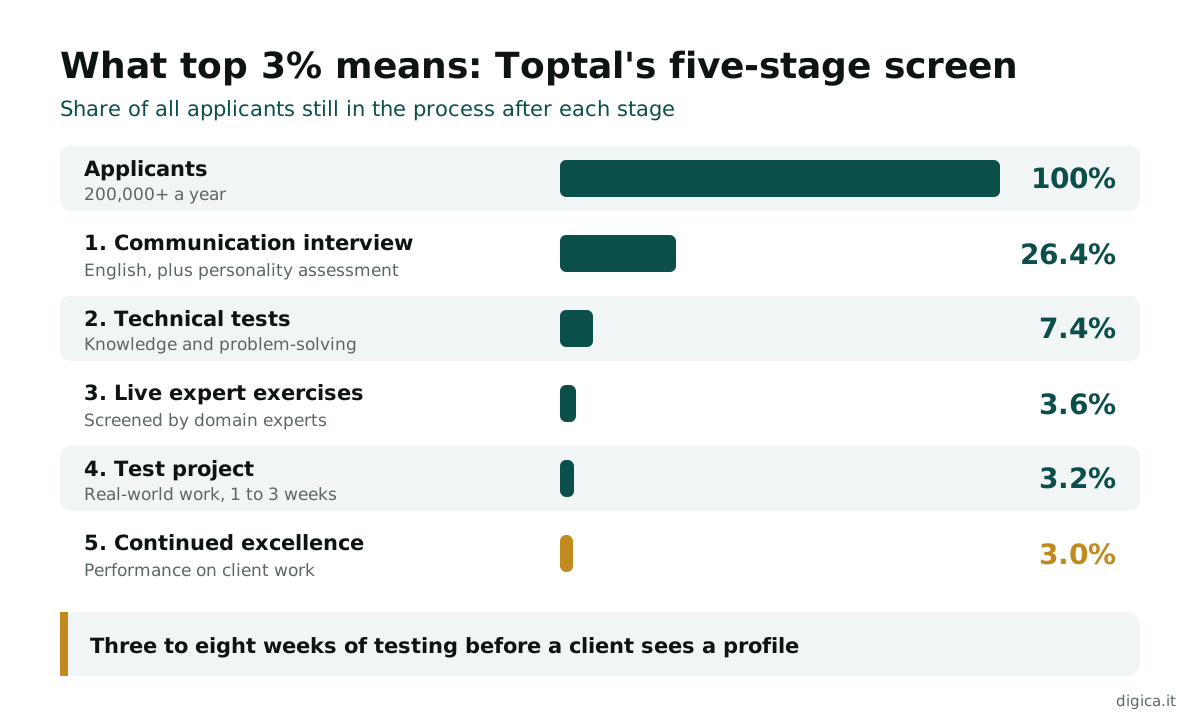
Toptal has the most rigorous published screen of any talent marketplace. Of every 100 applicants, 26.4 pass an English and communication interview with a personality assessment, 7.4 pass technical knowledge and problem-solving tests, 3.6 pass live exercises with domain experts, and 3.2 complete a real-world test project lasting one to three weeks. The last stage, continued excellence on client work, leaves 3 in 100. The whole process takes three to eight weeks, and more than 200,000 people apply each year.
The depth shows up in outcomes Toptal publishes. It says candidates are introduced within 24 hours in almost all cases, that 90% of clients hire the first candidate introduced, and that its trial-to-hire success rate is 98%. Clients can trial a hire for up to two weeks and are not billed if they are not completely satisfied.
Why it wins: the deepest screen, a paid test project before acceptance, and a no-risk trial after. Watch: the screen covers communication and skills, not background checks. Pricing is quoted per engagement.
Best for hiring at volume: Upwork
Upwork is the right choice when you hire often, across many skills, and can run your own interviews. Most clients hire within three days of posting a job, and on Business Plus an AI recruiter delivers a pre-vetted shortlist in under six hours across more than 125 categories. Business Plus talent is evaluated on work history and client feedback, plus a 30-minute interview on hard and soft skills.
For higher stakes, Upwork's Expert-Vetted program adds a live call with a Talent Manager and admits only the top 1%; decisions take four to six weeks, and Upwork's own analysis found Expert-Vetted freelancers have a 106% higher rehire rate than freelancers without a badge. The filter is exclusive to Business Plus. Large enterprise programs now run through Lifted, the Upwork company that took over Upwork Enterprise in August 2025.
Why it wins: the widest pool and the fastest shortlist, with a top-tier filter for roles that need it. Watch: outside Expert-Vetted, you are the vetting. No trial or replacement terms are published for Business Plus. Clients pay a 10% marketplace fee on Business Plus.
Best for defined deliverables: Fiverr Pro
Fiverr Pro suits work you can describe as a finished deliverable: a brand identity, a video, a landing page. In-house evaluators review each Pro applicant's experience, portfolio, work history, client feedback and language fluency, and Pros are reassessed on communication, responsiveness and on-time delivery. Fiverr does not publish an acceptance rate, and it does not describe skills tests or live exercises.
Is your vetting slowing supply more than it protects quality?
A growth audit maps your supply funnel, match rate and repeat hiring against what each match earns.
Where Fiverr Pro stands out is recourse. Its money-back guarantee covers Pro freelancer orders, project management and its expert sourcing service, which sends a comparison report on two candidates after a consultation with a Fiverr specialist. Claims must be made within 14 days of completion, refunds go to a Fiverr Pro balance rather than back as cash, and hourly orders are excluded.
Why it wins: packaged scope makes quality easy to judge, and the guarantee covers the miss. Watch: vetting is a portfolio and reputation review, not a skills test. Read the guarantee terms before a large order.
Best for hiring in Europe: Malt
Malt is one of Europe's largest freelance marketplaces, with more than 90,000 client companies. Its open marketplace verifies identity and company status through its payment provider, requires freelancers to have a legal business and bans subcontracting, then relies on reviews and recommendations for quality. There is no skills test on the open marketplace.
Malt's Super Malter badge is a reputation signal rather than a test: it rewards completed work, repeat clients and an average rating of at least 4.5 out of 5, and only 3.6% of regularly active freelancers hold it. For senior work, Malt Strategy is properly selective: consultants need at least two years at a top strategy firm or five at a well-known consultancy, and interim executives need ten years in a large company. Malt says Strategy projects are matched within 48 hours and average 4.8 out of 5.
Why it wins: local contracts and compliance across Europe, with a vetted tier for strategy work. Watch: on the open marketplace, quality is only as good as the reviews. Check recommendations closely.
Best for engineering teams: Andela
Andela specializes in engineering, and it vets like it. Candidates pass an English proficiency test, a technical assessment and a live technical interview before a matcher shortlists them; the client then interviews. In January 2026 Andela acquired Woven to add real-world engineering scenarios to its assessments, building on its earlier purchase of the assessment company Qualified.
It reports 17,000 certified AI-native engineers within a much larger trained network, more than 650 clients and a 98% enterprise client satisfaction rate. It says it can assemble teams within 72 hours, and its talent-facing terms treat the first 15 business days of an engagement as a trial the client can end immediately. Andela does not publish an acceptance rate.
Why it wins: engineering-specific testing and team assembly in days. Watch: no published acceptance rate or replacement guarantee. Ask for both in writing.
Best for attracting senior freelancers: Braintrust
Braintrust takes the opposite approach to fees, and it shapes who joins. Talent pays zero platform fees and keeps the full rate, which is a strong draw for senior freelancers who resent paying a platform fee on every invoice elsewhere. Braintrust says it surfaces matched candidates in under 48 hours and claims only the top 2% get through.
Its screen is light on human testing. Certification combines a government ID check with a 15 to 30 minute domain-specific AI voice interview, plus an optional background check, and takes under two hours. For direct hires, Braintrust refunds the fee or finds a replacement if the hire leaves within 30 days; no guarantee is published for contractors.
Why it wins: a supply model that attracts experienced freelancers, and a fast, AI-led screen. Watch: "top 2%" sits awkwardly beside a network of 2 million+ vetted professionals. Run your own technical interview.
Who does the vetting: you or the platform
Vetting never disappears. It moves. On an open marketplace you do it, in hours spent reading proposals and running interviews. On a vetted network the platform does it, and the cost sits inside the rate.
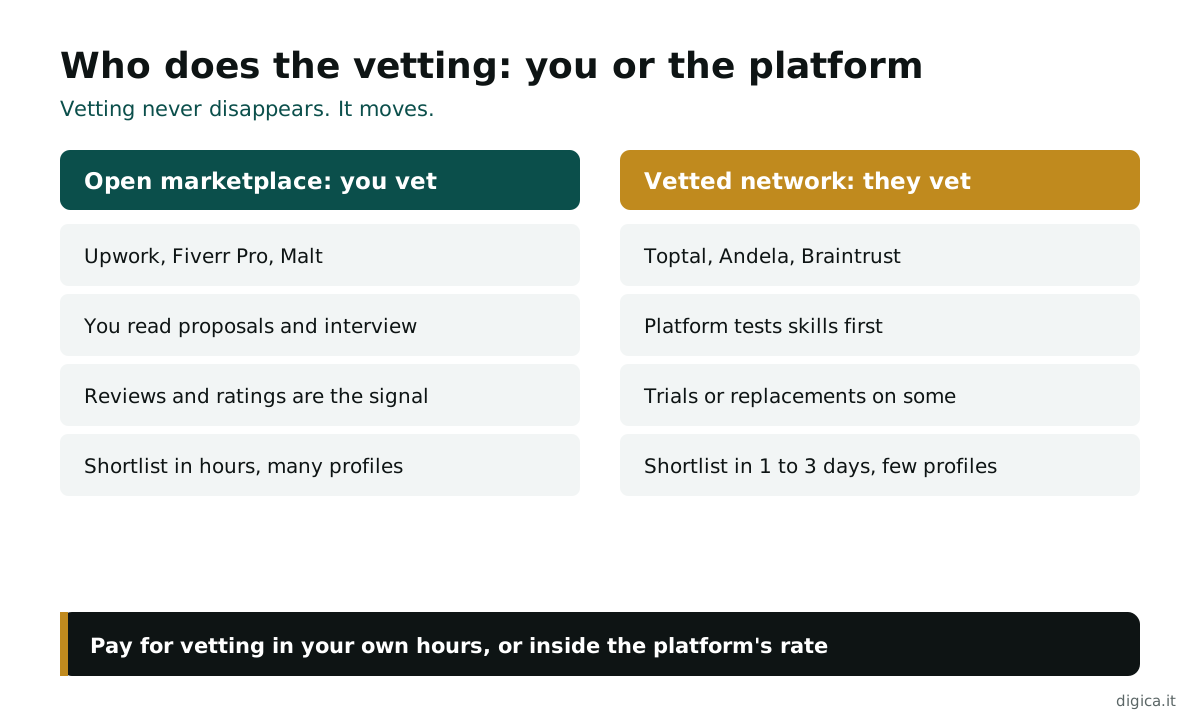
The trade-off is visible in how the platforms grow. Fiverr reports in its 2025 annual report that repeat buyers contributed 68% of marketplace revenue, which says quality on an open marketplace compounds through reputation: buyers come back to freelancers they already trust. Vetted networks compound differently, through the first hire. Toptal's figure that 90% of clients hire the first candidate introduced is the vetted model's whole pitch.
For the roles that matter most, the honest answer is to use both layers. Let the platform screen for skills, then run your own interview on the work that is specific to your business. No external screen knows your codebase, your clients or your standards.
Five mistakes that lead to a bad hire
Most bad hires through talent marketplaces come from the same five decisions, made before the first interview.
- Trusting the percentage, not the process. "Top 1%" and "top 3%" describe different tests. Ask what was tested, by whom, and how long it took.
- Skipping the trial. Toptal's no-risk trial runs up to two weeks and Andela treats the first 15 business days as a trial. Use the window to test real work, not onboarding tasks.
- Writing a vague brief. A shortlist is only as good as the brief behind it. Name the outcome, the tools and the seniority you need.
- Using an open marketplace for a role that needs deep vetting. Reviews measure client satisfaction on past jobs, not fit for a senior role on your team.
- Ignoring the replacement terms. Know before you hire what happens if the person leaves in the first month. Several platforms publish nothing.
For marketplace founders, every one of these is a product decision as well as a client mistake. Our guide to how to attract vendors to a B2B marketplace covers the supply side of the same problem: the quality of who joins decides the quality of every match. A platform that admits anyone quickly fills its search results with profiles clients cannot trust. One that screens too slowly loses the best freelancers to faster competitors. The balance between the two is a growth decision, not just an operations one.
Building a talent marketplace clients hire from twice?
We grow supply, demand and repeat hiring for freelance and talent marketplaces.
The best single measure of quality for a talent marketplace is repeat hiring: the share of clients who hire a second time within 90 days. It captures vetting, matching and onboarding in one number, which is why it is the first metric we look at when a talent marketplace asks why growth has stalled despite healthy sign-ups on both sides.
The question to ask every talent marketplace
Before you post a brief, ask one question: what exactly did you test, and what happens if the first hire fails? On a senior role paying $150,000, SHRM's range puts the cost of a failed hire at $75,000 to $300,000, which dwarfs any platform fee. The cost of doing nothing is accepting a shortlist on trust. Toptal, Andela and Braintrust will tell you what they test; Upwork's Expert-Vetted and Malt Strategy tiers will tell you who qualifies. Use the answer, not the percentage, to choose.
FAQ
What is a talent marketplace? A talent marketplace is a platform that matches people with work based on skills. External talent marketplaces such as Toptal, Upwork and Malt connect companies with freelance and contract talent. Internal talent marketplaces are HR software, from vendors such as Workday and Gloat, that match employees to internal roles and projects.
Which talent marketplace has the hardest vetting? Toptal publishes the most rigorous screen: five stages over three to eight weeks, including live expert exercises and a test project of one to three weeks, with fewer than 3% of applicants accepted. Upwork's Expert-Vetted tier, limited to the top 1%, and Malt Strategy are the most selective tiers on open marketplaces.
How fast can I hire through a talent marketplace? Upwork Business Plus delivers a pre-vetted shortlist in under six hours. Toptal usually introduces candidates within 24 hours, Braintrust in under 48 hours and Andela assembles teams within 72 hours. Most Upwork clients hire within three days of posting a job.
Do talent marketplaces offer a trial or guarantee? Some do. Toptal offers a no-risk trial of up to two weeks, Andela treats the first 15 business days as a trial, Fiverr Pro has a money-back guarantee with claims within 14 days, and Braintrust refunds or replaces direct hires who leave within 30 days. Upwork does not publish one for Business Plus.
Is Toptal better than Upwork? Toptal is better for senior roles where a miss is expensive, because it tests skills deeply before you see anyone. Upwork is better for frequent hiring across many skills, with a shortlist in hours. Many companies use Upwork for volume and Toptal for critical roles.
What is the difference between a talent marketplace and a staffing agency? A staffing agency recruits for you and places people, usually for a markup or placement fee. A talent marketplace gives you direct access to a pool of freelancers, either open for you to screen or pre-vetted by the platform, and usually handles contracts and payment.
Related Articles
- Freelance marketplace growth
- Best B2B marketplaces in 2026: 7 examples by industry
- How to attract vendors to a B2B marketplace
- Marketplace vendor onboarding: listed is not live
- The marketplace liquidity metric that compounds
This article is part of our B2B marketplace growth series. Browse more on the Digica blog.