The best agriculture marketplaces in 2026, grouped by type and compared on the farmers and buyers they reach
An agriculture marketplace is a B2B marketplace where farms, dealers, input suppliers and food buyers trade machinery, seed, fertilizer or crops online. Farmers now buy this way as a matter of routine. The USDA National Agricultural Statistics Service found that 50% of US farms used the internet to buy agricultural inputs in 2025, up from 32% in 2023.
That growth has not produced one dominant agriculture marketplace. It has produced several kinds, each reaching a different group. Equipment marketplaces reach farmers and dealers buying used tractors and combines. Input marketplaces reach row-crop farms buying seed and crop protection. Trading platforms reach importers, exporters and food processors. A platform with 196,000 listings and one with 117,000 member farms are both "big", but they are big at different things.
This guide groups six of the leading agriculture marketplaces by type and compares them on reach: how many farmers, buyers, dealers or listings each can show, and in which countries. It covers B2B agriculture only, not consumer farm shops. Facts come from each platform's own pages, filings and named research, checked on October 20, 2026. It is the reach lens we use when we help agriculture and food B2B marketplaces grow both sides of the trade.
Quick Navigation
- How reach differs across agriculture marketplaces
- Six agriculture marketplaces compared
- Equipment marketplaces with international reach: Agriaffaires and Mascus
- Equipment marketplaces for North America: TractorHouse and Machinery Pete
- Farm inputs and farmer community: Farmers Business Network
- Agri-food trading and sourcing: Tridge
- Why a listing count is not reach
- Three failure scenarios
- Which agriculture marketplace fits which seller
- FAQ
- Related Articles
How reach differs across agriculture marketplaces
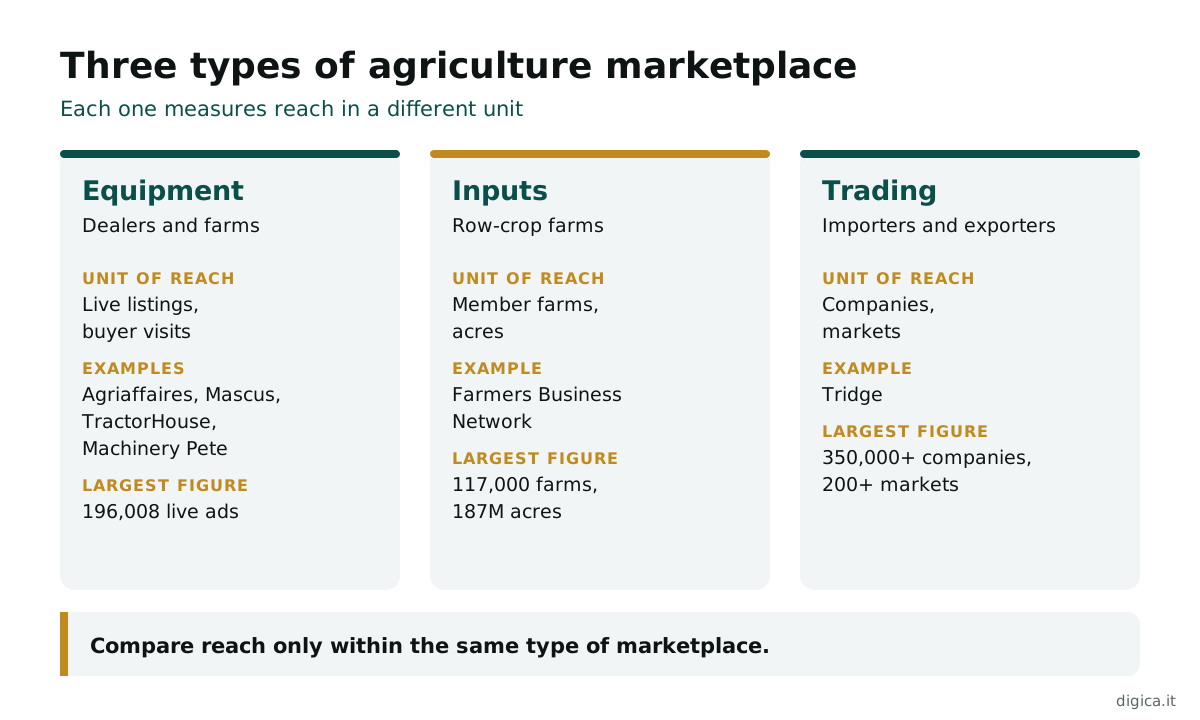
The short answer: each type of agriculture marketplace measures reach in a different unit, and the unit tells you who you will actually reach.
Equipment marketplaces measure reach in listings and buyer visits. Their customers are dealers and farms selling machinery, and what those sellers want to know is how many buyers will see a combine, in how many countries. Agriaffaires and Mascus publish live listing counts on their homepages; TractorHouse and Machinery Pete do not.
Input marketplaces measure reach in member farms and acres. A seed or crop protection brand cares less about page views and more about how many farms, farming how many acres, can buy from it. Farmers Business Network reports both.
Trading and sourcing platforms measure reach in companies and markets. An exporter of avocados or a processor buying sunflower oil wants to know how many verified buyers and suppliers sit on the platform, and in how many countries. Tridge reports companies, verified users and markets.
The practical rule follows. Before you compare two agriculture marketplaces on "reach", check that they are measuring the same thing. A listing count and a member count cannot be compared, and neither is the same as the number of people who will see your offer this month.
Six agriculture marketplaces compared
The short answer: Agriaffaires has the largest published equipment inventory, Mascus the widest country coverage, TractorHouse and Machinery Pete the deepest North American dealer ties, FBN the largest farm membership for inputs, and Tridge the broadest cross-border trading reach.
Six agriculture marketplaces compared by type, reach they publish, geography, main risk and best fit
| Marketplace | Type | Reach it publishes | Geography | Main risk | Best for |
|---|---|---|---|---|---|
| Agriaffaires | Equipment | 196,008 live ads; 15,000 new ads a day | 20+ countries, 20+ languages | No buyer or traffic figure | European dealers selling across borders |
| Mascus | Equipment | 85,263 agriculture listings; "100,000 buyers a day" claimed | About 70 country sites | Agriculture is a minority of listings | Dealers selling to export buyers |
| TractorHouse | Equipment | No public listing or visitor count | North America, plus Europe | Reach cannot be checked | US and Canadian dealers |
| Machinery Pete | Equipment and price data | Auction prices back to 1989 | US and Canada | Thin published reach figures | Farmers pricing used machinery |
| Farmers Business Network | Inputs and community | 117,000 farms, 187 million acres | US and Canada | Self-reported membership | Input brands reaching row-crop farms |
| Tridge | Trading and sourcing | 350,000+ companies, 480,000+ verified users | 200+ markets | User categories not audited | Importers and exporters of agri-food |
Read the "reach it publishes" column with the "main risk" column beside it. The platforms that publish the most are not always the biggest; they are the ones that let you check.
Equipment marketplaces with international reach: Agriaffaires and Mascus
The short answer: Agriaffaires is the larger agriculture specialist, Mascus the broader international equipment marketplace with agriculture as one category.
Agriaffaires, founded in France in 2000 by three farmers, has the largest published inventory of the agriculture equipment marketplaces on this list. On October 20, 2026 its UK site showed 196,008 live classified ads, including 30,108 tractors and 9,395 pieces of harvesting equipment. It says it operates in more than 20 countries and more than 20 languages and receives 15,000 new classified ads a day. Copyright on the site is held by LBC France, the company behind leboncoin.
Agriaffaires also lists rentals and auction sales and runs a price observatory, which lets sellers check what similar machines are listed for. That is useful reach in a different sense: a dealer who can price a used sprayer correctly sells it faster to the buyers already on the site.
Running an agriculture or food B2B marketplace?
In 30 minutes we look at how farmers, dealers and food buyers search for platforms like yours, and why they find your competitors first.
Mascus, established in Europe in 2001 and owned by RB Global, the company behind Ritchie Bros., since 2016, is an equipment marketplace for agriculture, construction, trucks and forestry. Its homepage showed 85,263 agriculture listings on October 20, 2026, against 259,101 construction listings, 95,829 trucks and trailers and 25,993 forestry listings. It links to about 70 localized country sites and tells dealers they can "reach over 100 000 buyers a day", a figure it does not break down.
The split is the point to understand. On Mascus, agriculture is about a fifth of the inventory. A dealer selling only farm machinery shares buyer attention with construction and trucks, but gains access to export buyers who search across categories.
The verdict. For a European agriculture dealer, Agriaffaires is the deeper specialist. For a dealer selling machinery that also suits construction or forestry buyers, or selling mainly to export markets, Mascus adds reach Agriaffaires does not.
Equipment marketplaces for North America: TractorHouse and Machinery Pete
The short answer: both are long-established names with deep dealer ties, and neither publishes the reach numbers that Agriaffaires and Mascus do.
TractorHouse is run by Sandhills Global, founded in 1978 and based on a 68-acre campus in Lincoln, Nebraska. Sandhills started with a printed equipment title and still says its monthly print distribution runs "in the millions". TractorHouse lists used tractors, combines, sprayers and other farm machinery, alongside auctions and rentals, and Sandhills runs TractorHouse sites in Europe, including Spain.
What TractorHouse does not publish is a listing count, dealer count or visitor figure. The clearest public signal is its iOS app, rated 4.6 stars from about 17,000 ratings. That points to a large, engaged audience, but it is not a reach figure a seller can plan around.
Machinery Pete, founded in 1989 by Greg Peterson from a home office in Rochester, Minnesota, and majority owned by Farm Journal since 2014, began as a price authority before it was a marketplace. Its about page, updated in January 2026, describes auction price data going back to 1989. Peterson's author biography describes a network of 2,000 implement dealers, 950 regional auctioneers and 600 agricultural lenders across the US and Canada.
Machinery Pete says sellers can get in front of "millions of shoppers", without a published figure behind it. Its real advantage is trust in its pricing: a farmer checking what a used combine sold for at auction is already a buyer.
The verdict. For a North American dealer, both belong on the shortlist. Ask each for listing and buyer data before you commit a budget, because neither offers it publicly.
Farm inputs and farmer community: Farmers Business Network
Farmers Business Network (FBN), founded in 2014 and based in San Carlos, California, has the largest reported farm membership of any input B2B marketplace on this list. In July 2025, when it raised $50 million, it reported more than 117,000 member farms covering 187 million acres across the US and Canada, and said it was opening its marketplace to third-party sellers.
FBN combines three things a farm uses: an input store for seed, crop protection, fertilizer and animal health products, a finance arm that it says has extended nearly $3 billion in financing, and a community. Its about page now invites farmers to join a community of "120,000+" farmers, and it says the FBN Community forum has more than 90,000 members. Its homepage cites more than 100,000 input deliveries.
Do farmers and food buyers find your marketplace first?
A growth audit maps how farms, dealers and food buyers search for suppliers, on Google and in AI answers, and which of your pages they never reach.
That makes FBN the main answer here for anyone searching "agriculture community". The forum is where farmers compare products and prices, which is why input brands care about it as much as the store.
The opening to third-party sellers changes its role. Until 2025, FBN mostly sold its own products. A marketplace open to outside brands is a new channel for input companies that want direct access to large row-crop farms.
The verdict. For an input brand selling to US and Canadian row-crop farms, FBN is the reach to beat. Its membership figures are self-reported, so ask how many members bought in the last 12 months.
Agri-food trading and sourcing: Tridge
Tridge, founded in Seoul in 2015 by chief executive Hoshik Shin, is the broadest cross-border agri-food trading platform on this list. It describes more than 350,000 registered companies, more than 480,000 verified users and more than 1 million users overall, across more than 200 markets. Its Sourcing Hub lists more than 20,000 verified companies in more than 190 countries.
Tridge's reach is about matching buyers and suppliers who would never meet otherwise. It says it handles more than 140,000 queries a day and has matched more than 725,000 companies across customs records. It employs more than 200 people. In January 2025 it agreed to help producers from South Korea's Jeju Province sell overseas, a sign of how regions use it as an export channel.
Its users are importers, exporters, distributors and food processors buying commodities such as fruit, grains, oils and seafood.
Global farmers are moving the same way. McKinsey's Global Farmer Insights 2026, a survey of about 5,500 farmers in 10 markets, found that 36% use digital channels to evaluate and compare products, up 14 points in a year.
The verdict. For an exporter or food buyer working across borders, Tridge has the widest reach. Its user categories are its own, so check how many verified buyers sit in your product and country before you pay for more.
Why a listing count is not reach
Most mistakes in choosing an agriculture marketplace come from mixing up the size of the platform with the number of buyers who will see your offer. The diagram below shows how fast the audience narrows, using US farms as the example.
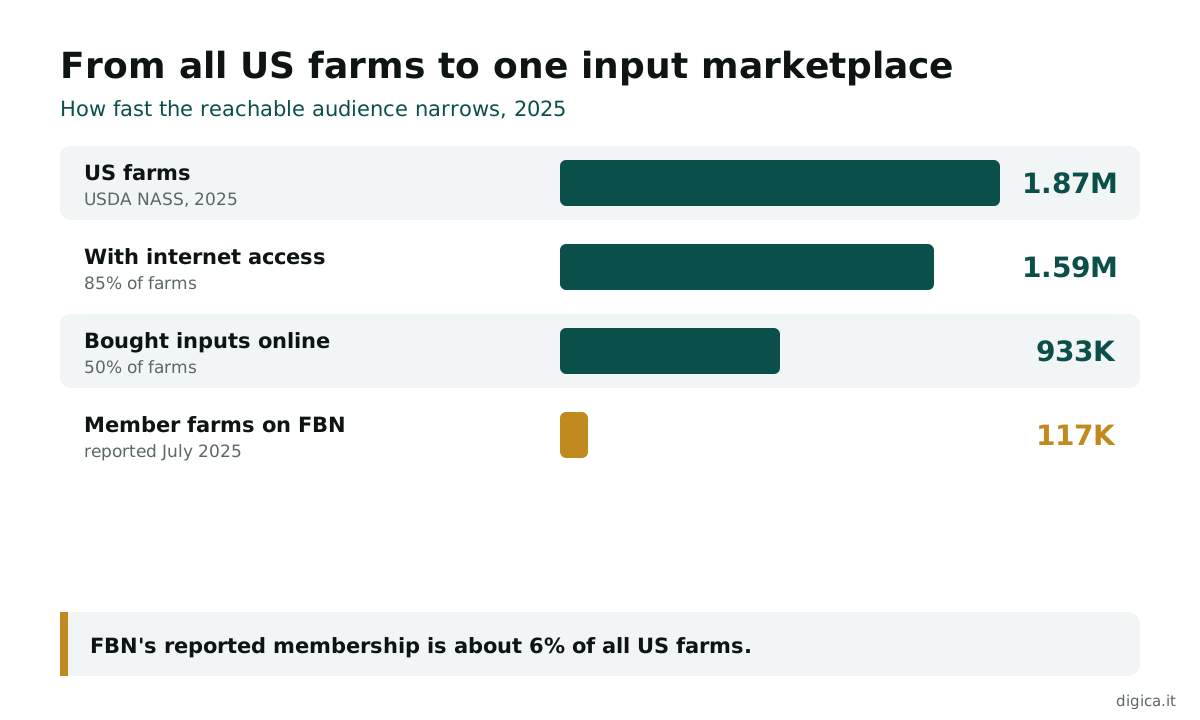
Start with the 1,865,000 US farms counted for 2025. 85% have internet access, and 50% bought inputs online in 2025. That leaves about 933,000 farms buying online. FBN's 117,000 member farms are a large share of the most engaged farms, but they are about 6% of all US farms.
The same narrowing applies to equipment. 196,008 listings on Agriaffaires means plenty of competition for your machine, not 196,008 buyers. A dealer should ask how many buyers searched for that category, in that country, last month.
Trading platforms need the same check. Tridge's 350,000 registered companies include buyers, suppliers and service providers across hundreds of products. An exporter of one crop should care about the verified buyers of that crop in the three or four countries it can ship to, a number that is far smaller than the headline and far more useful. In our experience, the sellers who ask for that narrower number before they pay for placement get better results from a smaller budget, because they spend it where the buyers already are.
Three failure scenarios
These are the patterns that recur when sellers choose an agriculture marketplace on the headline number.
- The listing count read as an audience. A UK dealer of used vineyard tractors lists on the platform with the largest total inventory and expects quick sales. Most of the platform's buyers are looking for row-crop machinery in other countries, and the tractors sit for months. A marketplace with fewer listings but more vineyard buyers in the dealer's own market would have sold them faster.
- The input brand that skipped the community. A seed company sells through a farm input store but ignores the farmer forum beside it. Farmers compare varieties there every day and recommend competitors. Answering questions in the community would have reached more buyers than the product listing alone.
- The exporter who paid for global reach. A cooperative pays for premium placement on a cross-border trading platform to reach "200+ markets". Its product sells mainly to buyers in three countries, and the extra reach produces inquiries it cannot serve. Checking verified buyers by product and country first would have pointed it to a smaller, focused plan.
Each started from a real number. Each read it as reach.
Which agriculture marketplace fits which seller
The short answer: decide by what you sell and where your buyers are, then compare marketplaces in the same group. These decision points make it specific.
- If you sell used farm machinery in Europe, start with Agriaffaires, and add Mascus if more than a quarter of your buyers are abroad or outside agriculture.
- If you are a dealer in the US or Canada, list on TractorHouse and Machinery Pete, and ask both for buyer numbers in your category before you upgrade.
- If you sell seed, crop protection or fertilizer to row-crop farms in North America, apply to sell on FBN and take part in its community.
- If you export or import agri-food commodities across borders, use Tridge, and check verified buyers in your product and target countries first.
- If a marketplace cannot tell you how many buyers searched your category last month, treat its reach as unproven and test it on a small budget.
Growing an agriculture or food B2B marketplace?
We help agriculture and food B2B marketplaces win the farmers, dealers and buyers who make both sides of the trade worth joining.
The number to take into your next planning meeting is the share of farms you can actually reach. The USDA counted 1,865,000 US farms in 2025, about 15,000 fewer than the year before. Half now buy inputs online. A marketplace that reaches even 6% of them, as FBN reports, is one of the largest channels in American farming. The biggest cost of doing nothing is choosing a platform on its total listings and spending a season reaching buyers who were never looking for what you sell.
FAQ
What is an agriculture marketplace? An agriculture marketplace is a B2B marketplace where farms, dealers, input suppliers and food buyers trade machinery, inputs or crops online. Examples include Agriaffaires and Mascus for equipment, Farmers Business Network for inputs and Tridge for agri-food trading.
What is the biggest farm equipment marketplace? Of the marketplaces in this guide that publish their inventory, Agriaffaires is the largest agriculture specialist, with 196,008 live ads in October 2026. Mascus has 85,263 agriculture listings across about 70 country sites. TractorHouse does not publish a listing count.
How many farmers buy agricultural inputs online? In the US, 50% of farms used the internet to buy agricultural inputs in 2025, up from 32% in 2023, according to the USDA National Agricultural Statistics Service.
Is there an online community for farmers? Yes. Farmers Business Network says its FBN Community forum has more than 90,000 members, and its wider network describes more than 120,000 farmers in the US and Canada.
Who owns Mascus? Mascus is owned by RB Global, the company behind Ritchie Bros. It was established in Europe in 2001 and joined Ritchie Bros. in 2016.
How do I compare reach between agriculture marketplaces? Compare platforms of the same type, and ask each for buyers who searched your category in your country last month. Listing counts and member counts measure different things.
Related Articles
- Agriculture and food B2B marketplace growth
- Best B2B marketplaces in 2026: 7 examples by industry
- Best wholesale marketplaces for retailers in 2026
- Best B2B logistics marketplaces in 2026
- How to attract vendors to a B2B marketplace
This article is part of our B2B marketplace growth series. Browse more on the Digica blog.