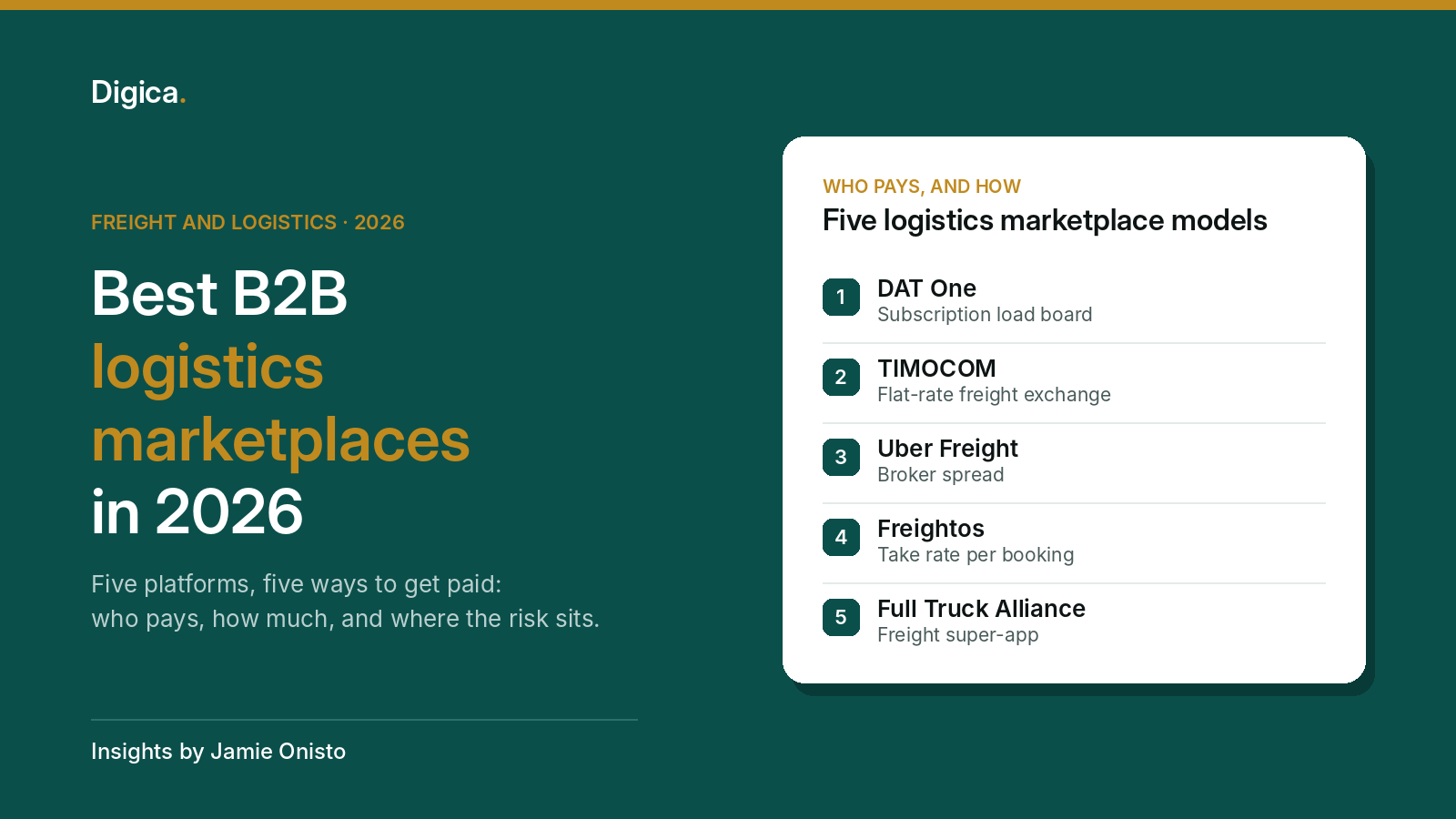
The 5 best B2B logistics marketplaces in 2026, and the business model behind each
Most lists of the best B2B logistics marketplaces rank platforms by size. Size is the wrong test. DAT says more than 291 million loads and trucks are posted on its network every year, and yet the best-known failure in digital freight was not small either. Convoy was valued at $3.8 billion in 2022 and stopped booking freight in October 2023.
The real difference between logistics marketplaces is who pays, when, and for what. A carrier pays DAT a monthly subscription whether a load closes or not. A shipper pays Uber Freight one price, and Uber Freight pays the carrier less. Freightos earns a sliver of each international booking. Those models decide which platform will still be standing when the freight cycle turns, and they decide what any founder building a freight and logistics marketplace should copy.
This shortlist covers five platforms across five models, with published prices and 2026 figures where they exist and "not published" where they do not. Every number comes from the platform's own pages or filings, checked on October 9, 2026. The second half is for operators: how these models make money, how they fail, and what fill rate is worth in dollars.
Quick Navigation
- How we picked the best B2B logistics marketplaces
- The five best B2B logistics marketplaces at a glance
- Load boards and freight exchanges
- Digital brokers and booking platforms
- Freight at super-app scale
- How B2B logistics marketplaces make money
- Three failure scenarios in freight marketplaces
- Where to start: a decision framework
- What fill rate is worth: a worked example
- What ten points of fill rate are worth on the same volume
- FAQ
- Related Articles
How we picked the best B2B logistics marketplaces
A B2B logistics marketplace is a platform where shippers, freight forwarders, brokers and carriers find each other and agree on a transport job. Some only connect the two sides. Others take the contract, carry the credit risk and pay the carrier themselves. Both count, because the buyer experiences both as "where I go to move freight".
We used four filters. The platform had to be live and taking new members in 2026. It had to publish enough about its model, its prices or its volume to compare it honestly. It had to serve businesses, not consumers moving a sofa. And each pick had to represent a different way of solving the same matching problem, because five near-identical load boards would help nobody choose.
That gave us five models. DAT runs a subscription load board in North America. TIMOCOM runs a flat-rate freight exchange across Europe. Uber Freight is a digital broker that sits between shipper and carrier. Freightos is a booking platform for international air and ocean freight. Full Truck Alliance is a Chinese freight super-app operating at a scale no Western platform matches.
Read the list with one question in mind: which side pays, and does it pay before or after a load moves? That answer predicts more about a platform's resilience than its truck count does. It is the same question we ask first in every marketplace business model review.
The five best B2B logistics marketplaces at a glance
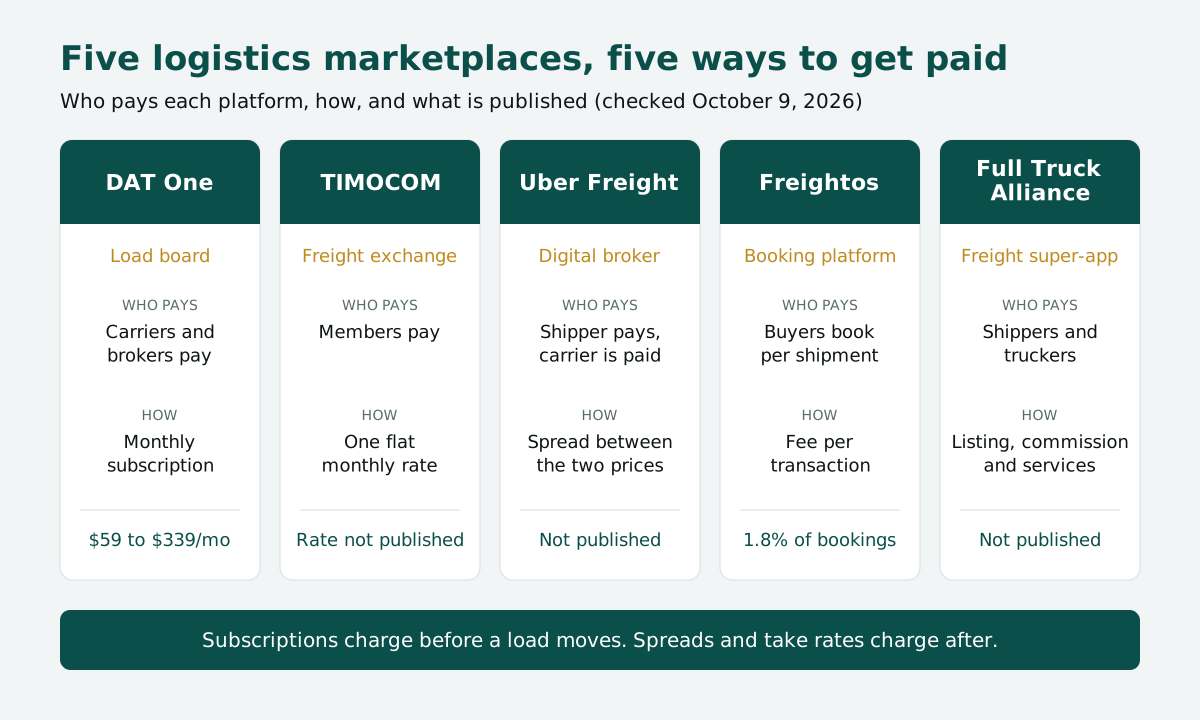
The five platforms differ most on who pays and how much is public. Only DAT publishes a price list; the public companies publish volume instead of fees.
Five B2B logistics marketplaces compared by model, published cost, main risk and best fit
| Platform | Model | Published cost | Main risk | Best for |
|---|---|---|---|---|
| DAT One | Subscription load board, North America | Carriers $59 to $339 a month; brokers from $159 a month; shippers not published | Subscription paid whether or not loads close | Carriers and brokers on the US and Canada spot market |
| TIMOCOM | Flat-rate freight exchange, Europe | One monthly flat rate for three accounts, amount not published; tenders charged per tender | Matching only, contract and payment stay between members | Cross-border European road freight |
| Uber Freight | Digital broker | Not published; margin is the spread between shipper price and carrier pay | Thin spread, segment still loss-making | Shippers who want one contracted counterparty |
| Freightos | International booking platform | Not published per booking; revenue was about 1.8% of booking value in Q2 2026 | Booking value grows faster than revenue | Forwarders and importers buying air and ocean freight |
| Full Truck Alliance | Freight super-app, China | Not published | Single-country regulation and pricing pressure | Learning what liquidity at scale looks like |
[cta:book-a-call | heading="Not sure which model your freight marketplace should copy?" | text="We map fill rate and monetization by lane in a 30-minute call, and show which corridors can reach liquidity first." | button="Book a growth call"]
Two patterns stand out. The platforms that publish prices charge the supply side a subscription, because a trucker needs to see the price before signing up. The platforms that publish volume monetize the transaction, and their investors care more about booking value than about any fee schedule. If you are building a logistics marketplace, that split is the first decision you face, and it is hard to reverse once members are used to one model.
Load boards and freight exchanges
Load boards and freight exchanges are the oldest logistics marketplace model. Members post loads or empty trucks, find each other, and close the deal privately. The platform earns a subscription and never touches the freight payment.
DAT One
DAT describes itself as operator of the largest truckload freight marketplace in North America. Its load board page cites more than 291 million loads and trucks posted a year and access to over 1.7 million trucks for brokers. Carrier plans start at $59 a month for partial-load operators and rise to $339 a month for fleets of ten or more trucks. Broker plans start at $159 a month. Shipper access is quoted on request.
The value is less in the listings than in the data around them. Higher plans add average lane rates, broker credit scores and days to pay, and a payment assurance credit of up to $1,000 if a broker does not pay. DAT states that brokers on its network pay in 28 days on average. For a small carrier, that trust layer is worth more than one extra load.
Best for: carriers and brokers running spot truckload freight in the US and Canada. Watch: the subscription is a fixed cost. A carrier in a thin lane pays the same $169 a month as one in a busy lane, so check posted volume on your own lanes before you upgrade.
TIMOCOM
TIMOCOM runs what it calls a road freight marketplace for Europe. The company reports more than 55,000 verified companies and up to 1 million freight and vehicle offers entered every day, with more than 156,000 users. Every member passes a company check before joining, which is the platform's answer to the fraud that plagues open freight exchanges.
Pricing is a single monthly flat rate covering the full marketplace and three user accounts, with tenders charged separately. The rate itself is not on the public site. Add-ons include live shipment tracking, transport orders, APIs for transport management systems and international debt collection.
Best for: forwarders, hauliers and shippers moving road freight across European borders. Watch: TIMOCOM matches but does not carry the contract. Payment terms, disputes and carrier performance remain between members, so the verification step does the heavy lifting.
Digital brokers and booking platforms
Digital brokers and booking platforms monetize the transaction instead of the membership. The buyer pays per shipment, which removes the subscription barrier but ties the platform's revenue to freight prices and its own margin discipline.
Uber Freight
Uber Freight is a digital freight broker: the shipper contracts with Uber Freight, and Uber Freight contracts and pays the carrier. In its quarterly filing for the period ended June 30, 2026, Uber reported that Freight revenue increased $322 million, or 26%, driven by a 25% rise in freight gross bookings. The same filing shows carrier payments up $320 million, and the Freight segment still reported an operating loss.
That is the broker model in one line. Revenue scales with every load, but almost every extra dollar from the shipper goes straight to the carrier. The platform wins on scale, technology and enterprise contracts, not on margin per load. Shipper and carrier pricing is not published.
Best for: shippers who want one accountable counterparty, contracted capacity and a single invoice. Watch: a broker's spread is its business. When spot rates move faster than contract rates, the broker absorbs the gap, and thin margins leave little room.
Freightos
Freightos runs a vendor-neutral booking platform for international freight, mostly air cargo and ocean. In the second quarter of 2026 it reported 458,000 transactions, up 15% year over year, and a record gross booking value of $422 million, up 33%. About 21,000 unique buyer users booked on the platform, and 75 carriers were actively selling.
[cta:growth-audit | heading="Is your booking value outrunning your revenue?" | text="A growth audit maps your supply, demand and lanes against the revenue each transaction actually earns." | button="Request a growth audit"]
Revenue tells a quieter story. Total revenue grew 3% to $7.7 million, about 1.8% of booking value on our arithmetic ($7.7 million divided by $422 million). Freightos guides to 1.847 million to 1.869 million transactions for full-year 2026 and is targeting break-even on adjusted EBITDA by the end of the year.
Best for: forwarders and importers who need instant air and ocean quotes and booking. Watch: booking value is not revenue. Higher freight prices lift booking value without lifting the platform's take, which is why the two numbers diverged this year.
Freight at super-app scale
Full Truck Alliance shows what a logistics marketplace looks like once liquidity is solved. It is not a platform most Western operators will join, but it is the benchmark every freight founder should know.
Full Truck Alliance
Full Truck Alliance (FTA) connects shippers and truckers across China through freight listing, brokerage and transaction services. In the second quarter of 2026 it reported 68.5 million fulfilled orders, up 12.7%, and 3.57 million average monthly active shippers, up 12.8%. Net revenues were RMB 3.38 billion, up 4.4%, and the company reports a non-GAAP adjusted operating margin of 38.4%.
The lesson is the margin. FTA earns money from listing fees, transaction commissions and services stacked on top of a network where nearly every lane already has supply. Liquidity came first. Monetization followed.
Best for: operators benchmarking what a mature, profitable freight marketplace looks like. Watch: single-country exposure. FTA's model is shaped by Chinese regulation of digital freight platforms and does not transfer as is.
How B2B logistics marketplaces make money
B2B logistics marketplaces make money in four ways: supply-side subscriptions, flat-rate memberships, broker spreads and transaction take rates. Each one puts the risk in a different place.
- Subscription load board (DAT). The carrier or broker pays monthly. Revenue is predictable and independent of freight prices. The risk sits with the member, who pays for listings that may not convert.
- Flat-rate exchange (TIMOCOM). One price for the full marketplace, plus paid extras. Simple to sell. The platform needs constant new offers to justify renewal.
- Broker spread (Uber Freight). The platform owns the contract and keeps the difference. Revenue is large, margin is thin, and the platform carries credit and price risk.
- Take rate (Freightos). The platform earns a fee per booking. Low friction for buyers. Revenue depends on how much of the booking value the platform can actually charge for.
- Services stack (FTA). Matching is the entry point; payments, financing and other services carry the margin once the network is liquid.
[cta:service | heading="Charging the right side of your freight marketplace?" | text="We build lane-level supply acquisition, demand and monetization for freight and logistics marketplaces." | button="See freight marketplace growth" | url="/freight-marketplace-growth.html"]
The pattern matters beyond freight. A logistics marketplace should charge the side that captures the value first, and charge per transaction only once it can prove that transactions happen. A subscription asked from carriers before the lanes are liquid will churn. We see the same churn pattern, in freight and outside it, in every vertical where vendors pay before they get leads.
Three failure scenarios in freight marketplaces
Freight marketplaces fail in predictable ways. The three below are patterns we see across logistics platforms, one of them public and well documented.
Scenario 1: buying growth below cost. Convoy, a venture-backed digital broker valued at $3.8 billion in 2022, shut down in October 2023 after the freight market turned. It had grown lanes and volume faster than it proved a profitable spread per load. When rates fell, the volume that had looked like traction became the loss. The right call: prove positive contribution per load in a handful of lanes before funding national coverage.
Scenario 2: an open board with no verification. A regional freight exchange lets anyone post. Fraudulent brokers and double brokering creep in, carriers go unpaid, and the best carriers quietly cancel their subscriptions. TIMOCOM's mandatory company check and DAT's broker credit and payment data exist precisely to stop this. The right call: treat verification as part of the product. In our experience a slower, checked onboarding beats a fast, open one within the first year, because trust is what members renew for. Our guide to marketplace vendor onboarding covers the activation side.
Scenario 3: celebrating booking value. A booking platform reports booking value up a third and calls it growth. Revenue is flat, because higher freight prices inflated booking value while the fee per booking stayed fixed. The board asks why the cash runway did not move. The right call: report revenue per transaction and fill rate alongside booking value. Booking value is a vanity metric when freight prices are volatile.
Where to start: a decision framework
Pick the platform or the model by volume, geography and who carries the contract. These thresholds are starting points from our experience, not published benchmarks.
For a shipper or broker choosing where to buy capacity:
- US or Canadian truckload, more than 50 spot loads a month: start with DAT One. Below that, a broker such as Uber Freight is usually cheaper than building carrier relationships yourself.
- Cross-border European road freight, more than 20 loads a month: start with TIMOCOM and budget time for carrier vetting.
- One counterparty and one invoice matter more than price: use a digital broker and compare its rates against a load board benchmark every quarter.
- International air or ocean freight, more than 10 shipments a month: use a booking platform such as Freightos to compare quotes before you negotiate contracts.
For a founder building a logistics marketplace:
- Fewer than 1,000 posted loads a month in your core corridor: do not charge a subscription yet. Charge per transaction or not at all until members see daily matches.
- Fill rate below 50% in a lane: do not open new lanes. Recruit carriers into the existing one first, using the liquidity metric that compounds to track it.
- Average load value above $1,500 and access to working capital for 30 to 60 days of carrier payments: a broker spread can work. Without that capital, stay a matching platform.
- Fill rate above 70% across your top 10 lanes: start adding paid services such as tracking, payments or factoring.
What fill rate is worth: a worked example
Fill rate, the share of posted loads that actually get matched, is the number that turns a logistics marketplace's traffic into revenue. The worked example below uses illustrative inputs, not data from any platform on this list.
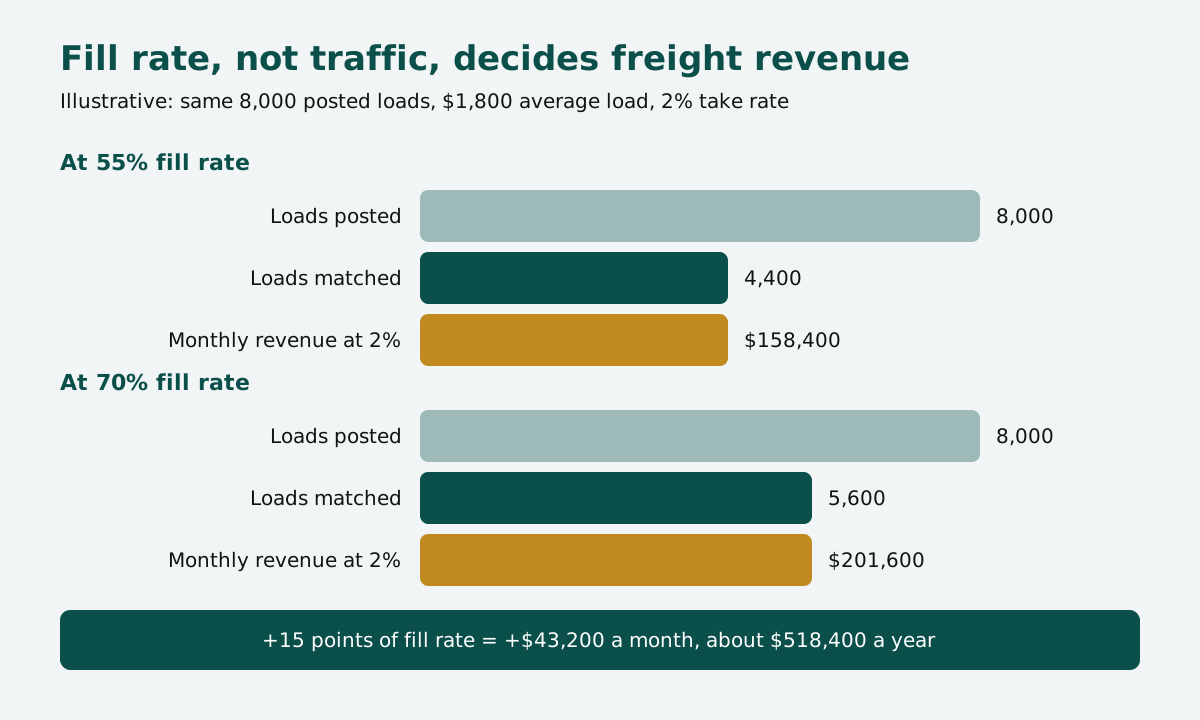
Assume a regional freight marketplace with 8,000 loads posted a month, an average load value of $1,800 and a 2% take rate, close to the 1.8% revenue-to-booking ratio implied by the figures in the Freightos investor results. At a 55% fill rate, 4,400 loads match. That is 4,400 × $1,800 = $7.92 million in monthly booking value, and 2% of it is $158,400 in monthly revenue.
Now raise fill rate to 70% on the same posted volume. 5,600 loads match, booking value is 5,600 × $1,800 = $10.08 million, and revenue is $201,600 a month. The difference is $43,200 a month, or $518,400 a year, with no new shippers and no extra marketing spend.
Where does fifteen points of fill rate come from? Almost never from more traffic. It comes from carrier density in the lanes where loads go unmatched, faster response to new posts, and verified members that shippers trust enough to book. In the logistics marketplaces we audit, the unmatched loads cluster in a small number of lanes, usually fewer than a fifth of the total. Fixing supply there moves the platform number.
The same logic applies to search. Lane and category pages that rank for "freight from X to Y" queries bring shippers into the lanes where you already have carriers, which raises fill rate instead of diluting it. Our guide to category page SEO for marketplaces shows how to decide which of those pages deserve to be indexed.
Two cautions on the example. A 2% take rate is low for a broker and high for a pure load board, so substitute your own model. And fill rate gains decay if you add lanes faster than carriers. Hold expansion until the existing lanes stay above the threshold for three months in a row.
What ten points of fill rate are worth on the same volume
On 8,000 posted loads a month at $1,800 a load and a 2% take, every 10 points of fill rate adds 800 matched loads, or $28,800 a month. That is about $345,600 a year from the demand you already have. The cost of doing nothing is the same figure in reverse: unmatched loads that teach shippers to post somewhere else. Take $345,600 per 10 points of fill rate into your next leadership meeting, then replace our inputs with yours.
FAQ
What is a B2B logistics marketplace? A B2B logistics marketplace is a platform where shippers, forwarders, brokers and carriers find each other and agree on transport jobs. Some, like DAT and TIMOCOM, only match the two sides. Others, like Uber Freight, take the contract and pay the carrier themselves.
What is the best freight marketplace in 2026? It depends on the lane and the mode. DAT One is the largest truckload load board in North America, with more than 291 million loads and trucks posted a year. TIMOCOM leads European road freight with more than 55,000 verified companies. Freightos is the strongest option for booking international air and ocean freight.
How much does a load board cost? DAT One carrier plans cost $59 to $339 a month and broker plans start at $159 a month. TIMOCOM charges one monthly flat rate for its full marketplace but does not publish the amount. Digital brokers such as Uber Freight charge per load instead of a subscription.
What is the difference between a load board and a digital freight broker? A load board lists loads and trucks and lets members agree terms directly, for a subscription. A digital broker contracts with the shipper, hires the carrier and keeps the spread between the two prices. The broker carries the payment risk; the load board does not.
How do freight marketplaces make money? Through supply-side subscriptions, flat-rate memberships, broker spreads, take rates on bookings, and paid services such as tracking, payments and factoring. Most mature platforms combine two or more of these.
Why did Convoy fail? Convoy, a digital freight broker valued at $3.8 billion in 2022, shut down in October 2023 after the freight market downturn. It had scaled volume faster than it proved a profitable margin per load, so falling rates turned growth into losses.
Related Articles
- Freight and logistics marketplace growth
- Best data marketplaces in 2026: 9 platforms compared
- Marketplace business models: how B2B platforms make money
- The marketplace liquidity metric that compounds
- Marketplace go-to-market when both sides are customers
This article is part of our B2B marketplace growth series.