How to Attract Vendors to a B2B Marketplace (and Keep Them)
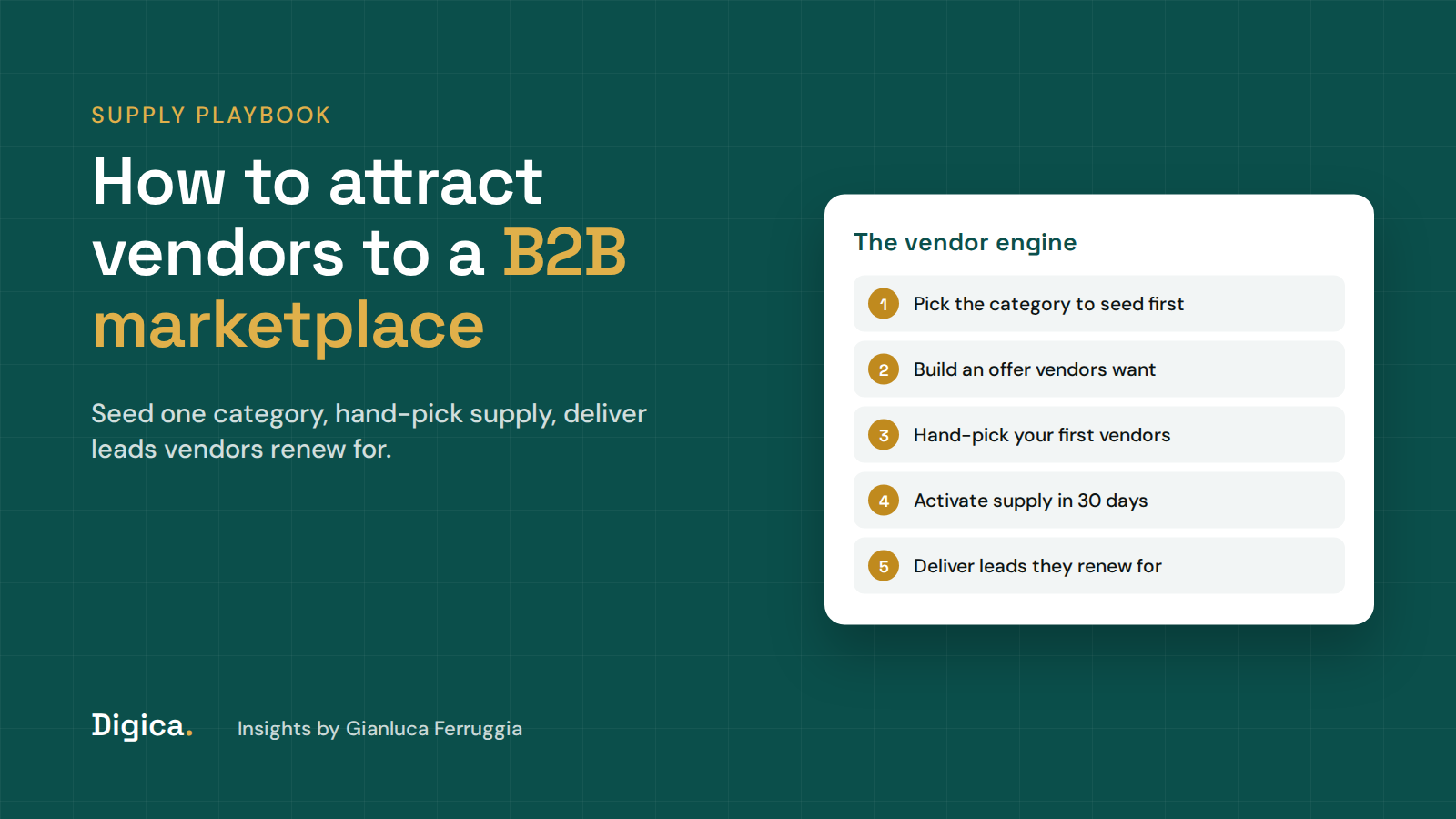
Most advice on how to attract vendors to a B2B marketplace is written by the companies that sell marketplace software. It tells you to import catalogs, add a seller dashboard and launch a referral bonus. That gets you 5,000 listings in a month. It rarely gets you 50 vendors who answer a buyer request within a day.
We learned the difference the slow way. Gianluca, Digica's founder, was General Manager at DesignRush, a B2B agency marketplace that grew from five people to more than 40,000 listed agencies and over a million monthly organic visitors. None of that came from bulk imports. It came from hand-picked supply, one category at a time, and leads good enough that vendors paid again the next year.
This guide is the operator version of that playbook. It covers which category to seed first, the offer vendors actually want, how to activate supply in its first 30 days and how to deliver leads vendors renew for. It is the same supply work we run inside our B2B marketplace growth consulting engagements.
Quick Navigation
- Why bulk imports do not build a marketplace
- The vendor engine: what vendors actually buy
- Step 1: Pick the category to seed first
- Step 2: Build an offer vendors want
- Step 3: Hand-pick your first 50 vendors
- Step 4: Activate supply in the first 30 days
- Step 5: Deliver leads vendors renew for
- Vendor acquisition channels compared
- Three failure scenarios
- How to measure B2B marketplace supply acquisition
Why bulk imports do not build a marketplace
A listing is not a vendor. A vendor is a business that logs in, keeps its profile current and replies to buyers. Bulk imports give you the first and almost none of the second.
The pattern is familiar. A marketplace scrapes a directory or buys a data file, creates thousands of unclaimed profiles and emails them all. A small share claim their page. Most never reply. Buyers then send requests into profiles nobody reads, get silence, and stop coming back. The category looks full and works empty.
That hurts twice. Buyers lose trust in the whole platform, not just the dead profile. And the good vendors you do have sit next to hundreds of ghosts, which makes the marketplace look like a phone book rather than a curated shortlist.
The investors who study this most closely say the same thing in a different way. NFX, which has backed dozens of early marketplaces, puts "get the hardest side first" and "appeal tightly to a niche" at the top of its list of tactics for solving the chicken-or-egg problem. In B2B, the hardest side is usually quality supply. Get enough of it in one niche and buyers become far easier to win.
The vendor engine: what vendors actually buy
Vendors do not join marketplaces because they like marketplaces. They join because they want revenue they cannot easily get on their own. Everything else is detail.
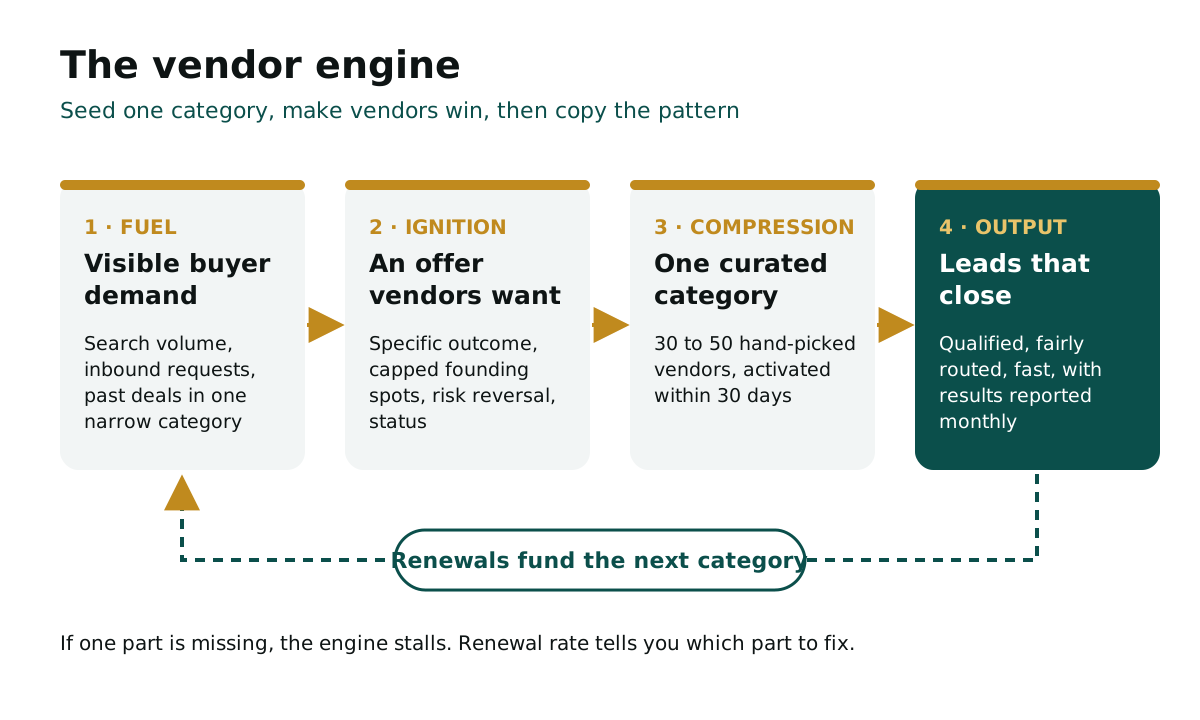
In our experience, vendor acquisition for a B2B marketplace runs like an engine with four parts:
- Fuel: buyer demand in a specific category, visible enough that vendors believe it.
- Ignition: an offer that makes joining an easy yes for the right vendors.
- Compression: a curated category, small enough that each vendor gets real attention.
- Output: qualified leads that close, which is what drives renewal.
If any part is missing, the engine stalls. Great leads with no visible demand never get the first vendors in. A strong offer in an overcrowded category spreads leads too thin. The order matters too: you seed one category, prove it, then copy the pattern to the next.
This is why the question "how to get more sellers on a B2B marketplace" is the wrong starting point. The better question is how to get the right 30 to 50 sellers into one category and keep them. Volume follows when the first category is working, because vendors in adjacent categories notice who is winning work.
Step 1: Pick the category to seed first
Seed one category at a time. A category with 40 active vendors beats ten categories with 400 dormant ones.
Pick the first category with four filters:
- Buyer demand you can prove. Search volume, inbound requests or past deals. If buyers already ask for it, vendors will listen.
- Fragmented supply. Many small and mid-size vendors with no dominant platform. They need you more than a market leader would.
- Deal size that supports a fee. Projects or orders worth enough that a vendor will pay for a lead without hesitation.
- A reachable vendor community. Associations, events, LinkedIn groups or trade media where you can find the best players by name.
For an agency marketplace, that might be "Shopify development agencies in the US" rather than "web design". For an industrial marketplace, it might be "membrane filtration suppliers" rather than "water treatment". Narrow categories also rank faster in search, which matters because organic demand is the cheapest fuel the engine can burn. Our marketplace SEO work usually starts on the same categories we seed with supply, so both sides grow on the same page.
Write down the category definition in one sentence before you recruit anyone. If you cannot explain who belongs and who does not, vendors will not understand why they were picked.
Not sure which category to seed first?
We map your categories by buyer demand, supply fragmentation and deal size, then pick the one to seed this quarter.
Most teams resist this step because it feels slow. It is not. A seeded category with real buyer flow becomes your sales asset for every category after it: a page you can show prospective vendors, with case studies and response times they can check. The second category takes half the time of the first, and the fifth takes a fraction of that.
Step 2: Build an offer vendors want
Your offer is the reason a busy vendor says yes. "List your business for free" is not an offer. Every directory says it, and free listings attract vendors who will not do anything with them.
A strong vendor offer has four parts:
- A specific outcome. "Qualified project requests from mid-market buyers in your category", with a typical budget range stated.
- Scarcity. A capped number of founding vendors per category. Vendors respond to exclusivity because it means fewer competitors per lead.
- Risk reversal. A trial period, a lead credit, or pay-per-lead pricing until the vendor has seen results.
- Status. A verified badge, editorial coverage or a place in a curated ranking that the vendor can use in its own marketing.
The a16z marketplace glossary makes a useful point here: it is typically easier to jumpstart supply than demand because suppliers are economically motivated. That motivation is your lever. Vendors will move fast for a credible path to revenue. They will ignore anything that looks like another place to maintain a profile.
Status is underrated. At DesignRush, editorial placements and rankings gave agencies something to share, and they shared it. In one campaign on a design B2B marketplace we earned more than 100 editorial placements, and a later program ran to 275+ editorial collaborations. Every one of those was a reason for a vendor to talk about the platform that featured them.
Price the offer so the vendor wins on the first deal. Worked example: assume a vendor pays $300 a month and its average project is worth $8,000. One closed project a year returns more than twice the annual fee of $3,600. Put that arithmetic on your vendor sales page, using your own deal data, not a market average you cannot back up.
Step 3: Hand-pick your first 50 vendors
Hand-picked supply is the core of this playbook. You decide who you want, then you go and get them.
Build a target list of 100 to 150 vendors for the seeded category. Rank them by the things buyers care about: relevant work, reviews, team size, location and responsiveness. Then recruit from the top down.
- Personal outreach from a founder or senior lead. Not a sequence from a generic sales inbox. Mention why they were chosen.
- Warm paths first. Existing buyers who already work with the vendor, mutual connections and trade associations.
- Done-for-you onboarding. Build the profile for them from their website and portfolio, then ask them to approve it. Approval takes five minutes. Building from scratch takes an afternoon they will never find.
- Founding vendor terms in writing. Lock in the scarcity and price you promised so it feels real.
Expect to talk to two or three vendors for every one who joins. That ratio is fine, because each vendor you sign is one you would put in front of a buyer tomorrow.
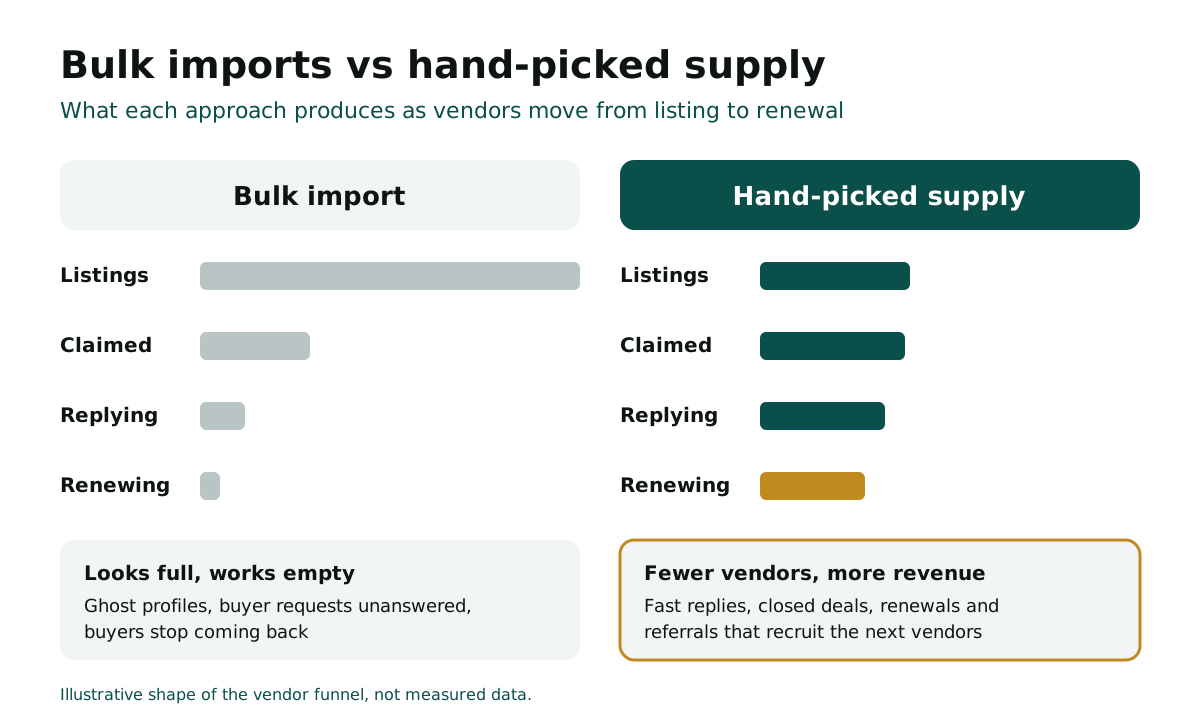
Worked example on cost: assume one supply manager and part of a founder's time cost $8,000 a month, and that pair signs 20 vendors a month. That is $400 per vendor. At $300 a month in fees, each vendor pays back its acquisition cost in under two months, as long as it stays. Bulk imports look cheaper per listing, but the cost per active, renewing vendor is usually far higher once you count the profiles that never respond.
Step 4: Activate supply in the first 30 days
Supply activation is where most marketplaces lose the vendors they worked hard to sign. A signed vendor who gets no lead in the first month concludes the platform does not work, and they are usually right.
Run every new vendor through a 30-day activation plan:
- Day 1 to 3: profile live and complete, with pricing, case studies and response commitments. Check it against what buyers actually filter on.
- Day 4 to 14: route the first buyer request. If organic demand is thin, source it by hand from your buyer network or run targeted campaigns for the category.
- Day 15 to 30: review every lead with the vendor. Did they reply? How fast? What did the buyer say? Coach them on the replies that win.
Define activation as one concrete event, such as "replied to a qualified buyer request within 24 hours". Track the share of new vendors who hit it within 30 days. It is the earliest signal you have of who will renew.
We cover the onboarding mechanics in more depth in our guide to marketplace vendor onboarding. The short version: treat onboarding as a sales process, not a form.
Step 5: Deliver leads vendors renew for
Renewal is the real test of vendor acquisition. A vendor who renews is proof the engine works, and the best recruiting asset you will ever have.
Vendors renew for leads that close. That means four things:
- Qualified buyers. Budget, timeline and scope captured before the request reaches the vendor.
- Fair distribution. Each lead goes to a small number of matched vendors, not to everyone in the category.
- Speed. Leads arrive while the buyer is still deciding, not a week later.
- Visible results. A monthly summary of leads sent, replies, meetings and deals won, so the vendor sees the return without asking for it.
Vendors joining but not renewing?
We audit your lead quality, routing and activation to find where vendor renewals leak.
Watch for leakage too. When vendors and buyers meet on your platform and then move the relationship off it, you lose the next deal and often the renewal. Keep adding value after the first introduction, through repeat buyer requests, reviews and visibility, so staying on the platform is the easier choice. A protected relationship is worth more than a policed one, and vendors notice which kind of platform they are on.
Referral motions follow the same rule. In a SaaS partner program we ran, 94% of referred accounts were still active after onboarding, and referred signups arrived as real accounts within six weeks. Vendors who are winning refer peers. Vendors who are not, warn them away.
Vendor acquisition channels compared
Not every channel suits every stage. Here is how the main options for B2B marketplace supply acquisition compare.
| Channel | Typical cost | Main risk | Time to active vendors | Best for |
|---|---|---|---|---|
| Bulk import or scraped listings | Low upfront, high per active vendor | Ghost profiles, buyer churn | Fast listings, slow activation | Filling long-tail categories after core ones work |
| Founder-led hand-picked outreach | Medium: senior time | Does not scale past early categories | 4 to 8 weeks | Seeding the first two or three categories |
| Supply sales team with done-for-you onboarding | Medium to high: salaries and tooling | Hiring before the offer is proven | 6 to 12 weeks | Scaling a proven category pattern |
| Editorial rankings and earned media | Medium: content and outreach | Weak if rankings lack credibility | 2 to 4 months | Building status and inbound vendor interest |
| Vendor referral program | Low: rewards per signed vendor | Referrals of low-quality peers | 1 to 3 months | Marketplaces with happy, renewing vendors |
| Inbound vendor SEO pages | Low to medium: content | Slow to start | 3 to 6 months | Long-term, compounding supply growth |
In practice, the strongest marketplaces combine three: hand-picked outreach to seed, editorial status to create pull, and referrals once vendors are winning. Bulk imports come last, if at all.
Three failure scenarios
These are the three supply mistakes we see most often, and what each one costs.
1. Launching ten categories at once. A marketplace launches with 2,000 vendors across ten categories and 300 buyer requests a month. Each category gets 30 requests, spread across 200 vendors. Nobody gets enough leads to care. The right call: put all 300 requests into two categories and let 60 vendors win real work.
2. Growing faster than quality. A team hits its vendor target by lowering the bar. Buyers start meeting vendors who do not fit, and trust erodes across the platform. Harvard Business Review's analysis of why network effects are not enough lists growing too fast too early and failing to foster trust among the main pitfalls for marketplaces. The right call: keep the admission bar, even when the target slips.
3. Signing vendors, then ignoring them. Sales signs vendors, then hands them to a self-serve dashboard. No first lead arrives. Worked example: assume 200 vendors at $300 a month, and renewal drops from 80% to 60%. Losing those 40 vendors costs $12,000 a month in fees, or $144,000 a year, before you count the cost of replacing them. The right call: own activation as a team metric, not a support ticket.
How to measure B2B marketplace supply acquisition
Measure vendors by what they do, not by how many you have. Track five numbers every month, by category:
- Active vendors: vendors who replied to at least one buyer request in the last 30 days.
- 30-day activation rate: share of new vendors hitting your activation event within their first month.
- Leads per active vendor: enough to matter, not so many that quality drops.
- Vendor win rate: share of leads that become meetings and closed deals, as reported by vendors.
- Renewal rate: share of vendors who renew at the end of their term. This is the number that decides whether your supply engine compounds.
Use thresholds to decide what to do next:
- Activation below 50%: fix onboarding and first-lead routing before you recruit anyone else.
- Fewer than two leads per active vendor a month: stop adding supply to that category and invest in demand.
- Renewal above 75% in a seeded category: copy the pattern to the next category on your list.
If you are not sure which of these is broken, a growth audit is the quickest way to find out. We look at supply, demand and the routing between them, and rank the fixes by revenue impact. Liquidity is the result of getting these numbers right, which we cover in the marketplace liquidity metric that compounds.
Get a supply and demand audit
We review your vendor funnel, activation and renewal by category and give you a ranked plan for the next quarter.
The same approach works outside agency marketplaces. On a water and wastewater B2B marketplace, organic impressions grew more than 10x within six months once the seeded categories had real supply and pages buyers could trust. Supply and demand grew together because they were built on the same categories.
Here is the number for your next board meeting. Worked example: assume 200 vendors paying $300 a month, or $60,000 in monthly revenue, with renewal at 60%. A focused seeding and activation program costing $36,000 over a quarter that lifts renewal to 80% retains 40 more vendors, worth $12,000 a month. That pays back in three months and keeps paying after. The cost of doing nothing is $144,000 a year in vendor fees walking out the door, plus every buyer who met an empty profile and never came back.
FAQ
How do you attract vendors to a new B2B marketplace? Seed one narrow category with visible buyer demand, build an offer with a specific outcome and limited founding spots, then hand-pick and personally recruit the best 30 to 50 vendors in that category.
Should a B2B marketplace import vendor listings in bulk? Not at launch. Bulk imports create unclaimed profiles that do not reply to buyers, which hurts trust. Use them later, if at all, for long-tail categories once your core categories are working.
How many vendors does a B2B marketplace need to launch? Enough in one category that every buyer request gets two or three good replies within a day. For most B2B categories that is 20 to 50 active vendors, not thousands of listings.
What makes vendors renew on a B2B marketplace? Qualified leads that close, distributed fairly and delivered fast, plus a clear monthly view of leads, replies and deals won. Status, such as rankings and editorial coverage, helps too.
What is supply activation in a marketplace? It is the point where a new vendor first does something valuable, such as replying to a qualified buyer request. Tracking the share of vendors who reach it in 30 days predicts renewal.
How long does it take to seed a B2B marketplace category? Typically four to eight weeks for the first category with founder-led outreach. Later categories go faster because you can show results from the first one.
Related Articles
This guide is part of B2B Marketplace Growth, Digica's hub on supply acquisition, demand generation, liquidity and monetization for B2B marketplaces.
← All insights