The 7 biggest B2B marketplaces in 2026, measured by buyers and sellers
Of the big B2B marketplaces that publish audience figures, the one with the most registered buyers is not Amazon or Alibaba. It is IndiaMART, which counts 234 million registered buyers and 132 million live product listings. Alibaba.com reports more than 47 million buyers across 190 countries, and Amazon Business serves more than 11 million organizations. Business buying has moved online at that scale because buyers want it to: Gartner's 2026 sales survey, as reported by Digital Commerce 360, found 67% of B2B buyers prefer a buying experience without a sales rep.
Most lists of the best B2B marketplaces rank by fame. We ranked by audience, the number of buyers and sellers each platform reports, because audience is what a marketplace sells to both sides. Two surprises came out of the numbers. The biggest B2B marketplaces are older than most people assume: DAT started in 1978, IndiaMART in 1996 and Alibaba.com in 1999. And every one of them got big by winning one narrow group of buyers or sellers before it went broad.
This guide covers one leading B2B marketplace per industry, seven in all, with buyer, seller and listing counts from filings and company pages, checked on October 12, 2026. For each we show how big each side is, where it started and what made it grow. Where we have a deeper shortlist for an industry, we link to it.
Quick Navigation
- What is a B2B marketplace?
- How we measured the biggest B2B marketplaces
- The seven biggest B2B marketplaces at a glance
- Supplier discovery in India: IndiaMART
- Cross-border wholesale: Alibaba.com
- Business procurement: Amazon Business
- Skilled services: Upwork
- Wholesale for independent retail: Faire
- On-demand manufacturing: Xometry
- Truckload freight: DAT One
- How the biggest B2B marketplaces got big
- The size that matters: active buyers
- FAQ
- Related Articles
What is a B2B marketplace?
A B2B marketplace is an online platform where many sellers sell to many business buyers, with the platform in between. It differs from a distributor, which buys stock and resells it, and from a supplier's own online store, which sells one company's products.
B2B marketplaces come in three broad types. Horizontal marketplaces, such as Amazon Business and Alibaba.com, sell almost anything to almost any business. Vertical marketplaces, such as Xometry for manufacturing or DAT One for freight, go deep in one industry. Services marketplaces, such as Upwork, match businesses with people rather than products. The industries we work with show how the vertical model plays out sector by sector.
How we measured the biggest B2B marketplaces
We measured each B2B marketplace by its audience on both sides: how many buyers it reports, how many sellers or suppliers, and how many listings where that is published. A marketplace is only as valuable to a seller as the buyers it can show them, and only as useful to a buyer as the sellers it can offer, so both sides count.
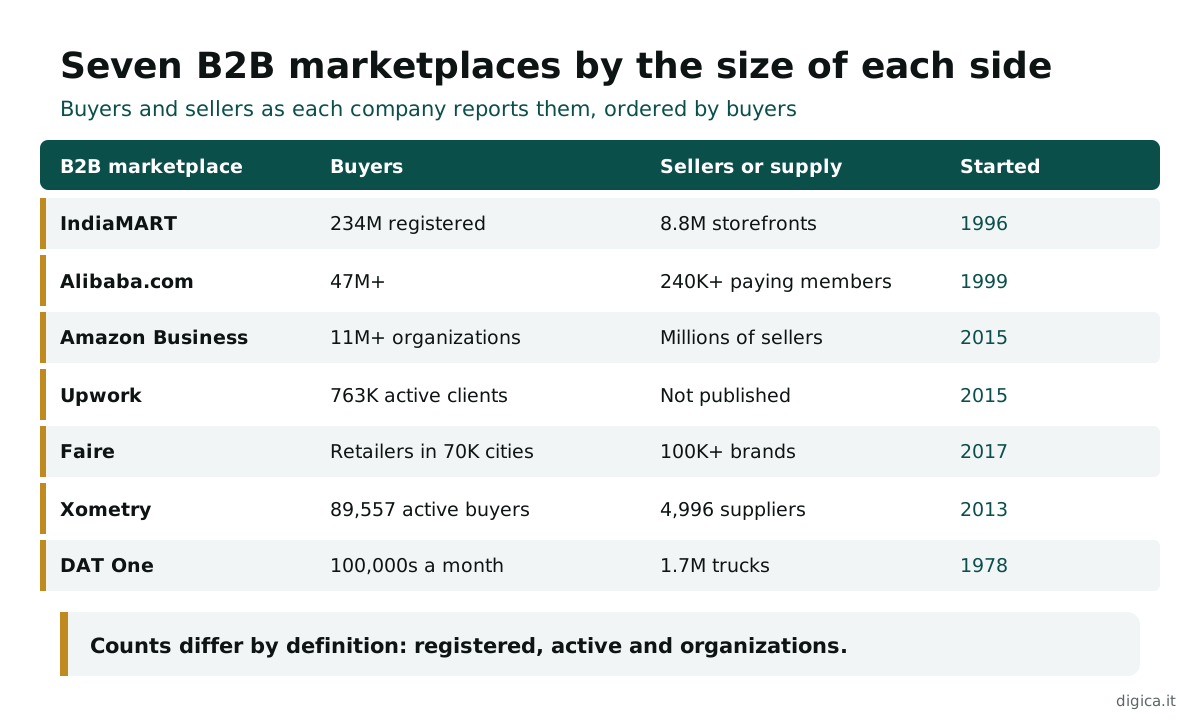
The numbers are not perfectly comparable, and we say so where it matters. IndiaMART counts registered buyers and, separately, active buyers. Upwork counts active clients over the past year. Amazon counts organizations served. DAT counts trucks and load posts rather than buyers and sellers. We used each company's own definition, from filings, investor presentations and company pages, and ordered the seven by reported buyers.
We picked one marketplace per industry to show range rather than seven horizontal giants. Each had to be live in 2026, sell to businesses, and publish audience figures we could verify. The question running through the list is the one any founder should ask of their own platform: which side did it win first, and how did that side pull in the other?
The seven biggest B2B marketplaces at a glance
IndiaMART leads on registered buyers and listings, Alibaba.com on cross-border reach, and Amazon Business on gross sales. The vertical marketplaces are far smaller in headcount but dominate their industries.
Seven B2B marketplaces compared by buyers, sellers, listings and reach
| B2B marketplace | Industry | Buyers | Sellers or supply | Listings | Reach |
|---|---|---|---|---|---|
| IndiaMART | Supplier discovery | 234 million registered; 41 million active | 8.8 million storefronts; 218,000 paying | 132 million products | India |
| Alibaba.com | Cross-border wholesale | 47 million+ | 240,000+ paying members | Not reported in filings | Buyers in 190+ countries |
| Amazon Business | Business procurement | 11 million+ organizations | Millions of sellers, per Amazon | Not published | 11 countries |
| Upwork | Skilled services | 763,000 active clients | Not published | Not applicable | 180+ countries |
| Faire | Retail wholesale | Retailers in 70,000 cities | 100,000+ brands | Not published | Nearly 35 countries |
| Xometry | On-demand manufacturing | 89,557 active buyers | 4,996 active suppliers | Quoted per part | US, Europe and Asia |
| DAT One | Truckload freight | Hundreds of thousands of customers a month | 1.7 million trucks | 700,000+ load posts a day | North America |
Which side of your B2B marketplace should you grow first?
In 30 minutes we look at your buyer and seller counts by category and show where the next match should come from.
Look at the ratio as well as the totals. On its latest figures Xometry has roughly 18 active buyers for every active supplier; Faire has more than 100,000 brands chasing retailers. A marketplace with a heavy buyer side needs to recruit supply, and one with a heavy supply side needs demand. That balance, more than the headline total, decides where the next dollar of growth effort should go.
Supplier discovery in India: IndiaMART
Buyers: 234 million registered, 41 million active in the past year. Sellers: 8.8 million supplier storefronts, 218,000 paying. Started: 1996, Delhi.
IndiaMART reports the most registered buyers of any marketplace on this list. Its first-quarter fiscal 2027 investor presentation reports 234 million registered buyers, up 9% year on year, 132 million live product listings and 26 million unique business enquiries in the quarter. Buyers post requirements free and suppliers pay for visibility.
Its growth story is a pivot. Founder Dinesh Agarwal describes IndiaMART as an export-oriented business from 1996 to 2009, before it turned to India's own small and mid-size manufacturers and traders, with deep roots in tier 1 and tier 2 cities. That domestic turn is what built the buyer base.
What made it big: a free buyer side, aimed at a market of millions of small businesses that had no other way to find suppliers online.
Cross-border wholesale: Alibaba.com
Buyers: 47 million+ from 190+ countries. Sellers: 240,000+ paying members. Started: 1999, Hangzhou.
Alibaba.com is the best-known cross-border wholesale B2B marketplace and Alibaba Group's first business. Its fiscal 2026 annual report counts more than 47 million buyers, down from 49 million a year earlier, and more than 240,000 paying supplier members as of March 2026.
It began, in Alibaba's own words, as an online wholesale marketplace for small Chinese exporters and entrepreneurs to reach global buyers. Eighteen founders led by Jack Ma built it from Hangzhou. The supply side came first: Chinese manufacturers who wanted export customers and had no affordable way to find them.
What made it big: a supply side with a clear, urgent need, which made the platform worth searching for buyers everywhere else.
Business procurement: Amazon Business
Buyers: 11 million+ organizations in 11 countries. Sellers: millions, according to Amazon. Started: 2015, United States.
Amazon Business is the largest procurement marketplace on this list by gross sales. Amazon reported $60 billion in annualized gross sales in July 2026. It serves 97 of the Fortune 100, operates in 11 countries from the US and UK to Japan and India, and added more than 1.8 million organizations in the first half of 2026 alone.
Are your buyer numbers registered, or active?
A growth audit separates the two, by category, and shows which buyers are worth recruiting more of.
Its wedge came from a failed first attempt. AmazonSupply launched in 2012 with Amazon as the only seller, targeting industrial contractors, lab scientists, auto repair shops and plumbers. In April 2015 Amazon replaced it with Amazon Business, opened it to third-party sellers and added business-only accounts. Opening the supply side turned a catalog into a marketplace.
What made it big: an existing buyer habit, Amazon shopping, carried into the workplace, plus a supply side opened to everyone.
Skilled services: Upwork
Buyers: 763,000 active clients. Sellers: freelancer count not published. Started: as Upwork in 2015, from companies founded in 1999 and 2003.
Upwork is the largest services B2B marketplace by disclosed volume, with $4.0 billion in gross services volume in 2025 and customers in more than 180 countries. Its active clients fell 4% year on year in the second quarter of 2026, to 763,000, while spend per client rose to a record. Our shortlist of the best talent marketplaces compares it with five alternatives on hire quality.
Upwork is a merger story. Elance and oDesk, two of the first freelance platforms, combined in 2014 and relaunched as Upwork in May 2015, putting the two biggest pools of freelancers and clients in one place.
What made it big: consolidation. Combining two marketplaces pooled liquidity on both sides overnight.
Wholesale for independent retail: Faire
Buyers: retailers in 70,000 cities. Sellers: 100,000+ brands. Started: 2017.
Faire connects independent retailers with wholesale brands. It lists more than 100,000 brands, serves retailers in 70,000 cities, and says it is used by hundreds of thousands of retailers and brands; it does not publish a separate retailer count. It operates in nearly 35 countries, having expanded into Europe from 2021.
Its wedge was the buyer side: US independent retailers, who could order from new brands with payment terms and free returns on a first order, removing most of the risk of trying an unknown product. Brands followed the buyers.
What made it big: taking risk away from the small buyer, which made the buyer side grow fast enough to attract brands.
On-demand manufacturing: Xometry
Buyers: 89,557 active buyers. Sellers: 4,996 active suppliers. Started: 2013.
Xometry is the smallest marketplace on this list by headcount, and it is growing fast. Active buyers rose 20% year on year in the second quarter of 2026, and active suppliers rose 17% in 2025 to 4,996, increasingly in Europe, China, India and Turkey. It also owns Thomasnet, the long-running North American supplier directory.
Picking the wedge for your B2B marketplace?
We help B2B marketplaces choose the first category and side to win, then build the supply and demand engines behind it.
Xometry was incorporated in 2013 as NextLine Manufacturing and renamed in 2015. Its wedge was instant quoting for custom parts: a buyer uploads a design, gets a price, and Xometry routes the job to a shop in its network. That turned a slow, quote-by-email process into a checkout.
What made it big: making the buyer's hardest step, getting a price, instant.
Truckload freight: DAT One
Buyers: hundreds of thousands of customers a month. Supply: 1.7 million trucks on the network. Started: 1978, Portland, Oregon.
DAT describes DAT One as North America's largest truckload freight marketplace, with more than 700,000 load posts a day. Our ranking of the best load boards compares it with five rivals on volume and reach.
It is also the oldest marketplace on this list. According to DAT, Al Jubitz founded it in 1978 as Dial-A-Truck at the Jubitz truck stop in Portland, showing loads on a monitor instead of note cards pinned to a board. It expanded along Interstate 5 and reached more than 200 truck stops in 42 states by 1985. The model has changed completely since, from monitors in diners to an app on every driver's phone, but the principle has not: put the freight where the trucks already are, and the brokers will follow the trucks.
What made it big: going where the supply already gathered. Truck drivers were at truck stops, so the loads went there too.
How the biggest B2B marketplaces got big
Every marketplace on this list started narrow. None launched as a horizontal platform for all businesses; each won one group of buyers or sellers with a specific, painful problem, then used that side to pull in the other.
The wedges fall into three patterns. Supply first: Alibaba.com and IndiaMART gave sellers a channel they could not get anywhere else, then sold that catalog to buyers. Demand first: Faire and Amazon Business started with buyers, by removing risk or carrying over a habit, and let sellers follow. Liquidity first: DAT went to where trucks already gathered, and Upwork merged two existing pools.
Each pattern suits a different starting position. Supply first works when sellers have an urgent problem the platform can solve before buyers arrive, such as reaching export customers. Demand first works when the platform can remove a buyer's risk or friction so completely that sellers have to follow, as Faire did with payment terms and free returns. Liquidity first works when both sides already gather somewhere, physically or online, and the platform simply makes the meeting efficient.
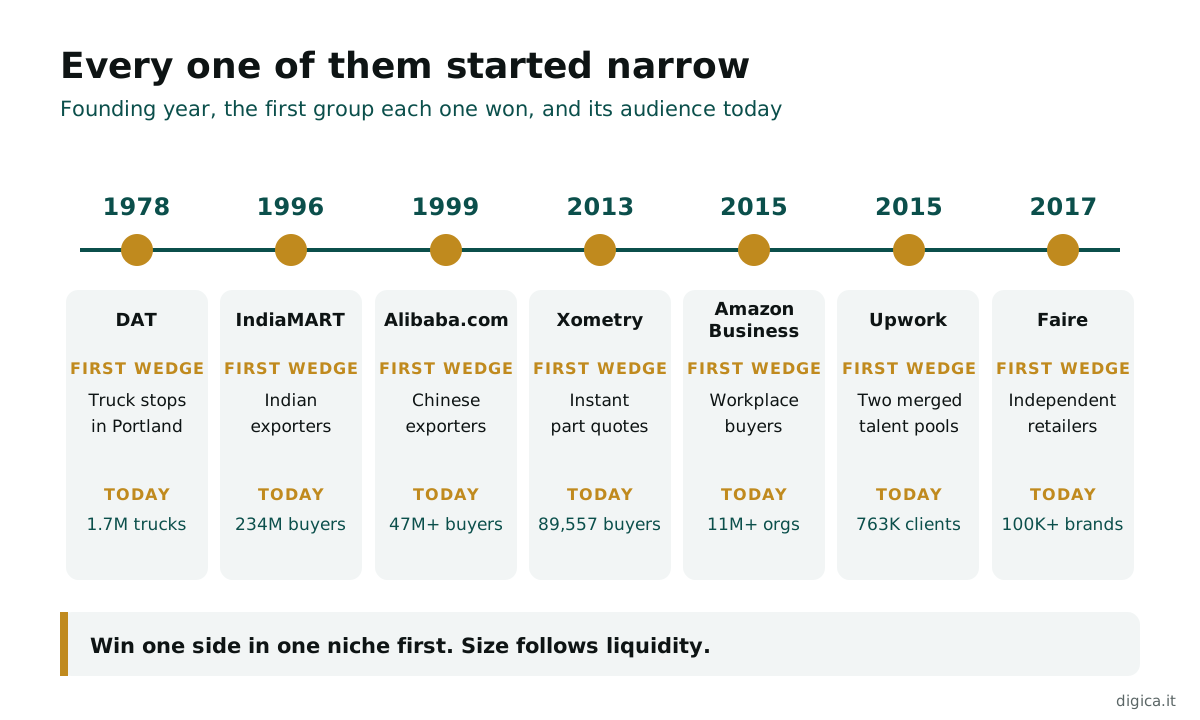
The timing matters as much as the pattern. DAT's company history shows seven years from one truck stop to more than 200. IndiaMART spent more than a decade as an export-oriented business before its domestic pivot. Even the fastest grower here, Faire, focused on US independent retail for four years before opening Europe. In our experience, founders underestimate how long the first wedge takes and overestimate how quickly a second category will fill on its own.
The lesson for founders is that size is the result of a narrow start, not a substitute for one. A new B2B marketplace that lists every category to look big usually ends up liquid in none. Our guide to the marketplace liquidity metric that compounds shows how to tell when one category is ready and the next can open, and our guide to how to attract vendors to a B2B marketplace covers the supply side of that first wedge.
The size that matters: active buyers
Registered audiences flatter. IndiaMART has 234 million registered buyers, but 41 million were active in the past year, and that active number fell 5% even as registrations grew 9%. Alibaba.com's buyers slipped from 49 million to 47 million, and Upwork's active clients fell 4%. The number to watch on any B2B marketplace, including your own, is active buyers per active seller, because that ratio decides whether a seller gets enough business to stay. The cost of doing nothing is quiet: sellers who do not see enough active buyers stop renewing, and the registered total keeps rising while the marketplace shrinks.
FAQ
What is the biggest B2B marketplace? Among marketplaces that publish figures, IndiaMART has the most registered buyers, with 234 million registered buyers and 132 million product listings. Alibaba.com is the largest cross-border wholesale marketplace, with more than 47 million buyers in 190+ countries, and Amazon Business is the largest in procurement by gross sales, at $60 billion a year.
What are examples of B2B marketplaces by industry? IndiaMART for supplier discovery in India, Alibaba.com for cross-border wholesale, Amazon Business for business procurement, Upwork for skilled services, Faire for retail wholesale, Xometry for on-demand manufacturing and DAT One for truckload freight.
What is a B2B marketplace? A B2B marketplace is an online platform where many sellers sell to many business buyers, with the platform in between. Unlike a distributor, it does not usually own the stock; it connects buyers and sellers and earns from the transaction, from memberships or from advertising.
What is the difference between a B2B and a B2C marketplace? A B2B marketplace sells to businesses, with larger orders, repeat purchasing, negotiated prices, payment terms and approvals. A B2C marketplace sells to consumers, usually one-off purchases paid upfront. B2B buyers also research longer and compare more suppliers.
What is the oldest B2B marketplace? Of the leaders in this list, DAT is the oldest: it started in 1978 as Dial-A-Truck, showing freight loads on monitors at a truck stop in Portland, Oregon. IndiaMART followed in 1996 and Alibaba.com in 1999.
How do B2B marketplaces grow? The largest ones grew by winning one narrow group first: Chinese exporters for Alibaba.com, independent retailers for Faire, truck stops for DAT. Once one side was strong, it attracted the other. Going broad before any category is liquid usually fails.
Related Articles
- B2B marketplaces and directories we grow
- Best load boards in 2026, ranked by loads and reach
- Best talent marketplaces in 2026: who vets hardest
- Best B2B logistics marketplaces in 2026: top 5 compared
- Best data marketplaces in 2026: 9 platforms compared
This article is part of our B2B marketplace growth series. Browse more on the Digica blog.