The 7 Best B2B Marketplace Growth Consultants in 2026
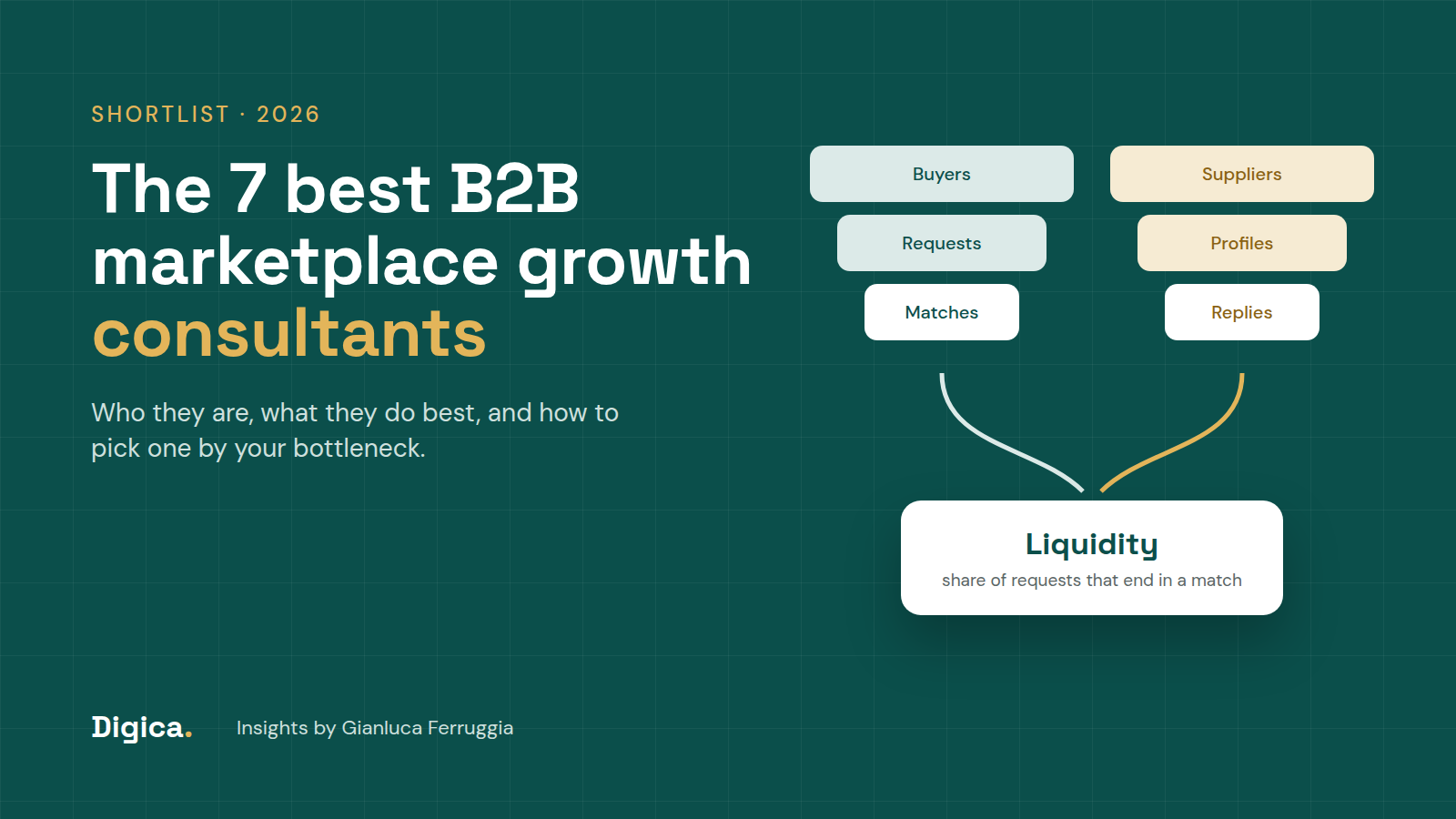
Hiring the wrong growth partner is one of the most expensive mistakes a marketplace makes. A qualified buyer request typically costs $200 to $900 to produce and a responsive supplier $150 to $600 to onboard, so six months spent growing the wrong side can burn well over $100,000 before anyone notices the match rate has not moved.
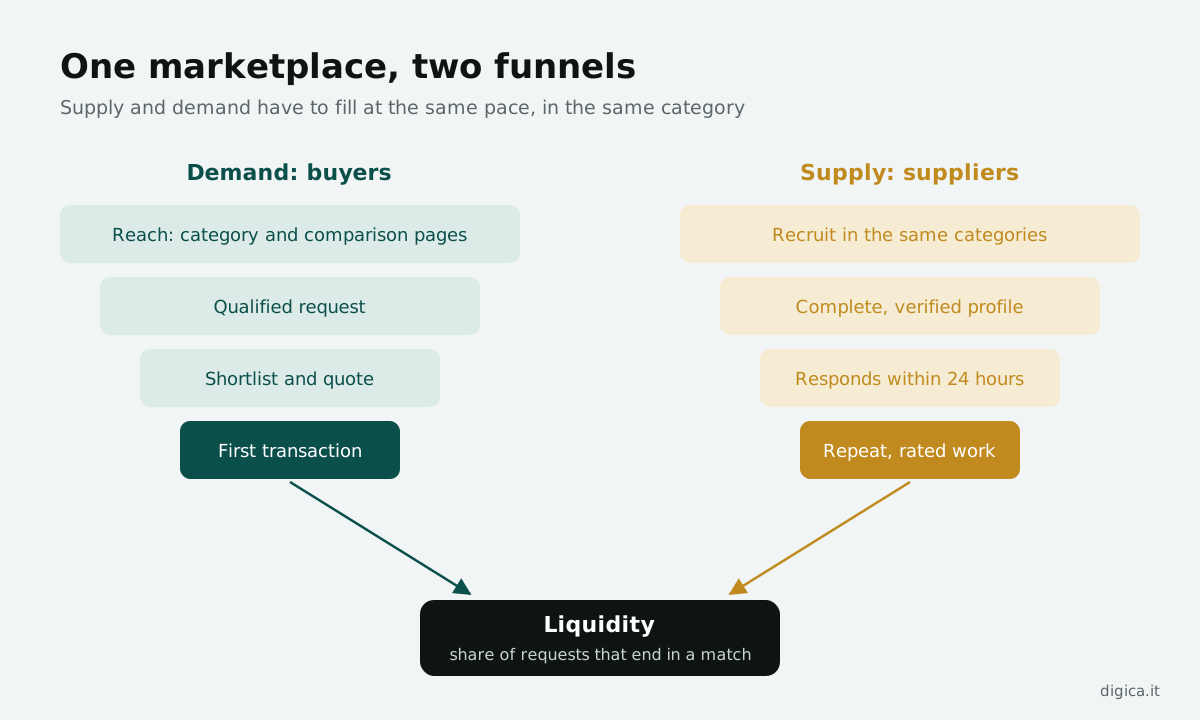
Most growth consultants have never run a marketplace. A marketplace is not one funnel but two, and both have to fill at the same pace, in the same categories. Win supply without demand and vendors churn. Win demand without supply and buyers don't come back. That is why the first question for any consultant is simple: which side have you grown, and how did you keep the other side in step?
This shortlist covers seven firms that pass that test, what each is best at, and a decision framework for picking one. If you want the short version of how we approach it, see our B2B marketplace growth consulting page.
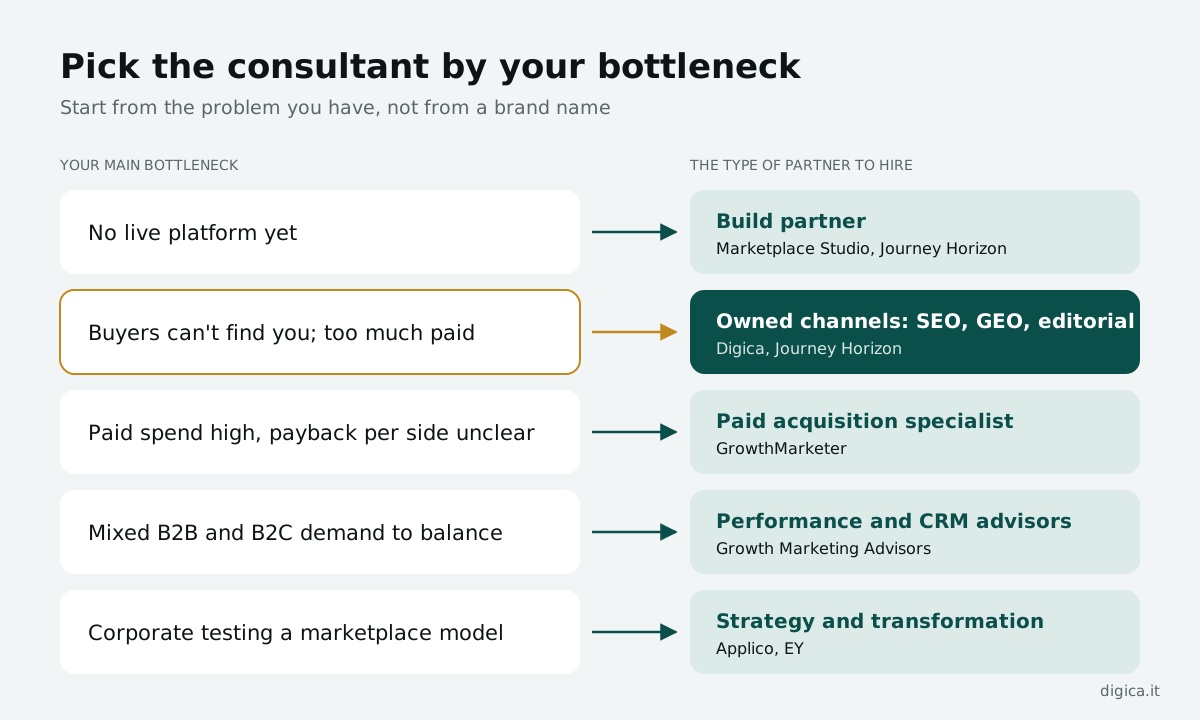
The map above is the fastest way to use this list: start from your bottleneck, not from a brand name.
Quick Navigation
- How we chose
- The shortlist at a glance
- 1. Digica
- 2. Applico
- 3. Marketplace Studio
- 4. Journey Horizon
- 5. GrowthMarketer
- 6. Growth Marketing Advisors
- 7. EY
- Three expensive mistakes to avoid
- What a good first 90 days looks like
- How to choose: a decision framework
How we chose
Every firm here has real two-sided marketplace experience and a clear lane. We applied four tests:
- Marketplace experience. They have built or grown two-sided platforms, not just online stores or SaaS.
- A clear lane. They are strongest in one part of the funnel: organic reach and authority, paid acquisition, product and build, or corporate strategy. Nobody leads in all four.
- Stage fit. Pre-launch, early traction, scaling or enterprise.
- Evidence. Named clients, published results or public research.
We also looked at how each firm measures success. The right yardstick is liquidity, which Andreessen Horowitz defines as the rate at which buyers can find sellers, and vice versa. A consultant who reports sign-ups instead of matches is measuring the wrong thing. We asked the same question of every firm below, including ourselves: what did the match rate do?
The shortlist at a glance
The table below compares the seven firms on fit, typical engagement and the main risk of choosing each one for the wrong job.
| Firm | Best for | Stage | Cost and engagement model | Main risk if misapplied |
|---|---|---|---|---|
| Digica | Organic growth and authority for B2B and AI marketplaces | Early traction to scale | Fractional CRO and CMO retainer | Slower than paid if you need volume this month |
| Applico | Large distributors building or backing B2B marketplaces | Enterprise | Strategic advisory and venture | Overkill for a startup |
| Marketplace Studio | Founders launching a new marketplace | Pre-launch to early | Fixed-scope sprints and builds | Build focus, less depth in one channel |
| Journey Horizon | One vendor for build and organic marketing | Early to scale | Project and retainer work | Delivery capacity, not senior leadership |
| GrowthMarketer | Scaling paid acquisition | Scale | Monthly, for $50,000 to $500,000 ad budgets | Rented demand that stops when spend stops |
| Growth Marketing Advisors | Balancing B2B and B2C demand | Early to scale | Performance and CRM retainer | Consumer bias for purely B2B platforms |
| EY | Corporates adding a marketplace model | Enterprise | Enterprise transformation program | Cost and pace built for large companies |
1. Digica
Digica is the pick when the right buyers and vendors are not finding your marketplace and you don't want growth to depend on paid spend.
We build the top of the funnel for marketplaces: organic traffic, earned authority and audience. The team grew DesignRush, a B2B agency marketplace, to 40,000+ listed agencies and over a million monthly users, and has run 275+ editorial collaborations. On one technical B2B marketplace, organic impressions grew more than 10x in six months.
Services include GTM strategy for AI marketplaces, generative engine optimization (GEO, getting cited by AI assistants), growth for software agencies and organic subscriber growth for SaaS. We work embedded as your fractional CRO and CMO until the engine runs without us.
Not sure which side is holding your marketplace back?
Book a 30-minute growth call. We look at your numbers together and tell you which side to fix first.
Not the right fit if: you need a paid media team or a development shop. We'll point you to one. In our experience, the marketplaces that stall longest are the ones that bought paid volume before they had the category pages and authority to convert it.
Question to ask: which of your distributor clients chose not to build a marketplace, and why?
2. Applico
Applico is the pick for billion-dollar distributors deciding whether to build, buy or partner on a B2B marketplace.
It advises large distributors on technology strategy and deals, and runs a venture fund focused on distribution. It is also known for its annual Top 50 B2B Marketplace ranking, one of the most cited reference lists in the category. The value is board-level clarity: whether a marketplace belongs in your strategy at all, and on what terms.
Not the right fit if: you're a startup that needs hands-on acquisition work. The advice is strategic, and the buyer is usually a distributor's leadership team rather than a founder.
Question to ask: after launch, who owns acquisition of each side, and what does month four look like?
3. Marketplace Studio
Marketplace Studio is the pick for founders going from idea to a live marketplace.
The Ottawa-based team founded and ran their own marketplaces before advising others. They offer pre-development sprints, build and launch, go-to-market programs for stalled platforms and fractional product leadership. They are a Sharetribe certified partner and report 30+ marketplaces shipped across rentals, services, B2B and talent, with an average of 10 weeks from kickoff to minimum viable product.
Not the right fit if: you're already at scale and need growth in one specific channel. Their strength is getting a sound platform live, not compounding one acquisition engine for years.
Question to ask: who sets the keyword and category strategy, and who only executes it?
4. Journey Horizon
Journey Horizon is the pick for teams that want one partner for both the platform and the organic marketing.
It is a marketplace and software development company with 200+ projects over 8+ years. Beyond Sharetribe and custom builds, it offers SEO, paid search, content marketing and AEO (answer engine optimization, for AI search). One vendor means fewer handoffs between whoever builds the category pages and whoever has to rank them.
Not the right fit if: you need senior commercial leadership more than delivery capacity. A development partner executes a plan well; it rarely sets the commercial strategy.
Question to ask: can you show cost per qualified buyer and cost per active supplier as two separate numbers?
5. GrowthMarketer
GrowthMarketer is the pick for marketplaces spending seriously on paid acquisition.
The Boulder, Colorado firm manages Meta and Google ads. For two-sided marketplaces, it runs supply and demand acquisition separately, tracks the economics of each side instead of one blended number, and reports weekly against transactions. Its stated fit is teams spending roughly $50,000 to $500,000 a month on paid acquisition.
Not the right fit if: your problem is organic reach or authority, not ad efficiency. Paid demand is rented: when the budget pauses, the flow of buyers pauses with it.
Question to ask: how do you decide which side to acquire first in a category with thin supply?
6. Growth Marketing Advisors
Growth Marketing Advisors is the pick for marketplaces that sell to both businesses and consumers.
Focused on two-sided marketplaces, the firm combines brand and performance marketing ("brandformance"), CRM and data management, with an emphasis on growing each side in the right order. That sequencing is where many marketplaces lose money: acquiring buyers into categories that don't yet have enough supply to serve them.
Many of the fastest-growing platforms in Andreessen Horowitz's Marketplace 100 serve consumers, and their playbooks travel well to hybrid models.
Not the right fit if: you're purely B2B with long, sales-led deals. Consumer-style performance playbooks convert poorly when every deal involves three approvers and a procurement review.
Question to ask: which parts of the program does your team deliver, and which does ours?
7. EY
EY is the pick for established companies adding a marketplace to their existing business.
Its marketplace model services help established companies find, target and scale new revenue through marketplace models, connecting providers and users across their value chain. For a corporate, the hard problems are rarely acquisition; they are governance, systems and the organisational change of opening a platform to third parties.
Not the right fit if: you're a startup. The engagement model, and its price, are built for enterprises.
Question to ask: what does the handover to our team look like, and how long does it take?
Three expensive mistakes to avoid
The most common hiring mistakes cost marketplaces months and tens of thousands of dollars. These are the three we see most often across the platforms we have worked with.
1. Hiring for the side you already have. A marketplace with plenty of suppliers hires a supply-acquisition specialist because that is what worked at launch. Outcome: more idle listings, higher supplier churn, no change in transactions. At $150 to $600 per onboarded supplier, 100 surplus suppliers is $15,000 to $60,000 spent on inventory nobody buys. The right call: diagnose which side limits matches, then hire for that side.
Get a second opinion before you hire
We review your supply and demand funnels in one call and flag the most expensive gap, whoever you end up hiring.
2. Buying paid volume before the pages convert. Buyers land on thin category pages, don't find enough relevant supply, and leave. At $200 to $900 per qualified request, a 50-request monthly target costs $10,000 to $45,000 a month, and a weak page can waste most of it. The right call: fix category pages and trust signals first, then scale spend.
3. Measuring sign-ups instead of matches. Reports look healthy while the match rate stays flat. The right call: agree on one liquidity metric per category before the engagement starts, and review it every month.
What a good first 90 days looks like
A good engagement shows its value in the first quarter, long before the compounding results arrive. Here is the rhythm we would expect from any serious marketplace growth partner, including us.
Weeks 1 to 3: diagnosis. Pull transaction data by category and by side. Find the categories where buyers search but don't match, and the ones where suppliers list but never win work. Agree on one liquidity metric per category and write down today's baseline.
Weeks 4 to 8: the wedge. Pick the two or three categories with the best mix of demand, margin and supply depth. Rebuild their category pages with real numbers, trust signals and clear next steps. Recruit supply only where buyers are already waiting.
Weeks 9 to 13: the engine. Turn what worked into a repeatable system: a publishing rhythm for category and comparison pages, a pipeline of earned mentions, and a monthly review of match rate, time to match and cost per qualified request on each side, three of the signals in Andreessen Horowitz's 13 metrics for marketplace companies.
By day 90 you should be able to answer one question with data: which side limits growth in each wedge category, and what it costs to fix. If a partner can't answer that, the next nine months won't answer it either.
How to choose: a decision framework
Pick the consultant type from your numbers, not from a pitch. Use these thresholds as a starting point:
- No live platform yet: a build partner (Marketplace Studio, Journey Horizon).
- Live, but fewer than roughly 20 transactions a month in your best category: fix the wedge category and its pages before scaling anything. A growth consultant can help, but the first job is focus.
- Transactions growing, but more than 70% of new buyers come from paid: invest in an owned channel: organic search, GEO and editorial authority (Digica, Journey Horizon).
- Paid spend above $50,000 a month with unclear payback per side: a paid specialist that tracks each side separately (GrowthMarketer).
- A corporate deciding whether a marketplace fits the strategy: Applico or EY.
Want Digica on your shortlist?
Talk through your numbers with Gianluca, or see how our fractional growth work for B2B marketplaces is structured.
Then ask every shortlisted firm three questions: which side will you grow first and why, who will be in our weekly meeting, and how does the handover work when you leave.
Here is the number to take into your next planning meeting. If 60% of your new buyers come from paid search at $200 to $900 per qualified request, shifting even a third of that demand to organic and AI search saves $20,000 to $90,000 for every 300 requests a year, and the payback on the content usually lands within two to three quarters. The cost of doing nothing is renting your demand forever and watching the price go up.
FAQ
What does a B2B marketplace growth consultant do? They grow both sides of a platform, buyers and suppliers, so each side finds enough of the other to transact. That covers acquisition, activation and liquidity, the share of searches or requests that end in a match.
How much does a marketplace growth consultant cost? It depends on the model. Fractional leadership is usually a monthly retainer, build partners work in fixed-scope projects, and paid specialists are typically priced against ad budgets that start around $50,000 a month. Compare the cost with what one qualified buyer or supplier costs you today.
How is marketplace growth different from SaaS growth? SaaS grows one type of customer. A marketplace grows two, in balance, category by category. Growing the wrong side first is the most common and most expensive mistake.
When should a marketplace hire a growth consultant? When the product works and transactions are happening, but growth has stalled or leans too hard on paid spend. Before that, a build partner is usually the better hire.
Should I hire a consultant or a full-time head of growth? Hire a consultant for 6 to 12 months when you need senior direction before the role is proven. Hire full time once the playbook works and needs someone to run it every day.
What results should I expect in the first 90 days? A diagnosis of which side limits matches, a wedge category plan, and first changes live on category pages or campaigns. Compounding organic results usually take two to three quarters.