GEO for Marketplaces: Turn Category and Listing Pages into AI Citations
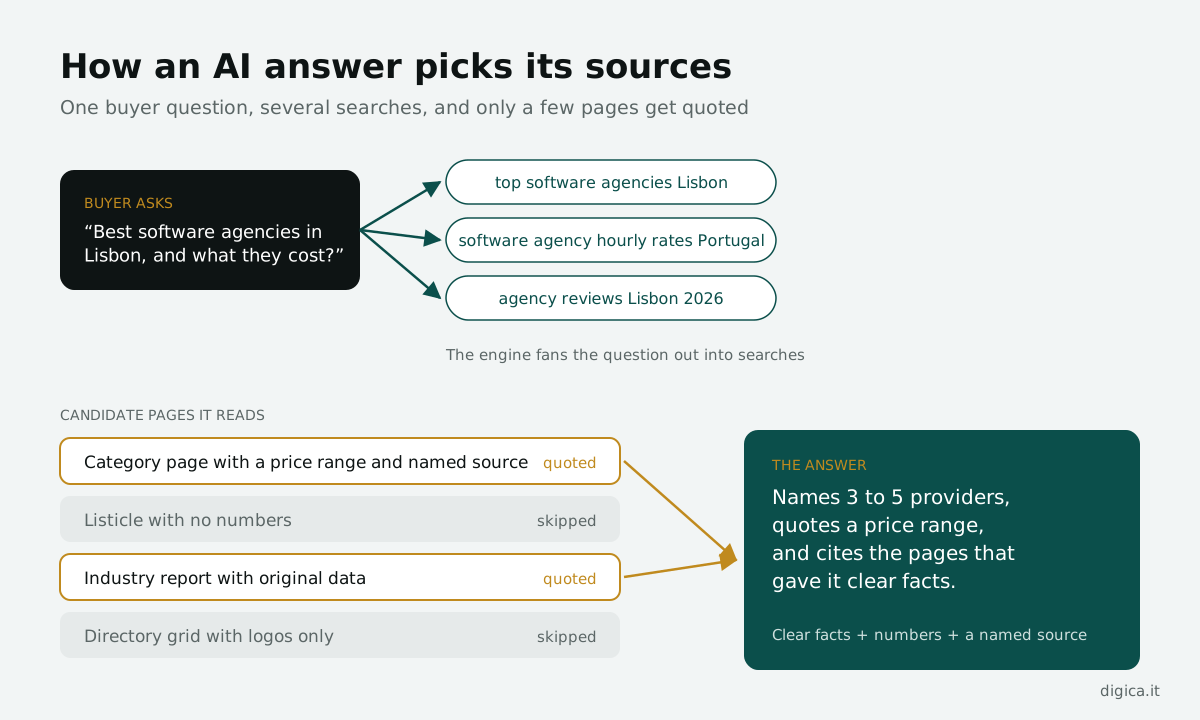
Your buyers still search, but more of them now ask an assistant first: who are the best agencies for this, what should it cost, which platform should I use? The answer names a few companies and cites a few sources. If your marketplace is not one of them, it drops out of the shortlist before a single click happens, and replacing that lost consideration with paid media can cost $25,000 to $80,000 for every 5,000 monthly sessions.
Generative engine optimization (GEO) is the work of becoming one of those cited sources. This playbook is written for marketplaces, because they hold an advantage most companies don't: thousands of pages of real, structured supply data. Presented well, that data is exactly what AI engines want to quote.
It sits on top of classic SEO rather than replacing it, and it is the core of our GEO service for marketplaces. For the bigger picture on how buyers now use assistants, see being the source AI answer engines cite.
Quick Navigation
- Why marketplaces start ahead
- What the research says
- Step 1: Turn category pages into answers
- Step 2: Make listing pages easy to read
- Step 3: Publish data only you have
- Step 4: Get mentioned where AI engines look
- Step 5: Make your identity unambiguous
- Step 6: Let the right crawlers in
- Three failure scenarios
- How to measure GEO
- Where to start: a decision framework
Why marketplaces start ahead
Marketplaces already own the raw material AI engines cite: specific, structured, up-to-date facts about a market. A typical B2B marketplace has three layers of it:
- Category pages that define a market, such as "software development agencies in Lisbon".
- Listing pages full of structured facts: services, prices, team size, location, reviews.
- Aggregate data nobody else has: price ranges, response times, demand by category.
Most marketplaces bury this in filters and templates. GEO is mostly about bringing it to the surface in a form an AI engine can read, trust and quote. The cost of leaving it buried is visibility you have already paid to build: every listing you onboarded at $150 to $600 is evidence an assistant could be citing today.
What the research says
AI engines reward evidence, not keywords. That is the headline of the study that named the field.
The term comes from a 2023 paper by researchers from Princeton University and IIT Delhi, among others, published at KDD 2024: GEO: Generative Engine Optimization. Across thousands of test queries, targeted content changes raised a source's visibility in AI answers by up to 40%.
Two findings matter most for marketplaces:
- What worked: citing credible sources, adding quotations and adding statistics. Clear, fluent writing also helped.
- What didn't: keyword stuffing. It lowered visibility.
Marketplaces sit on exactly the kind of statistics the study found most effective. The job is to put them where the engines can see them.
Step 1: Turn category pages into answers
Start with the 20 to 50 categories that drive the most revenue, and give each a short, factual summary at the top of the page. That summary is what an assistant quotes.
For each category, add:
- What the category is and who it's for, in two sentences.
- Your own numbers: typical price range, number of listed providers, average response time, with the source named ("based on 1,240 quotes on our platform in 2026").
- Three to five questions buyers really ask, each answered in two or three sentences.
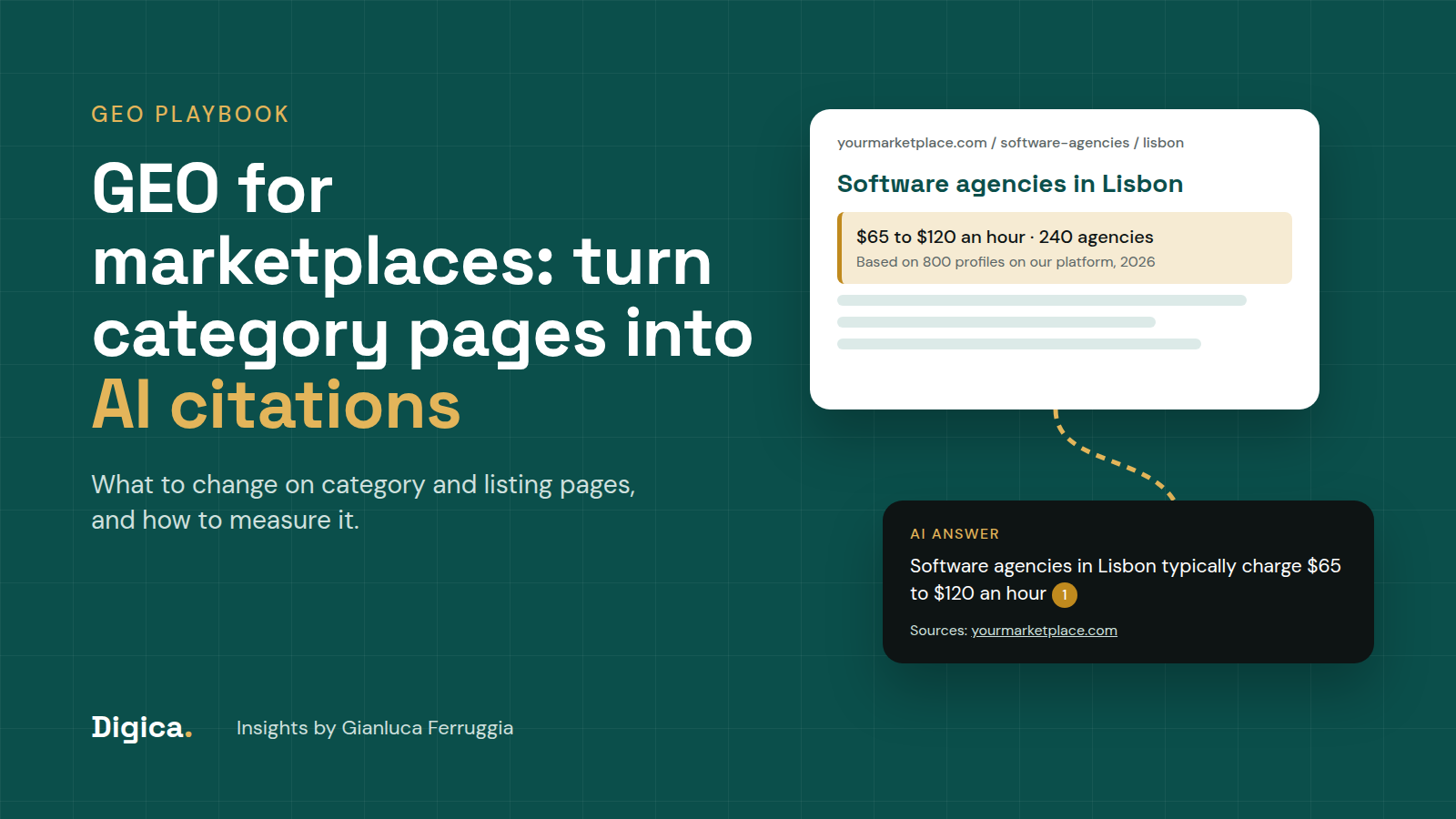
Compare two versions of the same page. A grid of logos gives an engine nothing to say. "Software agencies in Lisbon typically charge $65 to $120 an hour, based on 800 profiles on our platform" gives it a quotable fact with a named source, which is precisely what the research rewards.
Is your marketplace being cited today?
We check how ChatGPT, Perplexity and Google AI Overviews answer ten of your buyers' questions, and where you show up.
In our experience, category summaries are the highest-return GEO work for a marketplace: they reuse data you already have, and each one serves Google, AI assistants and human buyers at the same time. Start with the ten categories that bring in the most revenue, write a two-sentence summary for each, and add a short FAQ built from real buyer questions your sales team already hears.
Step 2: Make listing pages easy to read
Listing pages should state their key facts in plain text that any crawler can read. Google is explicit that no special markup is required for its AI features.
In its guidance on AI features and your website, Google says there are no additional requirements to appear in AI Overviews or AI Mode: a page needs to be indexed and eligible for a snippet, and no special schema is needed. So focus on the basics:
- Keep services, locations, prices and review scores in the page text, not only in images, tabs or scripts.
- Use standard structured data (schema.org
Organization,Service, andAggregateRatingwhere reviews are genuine) because it helps every machine interpret the page, not as an AI trick. - Show when the data was last updated. Freshness builds trust with buyers and engines alike.
Google also notes that clicks from results with AI Overviews tend to be higher quality, with people spending more time on the site. Pages that answer clearly earn those visits.
Step 3: Publish data only you have
An original report from your platform data is the most citable asset a marketplace can produce. Nobody else can publish it.
Once or twice a year, publish findings from your own activity: pricing benchmarks, demand trends, hiring or sourcing patterns. Journalists, analysts and AI engines cite reports like these, and they earn links you can't buy. One solid report can feed a year of category page updates, press pitches and social posts. Keep the methodology on the page: sample size, time period and how prices were measured. Engines and editors both trust numbers that show their working.
Step 4: Get mentioned where AI engines look
AI answers lean heavily on third-party sources, so your own site is only half the job. A marketplace that only talks about itself is rarely cited.
Build a steady flow of:
- Expert commentary in trade publications your buyers read.
- Places in "best of" lists and rankings for your category.
- Data partnerships where a publication uses your numbers and credits you.
Start with the sources that already appear in assistant answers for your core buyer questions. If Perplexity keeps citing the same two trade publications and one industry ranking when buyers ask about your category, those three are your outreach list. Offer them something they can't get elsewhere: a fresh price benchmark, a quote from your data team, or early access to your next report.
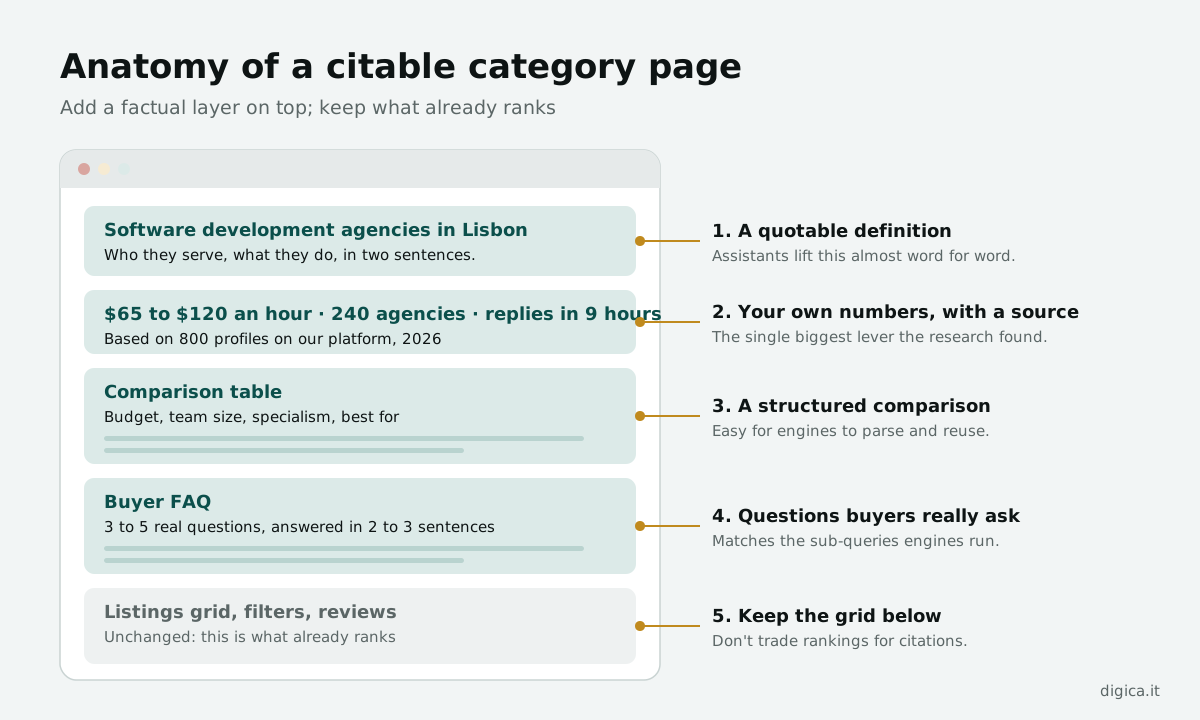
The page anatomy above and the earned mentions reinforce each other. A journalist who finds a clear price range on your category page is more likely to quote it, and that quote is exactly the third-party signal an assistant looks for.
Step 5: Make your identity unambiguous
AI engines need to be sure who you are before they recommend you. Inconsistent names and orphaned profiles make that harder.
Use the same company name everywhere: website, LinkedIn, directories, press. Link your site to your official profiles with sameAs structured data, and make sure your founders' profiles link back to the company. It is small, unglamorous work, and it is missing on most marketplaces we audit. Check three places first: the name in your site's structured data, your LinkedIn company page and your largest directory profiles. When all three say the same thing and point to the same website, assistants stop hedging about who you are. Repeat the check whenever you rebrand, launch a new product line or change domains.
Step 6: Let the right crawlers in
You can't be cited by an assistant that isn't allowed to read your pages. Many marketplaces block AI crawlers by accident.
Check your robots.txt file and your firewall or CDN bot settings. OpenAI's documentation on its crawlers explains that sites which block OAI-SearchBot will not be shown in ChatGPT search answers, while GPTBot is a separate crawler used for model training that you can allow or block on its own. Decide deliberately which to allow, rather than inheriting a default from your security vendor. A sensible default for most marketplaces is to allow search crawlers such as OAI-SearchBot and PerplexityBot, and to make a separate business decision about training crawlers.
Three failure scenarios
These are the three GEO mistakes we see most often, with what each one costs.
1. Rewriting everything for AI. A marketplace rewrites its top category pages in a chatty "AI-friendly" style and strips the listings grid. Organic rankings drop, and with them the leads those pages produced. At $200 to $900 per qualified buyer request, losing 40 requests a month costs $8,000 to $36,000 a month. The right call: add the factual summary on top and leave what already ranks intact.
Check your crawler and identity setup
A short review of bot rules, structured data and profiles usually fits in one call and clears the cheapest blockers first.
2. Blocking the crawler you needed. A security update blocks all AI bots by default. Nobody notices for a quarter, and the marketplace disappears from assistant answers in its core categories, exactly as OpenAI's crawler documentation warns for sites that block OAI-SearchBot. The right call: review bot rules every quarter and after every firewall change.
3. Generic content at scale. A team publishes 200 "what is X" articles that repeat what a hundred other sites already say. None get cited, because none contain anything new. The right call: publish less, and make every page carry at least one fact only you can provide. Ten category pages with real price ranges will earn more citations than two hundred generic explainers.
How to measure GEO
Rankings don't tell you whether you're cited, so GEO needs its own scorecard. Track four things every month.
- Prompt coverage: a fixed list of 30 to 50 buyer questions, checked monthly in ChatGPT, Perplexity, Gemini and Google AI Overviews. Are you named? Cited? Which page?
- AI referral traffic: visits from chatgpt.com, perplexity.ai and similar sources in your analytics.
- Share of voice: how often you're named compared with your two or three main competitors, on the same questions.
- What those visitors do: whether AI-referred visitors request quotes or book calls at a higher rate than average.
Monitoring tools for this typically cost $230 to $690 a month; a spreadsheet and an hour a month works for the first 30 prompts.
| GEO tactic | Typical cost to implement | Time to first signal | Main risk | Best for |
|---|---|---|---|---|
| Category page summaries | Low: internal time, reuses existing data | 4 to 8 weeks | Damaging pages that already rank | Marketplaces with 20+ revenue categories |
| Listing page clean-up | Low to medium: template change | 2 to 6 weeks | Breaking filters or layouts | Platforms with rich listing data |
| Original data report | Medium: analysis and design | 1 to 3 months | Weak methodology gets ignored | Marketplaces with 12+ months of data |
| Earned mentions | Medium: ongoing outreach | 2 to 4 months | Inconsistent effort | Categories with active trade media |
| Identity and crawler fixes | Very low: a few hours | 2 to 6 weeks | None, if tested | Everyone, first |
Where to start: a decision framework
Start with the cheapest fixes that unblock everything else, then move to the work that compounds. Use these thresholds:
- Any AI crawler blocked, or company name inconsistent across profiles: fix this first. It takes hours and nothing else works without it.
- 20 or more revenue categories with no summary at the top: start with your top 10 by revenue this month.
- 12 or more months of transaction data: plan one original report per half year. Pick the metric buyers ask about most, such as average price, lead time or supplier count by region, and publish the method alongside the numbers so journalists and assistants can reuse it with confidence.
- Named in fewer than 20% of your core buyer prompts: prioritise earned mentions in the publications those answers already cite.
Ready to turn category pages into citations?
Book a call to map your first ten category summaries, or see how our GEO work for marketplaces runs.
Here is the number for your next leadership meeting. If assistants shortlist providers before buyers ever reach Google, replacing that lost consideration with paid media costs $25,000 to $80,000 for every 5,000 monthly sessions. Category summaries built from data you already own avoid most of that cost, and they typically pay back within one to two quarters. The cost of doing nothing is paying every month for visibility your own data could earn.
FAQ
What is GEO for marketplaces? It is the work of getting a marketplace's pages cited in answers from ChatGPT, Perplexity, Gemini and Google AI Overviews, mainly by surfacing the platform's own data on category and listing pages.
Is GEO different from SEO? It builds on it. SEO gets your pages found and ranked. GEO makes them the source an AI engine chooses to quote. Most of the groundwork is the same.
Do I need llms.txt or special schema to appear in AI answers? Not for Google, which says no special files or markup are required for AI Overviews or AI Mode. Standard structured data still helps machines read your pages.
How long does GEO take to work? Identity and crawler fixes can show up within weeks. Category summaries take one to two months. Earned mentions and original data take a quarter or more.
Can a small marketplace compete with big brands in AI answers? Yes, often more easily than in classic search. AI engines cite specific, evidence-rich pages, not just big domains. Niche category data is an advantage.
How do I know if my marketplace is being cited? Run a fixed list of buyer questions through the main assistants every month and record whether you are named, cited and linked, alongside AI referral visits in your analytics.