Go-To-Market for AI Marketplaces: What Works and When to Hire a Consultant
Most AI marketplaces don't fail for lack of listings. They fail because buyers with budget never show up in the same category at the same time. Builders will list almost anywhere for free, so a new platform can reach 500 listings in a quarter and still close fewer than 10 paid transactions. At $300 to $1,200 to acquire one qualified enterprise buyer, a year of unfocused launch spend can pass $150,000 before anyone checks the match rate.
AI marketplaces are multiplying: agent marketplaces, AI tool directories, model and data marketplaces, AI talent platforms. They face the classic marketplace problem, getting enough buyers and sellers at once, with two extra twists. The supply side changes every few weeks. And the biggest distribution channels belong to platforms that may also compete with you.
This guide covers what a go-to-market (GTM) plan for an AI marketplace needs, the mistakes that burn the most money, and how to tell whether you need outside help. If you want the short version of how we run it, see our GTM strategy service for AI marketplaces.
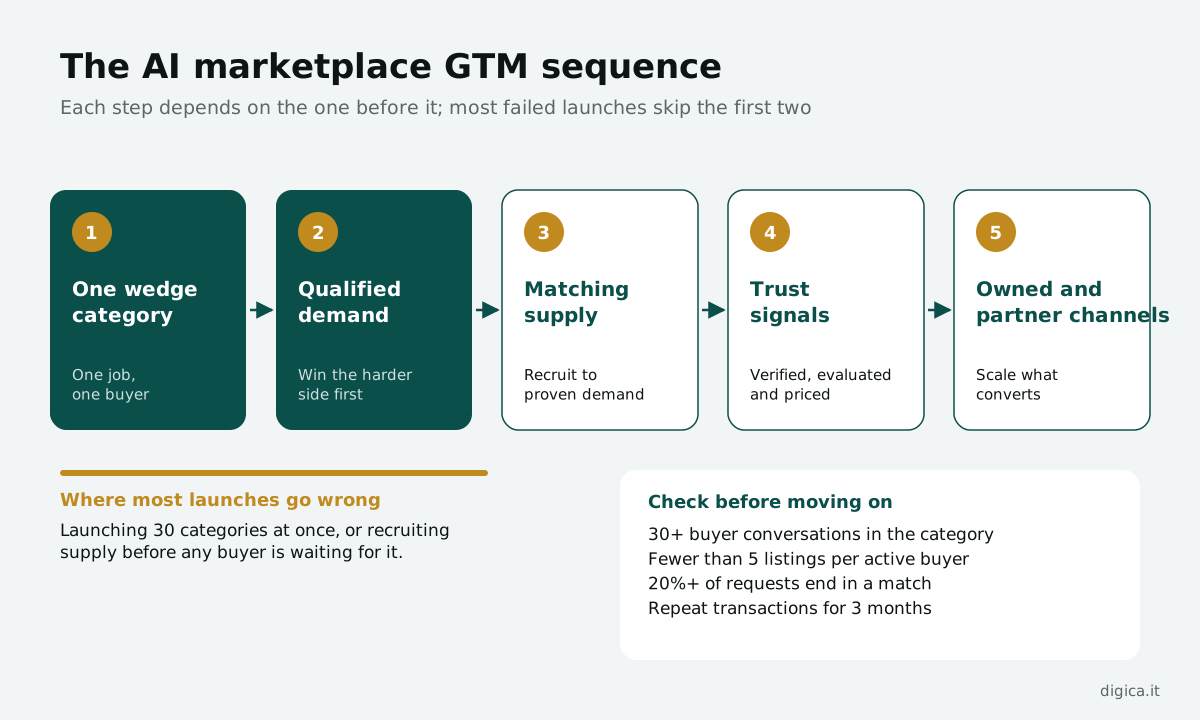
Read the sequence left to right: every step depends on the one before it, and most failed launches skip the first two.
Quick Navigation
- What counts as an AI marketplace
- The two twists that change the plan
- Step 1: Start with the harder side
- Step 2: Pick one wedge category
- Step 3: Build trust before you scale
- Step 4: Own at least one channel
- Step 5: Measure matches, not sign-ups
- Channel options compared
- Three failure scenarios
- When to hire a GTM consultant
- Where to start: a decision framework
What counts as an AI marketplace
The label covers four quite different businesses. The GTM logic is the same, but the harder side and the trust signals differ.
- Agent and app marketplaces: builders list AI agents or apps; businesses deploy them. Demand is usually the constraint.
- AI tool directories: discovery platforms for AI products, often monetized through listings and placements. Traffic is the constraint.
- Model and data marketplaces: teams buy or license models, datasets or evaluations. Trust and licensing clarity are the constraint.
- AI talent marketplaces: companies hire people who build, train or evaluate AI. Quality supply is often the constraint.
What they share: both sides move fast, buyers are nervous, and nobody has settled on a default platform yet. That last point is the opportunity.
The two twists that change the plan
1. Supply goes stale quickly. A single model release can make half your listings obsolete overnight. An agent that was best in class in spring can be outperformed by a free feature in autumn. Your plan needs an engine that keeps listings current, re-reviews them and retires dead ones, not just a launch push.
2. The biggest channels belong to giants. Enterprise buyers increasingly find AI products through big platform marketplaces such as AWS Marketplace, Salesforce AgentExchange and Microsoft's commercial marketplace. They are channels and competitors at once. Demand is growing fast: Gartner predicts that 40% of enterprise applications will include task-specific AI agents by the end of 2026, up from less than 5% in 2025. Much of that buying will run through platforms buyers already use. A good plan decides where you partner, where you stand apart, and what you own directly.
Step 1: Start with the harder side
In most AI marketplaces, qualified demand is harder to get than supply. Builders will list almost anywhere; buyers with budget, a use case and a deadline are scarce. Start where the constraint is, then recruit the other side to match, category by category.
In practice that means your first 90 days of GTM effort go mostly to buyers: interviews, a waitlist of named companies, pilot requests and content that answers their questions. Supply recruitment follows the demand you can prove. A platform that can tell a builder "we have 40 support teams looking for this" signs better suppliers, faster, than one that promises traffic.
The exception is AI talent marketplaces, where vetted supply is the scarce side. The rule still holds: find the constraint first, and spend there.
Not sure which side is your constraint?
Book a 30-minute GTM call and we work it out from your numbers, category by category.
A quick test for which side is harder: count how many qualified requests you could fulfil tomorrow if the other side showed up. If you have more listings than buyers could ever review, demand is your constraint. If buyers ask for things nobody on your platform offers, it is supply. Write the answer down, share it with the whole team, and revisit it every quarter, because the constraint often flips once the first category starts to work.
Step 2: Pick one wedge category
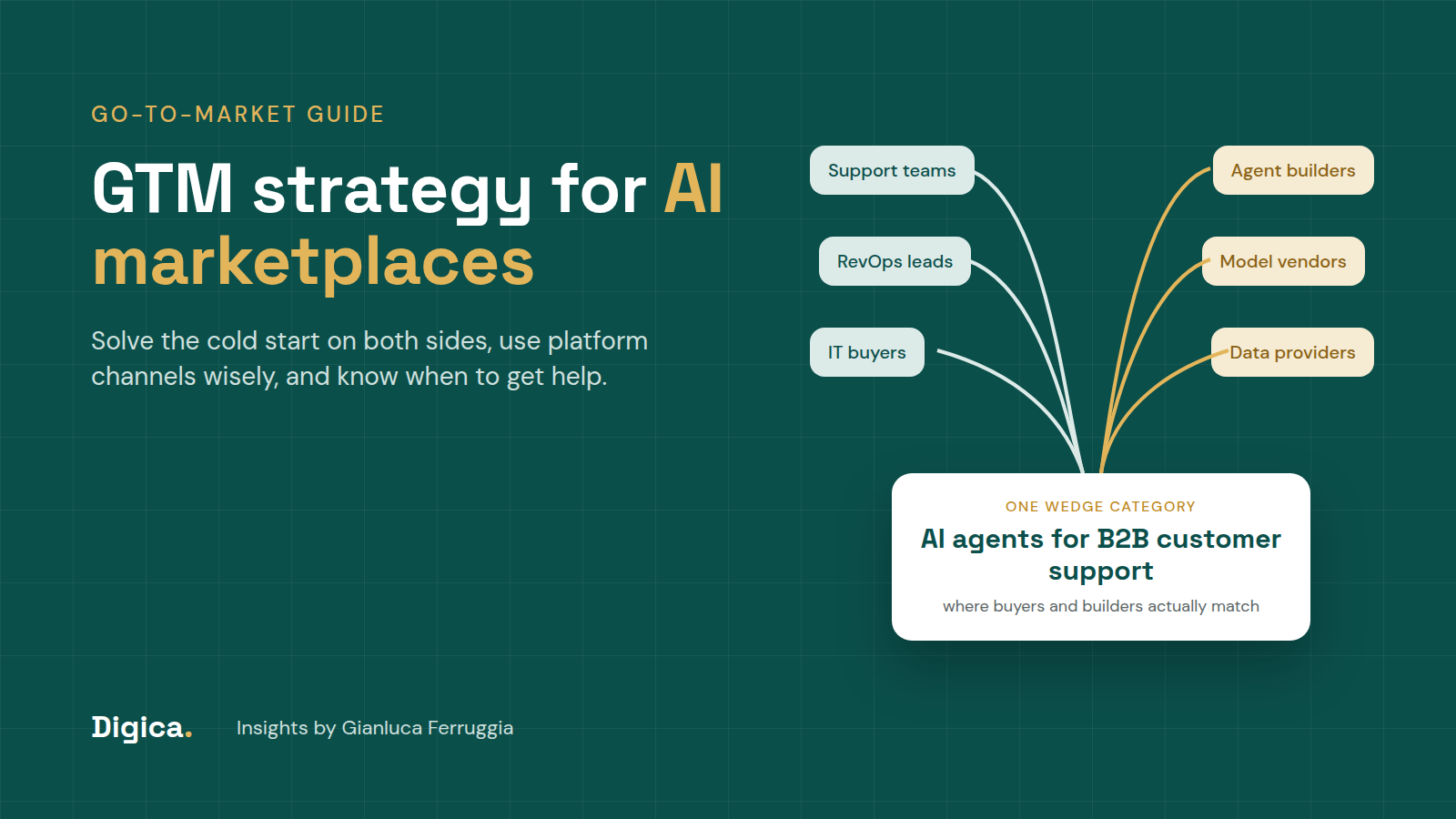
Don't launch as "the marketplace for AI". Launch as the best place for one job and one buyer, such as AI agents for customer support in B2B SaaS, or evaluation datasets for healthcare models. Depth in one category beats thin coverage across twenty.
A good wedge category has three properties: buyers with a clear budget line, at least 20 credible suppliers you can recruit, and a question buyers can't easily answer on their own, such as which agent integrates with our helpdesk and what it costs per resolved ticket. That question becomes your content, your comparison pages and your sales pitch.
Once the wedge works, expand into the next category that shares the same buyers or the same suppliers. That way each new category starts with half of its liquidity already in place.
Step 3: Build trust before you scale
Buyers of AI products worry about accuracy, security, data handling and lock-in. Procurement teams add their own checklist. A marketplace that reduces that risk earns the transaction; one that simply lists products becomes a directory.
The trust signals that move conversion are practical: verified listings, transparent evaluations on real tasks, clear pricing, security documentation in one place, and case studies with named outcomes. Each one answers a question that would otherwise stall a deal for weeks. None of them requires paid media, and all of them make every later channel convert better.
Step 4: Own at least one channel
If all your demand comes through big platform marketplaces or paid ads, you're renting it, and the rent goes up. Build at least one channel you own:
- Organic search and GEO: category and comparison pages that answer buyer questions and get cited by AI assistants. Our guide to GEO for marketplaces covers how.
- Editorial authority: rankings, benchmarks and reports your category trusts and reuses.
- Community and newsletter: a direct line to buyers and builders that no algorithm can take away.
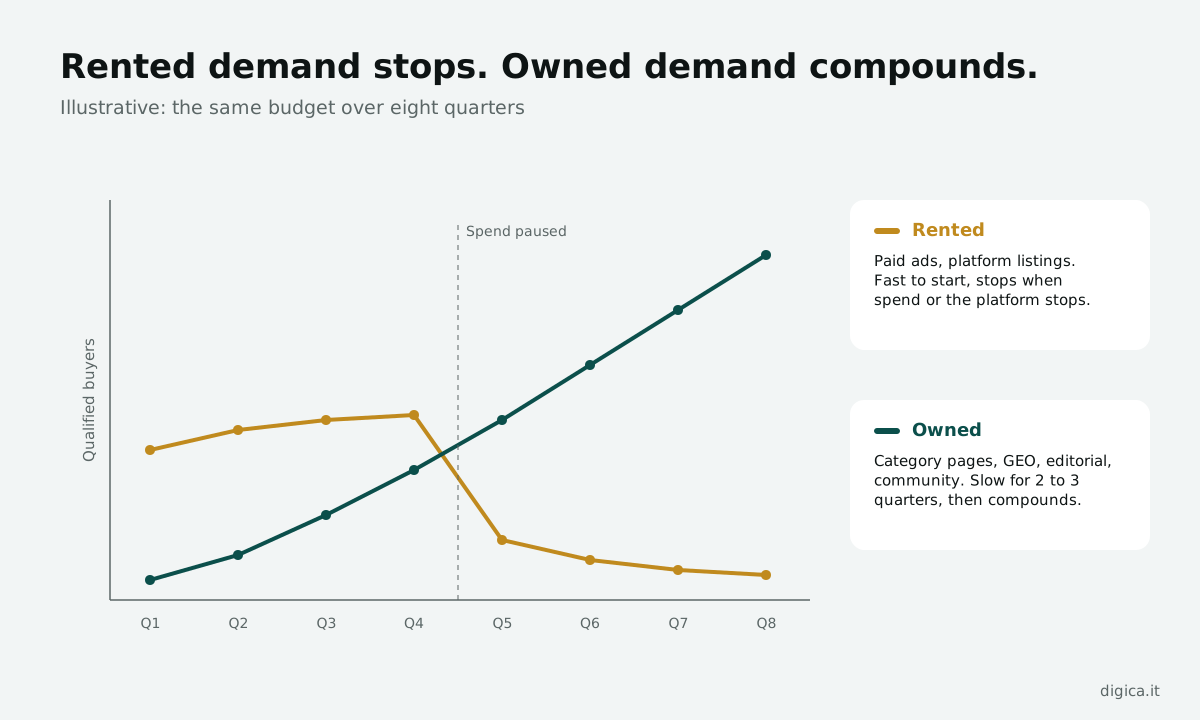
Owned channels are slower to start, usually two to three quarters before they carry real volume, which is exactly why they need to begin in the first year, not the third.
Step 5: Measure matches, not sign-ups
Sign-up counts on either side are misleading. A thousand builders and a thousand buyers mean nothing if they never transact with each other in the same category.
Track whether the marketplace works: the share of searches or requests that end in a match, time to first transaction, repeat use per category, and cost per qualified request on each side. These map closely to the liquidity and cohort signals in Andreessen Horowitz's 13 metrics for marketplace companies. Review them per category every month, not as a platform average, because averages hide the categories that are quietly failing.
Channel options compared
Most AI marketplaces end up using several channels. The question is the order and the balance.
| Channel | Typical cost | Time to first deals | Main risk | Best for |
|---|---|---|---|---|
| Hyperscaler marketplace listing | Low to list, plus platform fees and co-sell effort | 1 to 2 quarters | The platform owns the buyer relationship | Enterprise buyers with committed cloud spend |
| Paid search and social | $5,000 to $50,000 a month | Weeks | Cost per buyer rises as you scale | Testing demand in a new wedge category |
| Category and comparison pages (SEO and GEO) | Internal time plus content, often $3,000 to $12,000 a month | 2 to 3 quarters | Stops if publishing stops | Platforms with real supply and pricing data |
| Editorial rankings and reports | Medium: research and design | 1 to 2 quarters | Weak method gets ignored | Categories with active trade media |
| Community and newsletter | Low cash, high founder time | 1 to 3 quarters | Depends on a few people | Builder-heavy and talent marketplaces |
Hyperscaler listings deserve a clear-eyed view. They help most with procurement, because enterprise buyers can often pay through a cloud account they already have and a contract their legal team already signed. That is a real advantage, but it is the platform's front door, not yours.
Three failure scenarios
These are the three GTM mistakes we see most often in AI marketplaces, with what each one costs.
1. Launching broad. A platform opens with 30 categories and 800 listings. Traffic arrives, but no category has enough buyers or suppliers to match, so conversion stays below 1% and paid spend of $20,000 a month produces a handful of deals. The right call: cut to one wedge category until it reaches repeat transactions, then expand.
2. Outsourcing demand to a platform. A marketplace lists on a hyperscaler marketplace, sees early deals, and stops building its own channels. A year later, the platform launches a first-party alternative in the same category and the pipeline halves. The pull is understandable: early platform deals close faster because procurement is already solved, and the sales team can point to logos within weeks. The right call: treat platform listings as one channel with a ceiling, and keep at least a third of new buyers coming from channels you own.
Launched broad and stuck?
We help you pick the wedge category, cut what isn't matching and set the metrics that show progress.
3. Stale supply. A marketplace grows to 2,000 AI tools, but half have not been updated in six months. Buyers try three, hit two dead products, and stop trusting the rest. The right call: re-verify listings on a fixed schedule, show a last-verified date on every page, and remove what fails. A smaller catalogue that works beats a large one that buyers have learned to distrust.
When to hire a GTM consultant
Bring in outside help when:
- You have a product and early supply, but demand isn't compounding and paid acquisition is getting expensive.
- You're deciding whether to partner with or compete against a big platform marketplace.
- You need senior GTM leadership for 6 to 12 months, before a full-time hire makes sense.
You probably don't need one yet if you haven't validated a wedge category. Talk to 30 buyers first, write down the three problems they mention most, and check whether anyone on your platform already solves them. That exercise costs nothing and tells you more than any strategy deck.
When you do hire, look for four things. They've grown a marketplace, not just an AI product, because the two-sided dynamics are the hard part. They separate supply and demand in every plan and every metric. They build channels you own, not only campaigns that stop when the budget does. And they plan their exit: a good engagement ends with your team running the engine. Our shortlist of the best B2B marketplace growth consultants compares the main options.
Where to start: a decision framework
Use your numbers, not your ambitions, to decide what comes next. These thresholds are a starting point:
- Fewer than 30 buyer conversations in your chosen category: stop building channels and talk to buyers. Nothing else is worth funding yet.
- More than 5 listings for every active buyer: demand is your constraint. Move most GTM spend to buyer acquisition in one wedge category.
- Fewer than 20% of requests end in a match: fix supply quality and category depth before adding traffic.
- More than 70% of new buyers from paid or a single platform: start an owned channel this quarter, beginning with category and comparison pages.
- Repeat transactions in your wedge category for three months running: you are ready to add the next category that shares buyers or suppliers.
Building an AI marketplace?
Talk through your wedge category and channel mix with Gianluca, or see how our GTM work for AI marketplaces runs.
Here is the number for your next board meeting. If you pay $300 to $1,200 for each qualified enterprise buyer through paid channels, moving even a third of new demand to owned category pages and AI search saves $30,000 to $120,000 for every 300 buyers a year, and that content usually pays back within two to three quarters. The cost of doing nothing is renting your demand from the platforms most likely to compete with you.
FAQ
What is a go-to-market strategy for an AI marketplace? A plan for which buyers and suppliers you win first, in which category, through which channels, and how you'll know they're transacting with each other.
Which side should an AI marketplace build first? Usually demand. Builders list almost anywhere, while qualified buyers with budget are scarce. AI talent marketplaces are the main exception, where vetted supply is the harder side.
Should an AI marketplace list on AWS Marketplace or Salesforce AgentExchange? Often yes, for reach and easier procurement. AWS, for example, pitches its AI agent solutions marketplace on buying with an existing AWS account and central control of licensing and billing. But treat them as channels, not your whole plan, and keep a direct relationship with your best buyers.
How long does it take to see results? In a focused wedge category, early signs of liquidity usually show within one to two quarters. Owned channels like SEO and GEO take two to three quarters to carry real volume. Broad launches take longer and often stall.
What does a GTM consultant for AI marketplaces do? They diagnose which side limits matches, choose the wedge category, set the channel mix between platforms and owned channels, and build the metrics that show whether the marketplace works. The best ones hand the engine to your team.
How much should an AI marketplace spend on GTM in year one? Less than most expect, if it is focused. Fund buyer discovery and one wedge category first, then scale spend only once match rate and repeat use prove the category works.