The best community platforms for B2B communities in 2026, grouped by who they are built for
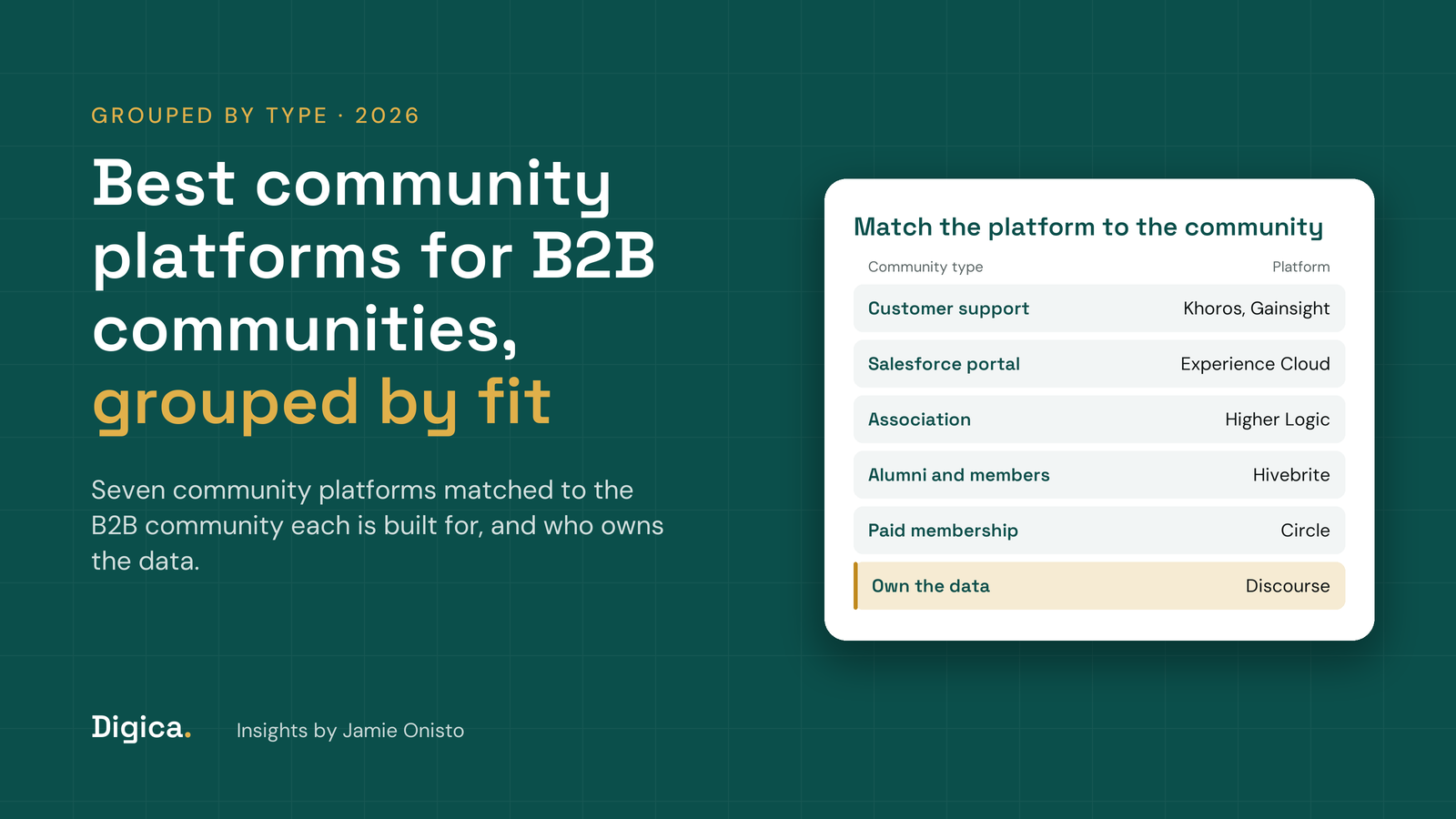
Higher Logic says it powers more than 270,000 online communities, Discourse more than 22,000, and Khoros more than 300 enterprise communities that draw 1.8 billion site visits a year. Those three numbers describe three different products. A community platform built for a software company's support forum, one built for a professional association and one you can run on your own servers have little in common beyond the word "community".
That is why most comparisons of community platforms mislead. They line up features and monthly prices, as if every B2B community needed the same thing. In practice, the first decision is fit: is this a customer support community, a member network, a paid membership or an open forum? The second is ownership: who hosts the community, which CRM it talks to, and whether you can take the data with you. Price comes third, and for enterprise platforms it is rarely published at all.
This guide groups seven community platforms by the kind of B2B community they are built for, and compares them on fit, integrations and data ownership. Facts come from each vendor's own pages and announcements, checked on October 15, 2026. It is the same lens we use when we help B2B communities and expert networks grow membership and organic reach.
Quick Navigation
- Seven community platforms at a glance
- Customer support communities: Khoros and Gainsight
- Salesforce-native portals: Experience Cloud
- Associations and professional networks: Higher Logic
- Alumni and member networks: Hivebrite
- Membership-led communities: Circle
- Open source and self-hosted: Discourse
- Who owns the member data
- Three ways a community platform choice backfires
- Which community platform fits your B2B community
- The number for your next platform review
- FAQ
- Related Articles
Seven community platforms at a glance
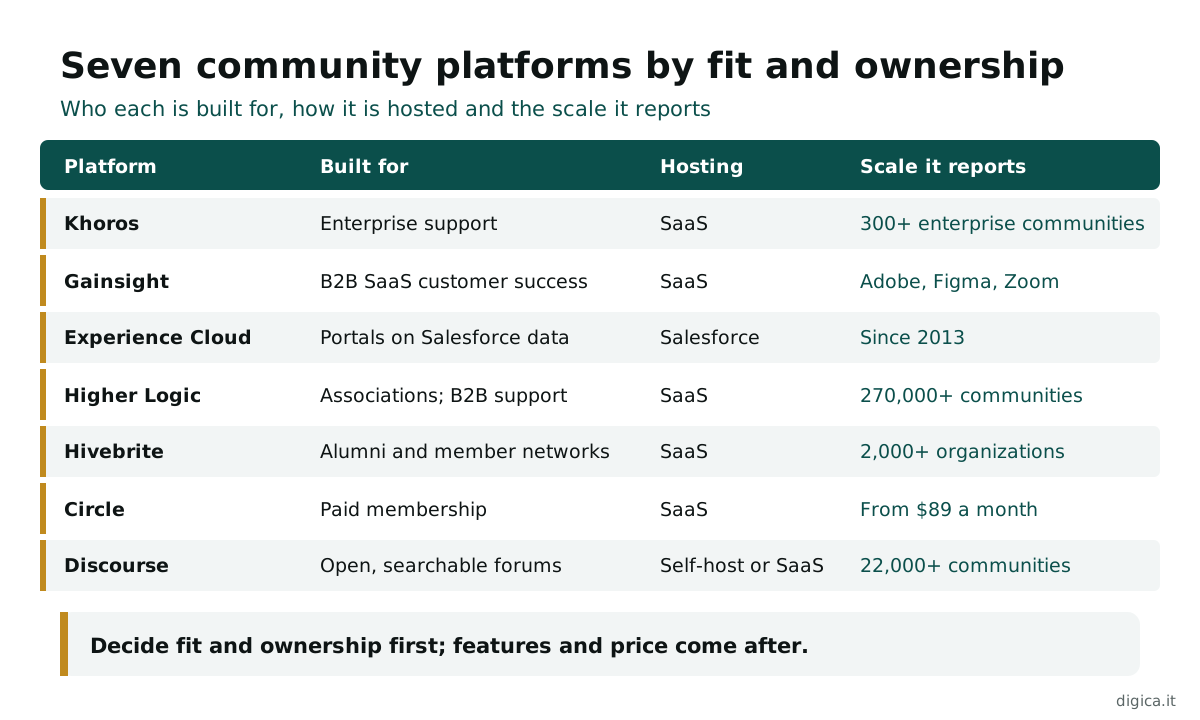
The short answer: Khoros and Gainsight are the community platforms for large customer support communities, Salesforce Experience Cloud for portals built on Salesforce data, Higher Logic for associations, Hivebrite for alumni and member networks, Circle for paid membership communities, and Discourse when you need to own and host the software yourself.
Seven community platforms grouped by the B2B community they fit, with integrations, ownership and cost
| Type | Community platform | Built for | Key B2B integrations | Hosting and data ownership | Published cost | Main risk | Best for |
|---|---|---|---|---|---|---|---|
| Customer support | Khoros | Large-brand peer support and self-service | Salesforce case escalation | SaaS | Not published | New owner since 2025 | Enterprise support deflection |
| Customer support | Gainsight Customer Communities | B2B SaaS customer communities | Zendesk, Jira, Gainsight CS, Skilljar, SSO | SaaS | Not published | Best value inside the Gainsight suite | SaaS companies running customer success |
| Salesforce portal | Salesforce Experience Cloud | Portals on live Salesforce records | Native Salesforce data and security | SaaS on Salesforce | Not on Salesforce's pages | Needs Salesforce skills to run | Partner and customer portals |
| Associations | Higher Logic (Thrive, Vanilla) | Associations; Vanilla for B2B support | Salesforce, Dynamics 365, iMIS, Nimble AMS | SaaS | Not published | Two products, two roadmaps | Professional associations |
| Alumni and members | Hivebrite | Alumni, member and professional networks | Salesforce, HubSpot, Blackbaud, iMIS, SAML SSO | SaaS | Custom quote | Less support-forum depth | Alumni and member networks |
| Membership | Circle | Paid communities, courses and events | Zapier; custom SSO on Scale | SaaS | $89 to $419 a month | Built for creators first | Paid B2B membership communities |
| Open source | Discourse | Open discussion forums | OpenID and OAuth2 SSO on Business | Self-host free, or hosted | $0 self-hosted; $100 to $500 a month hosted | You run the servers if self-hosted | Owning the platform and data |
Read the "built for" and "hosting" columns first. They narrow seven options to one or two before any feature list matters.
Customer support communities: Khoros and Gainsight
Khoros and Gainsight Customer Communities are built for the same job: a customer community where users answer each other's questions, so fewer of them open a support ticket. Both are SaaS, both publish no price, and both sell mainly to companies with large customer bases.
Khoros is the older of the two. Its history page traces it to Lithium, founded in 2001, which merged with Spredfast in 2018 and became Khoros in 2019. Its site claims more than 300 enterprise communities, 1.8 billion community site visits a year and more than $500 million in annual support costs saved through self-service. A native Salesforce integration escalates community threads to Salesforce cases and syncs user data, so a question the community cannot answer becomes a support case without retyping.
Ownership has changed. IgniteTech announced its acquisition of Khoros on May 27, 2025, and Khoros relaunched in 2026 with an AI product it calls Aurora. That matters for a buyer signing a multi-year contract: a new owner can change pricing, roadmap and support levels, so ask what is committed in writing, including support levels, price caps on renewal and the roadmap for features you depend on.
Running a B2B community that members visit but search engines never find?
In 30 minutes we look at how your community is indexed, and which threads could bring in new members.
Gainsight Customer Communities began as inSided, an Amsterdam company Gainsight agreed to acquire in January 2022. It now sits alongside Gainsight's customer success software and its Skilljar education product, and integrates with Zendesk, Jira and community single sign-on. Named customers include Adobe, Airtable, Figma, Zapier and Zoom. Gainsight was listed as a Representative Vendor in Gartner's May 2026 Market Guide for B2B Customer Community Platforms, and says it has completed more than 25 migrations from Khoros.
Self-service is the reason these platforms exist, and most companies under-use it. A Gartner survey of 5,801 customers found 60% of customer service agents fail to promote self-service options, and that agent promotion is associated with doubling the number of customers likely to use self-service next time. A community only deflects tickets if support points people to it.
The verdict: Khoros for very large consumer-facing and enterprise brands; Gainsight for B2B SaaS companies that want the community tied to customer success.
Salesforce-native portals: Experience Cloud
Salesforce Experience Cloud is less a community platform than a way to put a community, help center or partner portal directly on top of Salesforce. It began as Salesforce Communities in 2013, became Community Cloud, and was renamed Experience Cloud in late 2020.
Its advantage is data. Experience Cloud sites read and write live Salesforce records and inherit the organization's sharing and security settings, so a partner sees their own deals and a customer sees their own cases with no sync to break. Templates cover a customer account portal, a partner portal and a help center, each sold under its own license type.
The trade-off is that it behaves like Salesforce, not like a forum. Discussion features are thinner than on a dedicated community platform, and running it well needs Salesforce administration skills. Salesforce does not show Experience Cloud prices on its public pages today, so pricing has to come from a quote.
The verdict: the right choice when the community is really a portal on Salesforce data, such as partner deal registration or customer case tracking. For open peer discussion, pair it with or choose a dedicated community platform.
Associations and professional networks: Higher Logic
Higher Logic is built around associations. It says it powers over 270,000 online communities for more than 3,000 organizations, and that its Thrive product is trusted by over 1,700 associations. ASAE, the association for association executives, runs its Collaborate community on Thrive.
Fit for associations comes from integrations. Thrive connects to the membership and CRM systems associations run on, including Salesforce, Microsoft Dynamics 365, iMIS, NetForum, Nimble AMS, MemberSuite and YourMembership, so member records, dues status and committees flow into the community without manual exports. Higher Logic's own 2025 Association Community Benchmark Report, drawn from nearly 1,500 associations, found that communities tied into volunteering, mentoring, job boards and chapters saw at least twice as many logins.
Does your member community grow by referral only?
A growth audit maps how prospective members find your community, and where search and AI answers send them instead.
Higher Logic also owns Vanilla, founded in Montreal in 2009 and acquired in 2021, which serves B2B support communities for companies such as D2L, 6sense and Smartsheet. Vanilla connects to Salesforce and Zapier. Having two products means a buyer should confirm which one a proposal is for, and which roadmap it follows.
The verdict: the default community platform for professional associations, and a credible option for B2B support communities through Vanilla.
Alumni and member networks: Hivebrite
Hivebrite is built for networks of people who share an affiliation rather than a product: alumni of a university or company, members of a professional body, participants in a program. It says more than 2,000 organizations use it, and names CERN Alumni, CASE, Cornell Hotel Society and EIT Health on its homepage.
The feature set follows that use case: member directories, events, mentoring, job boards and fundraising rather than support threads. Integrations reach both corporate and nonprofit systems, including Salesforce, HubSpot, Zoho, Blackbaud, iMIS and Fonteva, and single sign-on runs over SAML 2.0, OAuth2 and OpenID Connect with Okta, Azure AD and OneLogin. Hivebrite is headquartered in Paris with a second office in New York, and pricing is by custom quote.
For a B2B company, Hivebrite fits a customer advisory network, a partner community or a former-employee network better than a support forum. Its strength is relationships between members, not answers to product questions.
The verdict: the best community platform for alumni, member and professional networks that run events, mentoring and directories.
Membership-led communities: Circle
Circle is the most transparent community platform here on price and the most consumer-flavored in origin. Its pricing page lists Professional at $89 a month, Business at $199 and Scale at $419 on annual billing, with a custom Circle Plus tier above. Every plan includes unlimited members.
Circle was built for creators running paid communities, courses and events, and many of its best-known users are individual creators. It has a growing B2B following: Exit Five, the community for B2B marketers, runs on it, as does the e-learning company Articulate. Custom single sign-on arrives on the Scale plan, and branded mobile apps only with Circle Plus, which matters for companies that want members inside their own login.
The fit question is revenue model. Circle suits a B2B community that charges for membership or bundles courses and events into a paid tier. For a free customer support community, its strengths go mostly unused.
The verdict: the best community platform for paid B2B membership communities, with published prices from $89 a month.
Open source and self-hosted: Discourse
Discourse is the one platform in this guide you can own outright. It has been open source under the GPL v2 license since 2013, and its pricing page is explicit that it is free to run on your own servers. Discourse says more than 22,000 communities run on it, including communities for Asana, OpenAI, Zoom, GitLab, NVIDIA and Mozilla.
Hosted plans exist for teams that do not want to run servers: Pro at $100 a month, Business at $500 a month with single sign-on over OpenID and OAuth2, and a custom Enterprise tier. A community can start hosted and move to self-hosting later, or the reverse, without changing software.
Discourse is built for long-form, searchable discussion, which suits developer and technical communities especially well. Threads are organized by topic and remain readable years later, which is also why a well-run Discourse community can rank in search for detailed product questions.
The verdict: the community platform for companies that need to own the software and the data, and for technical communities built around searchable discussion.
Who owns the member data
Data ownership is the decision most B2B community buyers skip, and the one hardest to reverse.
On six of the seven platforms, the vendor hosts the community and the data lives in its systems. That is normal and usually fine, but it makes three questions worth asking before signing: can you export every post, member and profile field in a usable format; does the community sync to your CRM in both directions; and who controls the URLs, since years of indexed threads are one of the most valuable assets a community builds. Discourse answers all three by letting you run it yourself.
Ownership also matters because communities change hands and change platforms. Khoros has a new owner, Gainsight advertises Khoros migrations, and Higher Logic runs two products. A community that cannot leave its platform cleanly loses search rankings and member history in every move. Our view: budget for an exit before you need one, and keep your community on a domain you control.
Three ways a community platform choice backfires
These patterns recur when B2B companies choose a community platform.
- Buying a support platform for a member network. A company buys an enterprise support community for what is really a customer advisory group. Members want events, introductions and a directory; they get a ticket-deflection forum. Engagement stalls within a year.
- Launching a community nobody points to. A support community goes live, but agents and help pages never link to it. The Gartner finding above applies directly: when agents do not promote self-service, customers do not use it, and the platform's deflection case never materializes.
- Under-resourcing the community after launch. The CMX 2025 Community Industry Trends Report found nearly one in five community teams have no full-time person working on community, and only 26% saw budgets increase while 18% saw cuts. No community platform runs itself; the software choice matters less than the person running it.
In each case the platform worked as designed. The mistake was choosing it before deciding what kind of community it was for, and who would run it.
Which community platform fits your B2B community
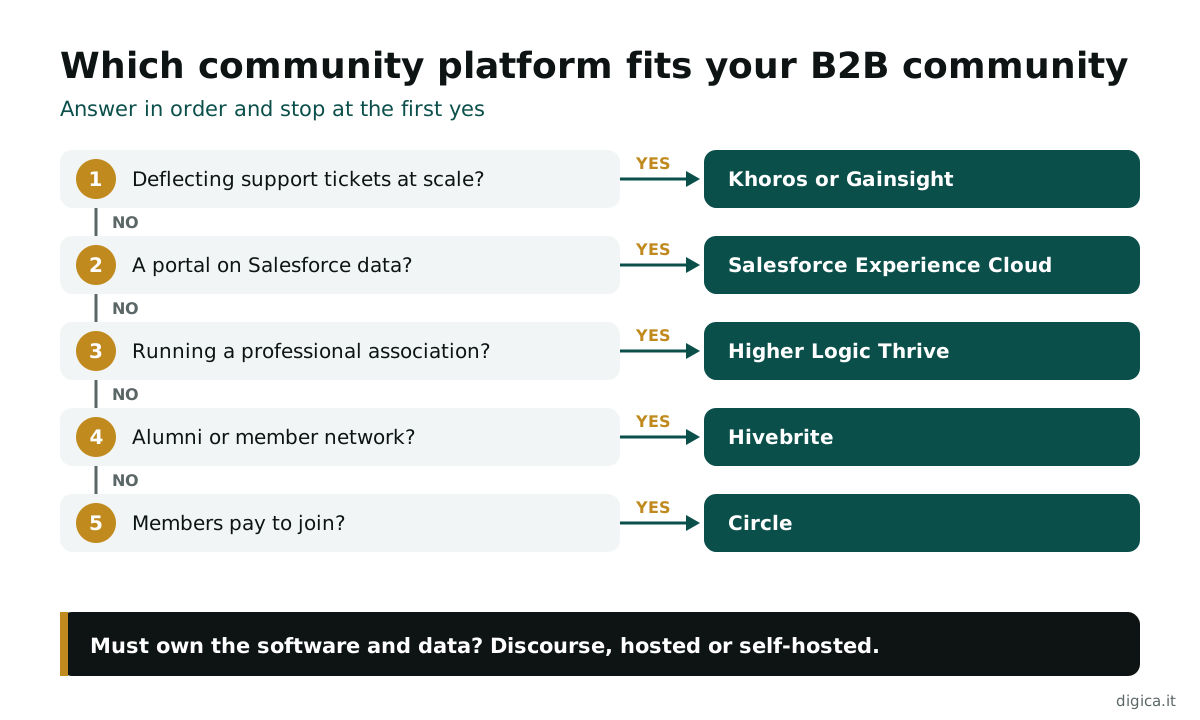
Answer these in order and stop at the first yes.
- If the community exists to deflect support tickets at enterprise scale, shortlist Khoros and Gainsight, and choose Gainsight if you already run Gainsight for customer success.
- If the community is a portal on Salesforce data, such as partner deals or customer cases, use Salesforce Experience Cloud.
- If you run a professional association, use Higher Logic Thrive and connect it to your membership system.
- If it is an alumni, partner or member network built on events and introductions, use Hivebrite.
- If members pay to join, or you bundle courses and events, use Circle.
- If you must own the software and data, or the community is technical, use Discourse, hosted or self-hosted.
Growing a B2B community or expert network?
We grow membership and organic reach for B2B communities, from the first members to an engaged network.
Whichever you choose, plan how new members will find the community. A platform hosts a community; it does not fill one. The communities that grow fastest make their best public threads findable in search, link them from help pages and product, and treat every answered question as a page that can bring in the next member. That is where community SEO earns its keep.
The number for your next platform review
Published prices make the cheaper end easy to compare: a Discourse Business plan is $6,000 a year, and Circle's Scale plan is about $5,000 a year on annual billing. Self-hosting Discourse avoids that fee entirely, at the cost of running servers. The larger cost sits elsewhere: choosing a community platform that does not fit means a migration later, and every migration risks the search rankings and member history the community spent years building. The biggest cost of doing nothing is picking on monthly price and paying for that migration within three years.
FAQ
What is a community platform? A community platform is software for running an online community: discussion threads, member profiles, events and moderation, usually with integrations to a CRM or help desk. Examples include Khoros, Higher Logic, Hivebrite, Circle and Discourse.
What is a B2B online community? A B2B online community brings together customers, partners or professionals around a product, an industry or a profession. Common types are customer support communities, partner portals, associations, alumni networks and paid membership communities.
What is the best community platform for B2B? It depends on the community. Gainsight and Khoros lead for customer support communities, Higher Logic for associations, Hivebrite for alumni and member networks, Circle for paid membership and Discourse for self-hosted forums.
Can I host a community platform on my own servers? Yes, with Discourse. It is open source under the GPL v2 license and free to run on your own servers. Hosted Discourse plans start at $100 a month.
How much does a community platform cost? Circle lists plans from $89 to $419 a month, and hosted Discourse from $100 to $500 a month. Khoros, Gainsight, Higher Logic and Hivebrite sell by quote, and Salesforce Experience Cloud prices are not shown on Salesforce's public pages.
Which community platforms integrate with Salesforce? Salesforce Experience Cloud runs on Salesforce data natively. Khoros escalates threads to Salesforce cases, and Higher Logic Thrive, Vanilla and Hivebrite all list Salesforce integrations.
What is the difference between a community platform and a forum? A forum is one feature: threaded discussion. A community platform adds member profiles, events, directories, single sign-on and CRM integration, so the community connects to the rest of the business.
Related Articles
- B2B communities and expert networks
- Community SEO
- Best startup communities in 2026, ranked by members
- The marketplace liquidity metric that compounds
- GEO for marketplaces
This article is part of our B2B marketplace growth series. Browse more on the Digica blog.