The best packaging marketplaces for brands, by minimum order and price
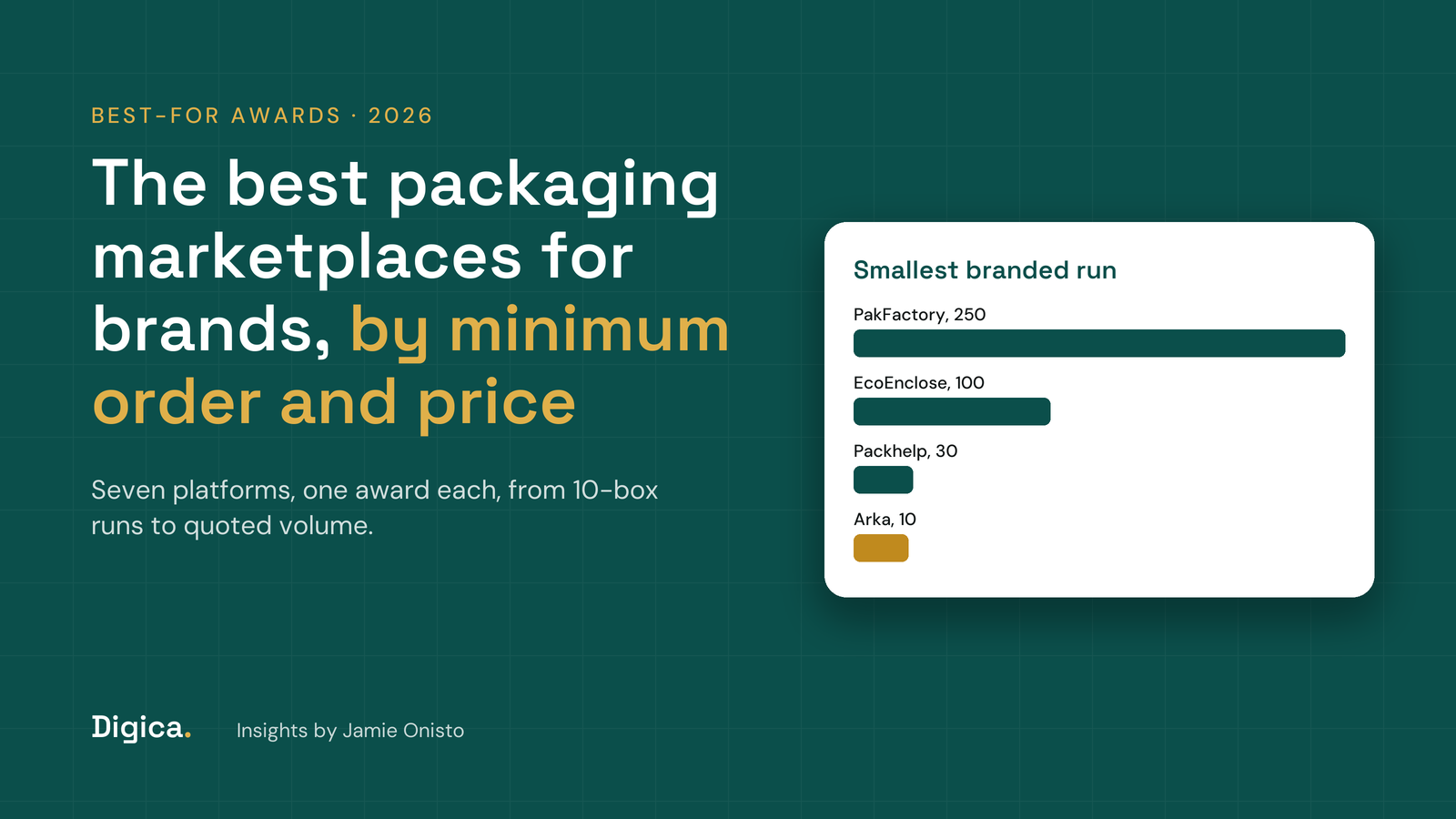
A brand can now order 10 custom printed mailer boxes online, where a few years ago a packaging supplier would rarely quote under 1,000. That change matters most to young brands, because the minimum order sets how much cash sits in a warehouse before a single product ships. Across the seven packaging platforms in this guide, the smallest branded run ranges from a single test box to 500 rigid boxes, depending on the box and the platform.
The catch is that a low minimum and a low price are rarely the same order. Small runs carry a high cost per box, and the cheapest unit prices sit behind quotes that start at hundreds or thousands of units. Most search results for "packaging marketplace" mix one company's own store with lists of suppliers, so it is hard to see which kind of platform you are on before you start designing.
This guide gives seven platforms one award each, judged on minimum orders and how they price: instant online, quote by request or a directory of suppliers. It is written for founders, operations and brand leads buying packaging, and for founders growing a packaging B2B marketplace. Figures are each company's own, checked on November 10, 2026.
Quick Navigation
- How we judged minimums and price
- The seven awards at a glance
- Best for low minimums in Europe: Packhelp
- Best for the smallest production runs: Arka
- Best for a price before you design: Packlane
- Best for sustainable shipping boxes: EcoEnclose
- Best for printed boxes at volume: PakFactory
- Best for comparing manufacturer quotes: Sourceful
- Best packaging suppliers directory: PMMI ProSource
- Where packaging orders go wrong
- Choosing a packaging marketplace by order size
- FAQ
- Related Articles
How we judged minimums and price
We asked three questions of each platform. What is the smallest branded order it will take? How does it price: an instant online quote, a quote by request or nothing at all? And who makes the boxes?
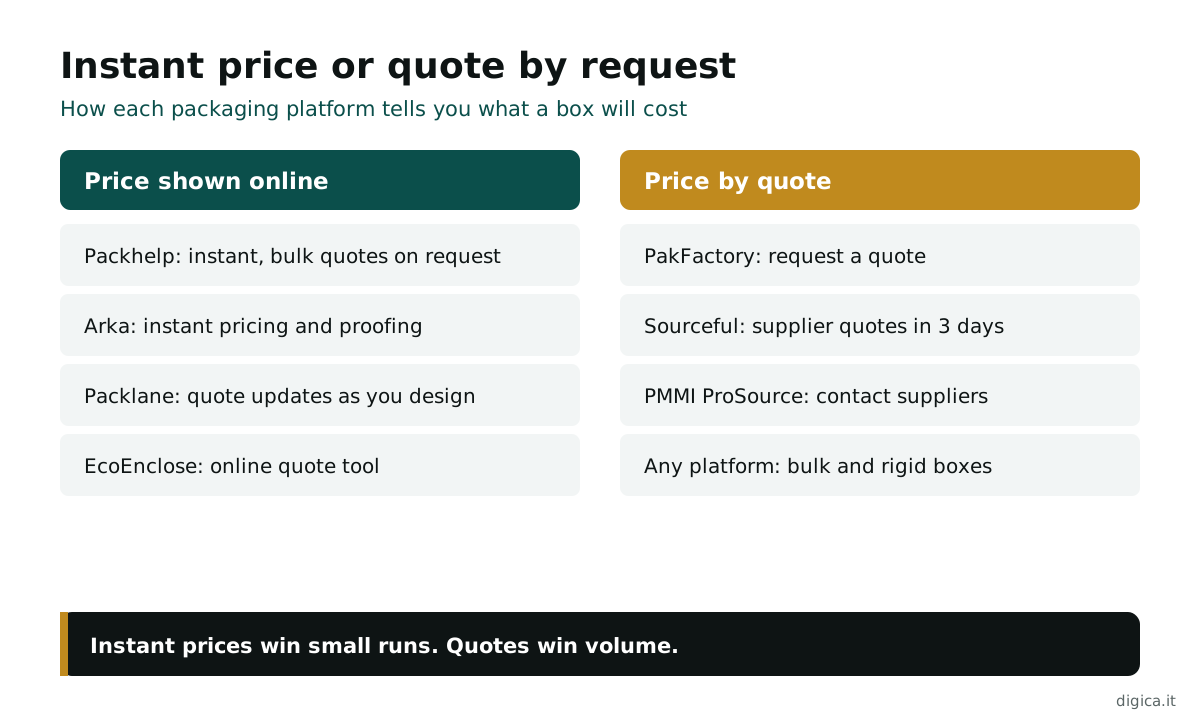
The third question changes how you should read the first two. Only two of our picks route orders across a network of suppliers. Packhelp works with a network of more than 200 suppliers in the EU, and Sourceful matches brands with pre-vetted manufacturers. Arka, Packlane and EcoEnclose are online configurators that sell their own packaging, PakFactory sources from certified manufacturers on quote, and PMMI ProSource is a directory. We kept them all because brands compare them directly when they search for a packaging marketplace.
The stakes are rising for anyone who ships in Europe. The EU generated 81.5 million tonnes of packaging waste in 2024, or 181.0 kg per person, and recycled 67.0 percent of it (Eurostat). Paper and cardboard made up the largest share. Regulators now want that figure to rise, which puts pressure on which materials brands choose and who can prove what a box is made of.
Our view: the minimum order is the number most brands look at first, and the least important over a year. The right platform is the one whose price still makes sense on your third reorder, not your first.
The seven awards at a glance
Arka takes the smallest production run, Packhelp the lowest minimum on a network of suppliers, and PakFactory the strongest case for large printed runs. Read the "Model" column first, because it tells you whether you are buying from one company or choosing between several.
Seven packaging marketplaces and platforms compared on model, smallest branded order, how they price, stated lead time, main risk and best fit
| Platform | Model | Smallest branded order | How it prices | Lead time, as stated | Main risk | Best for |
|---|---|---|---|---|---|---|
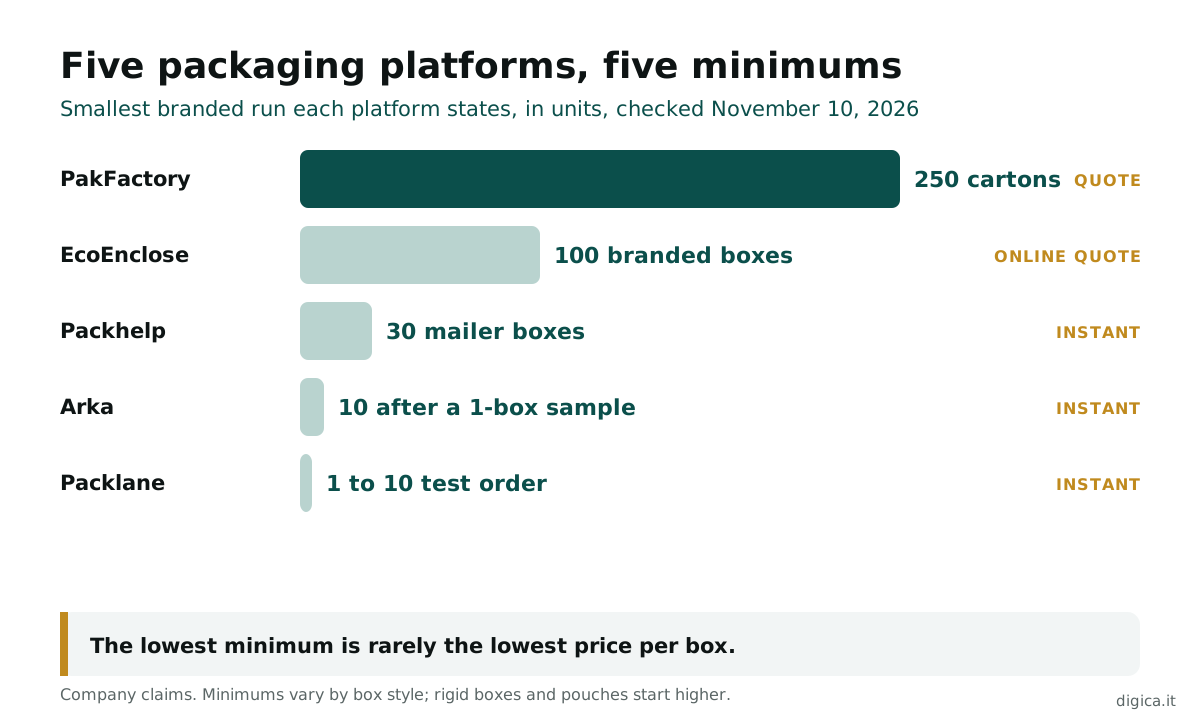
| Packhelp | Platform with 200+ EU suppliers | 30 mailer boxes, some models 1 | Instant online, bulk quotes | Express in as little as 72 hours | Minimum varies by model | Low minimums in Europe |
| Arka | Online configurator | 1 sample, then runs from 10 | Instant pricing and proofing | 7 to 10 business days, rush 3 to 5 | Shipping not included | The smallest production runs |
| Packlane | Online configurator | Test orders of 1 to 10 | Instant quote as you design | 7 to 15 business days | Price rises with options | A price before you design |
| EcoEnclose | US maker and seller | 100 branded boxes | Online quote, bulk quote at 1,000+ a week | Not stated on the box page | One maker's range | Sustainable shipping boxes |
| PakFactory | Quote-based, certified makers | 250 folding cartons, 500 rigid | Quote by request | 10 to 15 business days plus 5 to 7 shipping | No public prices | Printed boxes at volume |
| Sourceful | Supplier matching | Set by each supplier | Compare supplier quotes | Quotes in 3 days | Terms vary by supplier | Comparing manufacturer quotes |
| PMMI ProSource | Directory of member firms | Not applicable | You contact suppliers | Not applicable | Machinery-led | Finding packaging suppliers |
A "best for" award is not a ranking by size. Each platform earns its award for one job, and several would be a poor choice for another.
Best for low minimums in Europe: Packhelp
Packhelp wins on low minimums across a supplier network. Its mailer boxes start at 30 pieces per order, and some models, such as a mailer box with hot stamping, start at 1. The exact minimum appears on each product page, and Packhelp says the price per box drops as quantity grows.
It is the closest pick to a true packaging marketplace. Packhelp says it works with a network of more than 200 suppliers in the EU, and it also runs white-label packaging stores for B2B marketplaces whose own sellers need boxes. From its base in Warsaw, it reports more than 150 million units produced for more than 100,000 companies, with about 100 employees.
Speed is its second advantage. Its express service promises custom-size boxes from online design to delivery in as little as 72 hours, from runs of 30 units. Poly mailers have a higher minimum of 100 pieces.
Running a packaging B2B marketplace?
In 30 minutes we look at how brands find platforms like yours, on Google and in AI answers, and where they drop off between the configurator and the order.
Pick it when you sell in Europe and want to test a branded box before you commit to volume. Check the minimum on the exact model before you design, because it changes between products, and ask for a bulk quote once your reorders are predictable. Brands outside Europe should price shipping and duties before they compare it with a local supplier, because a low minimum is only useful if the boxes arrive when the product does.
Best for the smallest production runs: Arka
Arka has the lowest stated production minimum in this guide. Its FAQ says branded mailer and shipper boxes start with 1 sample box, then production runs from 10 up to 10,000,000 units. It credits the cost of the sample if you place a full order within 30 days.
Other minimums are higher. Branded poly mailers start at 100 units, unbranded mailer boxes at 50, and stock-size cartons at 25. Pricing and proofing are instant online, so you see a price as you configure the box.
Its timeline is stated clearly: standard production of 7 to 10 business days and rush production of 3 to 5, with shipping on top of both. For a brand launching at a trade show or testing a product drop, that is enough to plan around, as long as you add transit time to the date you work back from.
The trade-off is that you buy from one company. A run of 10 boxes is a way to test a design, not the cheapest way to pack a product, and the unit price on a tiny run will be several times what you pay at volume. Use it to prove the box, then compare quotes for the reorder.
Best for a price before you design: Packlane
Packlane wins because it shows a price on screen before you upload any artwork. Its homepage promises "tiny minimums" and an instant quote that updates as you design, so you can test sizes and quantities against a budget first.
On the default mailer box configuration we checked, the price shown was $3.40 a box for 250 boxes, or $850, with a notice that the setting was for unprinted boxes. Print, finishes and materials change the price, so treat that as a starting point rather than a benchmark. Its FAQ allows test orders of 1 to 10 custom mailers and shippers, while some premium print options have a 50-unit minimum.
Most custom orders take 7 to 15 business days to produce, rising with quantity, and a digital proof arrives within 24 hours of checkout. Packlane says more than 25,000 brands trust it, and it is based in Sherman Oaks, California.
Use it to set a budget before you brief a designer. Seeing the price move as you change size and quantity is the fastest way to learn where packaging cost actually comes from.
Best for sustainable shipping boxes: EcoEnclose
EcoEnclose wins on sustainable shipping boxes for brands that need to prove what their packaging is made of. It manufactures in the US and prints with soy or algae-based inks, from Louisville, Colorado.
Its minimums suit small brands. Custom sizing starts at 1 unit for unbranded boxes, and branding starts at 100 units. The company says manufacturing in the US lets it serve smaller runs than many overseas suppliers. Brands ordering more than 1,000 units a week are directed to a custom and bulk team for enterprise pricing, and free sample kits are available.
The regulatory direction favors this kind of supplier. The EU's Packaging and Packaging Waste Regulation has applied since August 12, 2026, and aims to make all packaging on the EU market recyclable in an economically viable way by 2030 (European Commission). US brands selling into Europe will increasingly need to show the recyclability of what they ship.
EcoEnclose says it has served more than 50,000 brands. The limit is range: it is one maker, focused on shipping packaging, so luxury retail boxes and complex inserts are better quoted elsewhere.
Best for printed boxes at volume: PakFactory
PakFactory wins for large printed runs, where the unit price matters more than the minimum. It sources from certified manufacturers and adds structural design, samples and prototyping, all priced by quote rather than online.
Its contact page states a minimum of 250 units for folding cartons and corrugated boxes, and 500 for rigid boxes. For the lowest price, it suggests around 1,000 paperboard boxes or 500 corrugated. A separate support article lists higher minimums for some products, so confirm the figure for your box when you ask for a quote.
The timeline is long for rigid boxes. PakFactory states 10 to 15 business days of production plus 5 to 7 of shipping for folding cartons and corrugated, and 25 to 30 business days of production plus 25 to 35 of shipping for rigid boxes. Custom samples take 5 to 7 days plus shipping. A rigid gift box can therefore take two to three months door to door.
It says more than 3,000 brands use it, and its sales office is in the Toronto area. Pick it when your volumes are steady and your packaging is part of the product, such as a rigid box for a premium launch.
Best for comparing manufacturer quotes: Sourceful
Sourceful wins for brands that want several manufacturer quotes without running the search themselves. Its supplier service promises quotes from pre-vetted packaging suppliers within 3 days, with lead times compared side by side and samples ordered in a few clicks.
It draws on a network of manufacturing partners across 4 continents, vetted to its own standard. Founded in 2020 to help brands build better supply chains, starting with branded packaging, Sourceful now also markets design tools for brands, so look for the supplier service specifically.
Minimums and prices depend on the supplier that quotes. That is the point: you are buying a comparison, not a fixed price list. For a brand moving from 500 to 5,000 units, a comparison of three or four manufacturers can be worth more than any instant quote.
The risk is that terms vary by supplier. Read each quote's minimum, payment terms and lead time separately, rather than assuming they match.
Best packaging suppliers directory: PMMI ProSource
PMMI ProSource is the strongest pick for a packaging suppliers directory. It is run by PMMI, the Association for Packaging and Processing Technologies, and showcases verified PMMI member solutions in streamlined categories covering machinery, materials and services.
It answers a different question from the platforms above. You do not order boxes there. You find the companies that make packaging, packaging machinery and the materials that go into them, then contact them directly. That makes it most useful for operations teams sizing a packing line or looking for a contract packager, rather than for a founder ordering a first run of mailers.
The limit is its focus. It leans toward machinery and processing, so a brand that only needs printed boxes will find faster answers on the platforms above. Compared with an old trade-press buyer's guide, though, it has the advantage of a curated, current member list.
Where packaging orders go wrong
These patterns recur when brands choose packaging by the first number they see. The examples and dollar figures are illustrative, not audited costs.
- The cheap unit price that tied up cash. A brand orders 5,000 boxes to get a low unit price, then changes its product size three months later. Most of the boxes are unusable. Ordering 500 at a higher unit price, and reordering once the design settled, would have cost more per box and saved several thousand dollars in write-offs.
- The lead time that left out shipping. A team plans a launch around a 7-business-day production time and forgets transit. The boxes arrive after the launch date, and products ship in plain cartons. Counting production, shipping and proofing together would have shown the gap.
- The recyclability claim nobody could prove. A US brand selling into the EU prints "recyclable" on its boxes without supplier documentation. A retail partner asks for evidence under the new EU rules and pauses the listing. Choosing a supplier that documents materials and inks, at a small premium, would have avoided the delay.
Do brands find your packaging platform before they find a competitor's?
A growth audit maps how brands search for custom packaging, on Google and in AI answers, and which box, material and industry pages you are missing.
The common thread is that each team optimized one number, the minimum, the unit price or the production time, and ignored the others. A one-page brief that states quantity, door-to-door date and material proof before anyone asks for a quote prevents all three, and takes less time than one round of corrections. Share the same brief with every platform you ask, so the quotes you get back answer the same question and can be compared line by line.
Choosing a packaging marketplace by order size
Start from how many boxes you need in the next 90 days, then the date you need them, then the proof your customers or retailers will ask for.
- If you need fewer than 30 branded boxes to test a design, use Arka's sample and 10-unit runs, or a Packlane test order.
- If you sell in Europe and need 30 to 500 boxes, start with Packhelp, and check the minimum on the exact model.
- If you want a budget before you brief a designer, price the box on Packlane first.
- If your customers or retailers ask for recycled content and recyclability, use EcoEnclose for shipping boxes, and keep its documentation on file.
- If you need more than 1,000 printed boxes on a steady schedule, ask PakFactory to quote, and allow up to three months for rigid boxes.
- If you are moving from 500 to 5,000 units and want competing quotes, brief Sourceful and compare at least three manufacturers.
- If you need machinery, materials or a contract packager rather than boxes, search PMMI ProSource.
Most brands will move between these platforms as they grow, and that is normal. A typical path runs from a sample and a short run on a configurator, to a few hundred boxes from a supplier network, to quoted runs of thousands from a manufacturer. The mistake is staying on the first platform out of habit after the order size has changed. Review your packaging supplier whenever your quarterly volume doubles, and ask for a fresh quote at the new quantity before you reorder.
Ecommerce keeps this choice growing in importance. Smithers values the global e-commerce packaging market at $78.4 billion in 2025, up 7.8 percent in a year, and forecasts $105.2 billion by 2031 (Smithers). More shipped orders mean more brands buying boxes, and more pressure to get the minimum and the price right together.
Growing a packaging B2B marketplace?
We help packaging B2B marketplaces win the suppliers that make them credible, and reach the brands searching for custom packaging.
The number to take into your next planning meeting is your packaging cost per order across a year, not per box on the first run. Run an illustrative case: a brand shipping 6,000 orders a year that pays $3.40 a box on 250-unit runs spends $20,400 on boxes. If a volume quote brought that to $1.50 a box at 1,000-unit runs, the saving would be $11,400 a year, against the cash tied up in stock. The prices are illustrative, so ask for your own quotes. The biggest cost of doing nothing is paying small-run prices for years after your volumes stopped being small.
FAQ
What is a packaging marketplace? A packaging marketplace is an online platform where brands order custom packaging from a network of manufacturers, or compare quotes from several. Packhelp and Sourceful are the closest examples here. Many sites called marketplaces are single companies selling their own boxes.
What is the lowest minimum order for custom boxes? Among the platforms in this guide, Arka states production runs from 10 units after a 1-box sample, and Packlane allows test orders of 1 to 10 boxes. Packhelp starts at 30 mailer boxes on most models, and some models start at 1.
How much do custom printed boxes cost? It depends on size, print and quantity. On Packlane, the default mailer box configuration we checked showed $3.40 a box for 250 unprinted boxes. Unit prices usually fall sharply as quantity rises, so compare quotes at your real annual volume.
What is the best packaging suppliers directory? PMMI ProSource, run by the packaging and processing trade association PMMI, lists verified member companies across machinery, materials and services. It suits operations teams more than brands ordering printed boxes.
How long does custom packaging take? Stated production times run from 3 to 5 business days for Arka's rush service to 25 to 30 business days for PakFactory's rigid boxes, before shipping. Packhelp's express service promises delivery in as little as 72 hours.
Does the EU packaging regulation affect US brands? Yes, if they sell into the EU. The Packaging and Packaging Waste Regulation has applied since August 12, 2026, and aims to make all packaging on the EU market recyclable by 2030. Ask suppliers for documentation on materials and recyclability.
Related Articles
- Packaging marketplace growth
- Best wholesale marketplaces for retailers in 2026
- Best manufacturing marketplaces for custom parts
- Best supplier databases and directories for B2B in 2026
- Best industrial marketplaces for MRO buying in 2026
Where this connects
This article is part of our B2B marketplace growth series. Browse more on the Digica blog.