The best industrial marketplaces for MRO buying, compared head to head on catalog breadth
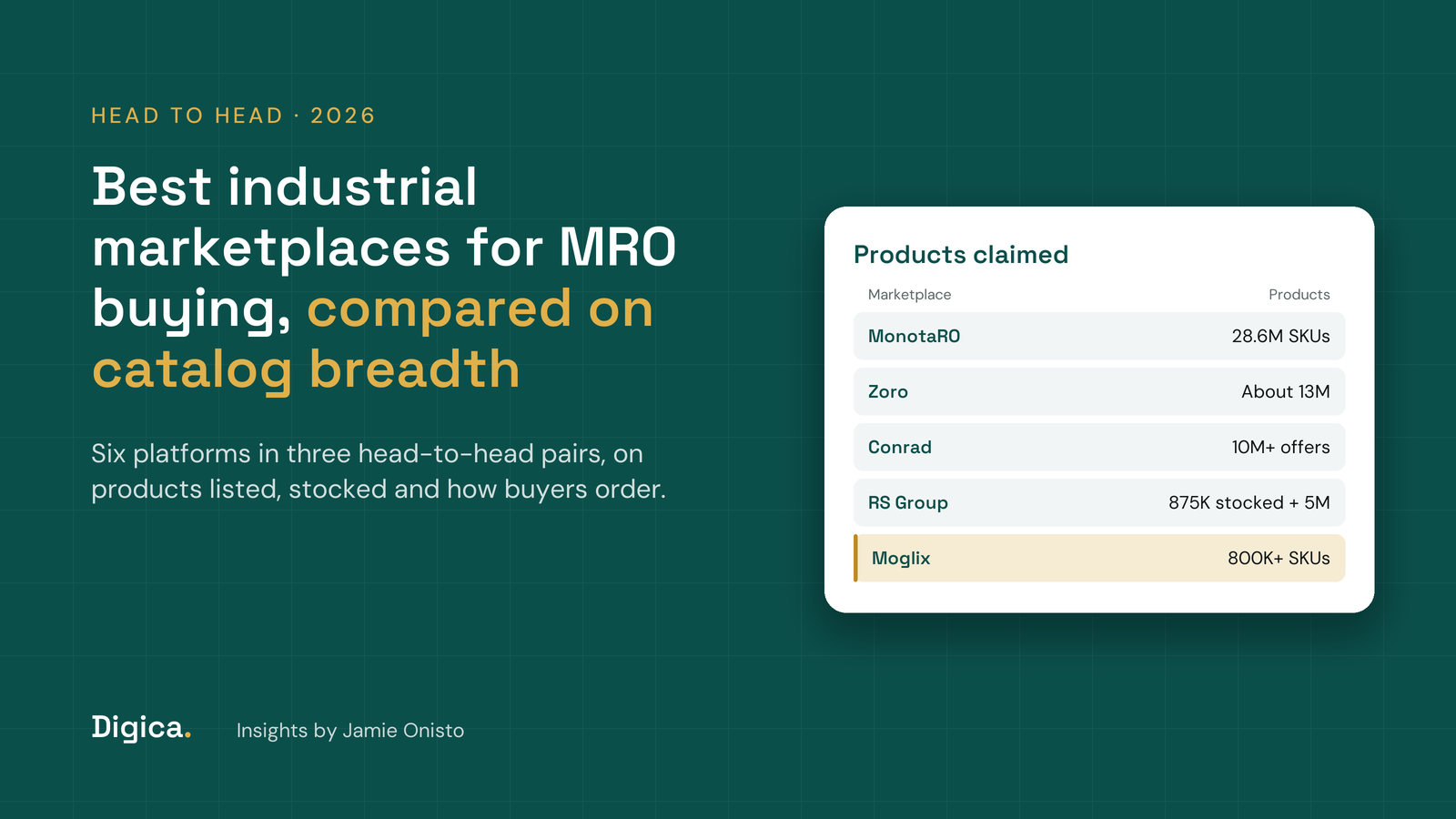
An industrial marketplace is judged on one question by every maintenance planner who uses it: is the part I need there? Catalog breadth is how the big platforms answer. MonotaRO says it carries 28.6 million SKUs. Zoro carries about 13 million products. Global Industrial carries hundreds of thousands. Those numbers are not exaggerations of the same thing. They describe different ways of running maintenance, repair and operations (MRO) supply, and a buyer who picks on the biggest number alone can end up waiting on a part that was listed but never stocked.
The channel is already mainstream. The US Census Bureau says machinery, equipment and supplies merchant wholesalers, the group that includes industrial supply distributors, made 29.8% of their $765.7 billion of 2024 sales through e-commerce (US Census Bureau). Nearly a third of that spend now starts on a screen, and the industrial marketplace that answers "is it there?" fastest wins the order.
This guide compares six industrial marketplaces for MRO buying head to head on catalog breadth: how many products each lists, how many it stocks, which categories it covers and how buyers order. It is written for maintenance, procurement and operations leads choosing where to buy, and for founders growing an industrial B2B marketplace. Figures are each company's own, checked on November 2, 2026. For used machinery, see our guide to surplus and used industrial equipment marketplaces.
Quick Navigation
- What makes an industrial marketplace useful for MRO
- Six industrial marketplaces, scored side by side
- Zoro against Global Industrial: breadth or procurement fit in the US
- RS Group against Conrad: stocked depth or marketplace reach in Europe
- MonotaRO against Moglix: the biggest catalogs in Asia
- Catalog breadth: listed, stocked and shipped today
- Punchout, accounts and one invoice: how MRO buyers order
- Three failure scenarios
- Choosing an industrial marketplace: a decision framework
- What catalog breadth is worth
- FAQ
- Related Articles
What makes an industrial marketplace useful for MRO
The short answer: an industrial marketplace is useful for MRO when it carries the long tail of parts a site needs, shows which of them are in stock, and fits the way the buyer's company already purchases. Breadth without stock or a purchasing route is a catalog, not a supply.
MRO buying is unusual. A plant may spend most of its MRO budget on a few hundred repeat items, then lose a day of output waiting for one bearing, seal or relay it orders once a year. That one-off part is why breadth matters. A platform with millions of SKUs gives the planner a good chance of finding it in one search, without a call to a specialist distributor.
The six platforms in this guide get to breadth in different ways. Some stock a large range themselves and sell it under one price list. Some add third-party sellers or drop-ship suppliers on top of their own stock. Some run an open B2B marketplace with many sellers behind one invoice. All six are B2B marketplaces or catalogs that behave like one, and the tests we use for every B2B marketplace apply: how much supply, how reliable it is and how well buyers are matched to it.
Our view: count stocked items before listed items. A listed SKU is a promise. A stocked SKU is a shipment.
Six industrial marketplaces, scored side by side
The short answer: MonotaRO has the broadest catalog, Zoro the broadest in the United States, Conrad the widest open marketplace of the European pair, RS Group the deepest stocked range across many countries, Global Industrial the strongest procurement connections for bulky equipment, and Moglix the widest reach across India, the Middle East and West Africa.
Six industrial marketplaces compared on products claimed, stock signal, region, how buyers order, main risk and best fit
| Marketplace | Products claimed | Stock signal | Region | How buyers order | Main risk | Best for |
|---|---|---|---|---|---|---|
| MonotaRO | 28.6M SKUs | 744K items ship same day | Japan | Web, One Source for large firms | Japan only | Japanese plants buying long-tail parts |
| Zoro | About 13M products | Third-party held items included | United States | Web account, Net 30 terms | Less technical support | US small and mid-size firms |
| Conrad | 10M+ product offers | Many sellers, one invoice | Europe | Web, OCI punchout, Smart Procure | No published seller count | European SMEs and engineering teams |
| RS Group | 875K stocked, 5M more listed | 875K stocked items | 33 markets | Web, eProcurement | Web revenue fell 6% | Engineering and maintenance teams |
| Global Industrial | Hundreds of thousands, plus drop ship | Own distribution centers | US and Canada | Web, punchout, EDI | Narrower range | Facilities buying storage and handling |
| Moglix | 800K+ SKUs, 1,500+ categories | Delivery to 20,000+ pincodes | India, Middle East, West Africa | Web, RFQ, enterprise sourcing | Still loss-making | Indian plants and enterprises |
Every figure is the company's own claim. The column to read first is "Stock signal", because it separates what a platform holds from what it can find for you.
Zoro against Global Industrial: breadth or procurement fit in the US
The short answer: Zoro wins on breadth, with about 13 million products against hundreds of thousands. Global Industrial wins on procurement connections and stocked heavy equipment. The choice depends on whether you buy by search or through a purchasing system.
Zoro
Zoro is the online, broad-catalog business of Grainger, based in Chicago. Grainger's 2025 annual report puts Zoro's range at about 13 million products, and says its endless assortment businesses keep expanding the offer of third-party held products, which is the marketplace side of the model. Zoro's own site lists 27 top-level categories, from abrasives and fasteners to pumps, test instruments and welding, with free shipping on orders over $50 for signed-in customers and Net 30 terms.
Running an industrial or MRO B2B marketplace?
In 30 minutes we look at how maintenance and procurement buyers find platforms like yours, on Google and in AI answers, and where they drop off before they order.
Grainger closed Zoro's UK business in the fourth quarter of 2025, so Zoro is now effectively a US platform. Grainger also describes the customers it serves through these businesses as having straightforward needs, which is a fair warning: expect a search box and a checkout, not an account manager or on-site inventory service.
Global Industrial
Global Industrial, based in Port Washington, New York, says it offers hundreds of thousands of brand-name and private-brand products, plus access to many more long-tail items from vendor partners through drop ship. Its own brands include Nexel, Paramount and Interion. It reported 2025 sales of $1.38 billion, up 4.8%, and runs five primary US distribution centers plus a large one in Canada.
Its strength is the purchasing route. Global Industrial says e-orders, including EDI, cXML, punchout and integrations with Ariba and Coupa, were more than 60% of transactions in its core US business in 2025. For a facilities team buying shelving, carts, lockers or janitorial supplies through a procurement system, that matters more than another 10 million SKUs.
The verdict. A small or mid-size US firm that buys by search and card should start with Zoro. A US facilities or public sector buyer that orders through Ariba, Coupa or EDI, and buys bulky equipment, should start with Global Industrial.
RS Group against Conrad: stocked depth or marketplace reach in Europe
The short answer: Conrad wins on raw breadth, with more than 10 million product offers behind one invoice. RS Group wins on stocked depth and international reach, with 875,000 products held across 33 markets.
RS Group
RS Group, based in London, says it operates in 33 markets and stocks more than 875,000 industrial and specialist products, with an additional 5 million listed from more than 2,500 suppliers. Digital channels make up 60% of group revenue, and its eProcurement business grew 9% like for like in the year to March 2026. Facilities and maintenance, and mechanical and fluid power, were among its strongest categories.
The caveat is in the same results. RS Group's web revenue fell 6% like for like, partly because it decommissioned certain products while integrating Distrelec in German-speaking markets, and some customers left. Catalog breadth is not only built. It can also be lost during a migration.
Conrad
Conrad, a family-owned company in Hirschau, Germany, runs the Conrad Sourcing Platform, which it says carries more than 10 million product offers. Business customers buy the whole range from Conrad as a single invoicing party, so they do not need to set up each seller as a new supplier. Conrad says 80% of its revenue now comes from business customers.
For an engineering team, the single invoice is the point. A long-tail part from a small specialist seller arrives on the same account as a stocked cable. The trade-off is transparency: Conrad does not publish how many sellers sit behind the 10 million offers, and older pages quote lower totals.
The verdict. A European maintenance team that wants the widest range with one supplier record should use Conrad. A team that wants stocked parts across many countries, with an eProcurement connection, should use RS Group.
MonotaRO against Moglix: the biggest catalogs in Asia
The short answer: MonotaRO has the broadest catalog in this guide, with 28.6 million SKUs in Japan. Moglix is smaller, with more than 800,000 SKUs, but covers India, the Middle East and West Africa with enterprise sourcing.
MonotaRO
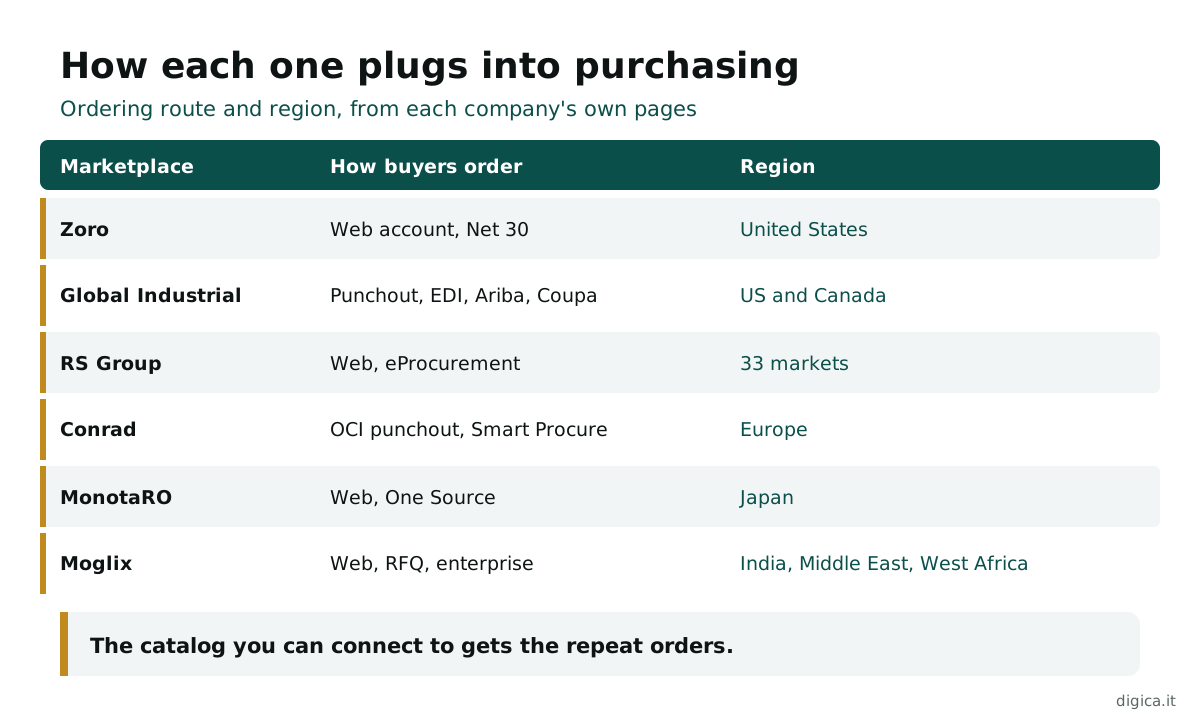
MonotaRO, based in Osaka and majority-owned by Grainger, says it carries 28.6 million product SKUs and serves more than 11.8 million customers. Of the items it sells, about 744,000 are available for same-day shipment, and about 684,000 of those are held in its own inventory. It sells at one web price to every customer, and offers a procurement system called MonotaRO One Source to large corporations.
That gap between 28.6 million listed and 744,000 shipped the same day is the clearest picture of catalog breadth in this guide. About 97% of the range is long tail, available but not on the shelf. For a Japanese plant, that is still valuable: one account covers the routine and the rare. The limit is geography, since MonotaRO serves Japan in Japanese.
Moglix
Moglix operates from Noida, India, and says it offers more than 800,000 SKUs across more than 1,500 categories, with delivery to more than 20,000 pincodes in India. It also operates in the Middle East and West Africa, and says gross profit rose 16.3% in its 2026 financial year. Buyers can order on the web with tax invoices, request quotes for bulk orders or use its enterprise procurement service.
Moglix is growing, but it reported a net loss of $11.3 million on $681.5 million of operating revenue in its 2025 financial year, and it is preparing for a possible listing. For a buyer that means a capable platform still investing ahead of profit.
The verdict. A Japanese manufacturer should use MonotaRO for breadth. An Indian plant or an enterprise buying indirect supplies across India and nearby regions should use Moglix.
Catalog breadth: listed, stocked and shipped today
The short answer: industrial marketplaces count breadth in three layers. Listed products are anything a buyer can find. Stocked products are held in the platform's own warehouses. Same-day products can leave today. Most platforms publish only the first.
MonotaRO is the rare platform that publishes all three, and its numbers show the shape of the whole category: 28.6 million listed, about 684,000 in inventory and 744,000 ready to ship the same day. RS Group publishes two layers, 875,000 stocked and 5 million more listed. Zoro, Conrad and Moglix publish the listed layer. Global Industrial publishes a smaller stocked range and points to drop ship for the rest.
The broad-catalog model is also the one growing fastest. Grainger says sales in its endless assortment segment, Zoro and MonotaRO, grew 20.6% in the second quarter of 2026 on a daily organic constant currency basis, against 11.7% for its high-touch North American business (Grainger). Buyers are rewarding breadth. They will reward it more when platforms show which part of it is on the shelf.
Do maintenance buyers find your industrial marketplace before a rival's?
A growth audit maps how MRO buyers search for platforms like yours, on Google and in AI answers, and which of your category, brand and part pages they never reach.
The practical test for a buyer is simple. Search for the ten parts that stopped a line last year. Count how many each platform lists, how many it shows as in stock and how many it can deliver within your downtime window. That score tells you more than any headline SKU count. Run it once a year, and again before any contract renewal, because catalogs change: platforms add sellers, drop slow lines and move items between stocked and listed without announcing it.
Punchout, accounts and one invoice: how MRO buyers order
The short answer: the right industrial marketplace is the one your purchasing process can actually use. A plant on Ariba or Coupa needs punchout or EDI. A small workshop needs a web account and payment terms. A team buying from many sellers needs one invoice.
Punchout lets a buyer browse a supplier's catalog from inside their own procurement system and bring the basket back for approval. Global Industrial, RS Group and Conrad all offer system connections, and Conrad adds a free browser tool, Conrad Smart Procure, for smaller firms without a purchasing system. MonotaRO offers its own procurement system for large corporations. Zoro is built around a web account with Net 30 terms.
Each route changes what breadth is worth. A 13 million product catalog that a procurement team cannot connect to its approval workflow will be used for emergencies only. A narrower catalog that sits inside the purchasing system gets the repeat orders. Our guide to procurement marketplaces for B2B buyers covers the buyer controls in more detail.
For operators, this is where growth often stalls. Buyers find a platform through search, like what they see, then discover it does not connect to their system. Publishing integration options clearly on category and product pages saves a sales call and keeps the order.
Three failure scenarios
These are the patterns that recur when buyers choose an industrial marketplace on headline catalog size.
- The listed part that was never stocked. A packaging plant orders a replacement gearbox from the platform with the biggest catalog because it appeared in the first search. The item was a long-tail listing with a three-week lead time, and the line runs at half speed for a fortnight. Filtering for stocked or same-day items first, and paying more from a stocking supplier, would have cost less than the lost output.
- The catalog nobody could order from. A manufacturer's maintenance team picks a broad-catalog platform, but procurement only approves orders that arrive through its procurement system. Engineers keep buying on personal cards and claiming expenses, and spend data never reaches the purchasing team. Choosing a platform with a punchout connection, even with a smaller range, would have kept the spend visible.
- The supplier setup that ate the saving. A European engineering firm buys from 15 small specialist sellers to save on unit prices, setting each one up as a new supplier. Supplier onboarding, invoices and payments cost more in admin time than the price difference. A marketplace with one invoicing party would have kept the range and removed most of the admin.
Each team used a real industrial marketplace. None matched the platform's stock and ordering model to how the part was needed.
Choosing an industrial marketplace: a decision framework
The short answer: start from where you are, how you order and how fast the part must arrive, then pick the industrial marketplace that matches.
- If you are a US small or mid-size firm buying by search with a card or Net 30, start with Zoro for breadth.
- If you are a US facilities, warehouse or public sector buyer ordering through Ariba, Coupa or EDI, start with Global Industrial.
- If you are in Europe and want the widest range with one supplier record, use Conrad, through OCI punchout or Conrad Smart Procure.
- If you need stocked electronics, automation and maintenance parts across several countries, use RS Group and connect it to your eProcurement system.
- If you run a plant in Japan, use MonotaRO, and filter for same-day items when downtime is at stake.
- If you buy indirect supplies across India, the Middle East or West Africa, use Moglix, with quotes for bulk orders.
- If a part stops a line for more than one shift, buy from whichever platform shows it in stock, not from the cheapest listing.
Digital buying is still growing in Europe too. Eurostat says enterprises in the EU with ten or more employees made 19.49% of their turnover from e-commerce in 2025, up from 19.13% in 2024 (Eurostat). The platforms that win that growth will be the ones buyers can connect to, not only the ones with the most listings.
Growing an industrial or MRO B2B marketplace?
We help industrial B2B marketplaces recruit the sellers and brands that fill the long tail, and reach the maintenance and procurement buyers comparing them.
Review the choice once a year against your own downtime log. The platform that saved you on the parts you buy every week may not be the one that saves you when the rare part fails, and most plants end up using two. One account for routine, repeat items, connected to the purchasing system, and one broad-catalog account for the rare part that stops a line, is a simple split that most procurement teams can approve in a single review.
What catalog breadth is worth
The short answer: catalog breadth is worth the downtime it prevents. A broad, well-stocked industrial marketplace turns a day of searching and waiting into a single order.
Run the numbers on a typical case. Suppose a production line earns a contribution of $5,000 an hour, and a missing part stops it for eight hours twice a year. That is $80,000 of lost contribution a year. If a platform that shows stock and ships the same day halves the wait, the saving is $40,000 a year, often from one account a team already has. The figures are illustrative, but the logic holds for most plants: the cost of downtime is far larger than any price difference on the part.
The number to take into your next maintenance review is hours of downtime spent waiting for parts, not the unit price of those parts. If your team cannot answer it, start logging it this quarter. The biggest cost of doing nothing is a line stopped for a part that was listed everywhere and stocked nowhere.
FAQ
What is an industrial marketplace? An industrial marketplace is an online platform where businesses buy industrial supplies and MRO parts, either from the platform's own stock, from third-party sellers or from both. Examples include Zoro, RS Group, Conrad, MonotaRO and Moglix.
Which industrial marketplace has the largest catalog? In this guide, MonotaRO reports the largest, with 28.6 million SKUs in Japan. In the United States, Zoro carries about 13 million products, and in Europe, Conrad says its sourcing platform offers more than 10 million products.
What does MRO mean in industrial buying? MRO stands for maintenance, repair and operations. It covers the supplies a business uses to keep sites and equipment running, such as bearings, fasteners, tools, safety equipment, electrical parts and cleaning supplies, rather than the materials that go into its products.
Do industrial marketplaces support punchout? Several do. Global Industrial, RS Group and Conrad offer connections to procurement systems, including punchout, and MonotaRO offers its own procurement system for large firms. Check the specific connection your system needs, such as OCI, cXML or EDI.
Is Zoro the same company as Grainger? Zoro is owned by Grainger and runs as its online, broad-catalog business in the United States. MonotaRO in Japan is also majority-owned by Grainger. Both sit in Grainger's endless assortment segment.
How should a business compare industrial marketplaces? Compare how many products each lists, how many it stocks, how fast it ships, how it connects to your purchasing system and which regions it serves. Test with the parts that caused downtime last year rather than with routine items.
Related Articles
- Industrial marketplace growth
- Best procurement marketplaces for B2B buyers in 2026
- Best surplus and used industrial equipment marketplaces
- Best manufacturing directories: Thomasnet alternatives
- Liquidity is the only marketplace metric that compounds
Where this connects
This article is part of our B2B marketplace growth series. Browse more on the Digica blog.