The best supplier databases and directories for B2B procurement in 2026, compared on supplier count and data quality
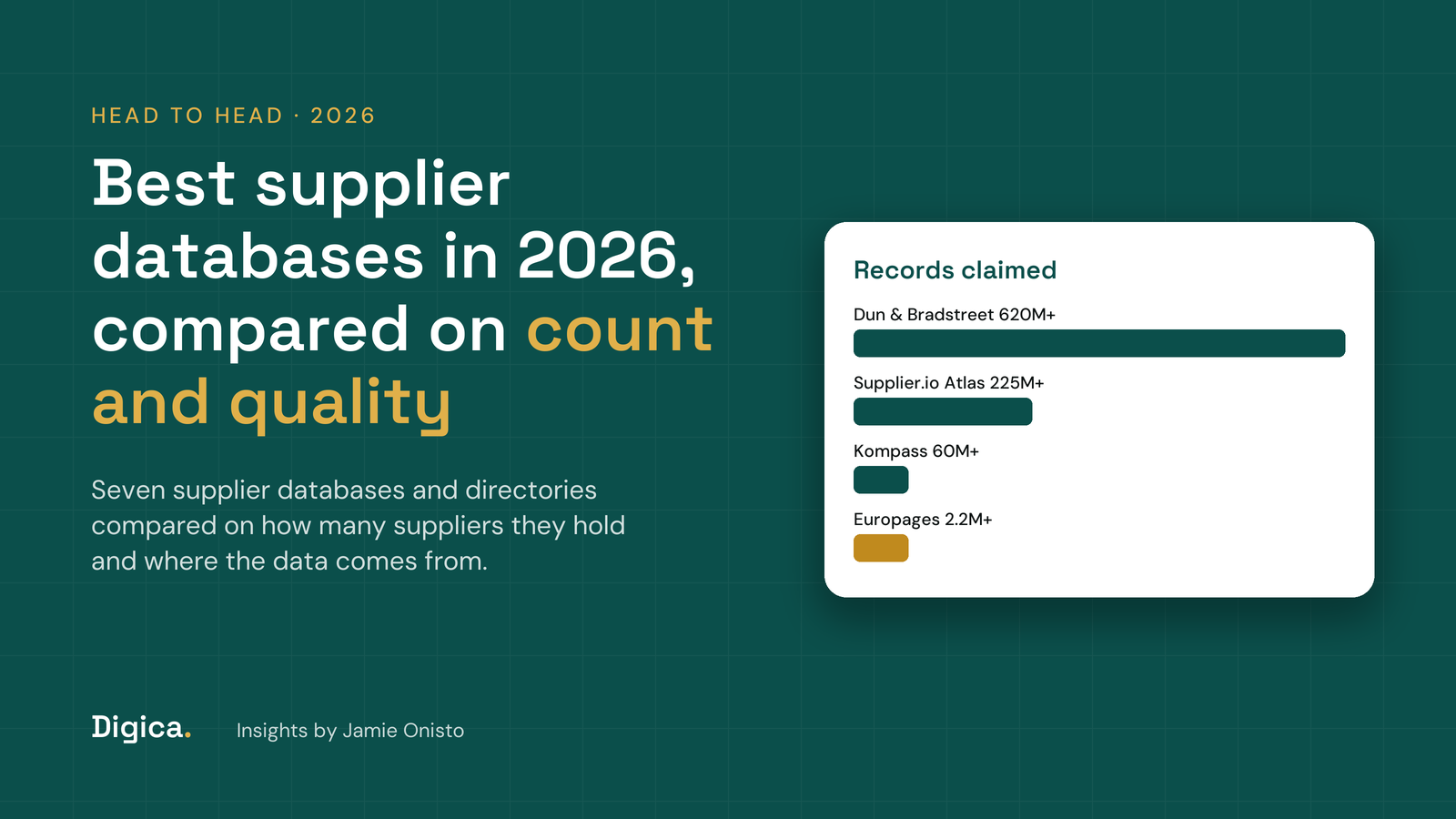
A supplier database is a searchable record of companies that sell to other businesses, used by procurement teams to find, compare and check suppliers. The biggest claim more than 600 million records. The best known industrial directory in North America lists about 500,000. Both are called supplier databases, and both can be the right answer, because the number of records tells you almost nothing about whether the record you need is accurate.
Data quality is where sourcing projects succeed or fail. A self-listed directory profile is only as current as the last time the supplier logged in. A compiled database can cover every registered company and still miss what a supplier actually makes. The Deloitte 2025 Global Chief Procurement Officer Survey found that procurement leaders rate maintaining active alternative sources (74%) and enhancing supplier information sharing (61%) among the most effective ways to manage risk. Both depend on supplier data you can trust.
This guide compares seven of the biggest supplier databases and directories head to head, on how many suppliers each claims and where its data comes from. Counts come from each company's own pages, checked on October 19, 2026. It is the same supply-side lens we use when we help procurement marketplaces grow the supplier side of their network.
Quick Navigation
- Seven supplier databases, head to head
- Where supplier data comes from
- Thomasnet against Europages and wer liefert was
- Kompass against Dun & Bradstreet
- SAP Business Network Discovery against Supplier.io
- Supplier directory, vendor directory or tender directory?
- Three failure scenarios
- Which supplier database fits which job
- What better supplier data is worth
- FAQ
- Related Articles
Seven supplier databases, head to head
The short answer: Dun & Bradstreet has the most records, Supplier.io has the most verified supplier attributes, Kompass has the broadest international company directory, Europages and wer liefert was lead in Europe, Thomasnet leads in North American industrial sourcing, and SAP Business Network Discovery suits buyers already on SAP.
Seven supplier databases and directories compared on supplier count, data source, coverage, cost to suppliers, main risk and fit
| Database | Suppliers it claims | Where the data comes from | Coverage | Cost for suppliers | Main risk | Best for |
|---|---|---|---|---|---|---|
| Thomasnet | 500,000+ | Supplier-claimed profiles | North America, industrial | Free listing, paid ads | Profiles only as current as the supplier | US industrial sourcing |
| Europages | 2.2M+ | Self-listed, with paid premium profiles | Europe, 111 sectors | Free listing, paid premium | Uneven profile depth | Cross-border European sourcing |
| wer liefert was | 600,000 | Self-listed, with paid premium profiles | Germany, Austria, Switzerland | Free listing, paid premium | Narrow geography | Sourcing in German-speaking markets |
| Kompass | 60M+ companies | Company self-reporting plus research | 70 countries | Free listing, paid data | Records can be thin | Building international longlists |
| Dun & Bradstreet | 620M+ businesses | Compiled business records | Global | Not applicable | Says little about capabilities | Supplier risk and financial checks |
| SAP Business Network Discovery | Millions, 190+ countries | Suppliers on SAP's network | 20,000+ categories | Free to join | Best inside SAP buying | SAP-based buying teams |
| Supplier.io (with TealBook) | 20M+ suppliers | Verified registries and certifications | Global, diversity data | Not applicable | Enterprise pricing | Supplier master data and diversity |
Read the "where the data comes from" column before the count. A database ten times bigger is not ten times more useful if its records are older or thinner than the one you need.
Where supplier data comes from
The short answer: from suppliers themselves, from compilers, or from a network the supplier transacts on. Each source fails in a different way.
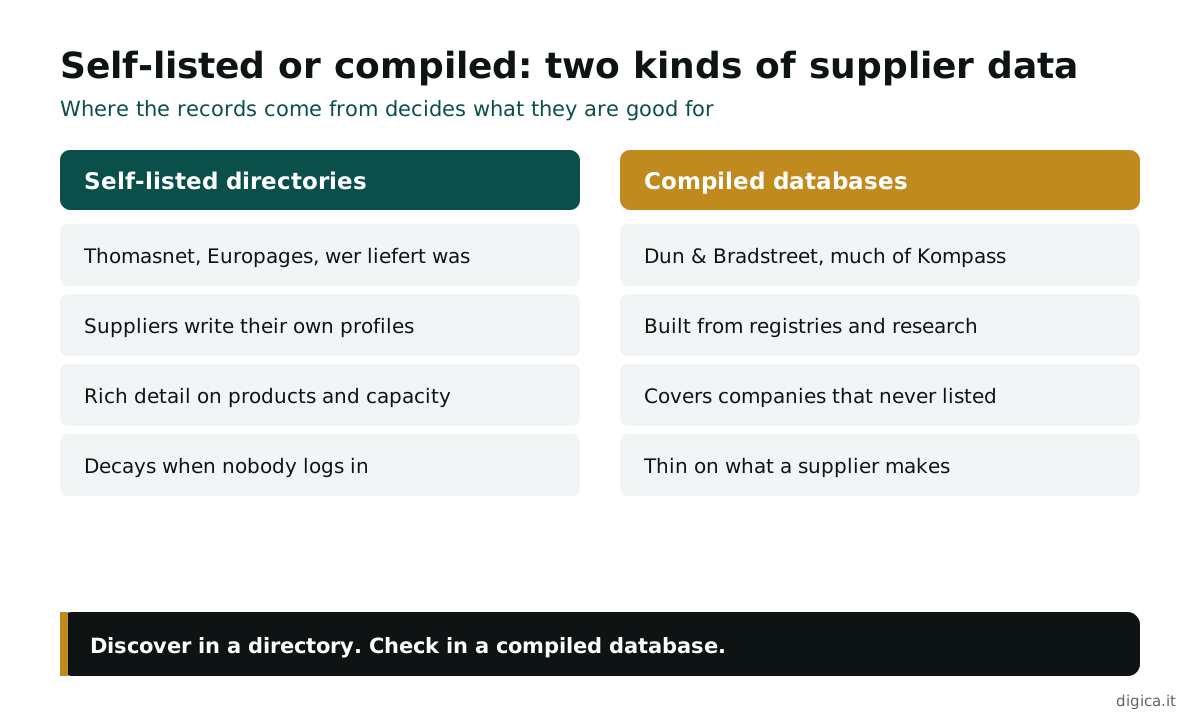
Self-listed directories, such as Thomasnet, Europages and wer liefert was, ask suppliers to create and maintain their own profiles. The upside is detail: a supplier that wants buyers will describe its products, certifications and capacity. The downside is decay. A profile that nobody has touched in three years still looks live, and the directory cannot know that the company stopped making the part you need.
Compiled databases, such as Dun & Bradstreet and much of Kompass, build records from registries, filings and research. They cover far more companies, including those that never asked to be listed. They are strong on who a company is, where it is registered and whether it is financially sound. They are weak on what it actually makes.
Network data, such as SAP Business Network Discovery, comes from suppliers who trade on a procurement network. It is current because suppliers use it to get paid and keep their details up to date, but it only covers suppliers already on that network.
Running a supplier directory or procurement marketplace?
In 30 minutes we look at how buyers in your category search for suppliers, and why the right suppliers are not joining you first.
Verified supplier-data platforms, such as Supplier.io, combine all three and add checks against legal registries and certification bodies. They are built for supplier master data: the clean list of vendors a large company already pays, enriched with diversity, risk and ownership data.
Ask any provider three questions before you buy. How was this record created? When was it last confirmed, and by whom? What happens when a supplier closes or changes its name? A provider that cannot answer all three for a sample of records is selling a count, not a database.
The practical rule we see work is to use a directory to discover, a compiled database to check, and a supplier-data platform to keep the vendor master clean. One tool rarely does all three well.
Thomasnet against Europages and wer liefert was
These three are the classic B2B supplier directories: suppliers list themselves, buyers search for free, and suppliers pay for more visibility. The difference is geography.
Thomasnet
Thomasnet, owned by Xometry since 2021, describes in-depth profiles of more than 500,000 North American suppliers. Its 2025 sourcing activity report, published in January 2026, counted more than 80,000 product and service categories and more than 1.5 million sourcing sessions a month. Two thirds of its active buyers were small and midsize businesses, and chemicals were the most sourced category.
Suppliers can claim a free listing and pay for advertising. In January 2026, Thomas launched a new search tool it says produces over 15% more supplier evaluations than its old search, along with performance-based listings and a filter for bot traffic.
Europages and wer liefert was
Europages and wer liefert was (wlw) are both run by Visable and still operate as separate sites in 2026. Europages says 1 million buyers use its database of more than 2.2 million suppliers, across 111 industry sectors and 670,000 products. wlw focuses on Germany, Austria and Switzerland, with 600,000 B2B suppliers, 400,000 buyers a month and 750,000 products; Visable says it handles more than 75,000 enquiries a month. Both carry a quality seal from BME, the German association for supply chain management and procurement.
Listing is free on both, with paid premium profiles. Europages has added a request hub where suppliers can browse buyer requests rather than wait to be found.
Head to head: Thomasnet wins for North American industrial parts and services. Europages wins for cross-border European sourcing. wlw wins inside the German-speaking market, where its buyer traffic is concentrated.
Kompass against Dun & Bradstreet
These two are the biggest company databases here. They matter less for discovering a specialist supplier and more for building a longlist or checking a supplier you have already found.
Kompass
Kompass lists more than 60 million companies across 70 countries. Much of its data starts with companies reporting their own details, which Kompass supplements with research, and it sells company lists and data products on top of its free directory. That makes it useful for a broad international longlist: every manufacturer of a product type in a region, for example. Records for smaller companies can be thin, so expect to verify contacts and capabilities before you send a request for quotation.
Dun & Bradstreet
Dun & Bradstreet says it gives access to information on more than 620 million businesses worldwide. Its supplier data is built for risk: a supplier evaluation risk rating, a failure score and ultimate beneficial ownership data. In August 2025, Clearlake Capital completed its acquisition of the company, taking it private at an enterprise value of about $7.7 billion.
Do the right suppliers find your B2B marketplace?
A growth audit maps how suppliers and buyers in your category search, on Google and in AI answers, and which pages they never reach.
D&B will tell you whether a supplier is financially sound and who owns it. It will not tell you whether it can machine a part to your tolerance. Use it as the second step, after discovery. Once a shortlist exists, a risk report on each finalist costs little next to the cost of a supplier that fails halfway through a contract. That is where a compiled database earns its fee: not in finding suppliers, but in ruling out the ones that would have become a problem a year later.
Head to head: Kompass wins for an international longlist of suppliers by product and region. Dun & Bradstreet wins for financial and ownership checks on suppliers you already plan to use.
SAP Business Network Discovery against Supplier.io
These two sit inside the procurement stack rather than on the open web. They suit larger buying teams more than a one-off search.
SAP Business Network Discovery
SAP Business Network Discovery, formerly Ariba Discovery, describes a global network of millions of suppliers from more than 190 countries, organized in more than 20,000 UNSPSC (United Nations Standard Products and Services Code) categories. Buyers post sourcing needs, and suppliers on the network respond. Suppliers can join for free.
Its strength is that the data is live: suppliers keep their details current because they trade and get paid through the network. Its limit is that it covers suppliers who chose to join SAP's network, which skews toward companies that already sell to large enterprises.
Supplier.io
Supplier.io bought TealBook in April 2026 and launched Atlas, a vendor master data product that draws on more than 225 million global supplier profiles plus verified legal registries. Its supplier database page describes more than 20 million suppliers and more than 820 million supplier insights, and says it is used by over 58% of the Fortune 100. It is strongest on diversity and small-business certifications, which it says are verified and updated continuously.
The value case is the cost of bad data. In one published example, TealBook helped Kraft Heinz cut supplier data maintenance costs by close to $1 million a year.
Head to head: SAP Discovery wins for teams that buy through SAP and want suppliers to come to them. Supplier.io wins for cleaning and enriching the supplier master, especially for diversity reporting.
Supplier directory, vendor directory or tender directory?
The short answer: a supplier directory and a vendor directory are the same thing, seen from different sides. A tender directory is different: it lists contracts, not companies.
Buyers tend to say supplier directory. Software and IT teams more often say vendor directory. Both mean a searchable list of companies that sell to businesses, and every directory in this guide fits either term.
A tender directory lists public contracts open for bids. Public procurement is a large market: in the EU alone, the European Commission says more than 250,000 public authorities spend around €2.6 trillion a year, about 15% of EU GDP, on services, works and supplies. That is roughly $2.8 trillion. Tenders above EU thresholds are published on TED, Tenders Electronic Daily, run by the EU Publications Office. US federal contract opportunities are published on SAM.gov. Private aggregators collect tenders from many sources into one search, for a subscription.
Building a procurement or sourcing marketplace?
We help procurement marketplaces grow both sides: the suppliers that make them worth searching, and the buyers who search them.
For a supplier, a tender directory is a source of demand. For a buyer, it is a compliance channel. Neither replaces a supplier database: the tender tells suppliers what you want, and the database helps you find who should see it. Buyers who publish a tender and then search a supplier directory for qualified bidders to alert usually get more, and better, responses than those who publish and wait.
Three failure scenarios
These are the patterns that recur when procurement teams choose a supplier database on size alone.
- The big database with the wrong answer. A buyer pulls 4,000 "precision machining" companies from a compiled database, sends a request for quotation to 300 of them, and gets 11 replies. Most records were classified from registration codes, not from what the companies make. A self-listed industrial directory would have given a shorter list of suppliers that actually offer the process.
- The directory profile nobody updated. A sourcing team shortlists a supplier from a directory profile that lists a certification the supplier let lapse two years ago. The gap surfaces in the audit, after samples are approved, and the project restarts with a second supplier.
- The vendor master full of duplicates. A company with 20,000 active suppliers finds the same supplier under three names in its records, each with different payment terms. Spend reports are wrong, diversity figures are overstated, and fixing it by hand takes a team a full quarter.
In each case, the database worked as designed. The team used it for a job it was not designed to do.
Which supplier database fits which job
Match the database to the job, not to the record count.
- If you need a North American industrial supplier for a specific part or process, start with Thomasnet.
- If you are sourcing across Europe, search Europages, and add wlw for Germany, Austria and Switzerland.
- If you need a longlist of every supplier of a product type in a region, use Kompass, then verify each record before you send a request for quotation.
- If a supplier will hold more than $1 million of your annual spend, run a Dun & Bradstreet risk and ownership check first.
- If you buy through SAP and want suppliers to come to you, post the requirement on SAP Business Network Discovery.
- If your vendor master holds more than 5,000 suppliers, look at a verified supplier-data platform such as Supplier.io before you buy another directory.
Review the choice once a year. Supplier databases change owners and products often: in the past 18 months, Dun & Bradstreet went private, Supplier.io bought TealBook, and Thomas rebuilt its search. A tool that fit last year may not fit now, and switching is cheaper than working around a database that no longer matches the job.
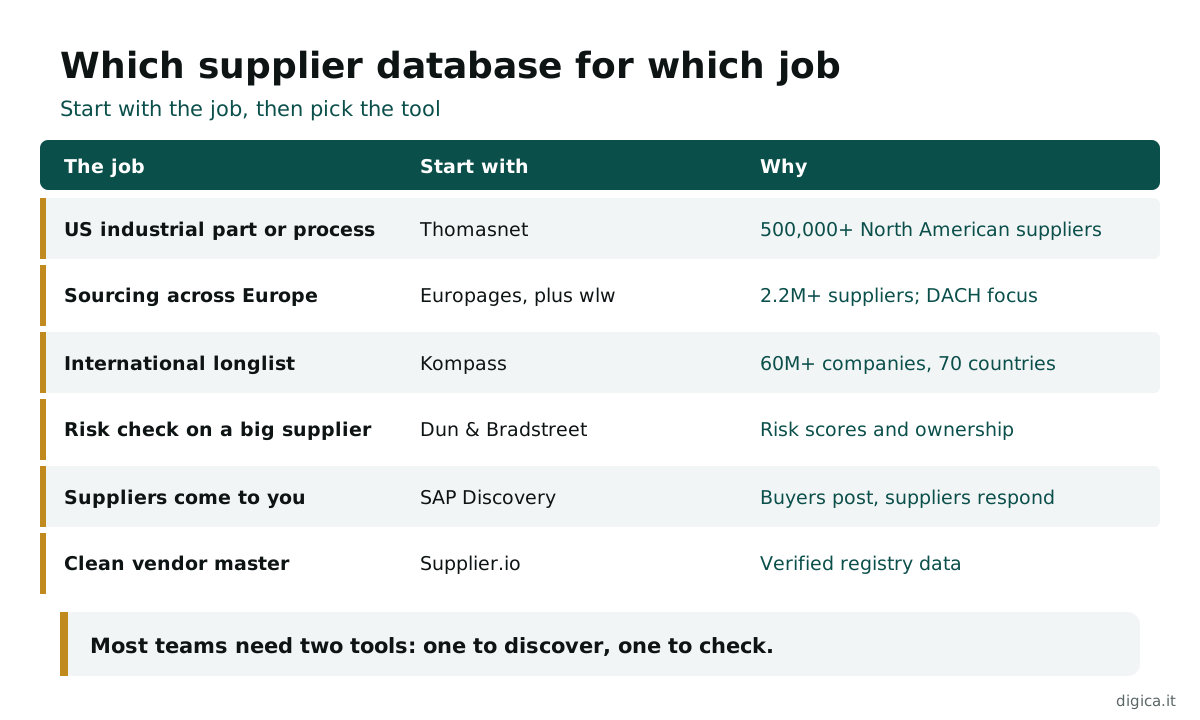
The diagram above sets the same jobs side by side. Most procurement teams need at least two of these tools: one to discover suppliers and one to check them. Large companies with thousands of active suppliers usually need a third, to keep the vendor master clean. Buying all three from one provider is rarely the cheapest or the best option.
What better supplier data is worth
Public buyers show the scale of what is at stake. The US Government Accountability Office reports that the federal government committed about $793 billion on contracts in fiscal year 2025. Private buyers spend more, across far more suppliers, and every one of those relationships starts with a record in a supplier database.
The number to take into your next budget meeting comes from the published Kraft Heinz example: close to $1 million a year saved on supplier data maintenance alone. If a supplier database cuts even one failed sourcing round a year, it usually pays back inside a single project cycle. The biggest cost of doing nothing is the one in the failure scenarios: an audit that finds a lapsed certification after samples are approved, and a sourcing project that starts again from zero.
FAQ
What is a supplier database? A supplier database is a searchable record of companies that sell to businesses, used to find, compare and check suppliers. Examples include Thomasnet, Europages, Kompass, Dun & Bradstreet and Supplier.io.
What is the biggest supplier database? By records, Dun & Bradstreet is the largest here, with information on more than 620 million businesses. Among self-listed supplier directories, Europages is the largest, with more than 2.2 million suppliers.
Is Thomasnet free to use? Buyers can search Thomasnet for free, and suppliers can claim a free listing. Suppliers pay for advertising and performance-based listings.
Are Europages and wer liefert was the same company? Both are run by Visable, but they operate as separate sites. Europages covers Europe broadly, and wer liefert was focuses on Germany, Austria and Switzerland.
What is the difference between a supplier directory and a supplier database? In practice, the terms overlap. A directory is usually the search interface buyers use, and a database is the underlying set of supplier records, which can also be sold as data.
What is a tender directory? A tender directory lists public contracts open for bids, such as TED for the EU and SAM.gov for US federal contracts. It lists opportunities, not suppliers.
Who owns TealBook? Supplier.io acquired TealBook in April 2026, and tealbook.com now redirects to supplier.io.
Related Articles
- Procurement marketplace growth
- The 7 biggest B2B marketplaces in 2026
- Best wholesale marketplaces in 2026
- Best B2B ecommerce marketplace platforms in 2026
- Best data marketplaces in 2026
This article is part of our B2B marketplace growth series. Browse more on the Digica blog.