The best procurement marketplaces for B2B buyers in 2026, ranked on catalog breadth and the controls a procurement team gets
A procurement marketplace is a B2B marketplace where employees buy from many approved suppliers through one catalog, while the procurement team keeps control of who can buy what, from whom, and with whose approval. The pressure to get this right is rising. The Hackett Group's 2026 procurement key issues research describes procurement teams facing an 8% workload increase amid declining headcount and operating budgets.
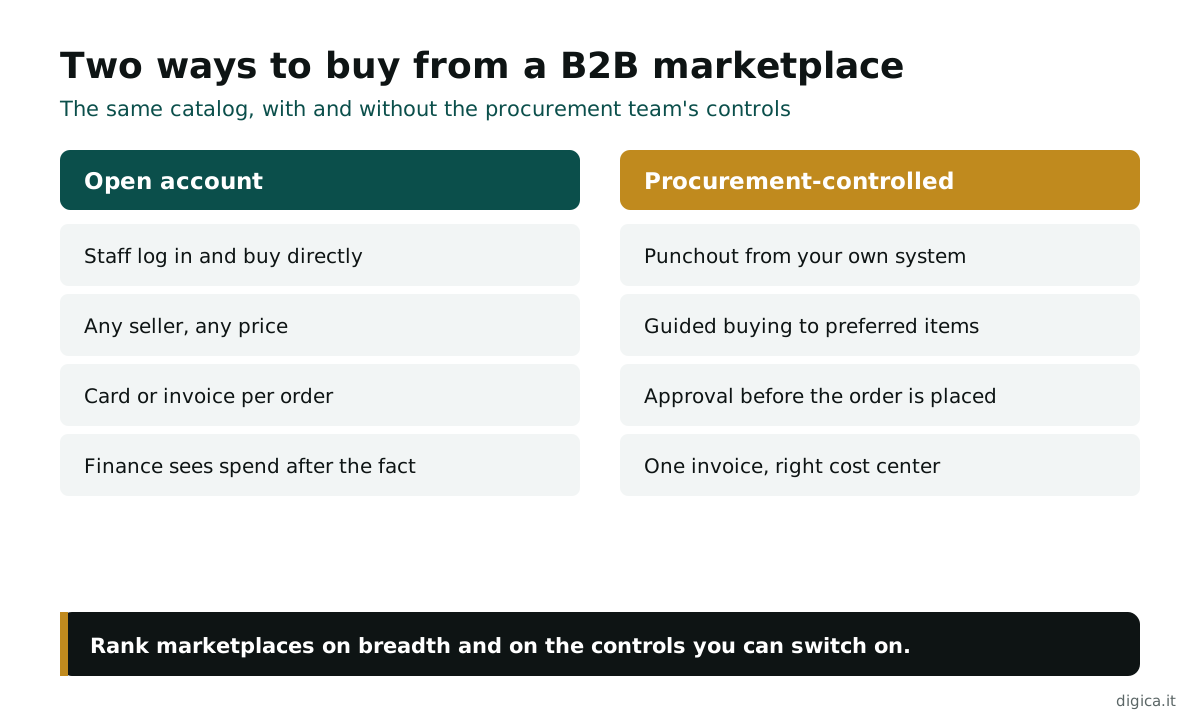
Most comparisons of procurement marketplaces stop at catalog size. That is half the decision. A catalog of hundreds of millions of items is only useful to a procurement team if it can stop a new hire buying a $900 chair, route a large order to a budget holder and send the invoice into the right cost center. Breadth without control turns into maverick spend. Control without breadth sends people back to their personal cards.
This guide ranks five of the leading procurement marketplaces on both: how much they offer and what controls the buyer gets, using the figures each company publishes, checked on October 22, 2026. It is the same supply and demand test we apply when we help procurement B2B marketplaces grow their supplier base and their buying organizations together.
Quick Navigation
- What a procurement marketplace is, and what it is not
- Five procurement marketplaces ranked
- 1. Amazon Business: the widest catalog with full controls
- 2. SAP Ariba Spot Buy: other catalogs inside your own approvals
- 3. Unite: the European procurement marketplace
- 4. Grainger: depth and service for maintenance buying
- 5. Zoro: a long catalog for smaller teams
- Catalog breadth against buyer control
- Three failure scenarios
- Which procurement marketplace fits how you buy
- FAQ
- Related Articles
What a procurement marketplace is, and what it is not
The short answer: a procurement marketplace is a multi-supplier catalog connected to a company's buying rules, and the useful test is whether staff can buy quickly without stepping outside policy.
The phrase covers two things. Some companies run a private procurement marketplace: a set of approved suppliers and contracted catalogs inside their own procurement software. Others buy from a public B2B marketplace, such as Amazon Business or Unite, that has been connected to their purchasing system. Most large buyers end up with both, because no private catalog covers everything staff need.
What separates a procurement marketplace from a store with business pricing is the control layer. The features that matter to a procurement team are approval workflows, spending limits by user or team, punchout (where a staff member shops the supplier's catalog from inside the company's own e-procurement system and the cart comes back as a requisition), purchase order and invoice handling, tax-exempt purchasing and guided buying that steers people to preferred products.
It is not a supplier directory. A directory helps you find a manufacturer to quote a custom part. A procurement marketplace helps you buy standard goods, from printer toner to safety gloves, at volume and within policy. In our experience, procurement teams that confuse the two either over-engineer their tail spend or under-control it.
Five procurement marketplaces ranked
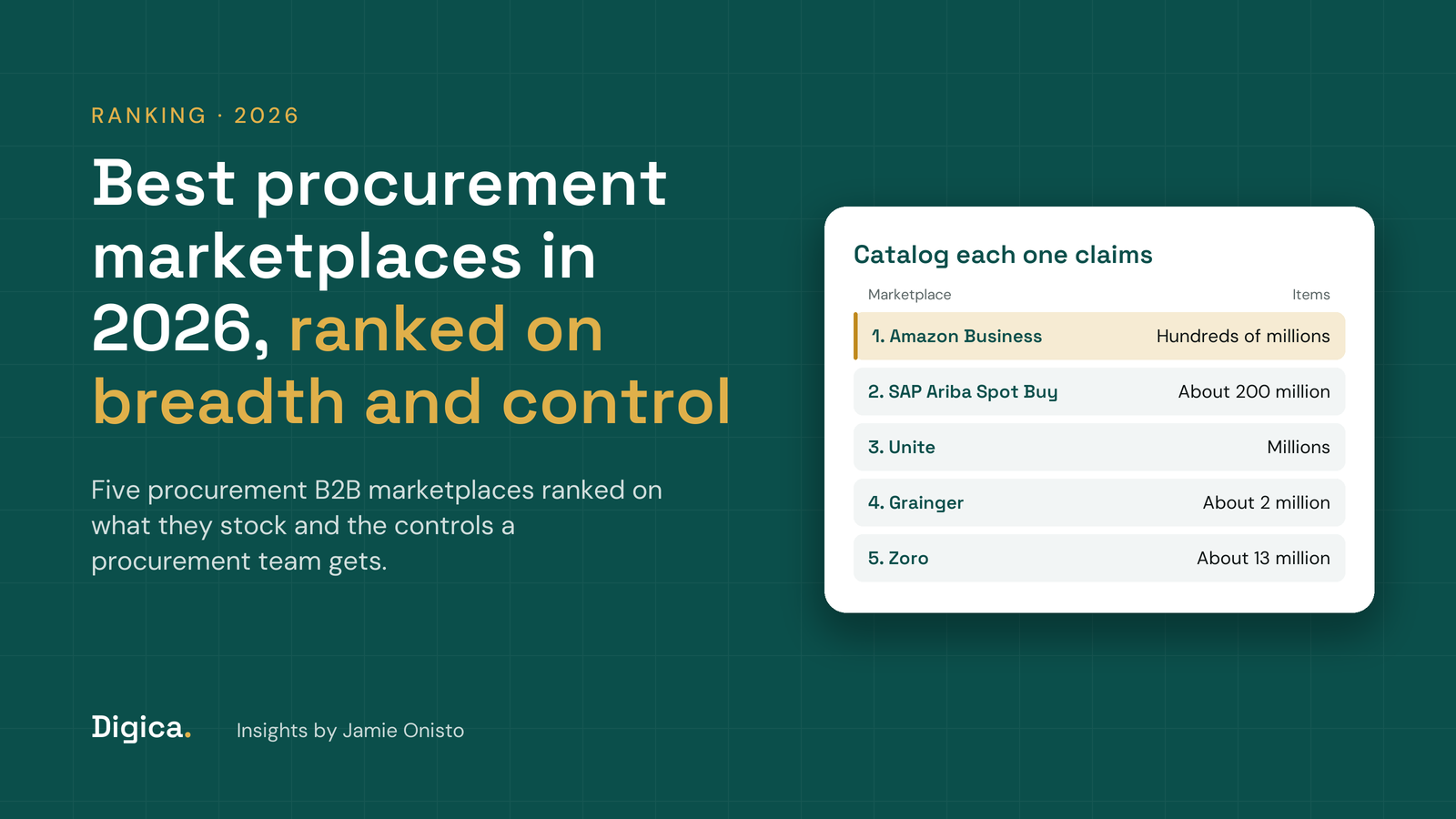
The short answer: Amazon Business ranks first for combining the widest catalog with a full set of controls, SAP Ariba Spot Buy second for putting other catalogs inside your own approvals, Unite third for European buyers, Grainger fourth for maintenance and operations, and Zoro fifth for smaller teams that need breadth more than workflow.
Five procurement marketplaces compared on catalog breadth, buyer controls, coverage, main risk and best fit
| Rank | Marketplace | Catalog breadth claimed | Buyer controls named | Coverage | Main risk | Best for |
|---|---|---|---|---|---|---|
| 1 | Amazon Business | Hundreds of millions of products | Approval workflows, purchasing system integrations, tax exemptions, Guided Buying | 11 countries | Breadth invites off-policy buying without guided buying set up | Organizations of any size buying general goods |
| 2 | SAP Ariba Spot Buy | About 200 million items | Requisition and approval in your own system, supplier choice, policy controls | Wherever SAP Ariba runs | Requires SAP Ariba | Large SAP Ariba customers with tail spend |
| 3 | Unite (formerly Mercateo) | Millions of items, thousands of categories | OCI and cXML punchout, user management, approval workflows | 12 European countries | Europe only | European buyers of indirect goods |
| 4 | Grainger | About 2 million products | eProcurement integration, managed service | North America focus | Narrower catalog than marketplaces | Maintenance, repair and operations teams |
| 5 | Zoro | About 13 million products | Business accounts, tax-exempt buying, Net 30 terms | US | Lighter workflow controls | Small and mid-size businesses |
The ranking weighs both columns together. A larger catalog with weaker controls does not beat a smaller one with stronger controls unless your team buys widely and trusts its users.
1. Amazon Business: the widest catalog with full controls
Amazon Business ranks first because it is the only marketplace here that combines the broadest catalog with every control a procurement team usually asks for. In a July 2026 press release, Amazon said Amazon Business drives over $60 billion in annualized gross sales, actively serves more than 11 million organizations, including 97 of the Fortune 100, and operates in 11 countries.
On breadth, the same release says customers have access to hundreds of millions of products, from a network of millions of sellers worldwide. No other procurement marketplace on this list comes close on that measure.
On controls, Amazon names approval workflows, purchasing system integrations, payment solutions, tax exemptions and Guided Buying, which directs employees to preferred products. That last feature matters more than it sounds. With a catalog this large, the risk is not that staff cannot find something. It is that they find ten versions of it, at ten prices, from ten sellers.
Running a procurement or supplier B2B marketplace?
In 30 minutes we look at how buying organizations find platforms like yours, and where your supplier supply is too thin to win their tail spend.
The trade-off is set-up effort. Amazon Business works best for procurement teams that switch on guided buying, connect it to their purchasing system and set approval rules before rolling it out. Teams that skip that step get the breadth without the control.
Why it ranks first. Widest catalog, a full control set, and coverage in 11 countries. For most organizations buying general goods, it is the default to beat.
2. SAP Ariba Spot Buy: other catalogs inside your own approvals
SAP Ariba Spot Buy ranks second because it gives procurement the strongest control of any option here, at the price of only working for SAP Ariba customers. SAP describes it as an on-demand catalog of approximately 200 million items, with pre-enabled sources such as Amazon Business and the Unite marketplace.
The design is different from a store. Staff search one catalog inside SAP Ariba Buying. When they check out, the shopping cart data goes directly to the company's e-procurement system for requisition creation and approval. SAP says built-in controls automate compliance with company procurement policies, procurement can choose which suppliers buyers can access, and suppliers are monitored against Office of Foreign Assets Control directories.
For a large company, that is the ideal shape for tail spend: the low-value, one-off purchases that never justify a contract but add up across thousands of employees. The marketplace breadth arrives, but every order runs through rules the company already owns.
The limit is plain. Without SAP Ariba, Spot Buy is not an option. And because it aggregates other marketplaces, the catalog breadth depends on which sources are switched on.
Why it ranks second. The strongest buyer controls on this list over a very large catalog, held back only by needing SAP Ariba.
3. Unite: the European procurement marketplace
Unite, known as Mercateo until its platform was renamed on September 30, 2024, ranks third as the leading procurement marketplace built for European organizations. Headquartered in Leipzig, Germany, it reported 2025 revenue of €465.3 million, about $503 million, operations in 12 European countries and more than 700 employees, in a March 2026 release.
On breadth, Unite says it connects organizations with vetted European suppliers across millions of items and thousands of categories. That is smaller than the two marketplaces above, but the supplier base is European, which matters for invoicing, VAT handling and delivery times.
On controls, Unite's support documentation describes punchout through the Open Catalog Interface (OCI) and cXML standards. A basket returns to the buyer's enterprise resource planning (ERP) system as a quote, the buyer's internal approval runs, and only then does the order go back to Unite. It also offers user management and approval workflows for teams buying on the platform directly. Unite is one of the pre-enabled sources inside SAP Ariba Spot Buy as well.
Do buying organizations find your procurement marketplace first?
A growth audit maps how procurement teams search for suppliers and marketplaces, on Google and in AI answers, and which of your category pages they never reach.
Why it ranks third. For a European buyer, Unite offers the right supplier base and mature punchout, with a catalog large enough for most indirect spend. It is also the clearest example here of a marketplace that wins by fitting into the buyer's own systems rather than asking staff to log in somewhere new. For a procurement team, that means fewer new logins to police and one approval route for every basket.
4. Grainger: depth and service for maintenance buying
Grainger ranks fourth on breadth and near the top on service. It is not a multi-seller marketplace in the Amazon sense, but for maintenance, repair and operations (MRO) buying it competes directly with one, and many procurement teams treat it as their main supplier catalog.
Grainger's fiscal 2025 annual report on Form 10-K says it serves more than 4.6 million customers worldwide and that its high-touch solutions businesses offer approximately 2 million products alongside technical support and inventory management. It also says customers in that segment use sophisticated electronic purchasing platforms that communicate directly with Grainger's systems through eProcurement technology.
That is the case for Grainger. A plant that needs the right bearing today values technical advice, onsite inventory and integration with its purchasing system more than a choice of a hundred sellers. Two million products is narrow next to the marketplaces above, but it is a curated two million for industrial buyers.
Why it ranks fourth. The best fit here for maintenance and operations teams, with a smaller catalog than the marketplaces above. For an MRO buyer, it may rank first.
5. Zoro: a long catalog for smaller teams
Zoro, Grainger's online-only business, ranks fifth: it offers far more products than Grainger but lighter controls than the marketplaces above. Grainger's 10-K says Zoro offers approximately 13 million products, aimed at small and mid-size businesses.
The controls are practical rather than enterprise-grade. Zoro says qualifying businesses can complete tax-exempt registration in about two minutes, with benefits available instantly. Approved business account holders get Net 30 terms, which Zoro describes as having zero interest, no annual fees and no late fees.
For a 40 person company without a procurement team, that is often enough. The owner or office manager needs breadth, tax handling and payment terms, not a multi-step approval chain. For a larger organization, the lack of deep workflow controls is the reason to route Zoro purchases through a procurement system rather than give staff open accounts.
Why it ranks fifth. Strong breadth and simple controls for smaller teams, but less workflow than the four options above.
Catalog breadth against buyer control
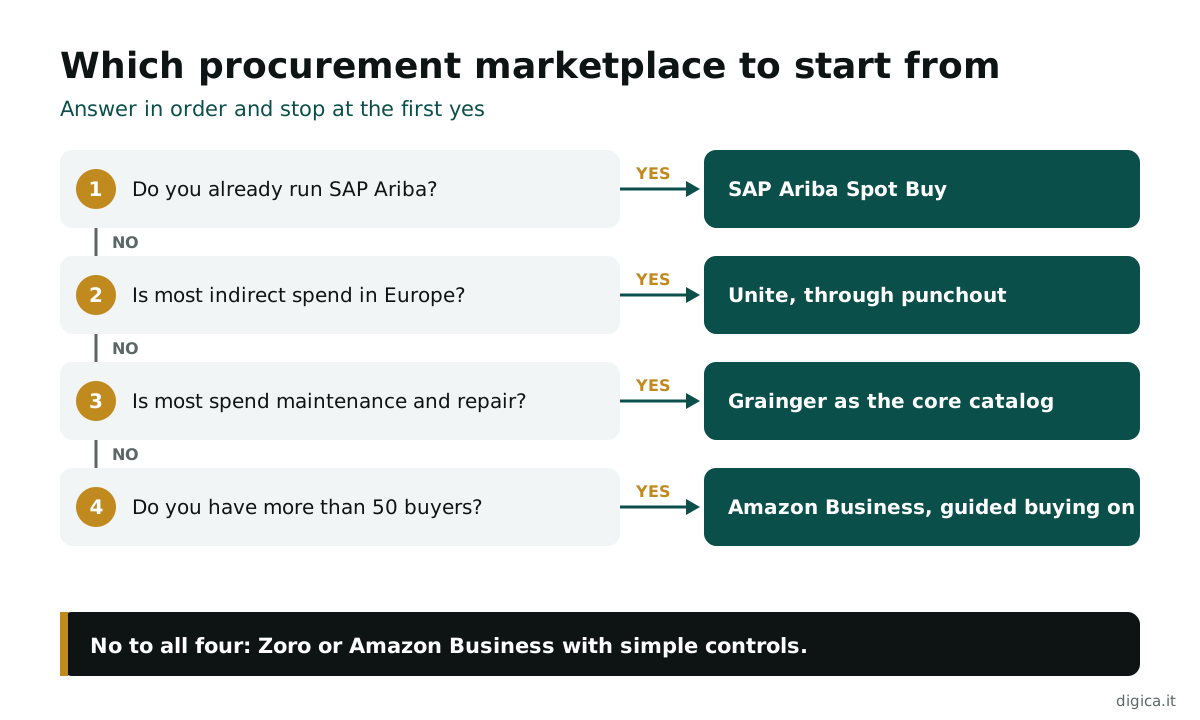
The five procurement marketplaces in this ranking sit at different points on the same two axes. The diagram below maps which one to start from, based on the size of your team and the system you already run.
Breadth and control pull in opposite directions. Every extra seller adds choice and adds risk: more prices to compare, more invoices to reconcile, more chances for a purchase to miss policy. Every extra control adds safety and adds friction: more approvals, slower delivery, more staff tempted to use a personal card.
The procurement marketplaces that rank highest here reduce that tension rather than pick a side. Amazon Business adds guided buying to a huge catalog. SAP Ariba Spot Buy pulls other catalogs inside the company's own rules. Unite returns every basket to the buyer's ERP before an order is placed.
The practical test is simple. Pick ten items your team bought outside policy last quarter. Check whether each marketplace stocks them, and whether its controls would have routed each one to the right approver. The marketplace that catches the most is the one that pays for itself.
Three failure scenarios
These are the patterns that recur when a company chooses a procurement marketplace on catalog size alone.
- The open account with no rules. A growing company opens a business marketplace account for every office manager to save time. Within a quarter, finance finds the same printer cartridges bought at five prices from five sellers, and several large orders that no budget holder saw. Turning on guided buying and approval limits before rollout would have kept the speed and lost the leakage.
- The controlled catalog that is too small. A procurement team connects only its main MRO distributor to its purchasing system, so every request for something outside that catalog goes to a manual purchase order. Staff wait days, then start using personal cards and expense claims. Adding a broad marketplace through punchout would have kept those purchases inside the system.
- The European buyer on a US-first catalog. A company with offices across Germany, France and Italy standardizes on a marketplace whose depth is strongest in the US, then struggles with cross-border delivery and VAT-compliant invoices. A European procurement marketplace would have matched its supplier base to where it actually buys.
Each team made a reasonable call on one axis. Each paid for ignoring the other.
Which procurement marketplace fits how you buy
The short answer: start from the purchasing system you already run, then the region you buy in, then the category of spend. These decision points make it specific.
- If you run SAP Ariba and more than 20% of your orders are off-contract, switch on Spot Buy and enable the sources your policies allow.
- If you buy general goods in North America, Europe or Asia and have more than 50 buyers, set up Amazon Business with guided buying and approval workflows before you invite users.
- If most of your indirect spend is in Europe, shortlist Unite and connect it through OCI or cXML punchout.
- If maintenance, repair and operations supplies make up most of your spend, use Grainger as your core catalog and add a marketplace for everything else.
- If you have fewer than 50 staff and no procurement team, Zoro or Amazon Business with tax-exempt status and payment terms will cover most needs.
- If you cannot see which purchases happen outside your system today, audit one quarter of card and expense spend before choosing anything.
Growing a procurement or supplier B2B marketplace?
We help procurement B2B marketplaces build the supplier supply and buying-organization demand that make a catalog worth connecting.
The number to take into your next finance review is the size of the market you are buying from. Amazon's July 2026 announcement put Amazon Business alone at over $60 billion in annualized gross sales across more than 11 million organizations, and Unite reported about $503 million in revenue for 2025. That much business buying happens on procurement marketplaces whether your team controls it or not. The biggest cost of doing nothing is leaving that spend on personal cards and expense claims, where nobody saves anything on price and nobody can see it until the quarter has closed.
FAQ
What is a procurement marketplace? A procurement marketplace is a B2B marketplace or multi-supplier catalog connected to a company's purchasing rules, so employees can buy from approved suppliers while procurement controls approvals, spending limits and invoicing. Amazon Business, SAP Ariba Spot Buy and Unite are examples.
What is the difference between a procurement marketplace and a supplier marketplace? A supplier marketplace usually helps buyers find and compare suppliers, often for quotes. A procurement marketplace adds the controls to buy through it at scale: punchout to the company's own system, approval workflows, purchase orders and consolidated invoicing.
What is punchout in procurement? Punchout lets a staff member open a supplier's or marketplace's catalog from inside the company's e-procurement system, fill a cart, and return it as a requisition for approval. Unite supports punchout through the OCI and cXML standards.
Which procurement marketplace has the largest catalog? Of the platforms in this guide, Amazon Business claims the widest range, with hundreds of millions of products. SAP Ariba Spot Buy describes an on-demand catalog of approximately 200 million items, and Zoro about 13 million.
Is Amazon Business a procurement marketplace? Yes, for most buyers. It offers approval workflows, purchasing system integrations, tax exemptions and guided buying, and it is a pre-enabled source inside SAP Ariba Spot Buy.
What is the best procurement marketplace in Europe? Unite, formerly Mercateo, is the largest procurement marketplace built for European buyers in this guide, with operations in 12 European countries and punchout for European ERP and e-procurement systems.
Related Articles
- Procurement B2B marketplace growth
- Best supplier databases and directories for B2B in 2026
- Best B2B marketplaces in 2026: seven examples by industry
- Best wholesale marketplaces for retailers in 2026
- How to attract vendors to a B2B marketplace
Where this connects
This article is part of our B2B marketplace growth series. Browse more on the Digica blog.