The best B2B ecommerce marketplace platforms in 2026, one award for each B2B job
US manufacturers and wholesale distributors sold $15.12 trillion of goods in 2025, according to a Digital Commerce 360 analysis of US Department of Commerce data, and digital channels, including online marketplaces, grew at a double-digit pace. More of that spend now runs through a B2B ecommerce marketplace: one storefront, many sellers, and the buying rules a business customer expects.
Those rules are what separate B2B marketplace software from a consumer cart with extra vendors. A business buyer asks for a quote, pays on 30 or 60 day terms, sees prices set by a contract, needs a manager to approve the order and often buys from inside a procurement system such as Coupa or SAP Ariba. A platform that handles one seller and a credit card well can still fail on every one of those.
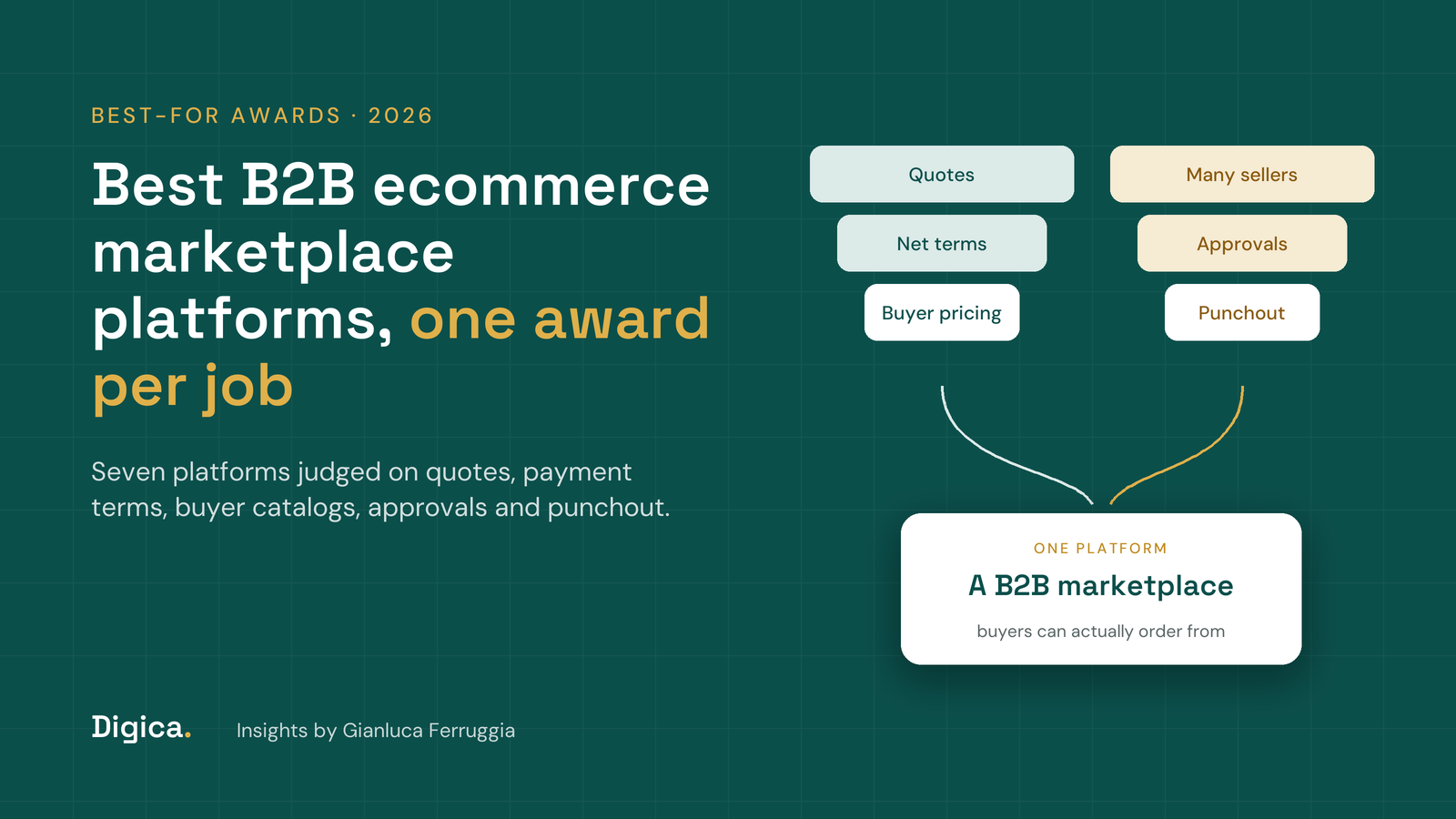
This guide gives a best-for award to seven B2B ecommerce marketplace platforms, judged on those B2B features: quotes and requests for quote, payment terms and invoicing, buyer-specific catalogs and pricing, approvals and punchout. Facts come from each vendor's own product pages, case studies and pricing, checked on October 16, 2026. It is the same lens we use when we help B2B marketplaces and directories grow after launch.
Quick Navigation
- The seven awards and the B2B features behind them
- Best for large distributors: Mirakl
- Best for spare-parts marketplaces: Spryker
- Best for procurement and punchout: Virto Commerce
- Best for complex buyer organizations: VTEX
- Best for adding sellers to an existing store: Marketplacer
- Best self-hosted option with public pricing: CS-Cart Multi-Vendor
- Best for testing a niche idea: Sharetribe
- The five B2B features that decide the shortlist
- How B2B marketplace launches stall
- Choosing your platform in five questions
- The figure to bring to the board
- FAQ
- Related Articles
The seven awards and the B2B features behind them
The short answer: Mirakl is the strongest choice for large distributors, Virto Commerce and VTEX lead on procurement and buyer approvals, and CS-Cart and Sharetribe are the low-cost ways to start. The table shows which B2B features each one publishes.
Seven B2B ecommerce marketplace platforms compared on B2B features, cost, risk and fit
| Award | Platform | Quotes and RFQ | Terms and buyer pricing | Punchout and approvals | Cost | Main risk | Best for |
|---|---|---|---|---|---|---|---|
| Large distributors | Mirakl | Quote management | Payment on terms, customer-specific and bulk pricing | Not stated on pages read | Quote-based SaaS | Enterprise scope and budget | Distributor groups with many subsidiaries |
| Spare-parts marketplaces | Spryker | Quotes and CPQ | Contract pricing, budgets by business unit | Approvals, role-based access | Not published | Needs a build team | Manufacturers selling parts through dealers |
| Procurement and punchout | Virto Commerce | RFQs and negotiated contracts | Tiered and account-specific pricing | cXML punchout to Coupa, Ariba, Jaggaer, SAP | Not published | You run more of the stack | Procurement marketplaces and GPOs |
| Complex buyer organizations | VTEX | Quote requests and approval | Contract pricing, customer catalogs | cXML and OCI punchout, multi-level approvals | Not published | Large platform for a small launch | Brands selling to large buyer accounts |
| Adding sellers to a store | Marketplacer | Not stated on pages read | Customer-specific and tiered pricing, invoicing | Not stated on pages read | Not published | Depends on your existing storefront | Retailers and distributors adding third-party sellers |
| Self-hosted, public pricing | CS-Cart Multi-Vendor | Not stated on pages read | Wholesale price rules | Not stated on pages read | From $725 a year | Your team runs hosting and updates | Small teams that want to own the code |
| Testing a niche idea | Sharetribe | Negotiation flows | Not listed on its public pages | Not listed on its public pages | From $39 a month to build | B2B features need custom code | Validating a niche before a bigger build |
Read the middle three columns first. If your buyers need punchout or multi-level approvals, the shortlist shrinks to two or three names before price comes into it.
Best for large distributors: Mirakl
Mirakl, founded in Paris in 2012 and run from dual headquarters in Paris and Boston since 2015, says it is trusted by 450+ brands worldwide. It is the best-known name in marketplace software, and its B2B claim is direct: manufacturers and distributors use the same platform as retailers, with native support for bulk pricing, customer-specific pricing, payment on terms and quote management.
Its strongest B2B story is about scale and structure. For Bunzl, Mirakl unified a business built from 220+ acquisitions into one buying experience across 32 countries, covering £11.8 billion, roughly $15 billion, of annual revenue. The buyer gets one consolidated invoice, and each subsidiary is settled for what it fulfilled. That is the hard part of a distributor marketplace, and few platforms show it working at that size.
Mirakl is sold as software as a service with quote-based pricing. It also reports a manufacturer story: Toyota Material Handling digitized aftermarket parts sales and reached 220% online growth.
The verdict: the best B2B ecommerce marketplace platform for large distributors and groups with many subsidiaries. A first test with a handful of sellers will find it more platform than it needs.
Best for spare-parts marketplaces: Spryker
Spryker, founded in Berlin in 2014, started with a marketplace as its first customer and now sells a composable commerce platform with an Enterprise Marketplace module. That module gives the operator one hub to manage merchants, offers and orders, including merchant onboarding.
Choosing a platform for a B2B marketplace launch?
In 30 minutes we look at your buyers, your first sellers and the features that will decide whether the launch gets traction.
Its B2B list is long. Spryker supports approvals, quotes, contract pricing, shared carts and role-based access, plus configure-price-quote tools and spend tracking across business units and budgets. Daimler Truck runs its B2B spare-parts marketplace for commercial vehicles on Spryker's cloud platform on AWS.
Spare parts suit Spryker's model. The catalog is huge, prices depend on the dealer contract, and many buyers sit inside one fleet operator with their own spending limits. A platform that treats budgets and approvals as standard saves months of custom work.
The verdict: the best choice for manufacturers selling parts through a marketplace of dealers and suppliers. Budget for a build partner, since composable means you assemble it.
Best for procurement and punchout: Virto Commerce
Virto Commerce, founded in 2011 and based in Los Angeles, says it supports requests for quote, negotiated contracts, punchout procurement and multi-warehouse order management without custom coding or bolt-on modules. Contracts, quotes and tiered pricing are native.
Punchout is where it stands out. Virto offers cXML punchout to Coupa, SAP Ariba, Jaggaer and SAP, with account-specific catalogs, pricing and approval workflows set up per buyer. A buyer stays inside their procurement system, opens the marketplace catalog, fills a cart and sends it back for approval. Its best-known customer is the OMNIA Partners procurement marketplace for public agencies.
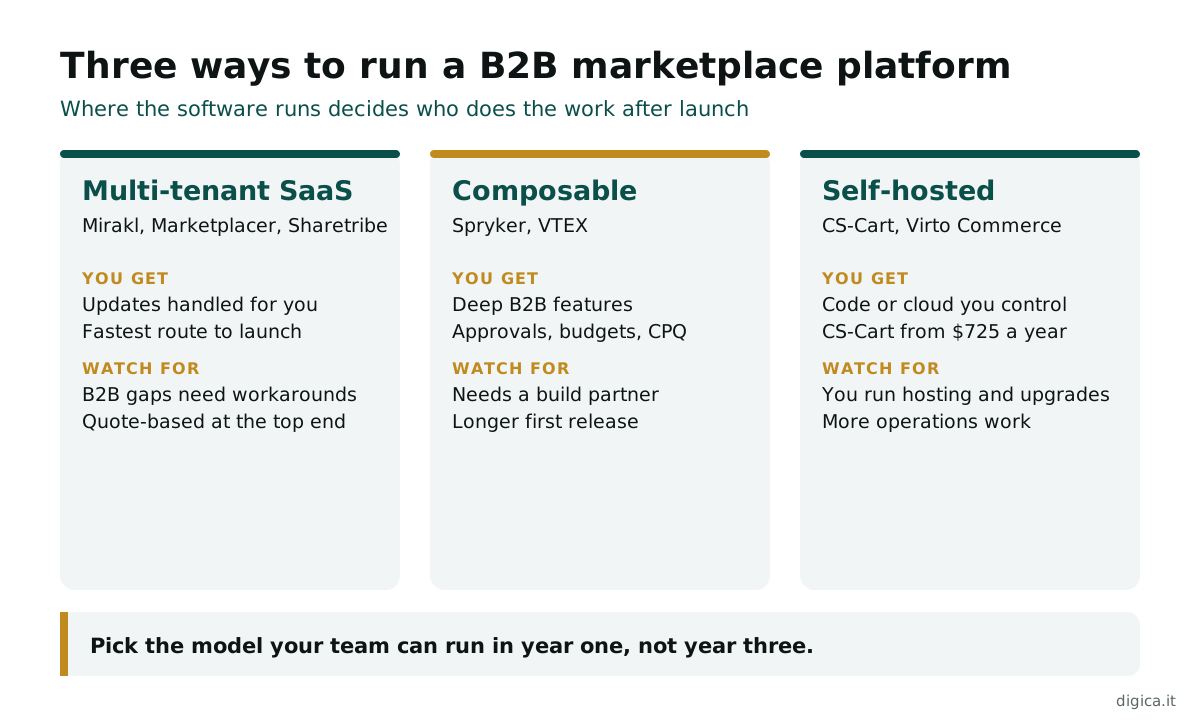
Virto can run in its own cloud, in your cloud or on your servers, built from 100+ prebuilt modules. That flexibility suits buyers with strict IT rules, and it also means your team carries more of the operations.
The verdict: the best platform for procurement marketplaces and group purchasing organizations whose buyers live inside Coupa or Ariba.
Best for complex buyer organizations: VTEX
VTEX, founded in Rio de Janeiro in 2000, says its platform handles over $15 billion in annual GMV across 3,500+ enterprise customers in 43 countries, a figure it cites from its 2024 annual report. Its B2B suite is built around the buyer's organization rather than the individual shopper.
Buyers get a company hierarchy with permissions for users, cost centers and approval chains, role-based access with multi-level approval workflows and budget limits, and a quote approval workflow. The pricing engine supports contract pricing, volume discounts, tiered tables and customer-specific catalogs, so each buyer sees the products, prices and payment methods in its contract. VTEX lists native punchout in both cXML and OCI formats for Ariba and Coupa.
Forrester's 2026 B2B predictions explain why this structure matters now: 61% of purchase influencers said their organization has or will use a private generative AI engine to support purchasing, and at least one in five B2B sellers will have to answer AI-powered buyer agents with dynamic counteroffers this year. A marketplace whose prices, permissions and approvals are structured data is easier for those buyers to work with. VTEX names Stanley Black & Decker and Colgate-Palmolive Brazil, which runs an oral-care marketplace for dentists, as B2B customers.
The verdict: the best choice when your buyers are large organizations with cost centers, budgets and approval chains.
Best for adding sellers to an existing store: Marketplacer
Marketplacer, based in Melbourne and built from the technology behind the BikeExchange marketplace, is designed to add third-party sellers to a store you already run. It has prebuilt connectors for Adobe Commerce, BigCommerce, Salesforce Commerce Cloud, Shopify and commercetools, and a Fast Start Program that launches a multivendor marketplace in 90 days.
Launched a B2B marketplace and the sellers are not selling?
A growth audit shows where buyers search for your category, which pages they never reach and what is stopping first orders.
Its B2B page lists customer-specific pricing, tiered rates and volume discounts, automated order management, invoicing and pricing workflows, quick reordering and self-service vendor portals. Marketplacer says its operator network draws 2 billion annual visitors and $35 billion in annual sales, and it is listed in Forrester's marketplace platforms landscape for physical goods, Q2 2026.
Its B2B case study is Medcart, a procurement marketplace for personal protective equipment for Australian health workers, where Marketplacer handles all payment transactions and orders grew an average of 62% a month after launch.
The verdict: the fastest way for a distributor or retailer to add sellers to an existing storefront. Check the quote and approval flows you need, since its B2B page does not list them.
Best self-hosted option with public pricing: CS-Cart Multi-Vendor
CS-Cart Multi-Vendor is the only platform in this guide with a full public price list. It describes itself as a source-available B2B marketplace platform: you install it on your own server, get the code and configure wholesale price rules for business clients.
Annual plans run from $725 a year for Standard to $1,449 for Plus and $3,599 for Ultimate, and lifetime licenses range from $3,590 to $19,990. CS-Cart says 2,000+ marketplaces have launched on Multi-Vendor, with 1,600+ add-ons, themes and integrations, and it has sold the software since 2005. On its B2B page it names ROBOTICS24.NET, an automation and robotics marketplace, and Ajalty.com, an auto parts marketplace in the United Arab Emirates.
The trade is ownership against work. You control the code and pay a known license fee, but your team runs hosting, security patches and upgrades, and any B2B workflow beyond price rules is likely to need add-ons or development.
The verdict: the best choice for a small team that wants to own its B2B marketplace code and know the license cost up front.
Best for testing a niche idea: Sharetribe
Sharetribe, based in Helsinki, is the cheapest way in this guide to put a working B2B marketplace in front of real buyers. It costs $39 a month to build in a test environment and $199 a month, billed yearly, to go live, with no transaction fees. The company says it is owned by its 22 team members and funded by more than 1,500 marketplace founders in over 70 countries.
It lists B2B product marketplaces as a use case, describing platforms for transactions that need negotiation, contracts and bulk orders. Its public pages do not list payment terms, multi-user company accounts or punchout, so a B2B launch that needs them should plan for custom development on top.
That is often the right trade at the start. A founder testing whether buyers in a niche will transact online needs a live marketplace in weeks, not a procurement integration.
The verdict: the best low-cost platform for proving demand in a niche B2B category before you commit to an enterprise build.
The five B2B features that decide the shortlist
Most B2B marketplace platforms can list products from many sellers. Five features decide whether business buyers can actually use them.
- Quotes and requests for quote. Large orders start with a price request, not a cart. Mirakl, Spryker, Virto and VTEX publish quote features.
- Payment terms and invoicing. Business buyers pay on invoice. Mirakl lists payment on terms; Marketplacer lists invoicing workflows.
- Buyer-specific catalogs and pricing. Each account sees its contract. VTEX, Virto, Mirakl, Spryker and Marketplacer all publish customer-specific pricing.
- Company accounts and approvals. Many users per buyer, with budgets and sign-off. VTEX and Spryker are strongest here.
- Punchout. Buyers shop from inside Coupa, SAP Ariba or similar systems. Virto and VTEX publish cXML punchout; VTEX also lists OCI.
The pattern is clear. The enterprise platforms publish all five, the mid-market platforms publish two or three, and the low-cost options publish one or two and leave the rest to custom work. That is fine if you know which ones your first buyers need before you sign.
How B2B marketplace launches stall
Most B2B marketplace launches that fail do so after the platform works. These are the patterns we see most often.
- Buying for year three on day one. A team signs an enterprise platform, spends nine months on integrations and launches with ten sellers and no buyers. The software was right for the scale it never reached.
- Missing one feature buyers will not live without. A marketplace launches without payment terms or punchout, and its first large buyer cannot order through procurement. One missing feature can block the account that was meant to prove the model.
- Treating launch as the finish line. The platform is live, but no buyer searching for the category finds it, and sellers leave after three months without orders. The software was never the bottleneck.
The fix is to match the platform to the first 12 months of buyers and sellers, list the B2B features those buyers need, and plan how buyers will find the marketplace before the build starts.
Choosing your platform in five questions
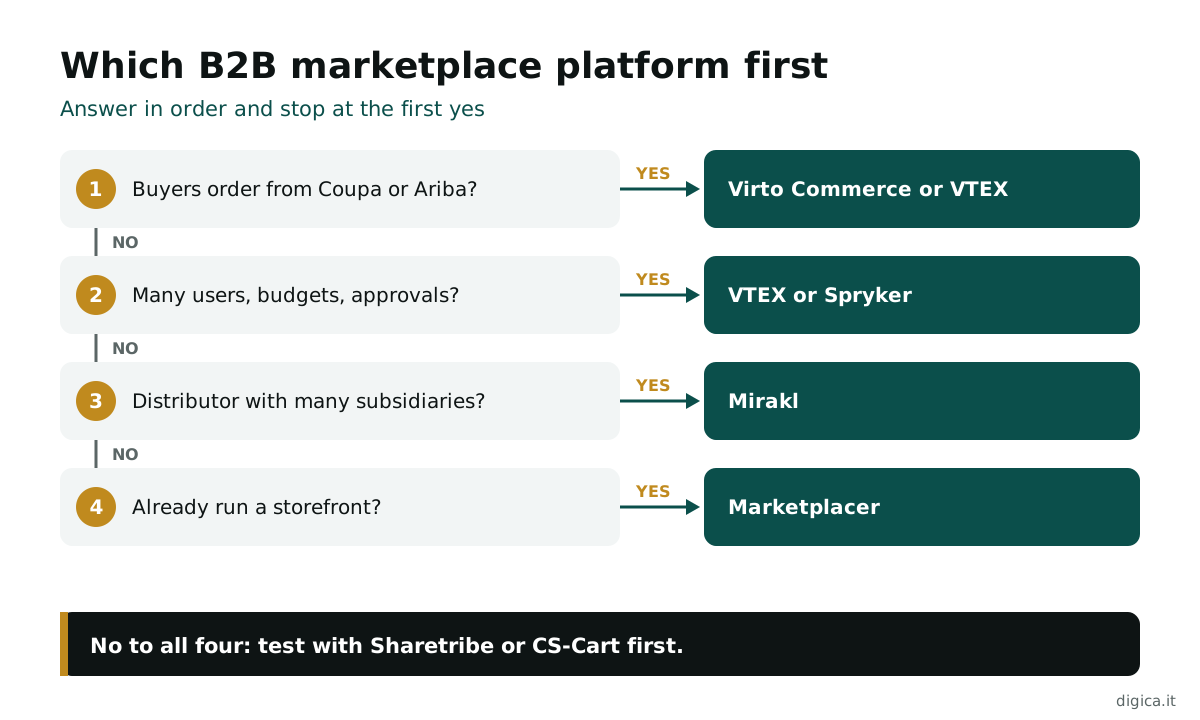
Answer these in order, and the shortlist usually narrows to one or two names.
- Do your buyers order from inside Coupa, SAP Ariba or another procurement system? If yes, start with Virto Commerce or VTEX, which publish cXML punchout.
- Do your buyers have many users, budgets and approval chains? If yes, shortlist VTEX and Spryker.
- Are you a distributor or group with many subsidiaries or warehouses? If yes, start with Mirakl.
- Do you already run a storefront on Shopify, Adobe Commerce, Salesforce or commercetools? If yes, look at Marketplacer first.
- Is your first-year platform budget under $5,000? If yes, test with Sharetribe at $39 a month to build, or CS-Cart Multi-Vendor from $725 a year, and plan custom work for B2B features.
Planning or rebuilding a B2B marketplace platform?
We help B2B marketplaces choose and brief the build, and our developers can deliver it when your team would rather not.
Whichever you choose, write the B2B feature list from your first five buyers, not from a vendor demo. A demo shows everything the platform can do. Your first buyers will tell you the three things it must do on day one, and those three decide whether the marketplace gets its first repeat order. Keep the rest of the list for the second release, once sellers are live and buyers are ordering, when you will know which gaps cost you real accounts.
The figure to bring to the board
Gartner forecasts that AI agents will intermediate more than $15 trillion in B2B spending by 2028, as reported by Digital Commerce 360. The platforms in this guide range from $39 a month at Sharetribe and $725 a year at CS-Cart to quote-based enterprise contracts at Mirakl, VTEX and Spryker. The biggest cost of doing nothing is not the license fee: it is a marketplace whose prices, terms and approvals cannot be read by the buyers and buying systems that will place those orders. Choose the platform that saves your first buyers from working around it.
FAQ
What is a B2B ecommerce marketplace? A B2B ecommerce marketplace is an online platform where many sellers sell to business buyers, with features such as quotes, payment terms, contract pricing and purchase approvals. Mirakl, VTEX and Virto Commerce are platforms used to run them.
What is the best platform to build a B2B marketplace? It depends on the buyer. Mirakl suits large distributors, Virto Commerce suits procurement marketplaces that need punchout, VTEX suits buyers with complex approvals, and Sharetribe or CS-Cart Multi-Vendor suit low-cost first launches.
Which B2B marketplace platforms support punchout? Virto Commerce publishes cXML punchout to Coupa, SAP Ariba, Jaggaer and SAP. VTEX lists native punchout in cXML and OCI formats for Ariba and Coupa.
How much does B2B marketplace software cost? Sharetribe costs $39 a month to build and $199 a month live, billed yearly. CS-Cart Multi-Vendor costs from $725 a year. Mirakl, VTEX, Spryker, Virto Commerce and Marketplacer do not publish prices.
Can I build a B2B marketplace on Sharetribe? Yes, for a first test. Sharetribe lists B2B product marketplaces with negotiation, contracts and bulk orders as a use case, but its public pages do not list payment terms, company accounts or punchout, so plan for custom development.
What features does a B2B marketplace need that a B2C marketplace does not? Quotes and requests for quote, payment on terms, buyer-specific catalogs and pricing, company accounts with approvals, and often punchout to procurement systems.
Related Articles
- B2B marketplaces and directories
- Best B2B marketplaces in 2026: 7 examples by industry
- Best wholesale marketplaces for retailers in 2026
- Best software marketplaces for SaaS vendors in 2026
- How to attract vendors to a B2B marketplace
This article is part of our B2B marketplace growth series. Browse more on the Digica blog.