Best data marketplaces in 2026: 9 platforms compared
Key takeaways
- Nine data marketplaces compared across four models: cloud-native exchanges, discovery brokers, audience marketplaces and exchange software.
- Snowflake providers earned more than $100 million in gross bookings in the first half of 2026, up 277% year over year.
- AWS Data Exchange lists 3,500+ datasets from 300+ providers; Datarade covers 500+ providers and Nomad Data 5,500.
- Spend drawdown programs win deals because buyers pay from committed cloud budget, with no new purchase order.
- A stalled vertical data marketplace can leave roughly $308,000 a year uncollected; the fix in the worked example pays back inside four months.
The best data marketplaces in 2026 are not the ones with the most logos on the homepage. They are the ones where a dataset gets found, licensed and delivered without a six-week procurement loop. Snowflake reported that providers on its Marketplace earned more than $100 million in gross bookings in the first half of 2026, up 277% year over year. That is where the money is moving: into marketplaces that sit on the rails buyers already run.
This list compares nine platforms across four models: cloud-native exchanges, discovery brokers, audience marketplaces and build-your-own exchange software. For each one you get who sells, who buys, how the money flows and where the risk sits. If you run a data marketplace or plan to launch one, the second half of the article is for you: how these platforms get liquidity, and what that means for your own supply and demand plan.
One note on method. Every figure here comes from the platform's own pages or from a named research source, checked on October 8, 2026. Where a platform does not publish a number, the table says so instead of guessing.
Quick Navigation
- How we picked and how to read this list
- The nine best data marketplaces at a glance
- Cloud-native data marketplaces
- Discovery and brokerage marketplaces
- Audience and collaboration marketplaces
- Build your own data exchange
- How data marketplaces make money
- How to choose a data marketplace as a buyer or provider
- What the leaders teach anyone launching a data marketplace
- What a slow data marketplace costs: a worked example
- FAQ
- Related Articles
How we picked and how to read this list
A data marketplace is a platform where organizations find, license and receive datasets, data products or data-driven services from third parties. The buyer might be a hedge fund, a retailer, a marketing team or an AI lab. The seller might be a data vendor, a SaaS company monetizing its exhaust data, or an enterprise opening part of its data estate to partners.
We used four filters. The platform had to be live and taking new listings in 2026. It had to publish enough about its model to compare it honestly. It had to serve B2B buyers, not consumer data brokers. And it had to represent a distinct way of solving the same problem, because a list of nine near-identical cloud exchanges helps nobody.
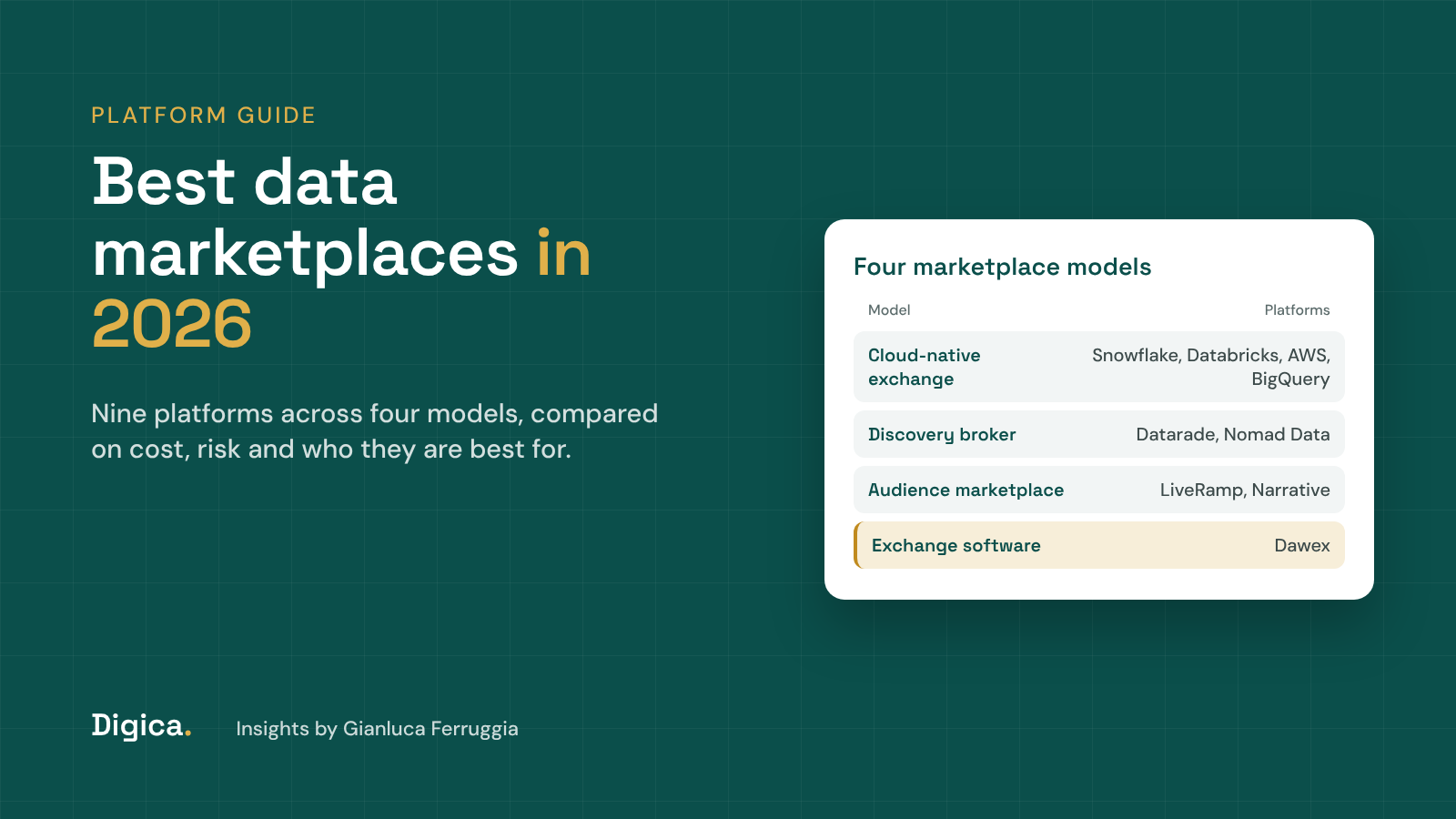
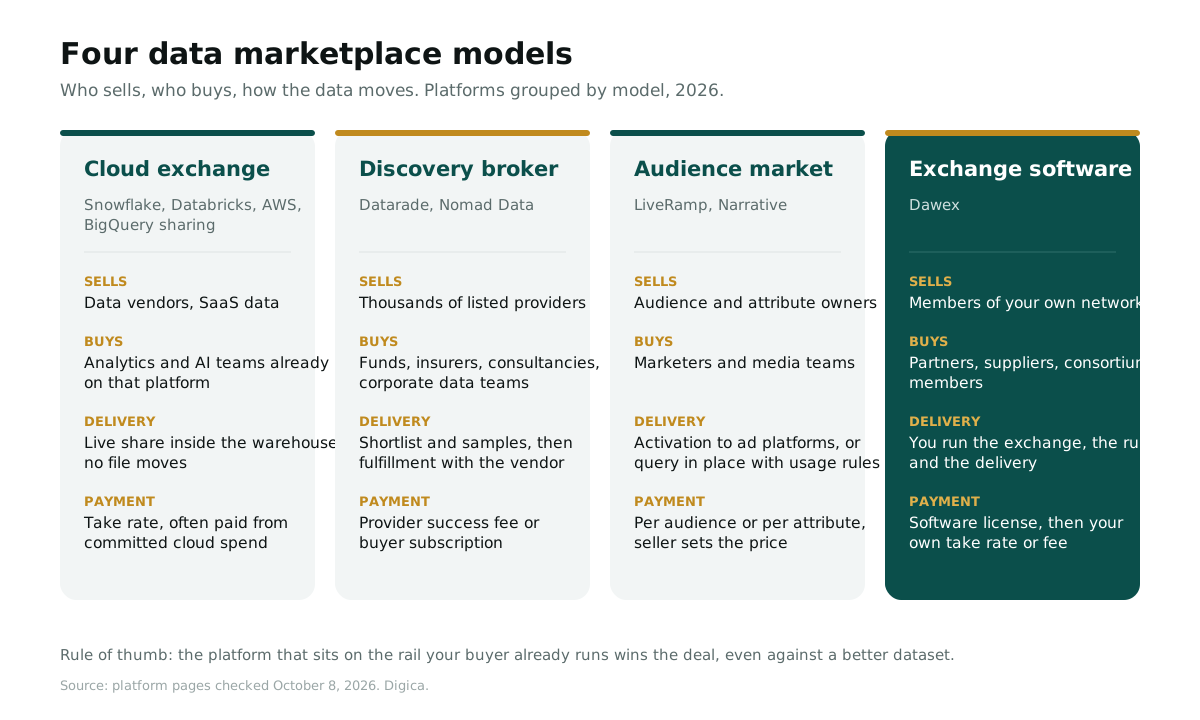
The result is four groups. Cloud-native marketplaces (Snowflake, Databricks, AWS, Google) deliver data inside a warehouse or lakehouse the buyer already pays for. Discovery brokers (Datarade, Nomad Data) help buyers find and compare vendors, then step aside. Audience marketplaces (LiveRamp, Narrative) serve marketers who need activation and identity, not raw files. And exchange software (Dawex) lets an enterprise run its own marketplace.
Read the list with one question in mind: where does the buyer already live? The platform that sits on that rail wins the deal, even when a competitor has the better dataset.
The nine best data marketplaces at a glance
The table below compares the nine platforms on the dimensions that decide a deal: the model, the cost to a provider or buyer where it is published, the main risk, and who each one is best for.
| Platform | Model | Published cost | Main risk | Best for |
|---|---|---|---|---|
| Snowflake Marketplace | Cloud-native exchange | Take rate not on the public page; buyers can apply existing Snowflake spend via Capacity Drawdown | Reach limited to Snowflake accounts | Providers selling live, query-ready data to analytics teams |
| AWS Data Exchange | Cloud-native exchange | Providers set price and duration per offer; 1,000+ free datasets | Catalog breadth hides quality variance | Buyers already on AWS who want files, APIs or Redshift tables |
| Databricks Marketplace | Cloud-native exchange (open protocol) | Free samples plus paid offerings; buyers can use up to 10% of commits | Younger catalog, listing count not published | AI and ML teams that want datasets, models and notebooks together |
| BigQuery sharing (ex Analytics Hub) | Cloud-native exchange | No extra cost to run exchanges; paid listings via Google Cloud Marketplace | Tied to BigQuery | Google Cloud shops sharing internally and with partners |
| Datarade | Discovery broker | Free for buyers; paid by the provider on purchase | No delivery layer, fulfillment is off-platform | Buyers comparing vendors across 500+ providers before committing |
| Nomad Data | Discovery broker plus AI search | From $3,000 a month for buyers, sales-led | Price point excludes small buyers | Funds, insurers and consultancies sourcing niche or alternative data |
| LiveRamp Data Marketplace | Audience marketplace | Provider terms not published | Advertising use only | Marketers buying third-party audiences for activation |
| Narrative | Collaboration marketplace | Sellers set price and usage rules at the query layer | Smaller provider base (30+) | Teams that want attribute-level data without a bulk license |
| Dawex | Exchange software | Enterprise license, not published | You own the liquidity problem | Enterprises and consortia running their own data exchange |
Two things stand out. First, the cloud-native platforms publish the least about fees and the most about reach, because the fee is negotiated inside a provider agreement and the reach is the pitch. Second, only the brokers publish buyer-side prices, because they are the only ones selling to the buyer directly.
Cloud-native data marketplaces
Four platforms dominate this group, and they share one idea. The buyer should not move the data. Subscribe, and the dataset appears inside the warehouse you already run, ready to join against your own tables.
Snowflake Marketplace
Snowflake describes its Marketplace as a place to access and share live, ready-to-query datasets, applications and services. The product page lists more than 820 providers and over 3,400 live data, agent and integrated SaaS solutions. Consumers are Snowflake customers; the page names Chipotle, Petco and DoorDash among them.
The commercial story is the strongest in the category. In a June 2026 post on Marketplace growth, Snowflake said providers earned more than $100 million in gross bookings between January 1 and June 16, 2026, a 277% increase year over year, across more than 1,700 transactions. Snowflake is careful to call this gross consumer payments to providers, not Snowflake revenue. The Capacity Drawdown Program lets a buyer pay for eligible listings out of committed Snowflake spend, which removes the procurement step that kills most data deals.
Best for: providers whose buyers are analytics teams on Snowflake. Watch: the take rate is not on the public page, so model your margin on the provider agreement, not the brochure.
AWS Data Exchange
AWS Data Exchange positions itself as the easy way to find, subscribe to and use third-party data in the cloud. Its page cites 3,500+ third-party datasets from over 300 providers, with more than 1,000 free datasets. Providers publish files, tables and APIs, and define a public offer with price, duration, subscription agreement and refund policy. Private offers and bring-your-own-subscription are both supported.
Delivery is the differentiator. Five dataset types are supported: files, API, Amazon Redshift, Amazon S3 and AWS Lake Formation in preview. A Redshift listing gives the buyer read-only query access without ETL.
Best for: buyers already standardized on AWS who need flexibility in format. Watch: breadth. A catalog this wide puts the quality screen on the buyer.
Databricks Marketplace
Databricks calls its Marketplace an open marketplace for data, analytics and AI, built on the OpenSharing standard so that buyers are not locked to one vendor. The docs describe it as an exchange where data providers, software vendors and technology partners publish offerings to more than 20,000 Databricks users. Named providers include LSEG, D&B, S&P Global, Shutterstock, Epsilon, AccuWeather, FactSet, Moody's, IQVIA and Crunchbase.
Listings span datasets, AI models, notebooks and, since June 2026, apps and MCP servers. Buyers can spend up to 10% of Universal Commits on eligible partner products through Commit Drawdown. Some listings complete the transaction in the provider's own interface.
Best for: teams buying data for models, not dashboards. Watch: Databricks does not publish a listing count, so compare catalog depth yourself before you list.
Running a data marketplace with slow supply or thin demand?
We map which categories can reach liquidity first, then build the vendor and buyer engines to get there.
BigQuery sharing, formerly Analytics Hub
Google renamed Analytics Hub to BigQuery sharing. The docs describe it as a data exchange platform where publishers create listings and subscribers combine shared data with their own in BigQuery. Subscribing creates a linked dataset in the buyer's project without replicating data, read-only, up to 1,000 linked datasets per shared dataset. Publishers can monetize through Google Cloud Marketplace or their own channels, and Google states there is no additional cost to manage exchanges and listings.
Best for: Google Cloud organizations sharing across business units and with partners. Watch: it is a BigQuery feature first and a marketplace second. Discovery outside Google's ecosystem is limited.
Discovery and brokerage marketplaces
Brokers solve a different problem. The buyer does not know which of 2,000 vendors has the dataset, at what price, with what coverage. The broker owns the search and the shortlist, and gets paid when a deal closes or on a subscription.
Datarade
Datarade bills itself as the easy way to find, compare and access data products from 500+ premium data providers. Buyers browse by category and use case, request samples and pricing, and get sourcing advice at no charge. The business model is explicit on the site: free for buyers, paid by the provider when a purchase happens. Datarade cites roughly 120,000 monthly visitors.
Best for: buyers early in a sourcing project who want to compare before they commit. Watch: there is no delivery layer. Once you pick a vendor, fulfillment, contracts and delivery happen with that vendor.
Nomad Data
Nomad Data combines vendor matching with AI document search. A buyer posts a data request and Nomad matches it against 5,500 providers and counting. Pricing is published, which is rare: plans start at $3,000 a month and scale with document volume and processing complexity. Buyers are funds, insurers, consultancies and corporate teams. Nomad states that it does not need access to a seller's data, which means it is a matching and management layer, not a hosted exchange.
Best for: teams sourcing niche or alternative data who value speed over catalog browsing. Watch: at $36,000 a year the floor excludes small buyers.
Audience and collaboration marketplaces
Marketers buy data differently. They need audiences, identity resolution and activation into ad platforms, and they are regulated harder than an analyst joining two tables. Two platforms serve that need.
LiveRamp Data Marketplace
LiveRamp describes its Data Marketplace as the industry's largest, most trusted, neutral marketplace, with 200+ data sellers and 650+ partners and more than 500 destinations for activation. Sellers are third-party data providers across behavioral, geographic, transaction and CTV audiences. Buyers are marketers. Provider payment terms are not published; LiveRamp sells a separate Data Monetization product to data owners.
Best for: marketers who need audiences activated into DSPs, CTV and retail media networks. Watch: this is advertising infrastructure. If your use case is analytics or AI training, you are in the wrong aisle.
Listing on these marketplaces and not seeing transactions?
We fix the listing, the sample data and the request response process, then build the demand that finds them.
Narrative
Narrative positions itself as a composable hub where sellers list, price and license the data they already own, and buyers source the attributes they need instead of signing a bulk license. Sellers enforce pricing, usage rights and retention at the query layer through access rules, and collaboration runs in place, in the seller's cloud under the seller's governance. The marketplace lists 30+ providers.
Best for: teams that want attribute-level sourcing and in-place collaboration. Watch: 30 providers is a thin shelf. Check coverage for your attributes before you build a workflow on it.
Build your own data exchange
Sometimes the right answer is not to list on someone else's marketplace but to run your own. Industry consortia, large enterprises with partner ecosystems and sector platforms all face this choice.
Dawex
Dawex sells infrastructure to build, operate and scale data ecosystems: an internal data marketplace, an external data marketplace and data spaces offered as a service. Customers named on the site include Airbus, Valeo, Colas, Auchan, La Poste, AFP and EDF. The platform covers governance, publication, discovery, pricing, licensing and transaction control, and is SOC 2 and SOC 3 certified. Pricing is enterprise and not published.
Best for: organizations that need to own the exchange, the rules and the member relationships. Watch: the software gives you a marketplace. It does not give you liquidity. That is the hard part, and it is the subject of the second half of this article.
How data marketplaces make money
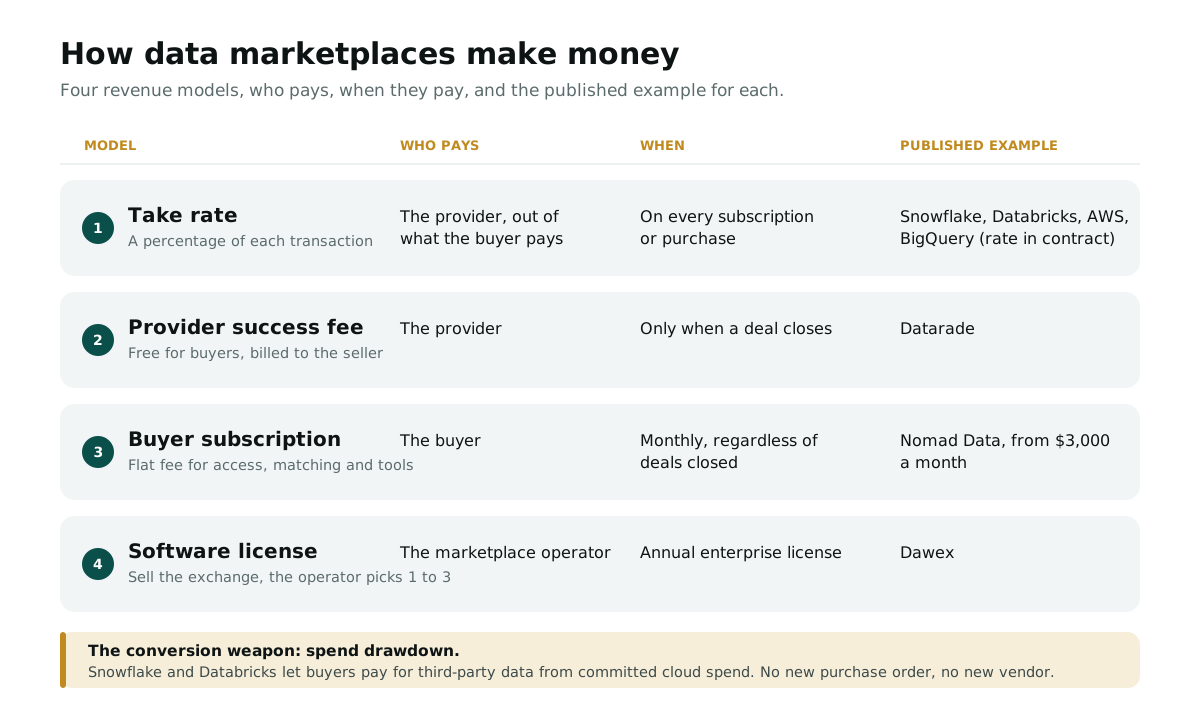
There is real money behind these models. Grand View Research put the global data marketplace platform market at $1.5 billion in 2024 and expects it to reach $5.73 billion by 2030, a 25.2% compound annual growth rate. Strip away the branding and there are four revenue models at work across these nine platforms. They mirror the marketplace business models you see in every B2B vertical.
- Take rate on transactions. The platform keeps a percentage of what the buyer pays the provider. The cloud exchanges run on this model, and most keep the percentage inside the provider agreement rather than on a pricing page.
- Success fee from the supply side. The broker is free for buyers and bills the provider when a deal closes. Datarade is the clearest example.
- Buyer subscription. The buyer pays a flat monthly fee for access, matching and tooling. Nomad Data at $3,000 a month and up is the published case.
- Software license. The platform sells the exchange itself. Dawex runs on this model, and the operator then picks one of the first three for the exchange it launches.
The cloud exchanges add a fifth mechanism that is less a revenue model than a conversion weapon: spend drawdown. Snowflake's Capacity Drawdown and Databricks' Commit Drawdown let a buyer pay for third-party data out of money already committed to the platform. For a provider, that turns a new-vendor procurement cycle into a line item on an existing contract. It is the single biggest reason Snowflake could report $100 million in provider gross bookings in half a year.
Why this matters beyond data: the pattern generalizes. Any B2B marketplace that can attach its transactions to a budget the buyer has already approved will outgrow one that asks for a new purchase order.
How to choose a data marketplace as a buyer or provider
For a buyer, the decision tree is short. Start with where your data already lives. If your analysts work in Snowflake, Databricks, Redshift or BigQuery, the matching cloud exchange removes integration cost and often procurement cost too. If you do not yet know which vendor has what you need, start with a broker and let them do the first screen. If you are buying audiences for media, you are in the LiveRamp and Narrative world, and the cloud exchanges will not help.
For a provider, the question is reach against margin. The cloud exchanges offer the most qualified buyers and the smoothest payment, at a take rate you will negotiate. A broker costs nothing until it delivers a deal. Listing on several platforms is normal, but each listing needs maintenance, sample data, documentation and a response process. In our experience running a B2B agency marketplace with 40,000+ listed vendors, the listings that won were not the ones with the longest descriptions. They were the ones where the vendor answered requests inside a day and showed proof a buyer could verify.
Three checks before you commit to any of these platforms:
- Ask for the actual terms in writing: take rate, payment timing, exclusivity, data usage rights after a subscription ends.
- Test the delivery path with one real dataset end to end, including the buyer's procurement step.
- Count how many active buyers in your category made a transaction in the last quarter. Reach numbers are provider counts dressed up. You want demand counts.
What the leaders teach anyone launching a data marketplace
If you run a data marketplace, or a vertical B2B marketplace with a data product inside it, the nine platforms above are your case studies. The market is growing at 25% a year, which attracts entrants, and most of them will stall on the same problem: supply without demand, or demand without the right supply.
Five lessons stand out.
Sit on an existing rail. Snowflake and Databricks did not invent new buyers. They monetized the ones already inside the product, and they keep widening what can be sold there: Databricks opened its Marketplace to apps and MCP servers in June 2026 with 20 launch partners. If you cannot be the rail, integrate with it: a Snowflake or Databricks listing for your own data product is a channel, not a competitor.
Remove the procurement step. Drawdown programs convert because the money is already approved. Your version might be an annual prepaid credit that buyers spend across vendors, or a master agreement that covers every provider on the platform. Any model where the buyer signs once and buys many times will outperform a model where every dataset is a new contract.
Seed supply by category, not by volume. AWS lists 3,500 datasets, but the buyer only cares about the 12 in their category. When we grew a vertical marketplace from five people, the categories that reached liquidity first were the ones where we hand-picked the first vendors and delivered the first leads ourselves. Our guide on how to attract vendors to a B2B marketplace walks through that sequence.
Measure liquidity per category. A platform-wide match rate hides dead shelves. The liquidity metric that compounds is the share of listings that transact in a set window, per slice. Datarade's model only works because enough categories have enough providers for comparison to be worth a buyer's time.
Want to know which categories on your platform can reach liquidity first?
A growth audit maps your supply, demand and search footprint against the categories buyers are actually searching for.
Make the catalog findable. Buyers search for datasets by use case and industry long before they search for your brand. Provider and category pages that rank for those queries are the cheapest demand you will ever buy. That is standard marketplace SEO: one indexable page per category with real demand and enough supply, structured data on every listing, and internal links that push authority to the shelves that convert.
What a slow data marketplace costs: a worked example
Operators tend to underprice the cost of a stalled marketplace because nothing visibly breaks. Listings sit there. The site works. The number that moves is the one nobody puts on a dashboard: deals that never happened.
Assume a vertical data marketplace with 150 providers, an average subscription of $18,000 a year, and a 15% take rate. Each closed subscription is worth $2,700 to the platform. Assume the platform converts 2% of qualified buyer requests into subscriptions, and gets 400 qualified requests a month. That is 8 subscriptions a month, or $21,600 in monthly platform revenue.
Now assume three fixes from this article: a drawdown-style master agreement that halves procurement friction, hand-picked supply in the three thinnest categories, and category pages that rank. If conversion moves from 2% to 3.5% and qualified requests grow 25% to 500 a month, the platform closes 17.5 subscriptions a month, or $47,250. The difference is $25,650 a month, roughly $308,000 a year, from a platform that looked fine on the surface.
Set that against the cost of the fix. An embedded growth team at $15,000 a month for six months is $90,000, with payback inside the first four months once the new run rate holds. The cost of doing nothing is the $308,000 a year you did not collect, and the gap compounds, because every provider who churns from a quiet category makes the next buyer less likely to find a match. For the comparison with hiring or a traditional agency, see our breakdown of what a growth consultant costs.
FAQ
What is a data marketplace? A data marketplace is a platform where organizations find, license and receive datasets, data products or data services from third parties. The best data marketplaces also handle discovery, contracting, payment and delivery, so a buyer can subscribe and start querying without moving files by hand.
Which is the best data marketplace in 2026? It depends on where your buyers or your analysts already work. Snowflake Marketplace has the strongest published commercial traction, with providers earning more than $100 million in gross bookings in the first half of 2026. AWS Data Exchange has the broadest catalog at 3,500+ datasets. Datarade and Nomad Data are best for comparing vendors before you commit.
How do data marketplaces make money? Four ways: a take rate on each transaction, a success fee paid by the provider, a buyer subscription, or a software license to run your own exchange. Cloud exchanges add spend drawdown, which lets buyers pay for third-party data from committed platform spend.
What does it cost to list data on a marketplace? It varies. Datarade is free for buyers and bills providers on a purchase. Nomad Data charges buyers from $3,000 a month. Snowflake, Databricks, AWS and Google keep provider fees inside the provider agreement rather than on a public pricing page. Always get the terms in writing before you build a listing.
Is a data marketplace the same as a data broker? No. A broker buys or aggregates data and resells it under its own name. A marketplace connects the original provider with the buyer and takes a fee or a subscription for doing so. Datarade and Nomad Data are marketplaces that look like brokers because they manage the search, but the contract is still between buyer and provider.
Should a company build its own data marketplace or list on an existing one? List first, build later. Listing on Snowflake, Databricks, AWS or BigQuery sharing reaches buyers who already have budget and tooling. Build your own exchange, with software like Dawex, only when you control a network of members who need to trade with each other and you can seed supply and demand yourself.
How does a new data marketplace get liquidity? Pick two or three categories, hand-recruit the first providers, deliver the first buyer requests yourself, and only widen the catalog once those categories transact every month. Measure liquidity per category, remove the procurement step with a single master agreement, and make category pages rank for the queries buyers actually use.