Google's UGC Fresh Data Program: what B2B platforms should do
Key takeaways
- On 8 October 2026 Google launched the UGC Fresh Data Program, a dedicated pipeline for approved platforms to send fresh user content.
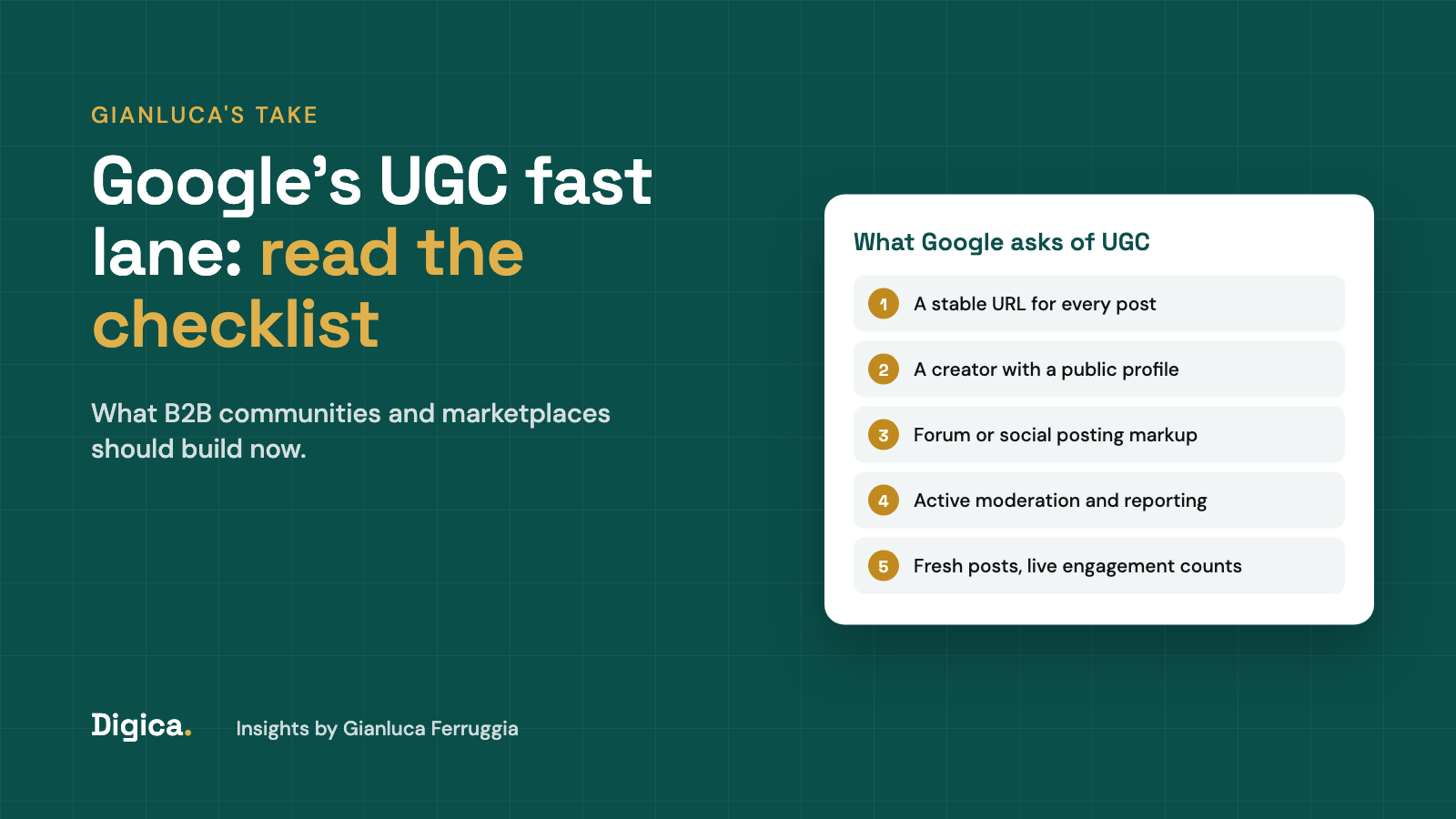
- Entry needs high volume, a significant user base, OAuth 2.0, validated JSON-LD, active moderation and posts sent ideally within minutes.
- Most B2B communities and marketplaces will not qualify, and Google says the program does not guarantee Search visibility.
- The eligibility list is still the clearest written spec Google has published for trusted user-generated content.
- Build to it now: stable URLs, public creator profiles, forum and review markup, and visible moderation.
On 8 October 2026, Google published a new page in its Search documentation: the UGC Fresh Data Program. Approved platforms get a dedicated pipeline to send user-generated content and engagement signals straight to Google, so fresh posts can be processed for Search features without waiting for a crawl. Barry Schwartz spotted it for Search Engine Roundtable and Search Engine Land the same day.
Most of the reaction I have seen asks one question: can we get in? For almost every B2B community, marketplace or SaaS platform I work with, the honest answer is not yet. The bar is built for platforms with very high volume.
I think that is the wrong question. The program is for a few platforms. The eligibility list is for everyone. It is the clearest written description Google has given of what trusted user-generated content looks like, and the base of good community SEO. You can build to it today.
Quick Navigation
- What Google announced
- My take: read the checklist, not the form
- What it means for communities, marketplaces, SaaS and agencies
- The growth play
- Should you apply?
- FAQ
- Related Articles
What Google announced
Google describes the program as "a specialized pipeline designed exclusively for trending UGC content." It sits apart from the Indexing API and from regular crawling, and Google is explicit that it "doesn't guarantee that content will appear in Search."
To qualify, a platform needs:
- UGC at the core. Mostly user posts, social posts or forum discussions, on dedicated pages with stable URLs. Profile pages and feeds do not count.
- Scale. High content volume and a significant user base.
- Open access. Public pages that Googlebot and users can reach, with no login or paywall. In Google's words, "all UGC must be attributable to a creator with a public profile."
- Technical readiness. OAuth 2.0 authentication, strictly validated JSON-LD, and schema.org markup such as SocialMediaPosting or DiscussionForumPosting with interaction statistics.
- Moderation. No illegal content, active moderation and a way for users to report posts.
- Speed. Content sent as close to creation as possible, ideally within minutes, and engagement counters updated within 72 hours of creation.
Applications go through a Google form, and Google says to expect an answer within 6 to 8 weeks. The source is the Google Search Central documentation, and the Search Engine Land coverage confirms the details.
My take: read the checklist, not the form
Google rarely tells you what it wants in bullet points. Here it did. Read the list again without the scale requirement and the API. What is left is a quality standard: a real person behind every post, a permanent page for every discussion, structured data that says what the page is and how people engaged with it, and visible moderation.
Is your UGC built to Google's checklist?
We audit threads, reviews and forum markup against Google's eligibility list and show you what to fix first.
That standard applies whether or not you ever send Google a single API call. A thread with an anonymous author, no stable URL and no visible moderation is a weak page in normal Search and a weak source for AI answers. In the same week, Google added a line to its helpful content guidance calling fabricated creator profiles "a form of deception." Read together, the message is consistent. Who wrote it matters, and it has to be real.
There is a second point most people are missing. A fast lane for the biggest platforms widens the gap on fresh, trending queries. Smaller B2B communities will not win that race on speed. They win on depth: expert answers, niche questions the big platforms never cover, and pages that stay useful long after the trend has passed.
When I ran DesignRush as General Manager, the platform grew to 40,000+ listed agencies. The pages buyers trusted were never the ones with the most words. They were the ones where a buyer could see who stood behind the claim. That is exactly what this checklist asks for.
What it means for communities, marketplaces, SaaS and agencies
B2B communities. You are the closest fit and the most exposed. Audit three things: does every discussion live on its own permanent URL, does every member have a public profile page, and is your forum markup valid. Login walls keep your best answers out of Search entirely. Our community SEO work starts with exactly this audit.
B2B marketplaces. Your UGC is reviews, buyer questions and supplier answers. Most marketplaces bury them in tabs or scripts. Give them crawlable pages, show the person and the company behind every review, and mark them up properly. This layer separates a useful listing from a thin directory entry, and it sits at the core of marketplace SEO.
SaaS with directories, communities or marketplaces. Help forums, template galleries and integration reviews are UGC too. DiscussionForumPosting markup with real interaction counts is a low-cost upgrade that many SaaS forums still lack. It is one of the first checks in our SaaS SEO work.
Agencies. The eligibility list is a ready-made audit framework. Use it with every client that runs a forum, a review section or a community. It is a concrete deliverable, not a vague recommendation, and it fits naturally into digital agency growth.
The growth play
| Move | Who it is for | First step |
|---|---|---|
| A stable URL for every thread, review and answer | Communities, marketplaces | List the UGC that only lives in feeds, tabs or pop-ups |
| Public creator profiles | Communities, SaaS | Make member and reviewer profiles public and indexable, with consent |
| Validated forum and review markup | All four | Add DiscussionForumPosting or review markup with interaction counts, then test it |
| Visible moderation | Communities, marketplaces | Publish your moderation rules and add a report option to every post |
| Expert depth over speed | Communities | Seed the niche questions big platforms leave open, answered by named members |
| UGC audit as a service | Agencies | Package the checklist as a fixed-scope audit |
The order matters. URLs and profiles come first, because nothing else works without them. Markup comes second, because it tells Google and AI systems what the page is. Moderation comes third, because it protects the trust you have just built.
Should you apply?
Apply if you clearly meet the volume and user base bar and your engineers can ship near real-time feeds with OAuth and validated JSON-LD. If you are not there, do not spend a sprint on the application. Spend it on the checklist. Every item on it improves how your platform performs in Search today, and if Google ever opens the program wider, you will already be ready.
FAQ
What is the Google UGC Fresh Data Program? A program that lets approved platforms send user-generated content and engagement signals to Google through a dedicated pipeline, separate from normal crawling, so fresh posts can be processed quickly for Search features.
Who can apply? Platforms that mainly host user posts or forum discussions on stable public URLs, with high volume, a significant user base, public creator profiles, active moderation, OAuth 2.0 and validated structured data.
Does joining guarantee visibility in Search? No. Google states that the program doesn't guarantee that content will appear in Search.
Is it the same as the Google Indexing API? No. Google says it is separate from the Indexing API and from the regular crawling of web content.
What should a smaller B2B community do instead? Build to the eligibility list: stable URLs, public member profiles, valid forum markup and visible moderation. These help in Search today, with or without the program.