Top Independent Digital Marketing Agencies for 2027: Which Pricing Model and Payment Terms Fit Your Business
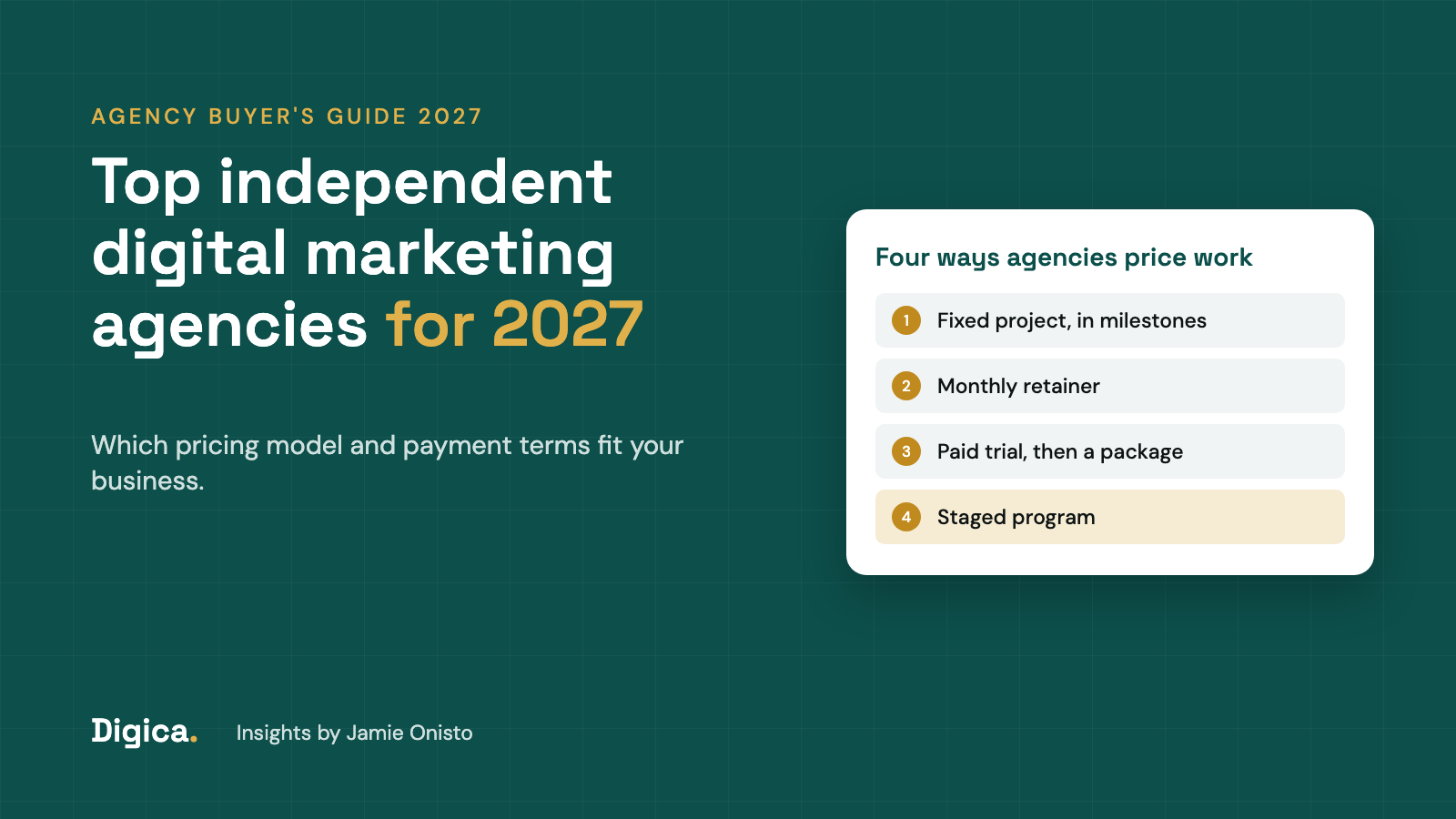
Most businesses shortlist a digital marketing agency on portfolio and price, then discover the real decision was the deal structure. A $40,000 website billed in three milestones and a $40,000 website billed on net 60 after launch are different purchases. One asks you to fund the work as it happens. The other asks the agency to fund it for you, which is why so few independent agencies will agree to it.
Independent agencies are where most mid-market work actually gets done. They are owner-led, small enough that the people who pitch you also run your account, and free of the holding-company layers that add cost without adding output. They also have less cash in the bank than a network agency, so how they price and when they get paid shapes how they behave on your account.
This guide profiles four independent, mid-sized US agencies going into 2027, each built on a different pricing model. It then covers the payment terms you can realistically negotiate, how agencies now offer flexible terms without carrying the cash flow risk themselves, and a framework for matching the deal to your business. If you are comparing growth partners more broadly, our guide to growth consultant pricing models covers the consulting side.
Quick Navigation
- Why the pricing model matters more than the shortlist
- The four pricing models independent agencies use
- Top independent digital marketing agencies for 2027
- The four agencies, side by side
- Payment terms: what you can negotiate
- How agencies offer flexible terms without the cash flow hit
- Three failure scenarios
- Where to start: a decision framework
- A worked example: one $40,000 project, three payment schedules
- How we chose these agencies
- FAQ
- Related Articles
Why the pricing model matters more than the shortlist
The pricing model decides who carries the risk if the work underdelivers, and the payment terms decide who funds the gap between work done and cash received. Both matter more to the outcome than a few thousand dollars on the headline fee.
Consider what each structure rewards:
- A fixed project rewards the agency for finishing on scope. You carry the risk that the scope was wrong.
- A monthly retainer rewards the agency for keeping you. You carry the risk of paying through the months before results show.
- A paid trial lets both sides test the relationship on a small budget before committing to a larger one.
- A staged program ties the next stage of spend to milestones you can measure, so neither side commits to the whole journey up front.
None of these is better in the abstract. A business with a defined deliverable, such as a new website, wants a fixed project. A business buying a compounding channel, such as SEO, needs a retainer, because search results rarely arrive inside a single quarter. The mistake is buying a channel on project terms, or a deliverable on retainer terms, and then judging the agency on a structure that was never going to fit.
Payment terms sit on top of the model. Two agencies can both sell fixed projects while one asks for 50% up front and the other bills monthly in arrears. For a mid-sized business managing its own working capital, that difference can matter as much as the fee itself.
The four pricing models independent agencies use
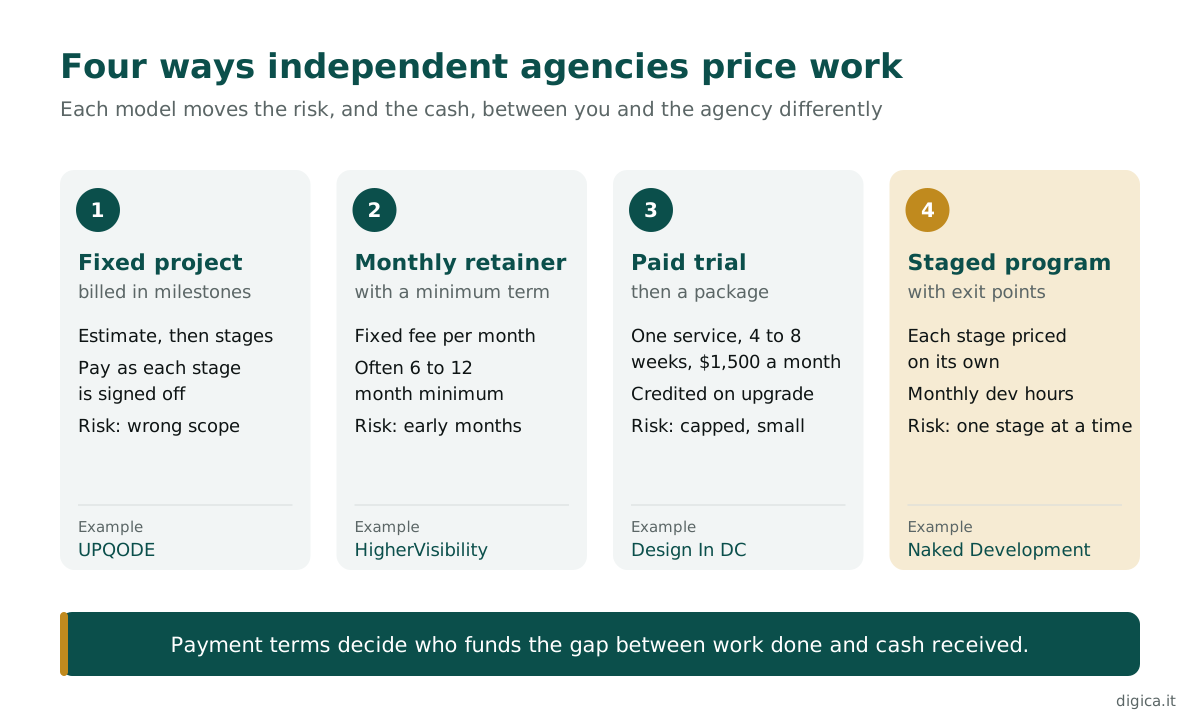
Independent agencies use four main pricing models: fixed projects billed in milestones, monthly retainers, paid trials that convert into packages, and staged programs. Hourly billing still exists, but mid-sized agencies increasingly wrap hours inside one of these four so the client sees a predictable number.
Fixed project, billed in milestones. The agency estimates the work, splits it into stages and invoices as each stage is signed off. Common for websites, rebrands and app builds. Cash flow is shared: you pay as value appears, and the agency is rarely more than one milestone out of pocket.
Monthly retainer. A fixed monthly fee for an agreed scope, usually with a minimum term. Common for SEO, paid media and content. The agency gets predictable revenue; you get a team that knows your account. The risk sits with you in the early months, before the channel compounds.
Paid trial, then package. A short, priced engagement on one service, with the fee credited toward a larger package if you continue. It turns the first month into a real test rather than a sales pitch.
Staged program. A sequence of defined engagements, each with its own price and exit point, often moving from a discovery or build stage into ongoing monthly hours. Common in product and app development, where the right next step depends on what the last one proved.
Top independent digital marketing agencies for 2027
These four agencies are independent, US-based and mid-sized, and each runs a different pricing model. All details come from the agencies' own websites as of November 2026, plus our own market research where noted. Figures such as client results and ratings are the agencies' own claims.
1. UPQODE: fixed projects with milestones, for mid-market B2B websites
Based: Nashville, Tennessee. Founded: 2014, according to its homepage. Best for: mid-market B2B companies that need a WordPress or Shopify site built properly, then maintained.
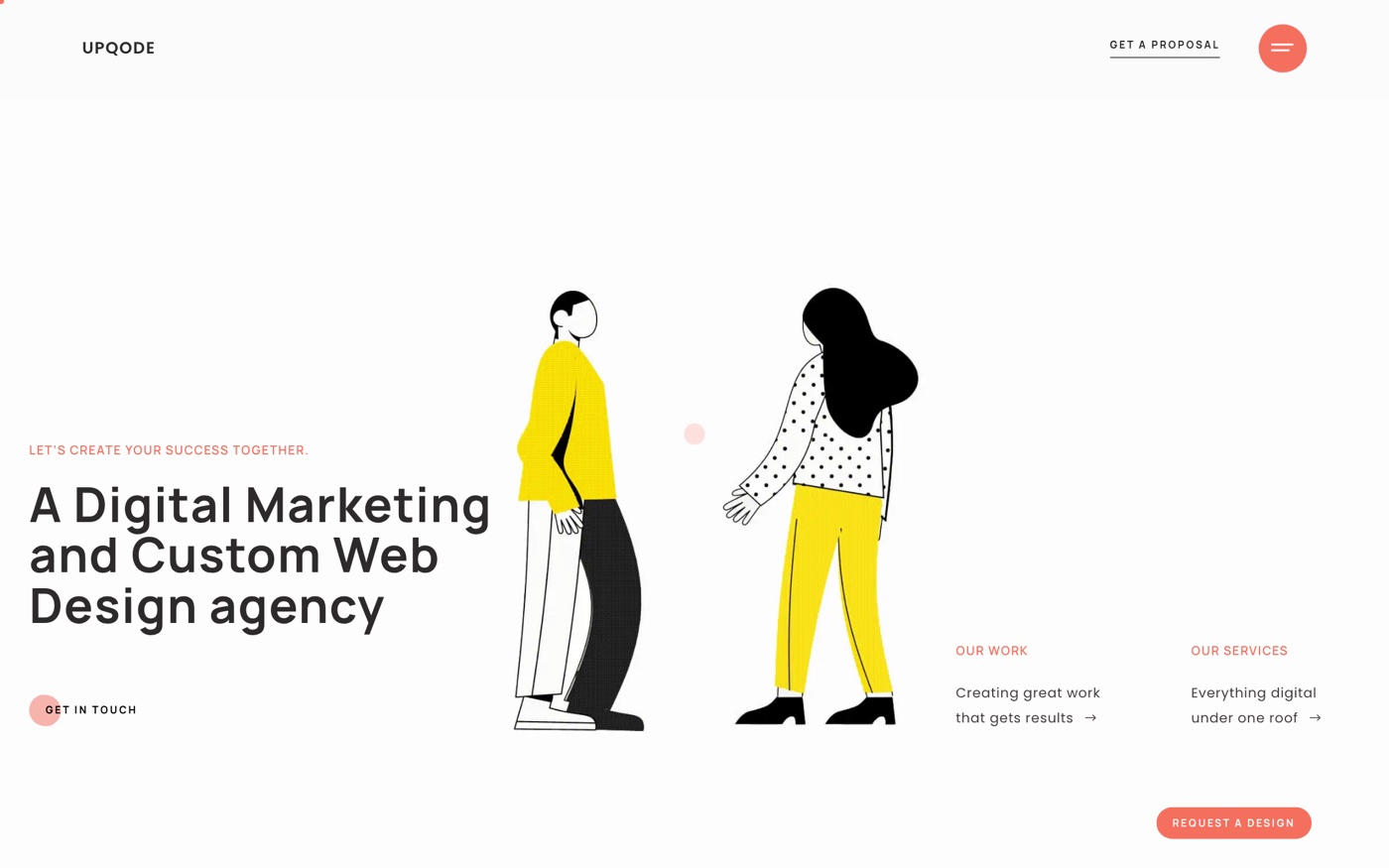
UPQODE's homepage, captured November 2026.
UPQODE is a web design and development agency that also runs SEO, PPC, content and website maintenance. It describes itself as part of a small group of sister companies, the Qoders family, and claims more than 40 awards on its homepage. Its portfolio leans toward B2B work in finance, software and IT, transportation and logistics, construction and health care.
Pricing model. UPQODE does not publish prices. Its published process runs from a brief and discovery call to an estimate with agreed milestones, then design, development, QA and delivery. Progress is visible in a project management app, and monthly maintenance is offered after launch. From what we see in the market, typical projects at this kind of agency fall between $10,000 and $50,000.
What it means for you. Milestone billing suits a buyer who wants to see each stage before paying for the next. Agree up front what counts as sign-off for each milestone, because a vague acceptance clause is where fixed projects usually stall.
2. HigherVisibility: monthly retainers for multi-location and regulated brands
Based: Memphis, Tennessee, with offices in Atlanta, Chicago and Miami. Founded: 2009. Best for: franchise and multi-location brands, legal, automotive and financial services companies buying search as an ongoing channel.
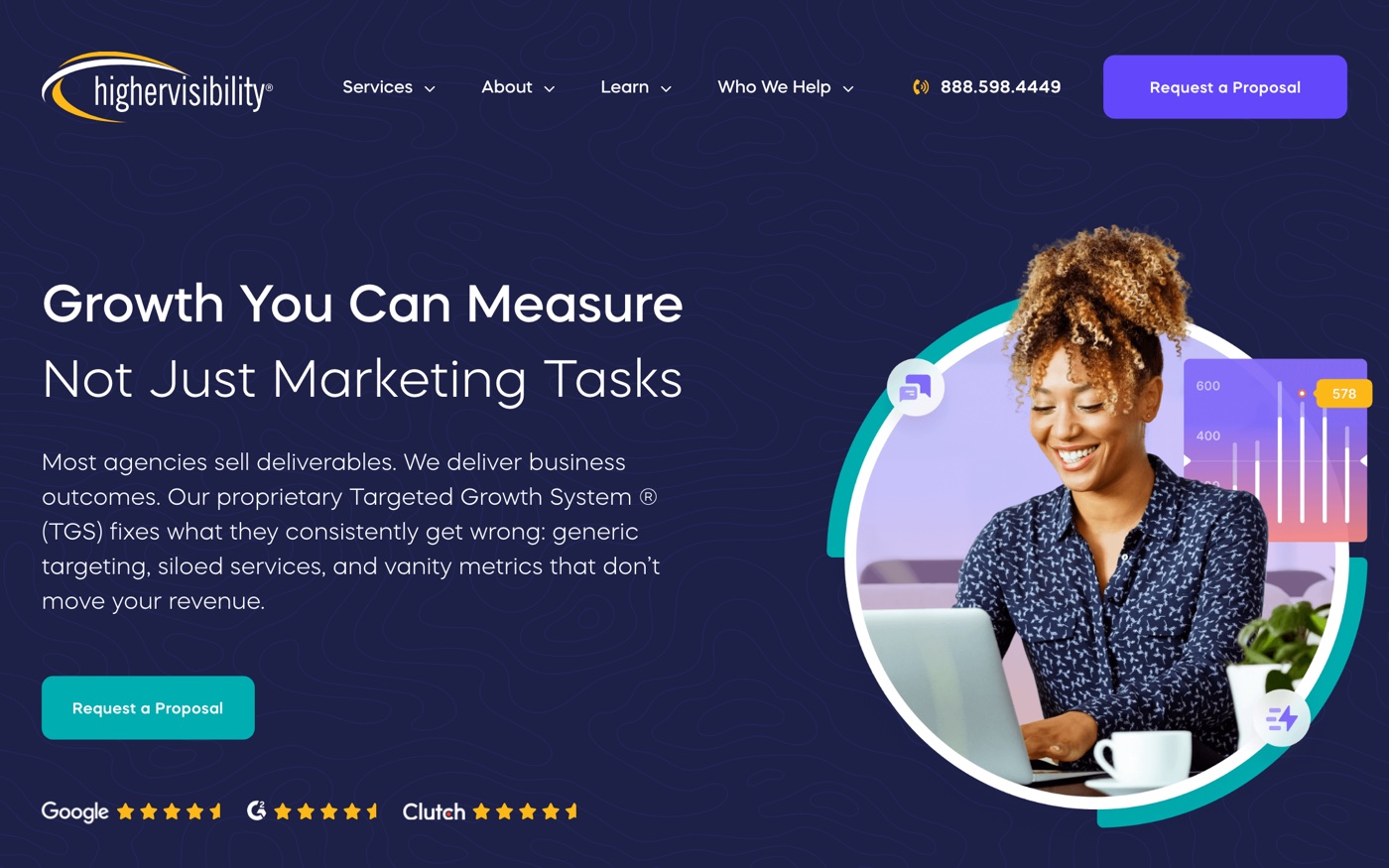
HigherVisibility's homepage, captured November 2026.
HigherVisibility is a performance marketing agency covering SEO, AI search optimization, local and franchise SEO, link building, PPC, web design and conversion optimization. Its about page says it was named SEO Agency of the Year by Search Engine Land, and its homepage lists results for brands including Caliber Collision, Lawn Doctor and Evolve Bank & Trust. It runs its engagements through a proprietary planning framework it calls the Targeted Growth System.
Pricing model. Monthly retainer. HigherVisibility does not publish package prices, but its enquiry form asks prospects to choose a monthly investment band ranging from under $500 to more than $20,000 a month. Its own SEO pricing guide says most businesses invest $1,500 to $5,000 a month and describes typical SEO retainers as running six to 12 months minimum. From what we see, clients at agencies of this profile typically spend $10,000 to $50,000 a year.
What it means for you. A retainer with a minimum term is the right structure for search, which takes months to compound. Before signing, ask what the agency will report in months one to three, when rankings have not yet moved, and what the exit terms are if the leading indicators are flat.
3. Design In DC: a paid trial that converts into a package
Based: Washington, DC. Best for: government contractors, associations, nonprofits and professional services firms that want one partner for web, marketing, apps and video.
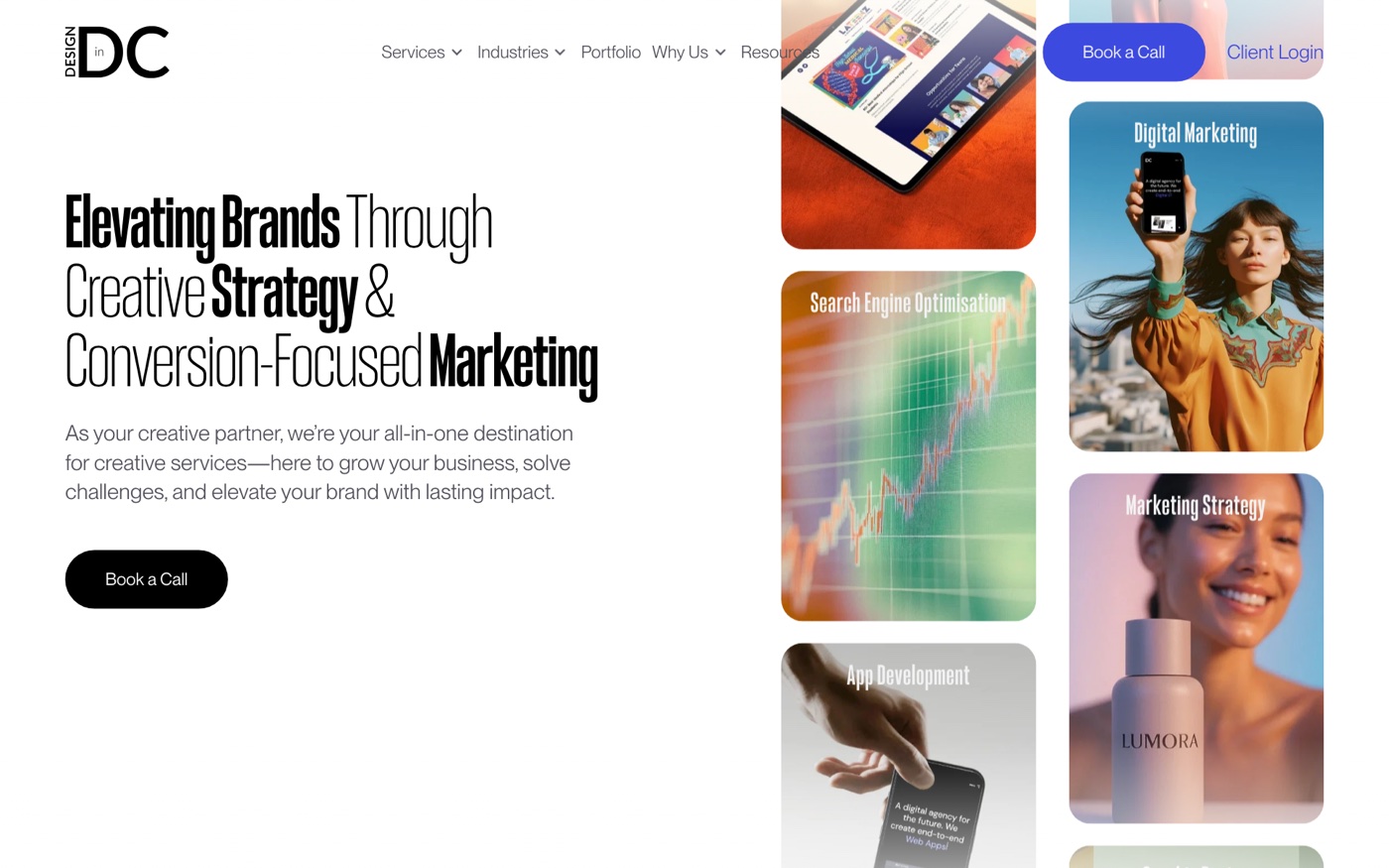
Design In DC's homepage, captured November 2026.
Design In DC is a full-service digital agency covering web design, digital marketing, app development, branding and video production. It combines a core team with a vetted global network of creative professionals, which lets it staff larger projects without carrying a large fixed headcount. Clients shown on its site include Accenture, Virginia Tech and BGR Group, and its industry list runs from government and the public sector to energy, healthcare and SaaS.
Pricing model. The most transparent of the four. Its pricing page offers a trial package at $1,500 a month for a single service (SEO, paid ads, email, social or sales automation) over a four to eight week engagement. If you upgrade to a monthly package within 60 days, the trial is credited toward it. Above that sit tiered marketing, website and maintenance packages priced on quote, with website timelines from one to two months up to six to 12 months or more. Its homepage offers both a subscription model and pay-per-use. Its web process ends with a warranty period and training after launch. From what we see, its project work typically runs $10,000 to $50,000, reaching about $80,000 at the top end.
What it means for you. A paid trial is the cheapest way to test an agency before a long commitment. Use it on the service you care about most, and set two or three measures in advance so the decision at week eight is about evidence rather than relationship.
4. Naked Development: a staged program for early-stage app founders
Based: Irvine, California. Best for: early-stage founders building an app-based company who want product, launch and growth support in one place.
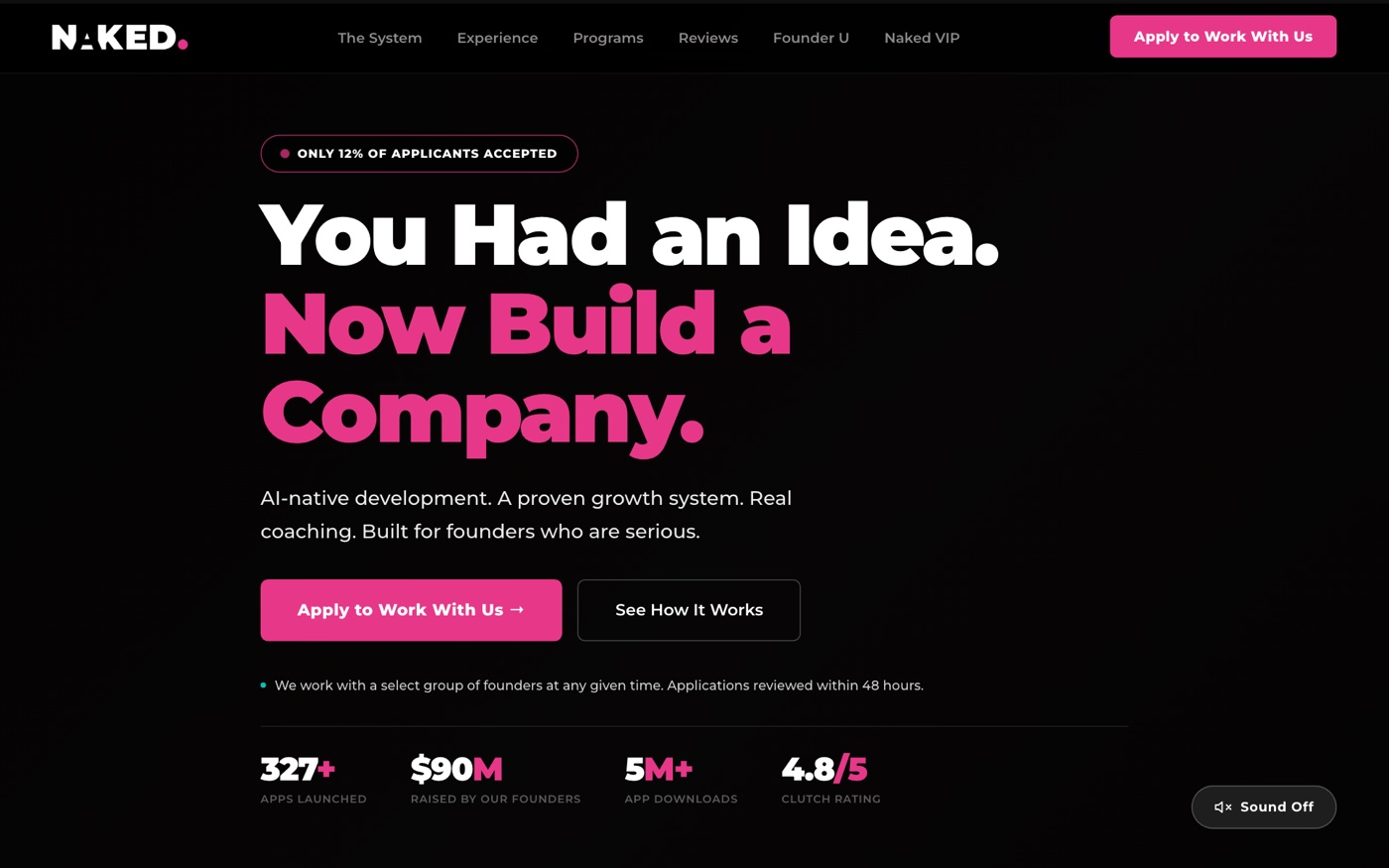
Naked Development's homepage, captured November 2026.
Naked Development is a mobile app product agency that positions itself as building app companies rather than apps. Its homepage claims more than 327 apps launched, $90 million raised by its founders and a 4.8 out of 5 rating on Clutch, and says it accepts 12% of applicants. Founders work with the team in person at its Irvine headquarters.
Pricing model. A staged program with defined exit points. Founders can start with App Camp, a six-month program with weekly live group coaching; move to Naked VIP, a 14-day done-for-you company build including five days on site; and continue on the Accelerator, three tiers of monthly development hours that roll over within the term. App Camp carries a money-back guarantee: if the founder decides after the initial session that Naked is not the right team, they get a full refund. From what we see, build engagements at agencies like this typically run $50,000 to $200,000.
What it means for you. Staged programs suit founders who do not yet know what the full build will cost, because each stage proves something before the next is bought. Check what you own at each exit point, including code, accounts and designs, before you start.
The four agencies, side by side
Four independent US digital agencies compared by pricing model, entry point, payment exposure and best fit.
| Agency | Based | Pricing model | Published entry point | Who funds the work | Best for |
|---|---|---|---|---|---|
| UPQODE | Nashville, TN | Fixed project, milestones, then maintenance | Estimate after discovery call | Shared, stage by stage | Mid-market B2B websites on WordPress or Shopify |
| HigherVisibility | Memphis, TN | Monthly retainer | Monthly bands from under $500 to $20,000+ | Client, monthly, from month one | Multi-location, legal, automotive, financial services |
| Design In DC | Washington, DC | Paid trial, then package or subscription | $1,500 a month trial, credited on upgrade | Client, small and capped at first | Government, associations, professional services |
| Naked Development | Irvine, CA | Staged program plus monthly dev hours | App Camp, with a refund guarantee | Client, one stage at a time | Early-stage app founders |
The pattern worth noticing is in the "who funds the work" column. Every model asks the client to pay before or during the work. None of them advertises letting you pay 60 days after delivery. That is not stubbornness. It is the arithmetic of running an agency.
Payment terms: what you can negotiate
Most independent agencies will negotiate payment terms within a range: a deposit of 25% to 50% on projects, milestone billing, monthly billing in advance on retainers, and invoices due in 15 to 30 days. Longer terms, such as net 60 or net 90, are what larger buyers ask for and what small agencies find hardest to give.
The reason is cash flow. An agency pays its people every two weeks. If a client pays 60 days after an invoice, and the invoice goes out when a stage is finished, the agency may be funding three or four months of salaries before it sees the money. A network agency can absorb that. A 30-person independent shop with five clients on net 60 may not, which is why many refuse, price the delay into the fee, or ask for a large deposit.
What you can usually negotiate:
- Smaller deposits in exchange for more milestones.
- Monthly billing in arrears rather than in advance, once a relationship is established.
- Net 30 instead of net 15, particularly for larger or public-sector clients with fixed payment cycles.
- Credits for trials or discovery work against the main engagement.
What is harder: net 60 or longer on a large project, especially from a newer client. Until recently, the honest answer from most independent agencies was no. That is starting to change.
How agencies offer flexible terms without the cash flow hit
Some independent agencies now offer clients net 60 or net 90 terms and still get paid within a day, by using invoicing software with early payout built in.
Cheque is one of these tools, built for agency and studio owners. The agency invoices through Cheque and receives early payout offers, with the fee shown before it accepts. Accept one and the money arrives within a day, while the client gets the same invoice, for the same amount, due on the same date. Cheque says it is not a loan, and that if a client never pays, the loss is Cheque's rather than the agency's.
For an agency, that means saying yes to the terms a larger client asks for without carrying months of payroll. For a buyer, it is worth asking whether an agency uses a tool like this, because it changes what it can offer you.
Disclosure: Digica has a referral partnership with Cheque. None of the agencies profiled above was paid to appear, and we have no information on whether any of them uses Cheque.
Running an agency and want bigger clients without the cash flow strain?
We help independent agencies win the buyers commissioning their work, and get them on terms the agency can live with.
Three failure scenarios
The SEO project. A business buys a three-month fixed project for search, pays in full and sees little movement by month three. The agency delivered the scope. The channel simply needed nine to 12 months. The fix is to buy a compounding channel on a retainer with clear leading indicators for the early months, not on a project fee that ends before the results begin.
The retainer nobody reviews. A business signs a 12-month retainer, the monthly reports arrive, and nobody compares them against the targets agreed at the start. By month ten, the spend is habit rather than a decision. Put a formal review at month three and month six into the contract, with the right to change scope at each.
The terms that broke the agency. A business insists on net 90 from a small agency that agrees in order to win the work. Four months in, the agency is short of cash, the senior team moves to clients who pay faster, and the account gets the juniors. The client won the negotiation and lost the team. Ask for long terms only from an agency that can fund them, or one that uses an early payout tool so the terms cost it nothing.
Where to start: a decision framework
Match the model to what you are buying, then match the terms to your cash position.
- Buying a defined deliverable (a website, a rebrand, an app version): choose a fixed project with milestones, like UPQODE's model. Negotiate the acceptance criteria for each milestone before you negotiate the price.
- Buying a channel that compounds (SEO, AI search visibility, content): choose a retainer with a minimum term you can live with, like HigherVisibility's model. Agree the leading indicators for months one to three.
- Unsure whether the agency is right: start with a paid trial on one service, like Design In DC's model, and decide at the end on evidence you set in advance.
- Building something whose total scope is unknown: choose a staged program with exit points, like Naked Development's model, and confirm what you own at each exit.
- Need longer payment terms: ask for them openly, and ask how the agency will fund them. An agency that can offer net 60 without strain is a safer partner than one that agrees reluctantly.
If you are on the other side of this table, an agency owner trying to win larger clients, the same framework applies in reverse. Larger buyers expect a clear model and terms that fit their payment cycle. Our work on growth for digital agencies covers how to get in front of those buyers before they reach a shortlist.
A worked example: one $40,000 project, three payment schedules
Take a $40,000 website project that runs for 16 weeks, with the agency's team costing it roughly $2,000 a week to deliver.
Schedule A: 50% deposit, 50% on launch, net 15. The client pays $20,000 in week one and $20,000 about two weeks after launch. The agency is never more than about $12,000 out of pocket. The client funds half the work before seeing any of it.
Schedule B: three milestones of 30%, 40% and 30%, net 30. The client pays $12,000, $16,000 and $12,000, each about a month after the stage is signed off. The agency carries just under $20,000 at its peak. Both sides share the risk.
Schedule C: one invoice on launch, net 60. The client pays nothing until about 24 weeks after the work starts. The agency carries the full $32,000 of delivery cost for that whole period, then waits two more months for its margin. On three projects like this at once, a small agency is funding close to $100,000 of work.
Schedule C is what many larger buyers would prefer, and what most independent agencies cannot afford. With an early payout tool, the agency can accept Schedule C, accept an early payout offer and be paid within a day, in exchange for a fee shown up front, and the client still pays on day 60. The agency trades a known fee for the cash flow gap. The client gets its preferred terms without pushing a smaller partner into strain.
The number to take into your next negotiation: on net 60 terms, a 16-week, $40,000 project leaves the agency funding its delivery costs for around 24 weeks. Ask how they plan to cover that, and you will learn a lot about the partner you are hiring.
How we chose these agencies
We looked for agencies that are independent (not owned by a holding company), headquartered in the US, mid-sized rather than solo studios or networks, and clear enough about how they price that a buyer can compare them. We then picked four that each represent a different pricing model, so the guide covers the main deal structures a buyer will meet.
Details are taken from each agency's own website in November 2026, supplemented by our own research on typical project sizes. Client results, awards and ratings are as the agencies state them. No agency paid to be included, and we have no commercial relationship with any of them. If you run an independent agency and think your pricing model belongs in a future edition, we would like to hear from you.
FAQ
How do independent digital marketing agencies price their work? Most use one of four models: fixed projects billed in milestones, monthly retainers with a minimum term, paid trials that convert into a package, or staged programs with exit points. Hourly billing still exists but is usually wrapped inside one of these so the client sees a predictable fee.
What payment terms do digital marketing agencies usually offer? Most independent agencies ask for a deposit of 25% to 50% on projects, bill retainers monthly in advance and set invoices due in 15 to 30 days. Net 60 or net 90 is harder to get from a small agency, because it means the agency funds months of salaries before it is paid.
Is a retainer or a project fee better for digital marketing? It depends on what you are buying. A project fee suits a defined deliverable such as a website or rebrand. A retainer suits a channel that compounds over months, such as SEO or content. Buying a compounding channel on a short project fee is one of the most common reasons engagements disappoint.
Can I ask a small agency for net 60 payment terms? You can, but ask how the agency will fund the gap. Some agencies now use invoicing tools with early payout, such as Cheque, which pay the agency within a day while the client still pays on the agreed date. An agency that agrees to long terms without a way to fund them may struggle to keep its senior team on your account.
How much do mid-sized independent agencies cost? From what we see, project work at mid-sized independent agencies typically runs $10,000 to $50,000 for websites and marketing builds, and $50,000 to $200,000 for app development. Retainer clients typically spend $10,000 to $50,000 a year. Published entry points can be lower, such as Design In DC's $1,500 a month trial.
Related Articles
- Growth consultant cost: pricing models and what to expect
- The best B2B agencies, compared
- How to choose a GEO agency for a B2B marketplace
- The best agency directories
- The best B2B marketplace growth consultants
Where this connects
This article is part of our agency growth series. For more, browse the Digica blog or see our B2B marketplace growth consulting.