How to Choose a GEO Agency for a B2B Marketplace (and What It Should Cost)
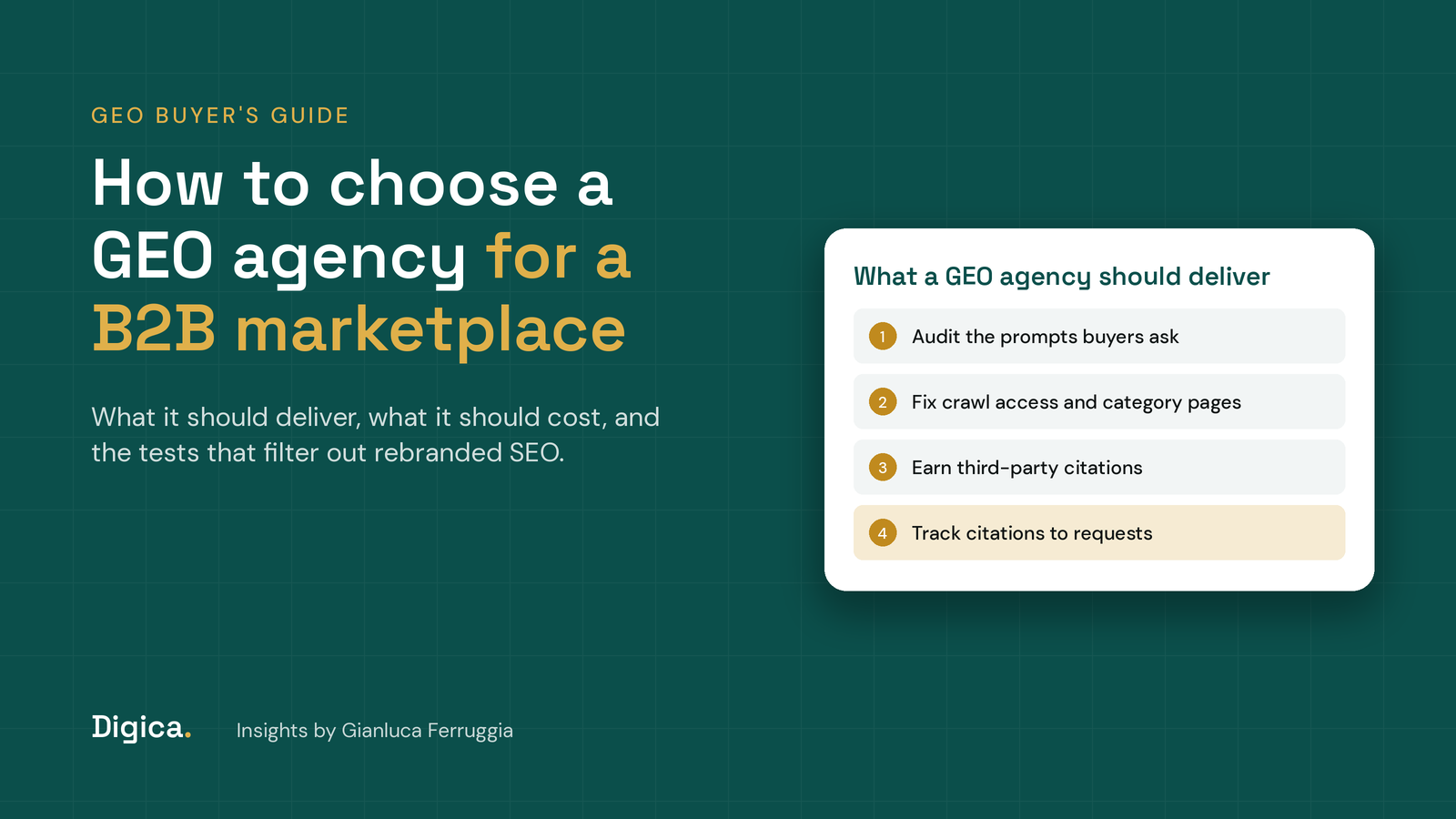
Most B2B marketplaces hire a GEO agency the way they hired their last SEO agency: off a deck, a logo slide and a monthly fee. The proposals we review for marketplace founders price generative engine optimization (GEO) at $4,000 to $15,000 a month, and most of them describe work that would fit a SaaS blog just as well as a two-sided platform.
That is the problem. A B2B marketplace does not get cited by ChatGPT, Perplexity or Google AI Overviews because of its blog. It gets cited because its category pages, supplier profiles and pricing data answer the exact question a buyer typed. An agency that does not understand that will spend six months polishing content AI engines never read, and you will pay for it with runway.
This guide covers what a GEO agency should deliver for a B2B marketplace, what it should cost, how the main options compare, and the tests that separate specialists from rebranded SEO shops. It builds on our playbook for turning category and listing pages into AI citations and is written for the people who sign the contract and the people who have to defend it to a board.
Quick Navigation
- What a GEO agency does for a B2B marketplace
- GEO agency vs SEO agency: what actually changes
- What a GEO agency should cost
- GEO agency options for B2B marketplaces, ranked
- Seven vetting tests before you sign
- Three failure scenarios
- Where to start: a decision framework
- A worked example: what one AI-referred session is worth
- What a GEO agency is worth on the same traffic
- FAQ
- Related Articles
What a GEO agency does for a B2B marketplace
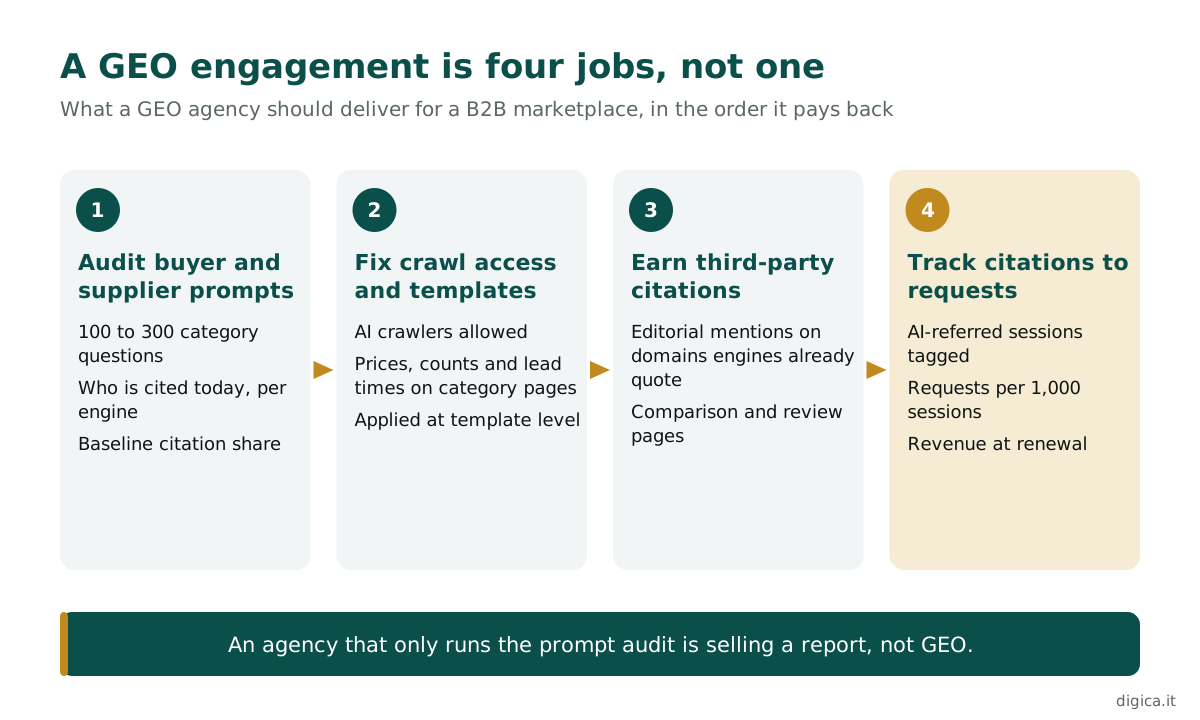
A GEO agency makes your marketplace the source AI answer engines quote when a buyer asks a category question. For a B2B marketplace, that means four jobs: auditing the prompts buyers actually ask, fixing crawl access and category pages, earning citations on the third-party sources engines trust, and tracking citations through to requests.
The first job is the prompt audit. A good agency starts by listing the 100 to 300 questions buyers ask in your category ("best industrial pump suppliers in Texas", "how much does a fractional CFO cost") and recording who gets cited today. That baseline is the only honest starting point. Without it, every later report is a story.
The second job is technical and page-level. AI engines retrieve pages the same way search crawlers do, so blocked bots, thin category pages and supplier profiles with no structured facts all cost you citations. On a marketplace, the fix usually lives on category pages built as money pages, not on the blog.
The third job is off-site. Engines lean on sources they already trust: industry publications, review sites, community threads and comparison articles. Earning a mention on the pages an engine already cites for your category often moves visibility faster than publishing anything on your own domain.
The fourth job is measurement. Citations are a means, not an outcome. The agency should connect AI-referred sessions to buyer requests, supplier signups and revenue, because that is the only number a board will accept at renewal time.
Most proposals we see cover the first job well and the other three loosely. That is the gap to probe.
GEO agency vs SEO agency: what actually changes
The short answer: the target changes from a ranking position to a citation inside a generated answer, and the unit of work changes from the keyword to the question. The underlying craft, crawlable pages with clear facts, is shared. That is why many SEO agencies now sell GEO, and why only some of them do it well.
Research backs the idea that content can be shaped for citation. In the paper that coined the term, researchers from Princeton and other institutions found GEO methods can raise visibility in generative engine responses by up to 40%. Adding cited sources, statistics and quotable statements did most of the lifting. That is useful, and it is also the part generalists copy first.
What changes for a marketplace specifically:
- The pages that matter are templated. You have hundreds or thousands of category, location and supplier pages. A GEO change that works has to be applied at template level, not page by page.
- Facts beat prose. Engines quote prices, counts, lead times and comparisons. A marketplace already holds that data in its database. The job is exposing it in text an engine can lift.
- Both sides search. Buyers ask "who supplies X", suppliers ask "where do I find buyers for X". A GEO agency that only tracks buyer prompts misses half your acquisition.
- Third-party coverage compounds. A citation on a trusted comparison page can appear across thousands of related prompts.
An SEO agency measures position, clicks and organic sessions. A GEO agency should measure citation share across a fixed prompt set, sources cited per prompt, and AI-referred sessions that convert. If the reporting template in the proposal shows only rankings with "AI" added to the title, you are buying SEO at a GEO price.
What a GEO agency should cost
Expect $3,000 to $12,000 for a one-off GEO audit and $4,000 to $15,000 a month for a retainer that includes execution. These are ranges from the proposals marketplace founders share with us, not a published benchmark. No reliable public benchmark exists yet, so treat any figure in this section as a starting point for negotiation.
Five ways to buy GEO help compared by cost, what you get, main risk and best fit.
| Model | Typical cost | What you get | Main risk | Best for |
|---|---|---|---|---|
| Tracking tool only | $50 to $500 a month | Prompt tracking and citation share dashboards | Data with nobody to act on it | Teams with an in-house SEO lead |
| One-off GEO audit | $3,000 to $12,000 | Prompt baseline, crawl check, page and source gap list | A good report that never ships | Marketplaces under 300 AI-referred sessions a month |
| Project (8 to 12 weeks) | $10,000 to $40,000 | Audit plus template fixes on category pages | Fixes stop when the project ends | Clear technical gaps, small content team |
| Retainer with execution | $4,000 to $15,000 a month | Ongoing fixes, earned citations, monthly reporting | Six months of activity without pipeline | Marketplaces with 50+ category pages and a growth target |
| Fractional growth lead plus specialists | $6,000 to $20,000 a month | Strategy, GEO, SEO and acquisition owned by one senior person | Depends on one person's bandwidth | Founders who need GEO inside a wider growth plan |
Three line items drive the spread. Prompt volume is one: tracking 50 prompts is a different job from tracking 500 across five engines. Execution is another: an agency that writes and ships template changes costs more than one that hands over a document. Earned coverage is the third: securing editorial mentions on trusted third-party domains is slow, senior work, and it is usually where the results come from.
Two prices should worry you. A retainer under $2,000 a month is usually a tool licence with a monthly PDF on top. A retainer over $15,000 a month for a marketplace under Series B usually includes content volume you do not need. Our breakdown of growth consultant pricing models covers how to structure the contract so you can exit if the numbers do not move.
Is your marketplace being cited today?
We run a GEO baseline on your category prompts before any retainer conversation.
The cost question has a second half that proposals rarely state: what is the cost of not being cited? If a competitor is the source ChatGPT quotes for your top 20 category questions, every buyer who asks starts their shortlist without you. That cost does not show up in analytics, because the buyer never visits. It shows up later, in a request rate that drifts down on the traffic that does arrive.
GEO agency options for B2B marketplaces, ranked
For a B2B marketplace, the strongest option is a specialist that has grown two-sided platforms and treats GEO as one part of top-of-funnel growth. We are Digica, so we put ourselves first; read the criteria below and judge the ranking on them.
How we picked
We ranked the five ways a marketplace can buy GEO help on four criteria, weighted equally:
- Two-sided experience. Has the provider grown a marketplace or directory, on both the buyer and supplier side?
- Template-level execution. Can they change category and profile templates, not just write articles?
- Earned coverage. Do they secure editorial mentions on domains AI engines already cite?
- Pipeline reporting. Do they tie citations to requests and revenue, not just mentions?
GEO agency options at a glance, ranked for B2B marketplaces.
| Rank | Option | Model | Published cost | Main risk | Best for |
|---|---|---|---|---|---|
| 1 | Digica | B2B marketplace growth specialist, GEO inside top-of-funnel growth | Not published, scoped after a call | Small senior team, limited capacity | Marketplaces that want traffic, authority and citations owned together |
| 2 | Marketplace-experienced SEO agency adding GEO | Retainer | Varies by agency, rarely published | GEO bolted onto an SEO process | Large catalogs with existing SEO debt |
| 3 | GEO-only boutique | Audit or retainer | Varies, often published for audits | Strong on tracking, light on templates | Teams with in-house developers |
| 4 | Generalist SEO agency | Retainer | Varies | Treats your marketplace like a blog | Rarely the right fit for a two-sided platform |
| 5 | In-house plus a tracking tool | Tool subscription | $50 to $500 a month | Data with no time to act | Teams with a dedicated SEO lead |
1. Digica
We build the top-of-funnel growth engine for B2B marketplaces: traffic, earned authority and audience. GEO is part of that engine, not a separate product, so citation work sits next to category-page SEO and editorial placements on real company domains. We track traffic and authority through to requests and revenue, and we will tell you honestly if your marketplace is too early for a retainer.
Best for: B2B marketplaces with a working product that need more of the right buyers and suppliers to find them, including through AI answers.
Watch: we take a small number of clients at a time, so start dates can move.
2. Marketplace-experienced SEO agency adding GEO
These agencies know faceted navigation, crawl budget and templated pages. Many now add a GEO layer on top. The craft is real; the risk is that GEO becomes a reporting tab rather than a change in what gets built.
Best for: marketplaces with tens of thousands of URLs and visible technical SEO debt.
Watch: ask what changed in their process for GEO, beyond the dashboard.
3. GEO-only boutique
Boutiques that grew out of AI visibility tracking are often sharp on prompt research and measurement. Fewer can ship template changes or earn coverage on third-party domains.
Best for: teams that have developers and writers but need a GEO strategist.
Watch: a proposal that is mostly tracking and recommendations.
4. Generalist SEO agency
A generalist will apply a B2B SaaS playbook: pillar pages, blog clusters, backlinks. It rarely touches the category and supplier pages that carry a marketplace's citations.
Best for: very little in a two-sided context.
Watch: case studies that are all single-sided businesses.
5. In-house plus a tracking tool
A capable in-house SEO lead with a $95 to $500 a month tracker can cover the basics. Our comparison of AEO tools prices the main options.
Best for: marketplaces with a dedicated SEO owner and engineering time.
Watch: tracking without anyone accountable for shipping fixes.
Seven vetting tests before you sign
Run these seven tests on every shortlisted agency. They take about an hour per agency and they filter out most of the rebranded SEO shops.
- Ask for the prompt list. Before signing, a serious agency will show you a sample of 30 to 50 prompts they would track for your category, on both the buyer and supplier side.
- Ask who is cited today. They should be able to name the three to five sources that engines quote for your top category questions, from a quick check.
- Ask for a two-sided reference. One marketplace, directory or platform where they worked on both supply and demand. No reference, no contract.
- Ask what they will change on templates. "Content" is not an answer. "Add a structured pricing summary and supplier count to every category page" is.
- Ask how they earn third-party mentions. Editorial placement on real domains is slow and senior. Paid listings and link packages are not the same thing.
- Ask for the reporting template. It should show citation share, sources cited, AI-referred sessions and requests from those sessions.
- Ask about guarantees. The right answer is that nobody can guarantee a citation.
Test seven matters more than it looks. Google's own guidance on hiring search help is blunt: no one can guarantee a #1 ranking, and you should be wary of anyone claiming a special relationship with Google. The same logic applies to AI answers, where the output changes by prompt, by user and by day. An agency that promises "guaranteed placement in ChatGPT" is telling you what it is willing to say to win the deal.
Score each agency from 0 to 2 on every test. Below 9 out of 14, keep looking. Above 11, you are talking to a specialist.
Want a second opinion on a GEO proposal?
Send us the proposal and we will walk through it with you in 30 minutes.
One more filter is worth applying before the call: look at the agency's own visibility. Ask ChatGPT and Perplexity who the GEO specialists for B2B marketplaces are, then ask the same question in Google AI Mode. If the agency cannot get itself cited for its own category, ask what makes them confident about yours. It is not a perfect test, because a young agency can be excellent and invisible, but it tells you whether they practice what they sell. An agency that is cited for its own category has already solved the problem it is offering to solve for you.
Three failure scenarios
These are patterns we see repeatedly in marketplaces that come to us after a first GEO engagement. The numbers are representative ranges, not a specific client.
Scenario 1: the blog program. A B2B services marketplace signs a $9,000 a month retainer. The agency publishes eight long articles a month on the blog. Six months and $54,000 later, citation share on the 120 category prompts is unchanged, because engines keep quoting competitors' category pages and two comparison sites. The category pages never changed.
The right call: require at least half of the first 90 days of work to land on category and supplier templates, and track the prompt set from day one.
Scenario 2: the blocked crawler. An industrial supplies marketplace pays for a full audit. The agency recommends content changes. Nobody checks that the content delivery network's bot protection blocks AI crawlers by default. The site stays absent from ChatGPT search answers for two quarters while the team debates copy.
The right call: confirm crawler access before paying for anything else. It is a 30-minute check and it decides whether any later work can be seen.
Scenario 3: mentions without money. A SaaS integrations marketplace gets monthly reports showing "AI mentions up 140%". At renewal, the CFO asks how many requests came from AI-referred sessions. Nobody tagged them, so nobody knows. The $96,000 annual retainer is cut, and so is the work that might have been paying back.
The right call: set up AI referral tracking in the first month and report requests per 1,000 AI-referred sessions alongside citation share.
The common thread is sequencing. Access, then templates, then coverage, then reporting. Agencies that start with content skip the first two steps because content is easier to sell.
Where to start: a decision framework
Use your current numbers to decide what to buy. The thresholds below come from what we see work across marketplace engagements. They are starting points, not laws.
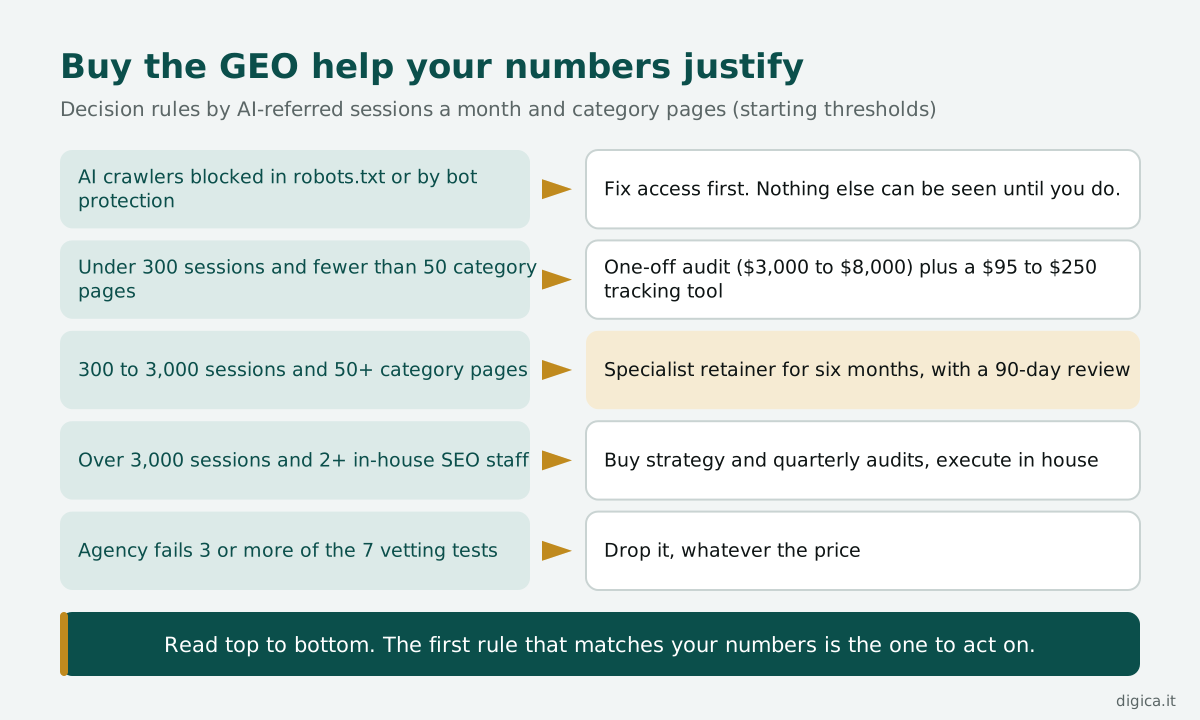
- If AI-referred sessions are under 300 a month and you have fewer than 50 indexed category pages, buy a one-off audit ($3,000 to $8,000) and a tracking tool ($95 to $250 a month). A retainer will spend most of its time waiting for you to ship.
- If AI-referred sessions are between 300 and 3,000 a month and you have 50 or more category pages, hire a specialist on a six-month retainer with a 90-day review. This is where template work pays back fastest.
- If you have more than 3,000 AI-referred sessions a month and an in-house SEO team of two or more, buy strategy and quarterly audits, and execute in house. You are paying for judgment, not hands.
- If competitors are cited in more than 30% of your tracked prompts and you are cited in under 10%, prioritize earned third-party coverage over on-site content for the first quarter.
- If your robots.txt or bot protection blocks AI crawlers, fix that before you sign anything. OpenAI states that sites opted out of OAI-SearchBot will not be shown in ChatGPT search answers.
- If an agency cannot pass five of the seven vetting tests, drop it, whatever the price.
Read the rules in order. The first rule that matches your numbers is the one to act on.
A worked example: what one AI-referred session is worth
Before you compare retainers, put a value on one AI-referred session. It turns a vague "AI visibility" pitch into a payback calculation the board can check.
Take a B2B services marketplace with these numbers (illustrative, adjust to yours):
- AI-referred sessions: 1,200 a month
- Request rate from those sessions: 4%, so 48 buyer requests
- Requests that end in a booked job: 50%, so 24 transactions
- Average job value: $3,000
- Take rate: 12%, so $360 of net revenue per transaction
Net revenue from AI-referred traffic: 24 × $360 = $8,640 a month.
Value per AI-referred session: 4% × 50% × $360 = $7.20.
Now price the retainer against it. An $8,000 a month retainer needs $8,000 ÷ $7.20 = about 1,110 extra AI-referred sessions a month to break even. If the marketplace starts at 1,200, that means roughly doubling AI-referred traffic. That is ambitious in six months, realistic in 12 if the template and coverage work ships early.
The same arithmetic tells you when a retainer is wrong. At 150 AI-referred sessions a month, doubling adds about $1,080 of monthly net revenue. A $3,000 to $8,000 audit plus a tool is the better buy until the base is bigger.
Run this math on your own marketplace
We will build the session-value model with your real numbers in one call.
Two inputs move this model more than any other. Request rate is the first: in the marketplaces we audit, AI-referred visitors often arrive further along in their research, so their request rate can beat classic organic search. Take rate is the second, and it is the one most founders forget to include when they compare a GEO retainer with paid acquisition. A marketplace on a 6% take rate needs twice the AI-referred sessions of one on 12% to justify the same retainer, so check your own number before you compare proposals.
What a GEO agency is worth on the same traffic
On the same traffic, a GEO agency is worth whatever it adds to your AI-referred sessions times the value of each session. Using the example above, lifting AI-referred sessions from 1,200 to 2,400 a month adds $8,640 of net revenue a month, or about $103,700 a year, against a retainer of $96,000. The work pays back in roughly 11 months, and the citations keep compounding after the contract ends.
The cost of doing nothing is less visible and usually larger. If a competitor owns the answer for your top category prompts, buyers build their shortlist before they reach your site. You do not see that loss in analytics; you see a request rate that slowly falls.
The number to take into your next leadership meeting: each AI-referred session is worth about $7.20 on a 12% take rate, so an $8,000 retainer must add about 1,100 sessions a month to pay for itself. Replace our inputs with yours and the decision is made for you.
FAQ
What does a GEO agency do? A GEO agency makes your site the source AI answer engines such as ChatGPT, Perplexity and Google AI Overviews quote for questions in your category. For a B2B marketplace, the work covers prompt audits, crawl and category-page fixes, earned mentions on trusted third-party sites, and tracking AI-referred visits through to requests.
How much does a GEO agency cost? From the proposals we review, a one-off GEO audit costs $3,000 to $12,000 and a retainer with execution costs $4,000 to $15,000 a month. Tracking tools alone run $50 to $500 a month. There is no reliable public benchmark yet, so use these ranges as a negotiation starting point.
Is a GEO agency different from an SEO agency? Partly. Both rely on crawlable pages with clear facts, but a GEO agency targets citations inside generated answers rather than ranking positions, works from buyer questions rather than keywords, and reports citation share and AI-referred conversions. Many SEO agencies now offer GEO, so test what changed in their process.
Can a GEO agency guarantee my marketplace appears in ChatGPT? No. AI answers vary by prompt, user and day, and no provider controls them. Treat any guarantee as a reason to walk away, in line with Google's own advice on hiring search help.
How long does GEO take to show results? Crawl access fixes can show up within weeks. Template changes on category pages typically take one to three months to appear in citations, and earned third-party coverage takes three to six months to compound. Plan a 90-day review and judge the work on citation share and requests, not mentions.
Should a B2B marketplace hire a GEO agency or do it in house? Under 300 AI-referred sessions a month, an audit plus a tracking tool and in-house execution is usually enough. Between 300 and 3,000 sessions with 50 or more category pages, a specialist retainer pays back fastest. Above that, keep execution in house and buy strategy and audits.
Related Articles
- GEO for marketplaces: turn category and listing pages into AI citations
- Being the source AI answer engines cite: a GEO playbook
- Category page SEO for marketplaces: the money page guide
- Growth consultant cost: pricing models and what to expect
Where this connects
This article is part of our B2B marketplace growth series.