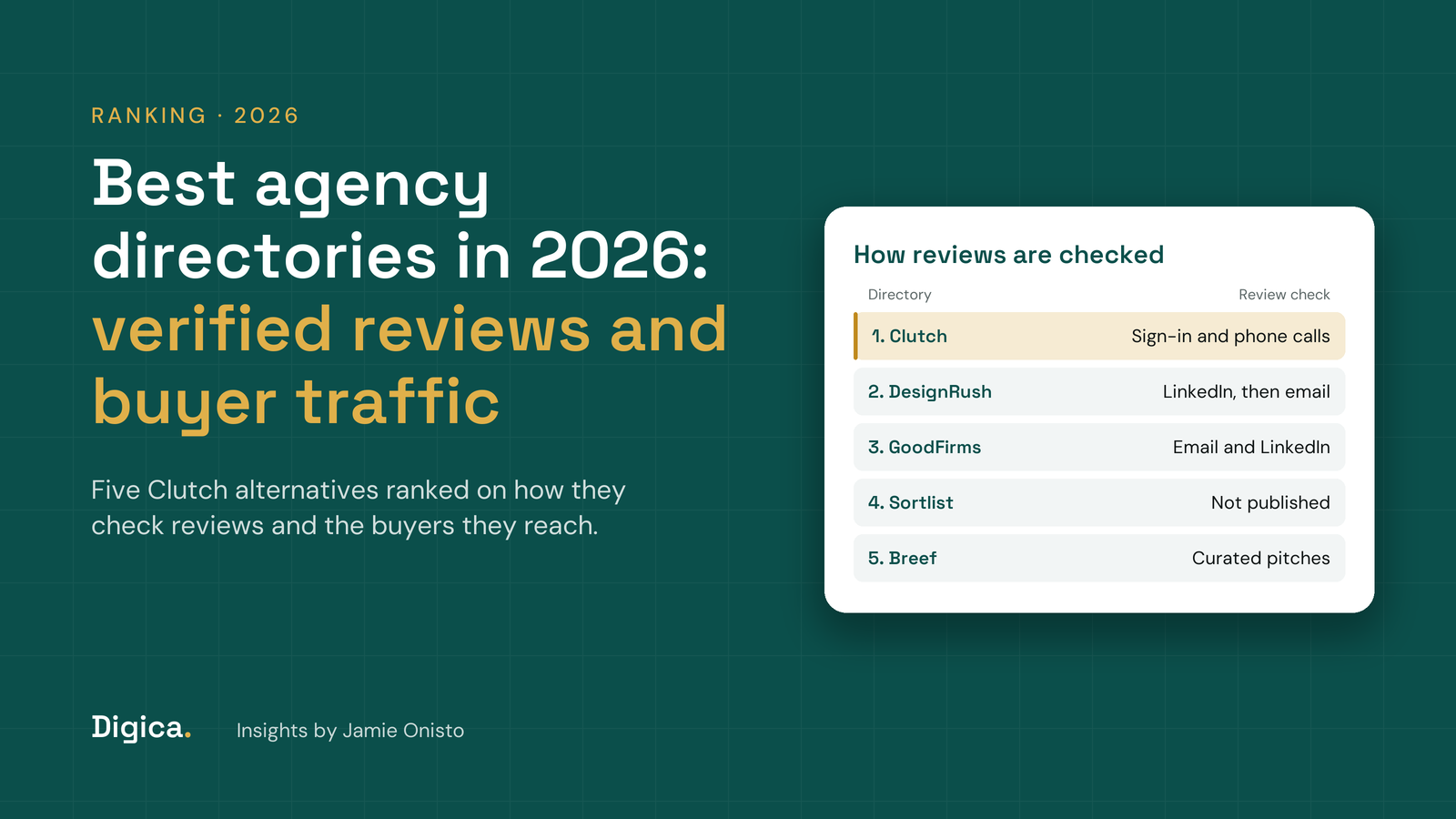
The best agency directories in 2026, ranked on verified reviews and buyer traffic, with the Clutch alternatives worth a look
An agency directory is a B2B marketplace where companies look for marketing, design, development and IT agencies, read client reviews, and contact a shortlist. The biggest is large: Clutch says it lists more than 400,000 service providers in over 1,900 categories. For a buyer, that scale is both the point and the problem. A category page with 3,000 agencies is only useful if the reviews on it are real and the order on the page means something.
Both are under scrutiny. Since October 21, 2024, the US Federal Trade Commission's rule banning fake reviews and testimonials has covered fake and AI-generated reviews, undisclosed insider reviews and company-controlled sites that pose as independent. Every directory in this guide now publishes how it checks reviews. Fewer explain clearly how paid placement changes what you see first.
This guide ranks five of the biggest agency directories and Clutch alternatives on two things: how each one verifies reviews, and how many buyers it says it reaches. Figures are each directory's own claims, checked on October 18, 2026. It is written for B2B buyers choosing an agency, and for agencies deciding where to be listed, the question we work on in professional services marketplace growth.
Disclosure: Digica's founder, Gianluca Ferruggia, was previously General Manager of DesignRush. DesignRush is not a Digica client, and its figures below are its own public claims.
Quick Navigation
- Five agency directories, ranked
- 1. Clutch: the deepest pool of verified reviews
- 2. DesignRush: marketing and web design shortlists
- 3. GoodFirms: software and IT outsourcing
- 4. Sortlist: post a brief, get matched
- 5. Breef: curated pitches instead of reviews
- How verified is a verified review?
- Paid placement and what it buys
- Three failure scenarios
- Choosing a directory: a decision framework
- The number to take to your next shortlist meeting
- FAQ
- Related Articles
Five agency directories, ranked
The short answer: Clutch ranks first for the depth of its review checks and the size of its buyer audience, DesignRush second for marketing and web design, GoodFirms third for software and IT, Sortlist fourth for brief-based matching in Europe, and Breef fifth for buyers who want curated pitches rather than reviews.
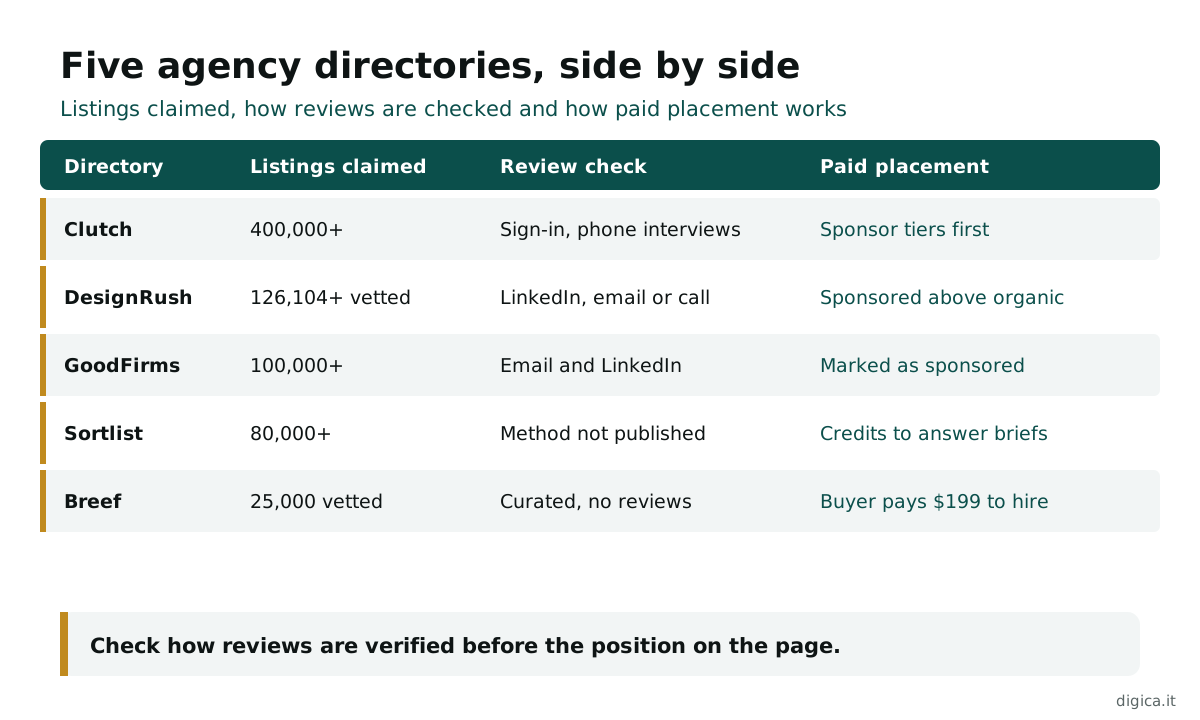
Five agency directories compared on listings, review checks, buyer reach, paid placement, risk and fit
| Rank | Directory | Listings it claims | How reviews are checked | Buyer reach it claims | Paid placement | Main risk | Best for |
|---|---|---|---|---|---|---|---|
| 1 | Clutch | 400,000+ providers | Sign-in with LinkedIn, Google or company email; optional phone interviews | 15 million business leaders a year | Sponsor tiers listed first on category pages | Default order is paid first | Verified reviews across IT, development and marketing |
| 2 | DesignRush | 126,104+ agencies vetted, 49% of applicants rejected | Reviewer checked through LinkedIn, then email or call if needed | 1,000,000+ monthly B2B visitors | Sponsored listings above organic | Agency counts vary across its pages | Marketing, branding and web design in the US |
| 3 | GoodFirms | 100,000+ companies | Business email and LinkedIn cross-checked; unverifiable reviews rejected | 2 million+ monthly users | Sponsored listings marked as such | Skews to offshore software firms | Software and IT outsourcing |
| 4 | Sortlist | 80,000+ providers | Says reviews come from verified clients; method not published | Not published | Agencies pay credits to answer briefs | Who answers depends on who pays | European buyers who post a brief |
| 5 | Breef | 25,000 vetted agencies | Agencies vetted, no public reviews | 60,000+ marketers and founders | Buyer pays $199 when it hires | Few public reviews to check | Fast, scoped pitches in the US |
Read the review column before the traffic column. A large audience only helps you if the reviews it reads are real.
1. Clutch: the deepest pool of verified reviews
Clutch, based in Washington, DC, is the largest agency directory by its own count, with more than 400,000 service providers across more than 1,900 categories. It says it is visited by 15 million business leaders a year from 194 countries, and its May 2026 announcement of ClutchAI cited more than 1.4 million monthly users.
Its review checks are the most layered here. Reviewers must sign in with LinkedIn, Google or a company email, and Clutch checks identity and work history. Reviews it cannot verify but still considers useful are published with a "Not Verified" label rather than hidden. For providers on a paid or verified plan, Clutch also runs 15-minute phone interviews with clients and transcribes them onto the profile.
Ranking is where buyers should look twice. Clutch scores providers out of 40 points on reviews, market presence and client experience, and plots them on a Leaders Matrix. But the default order of a category page follows sponsorship tiers, from Quadruple Diamond down to Starter, with Clutch Rank only ordering sponsors within each tier. Clutch says sponsorship does not affect the Leaders Matrix, so that is the view to use for a shortlist.
Why it ranks first: the most detailed review verification and the largest claimed audience. Switch from the default list to the Leaders Matrix before you shortlist.
2. DesignRush: marketing and web design shortlists
DesignRush, founded in 2017, focuses on marketing, branding, web design and development agencies. Its directory pages say it has vetted 126,104+ agencies and rejected 49% of applicants, and its advertising page claims 1,000,000+ monthly B2B visitors. Other DesignRush pages give lower agency counts, so treat the totals as approximate.
Running an agency directory or services B2B marketplace?
In 30 minutes we look at how buyers search for agencies in your niche, and where your listings, reviews and proof pages lose them.
Its reviewers are checked through their LinkedIn profiles, with email or phone checks where needed. Ratings use a weighted average that pulls agencies with few reviews toward a baseline, so one five-star review does not put a new agency at the top. Reviews are the heaviest factor in its organic ranking, alongside services, portfolio, awards and team expertise.
Paid placement is stated plainly: sponsored listings appear above organic positions, and DesignRush says sponsorship does not change star ratings or review content. It also runs a project marketplace where only verified agencies can bid on posted briefs, and publishes monthly agency rankings and design awards.
Why it ranks second: a large US-focused audience and clear rules on reviews and sponsorship for marketing and design buyers. Check the agency count on the page you are reading rather than the headline total.
3. GoodFirms: software and IT outsourcing
GoodFirms, founded in 2014 and based in Las Vegas, Nevada, says it lists 100,000+ technology companies with 80,000+ client reviews and reaches 2 million+ monthly users. Its strength is software development, app development and IT outsourcing.
Its verification rule is stricter than most on one point. GoodFirms says it cross-checks each reviewer's business email and professional profile against the company, may contact reviewers on larger engagements, screens for financial or employment ties, and rejects reviews it cannot verify rather than publishing them with a label. A separate paid badge checks the provider's incorporation and tax documents.
Sponsored listings are marked as sponsored, and GoodFirms says sponsorship does not change ratings or reviews. The weak spot is data quality: some category pages show placeholder statistics, and the pool leans heavily toward offshore development firms.
Why it ranks third: strict review rules and a deep pool for software buyers. Less useful if you need a brand or creative agency.
4. Sortlist: post a brief, get matched
Sortlist, based in Brussels, Belgium, works differently from the three above. Instead of browsing lists, the buyer posts a brief, and agencies respond. Sortlist says it has 80,000+ providers with 31,282 reviews from verified clients. It bought the German directory Agenturmatching in 2020 and the sales software company Overloop in November 2024.
Its reach is strongest across Belgium, France, Spain, Germany, the Netherlands and the UK. It does not publish a monthly audience figure, and its review verification method is not public beyond the "verified clients" label.
Do buyers find your agency on the directories, then choose someone else?
A growth audit maps how buyers search for agencies like yours, on directories, on Google and in AI answers, and which proof pages they never reach.
The model shapes what you see. Agencies pay credits to respond to a brief, so the agencies that answer are the ones willing to pay for the lead. That is efficient for a buyer who wants responses fast, but it is a filter on budget as much as on fit.
Why it ranks fourth: the best option for European buyers who would rather post a brief than read reviews. Ask agencies for references outside the platform.
5. Breef: curated pitches instead of reviews
Breef, founded in New York in 2019 and now headquartered in Denver, Colorado, is a curated B2B marketplace rather than a review directory. It says it has 25,000 vetted agencies, has seen $500 million in projects created, and is trusted by 60,000+ marketers, creatives and founders in 27 countries.
The buyer side is priced openly: free to search, $199 when you hire, with cash back on agency spend for enterprise buyers. Breef strategists help scope the brief and curate the pitches.
What Breef does not offer is a large body of public reviews. You rely on its vetting and on the pitches, not on what past clients wrote.
That suits a buyer with a clear brief and a short timeline. It suits less well a buyer who wants to read what ten past clients said before talking to anyone, which is the job the review directories above do better. Use Breef for speed, and a review directory for due diligence on the agency it suggests.
Why it ranks fifth: fast, scoped pitches for US marketing and creative projects. Weakest on the lens of this guide, because verified public reviews are not its model.
How verified is a verified review?
"Verified" means different things on different directories. The checks fall into four levels.
The first is identity: is the reviewer a real person at a real company? Clutch, DesignRush and GoodFirms all check this through LinkedIn, a company email or a sign-in. The second is relationship: did that person actually hire the agency? Phone interviews, as Clutch runs, are the strongest public test. The third is independence: is the reviewer an employee, friend or paid contact of the agency? GoodFirms says it screens for these ties. The fourth is what happens to a review that fails: published with a label, as on Clutch, or rejected, as on GoodFirms.
The level a directory reaches matters more than the number of reviews it shows. A profile with 15 phone-verified reviews tells you more than one with 60 reviews that only passed a sign-in check. When two agencies look similar, compare the verification label on their reviews before you compare the stars.
There is a reason to care. A June 2025 Gartner survey found 61% of B2B buyers prefer a buying experience without a sales rep. When buyers shortlist without talking to anyone, the reviews they read do the work a reference call used to do.
The practical test: open three reviews for an agency you are considering and check whether the reviewer's name, title and company are shown, whether the review says how it was verified, and whether the project dates and budget are plausible. If two of the three fail, discount the rating.
Paid placement and what it buys
Every directory in this guide sells visibility, and that is not a scandal. It is how they pay for verification teams and buyer traffic. What matters is whether the paid order is labelled and whether a neutral view exists.
Clutch, DesignRush and GoodFirms all place sponsored agencies above organic ones on category pages, and all three say sponsorship does not change ratings or review content. Clutch also offers a Leaders Matrix that sponsorship does not affect. Sortlist charges agencies per lead rather than per position. Breef charges the buyer instead.
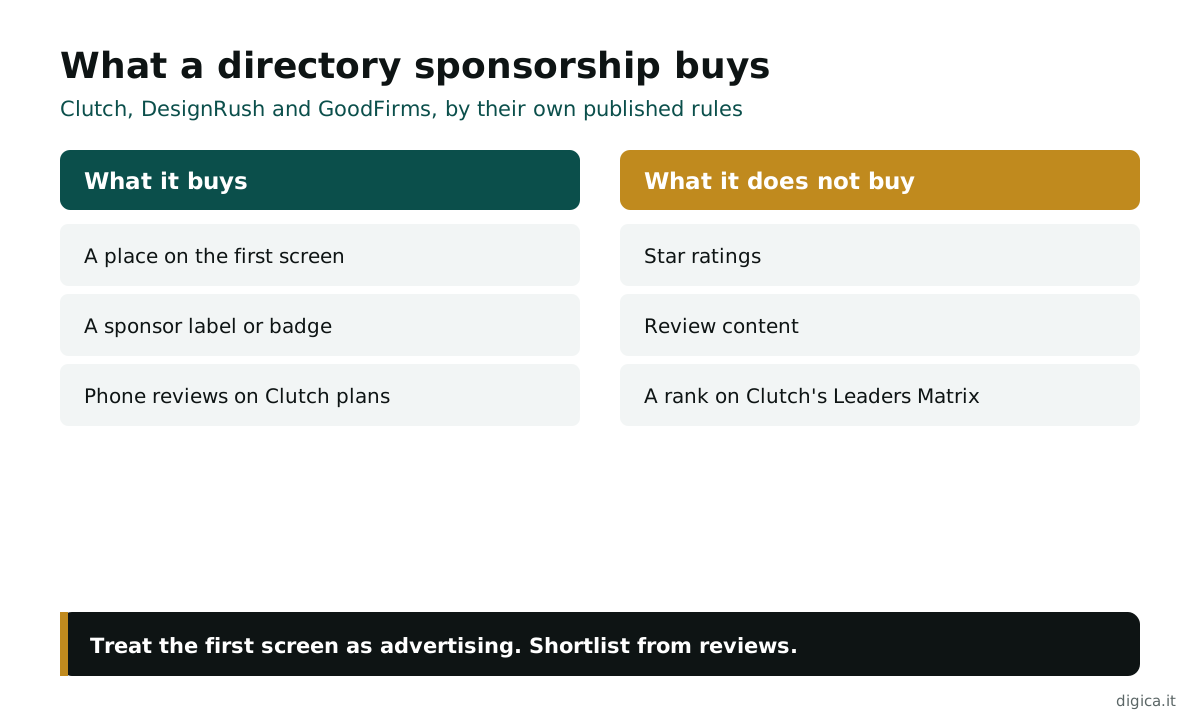
For a buyer, the rule is simple: treat the first screen of any category page as advertising, and switch to a ranking, matrix or filter view before you shortlist. For an agency, the rule is the reverse. A sponsorship buys position, but it does not buy reviews. An agency at the top of the page with three reviews will lose to one in the organic list with forty. Buyers scroll past the sponsored band more often than agencies expect, especially when the organic results carry more detailed reviews.
Three failure scenarios
These are the patterns that recur when buyers and agencies use directories badly.
- The shortlist that was an ad slot. A buyer takes the first five agencies on a category page, all of them sponsors. Two have fewer than five reviews, the chosen agency misses the first deadline, and the project restarts with a second agency three months and $60,000 later.
- The rating that was never checked. A buyer picks an agency with a 4.9 rating built on reviews from contacts who never hired it. The directory labels some reviews as not verified, but nobody on the buying side looked.
- The listing nobody maintained. An agency pays for a top tier for a year, never asks clients for reviews, and gets few leads. A competitor on the free tier with 40 detailed reviews wins the same buyers.
The fix is the same on both sides: reviews first, position second.
Choosing a directory: a decision framework
Use these decision points to choose where to start.
- If you need a development or IT partner, start with Clutch's Leaders Matrix, then check GoodFirms.
- If you need a marketing, branding or web design agency in the US, start with DesignRush and Clutch.
- If you are in Europe and would rather post a brief than browse, use Sortlist.
- If you need scoped pitches in two weeks or less, use Breef.
- If the project is above $50,000, ask each shortlisted agency for two references outside the directory, whatever the rating.
- If you run an agency, invest in client reviews before you buy a higher tier; a profile with fewer than ten reviews rarely benefits from sponsorship.
Running an agency and losing shortlists to rivals?
We help digital, design and development agencies win the buyers who compare them on directories, in search and in AI answers.
Whichever directory you use, keep a short record of each search: agencies contacted, agencies that replied within a week, and the review that most influenced your choice. After two projects, that record tells you which directory sends you the right agencies, and which only sends you the ones that paid to be seen. Share that record with whoever runs the next agency search in your company, so the next shortlist starts from evidence rather than from the first page of a category.
The number to take to your next shortlist meeting
Review quality is a real problem, not a theory. TrustRadius reports in its Review Quality Report 2025 that it published only 51.6% of the reviews submitted to it in 2024, rejecting the rest mostly for poor quality, AI-generated text or suspicious behavior. If a review site that screens hard rejects nearly half of what it receives, assume some of what you read on any directory would not pass. The biggest cost of skipping the check is a project restarted with a second agency, which on a $60,000 engagement can mean paying for the same work twice, and ten minutes spent checking the reviews avoids most of that risk.
FAQ
What is an agency directory? An agency directory is a B2B marketplace where companies search for marketing, design, development and IT agencies, read client reviews and contact a shortlist. Clutch, DesignRush, GoodFirms and Sortlist are among the largest.
What are the best Clutch alternatives? DesignRush for marketing and web design agencies, GoodFirms for software and IT outsourcing, Sortlist for brief-based matching in Europe, and Breef for curated pitches in the US.
How does Clutch verify reviews? Clutch asks reviewers to sign in with LinkedIn, Google or a company email and checks their identity and work history. It also runs 15-minute phone interviews with clients for providers on paid or verified plans, and labels reviews it cannot verify as "Not Verified".
Do agencies pay to rank higher on directories? Agencies can pay for sponsored placement above organic listings on Clutch, DesignRush and GoodFirms. All three say sponsorship does not change ratings or review content, and Clutch's Leaders Matrix is not affected by sponsorship.
Are fake reviews illegal in the US? Since October 21, 2024, an FTC rule bans fake and AI-generated reviews, undisclosed insider reviews and company-controlled sites posing as independent review sites, with civil penalties for knowing violations.
Is a sponsored agency worse than an organic one? Not necessarily. Sponsorship buys position, not quality. Judge every agency on the number, detail and verification of its reviews, whatever its place on the page.
Related Articles
- Professional services marketplace growth
- Best B2B marketplace growth consultants
- Best talent marketplaces in 2026: who vets hardest
- Best freelance marketplaces for businesses in 2026
- Best AI tools directories in 2026, compared on traffic
This article is part of our B2B marketplace growth series. Browse more on the Digica blog.