Growth Consultant Cost: Pricing Models and What to Expect
Ask five growth consultants what they charge and you will get five answers, from $35 an hour to a five-figure monthly retainer. The spread is real, but it hides the question that matters: what are you buying, and what should exist by day 90 that did not exist on day 1?
Most companies compare the wrong numbers. They put an hourly rate next to a retainer next to a salary, and pick the cheapest line. Then they find out in month four that the cheap option produced a strategy deck and no pipeline. The price of that mistake is not the fee. It is two quarters of growth you did not get.
This guide breaks down what a growth consultant, a fractional CMO for marketplaces and an embedded growth team actually cost, using published rate data where it exists and clearly labelled worked examples where it does not. It is written for B2B marketplaces, agencies, communities and SaaS platforms, but the maths travels.
Quick Navigation
- Three things people mean by growth consultant
- What the published rate data says
- The four pricing models
- What moves the price up or down
- What you should have by month 3
- Consultant vs full-time hire vs agency
- Three failure scenarios
- How to compare two proposals
- The payback maths
Three things people mean by growth consultant
"Growth consultant" covers three very different products. Price them side by side and they look like rivals. They are not. They do different jobs.
The advisor. A senior person who diagnoses, recommends and reviews. They join a weekly call, read your dashboards and tell your team what to do next. They do not run campaigns. You pay for judgement. Your team supplies the hands.
The fractional CMO. A senior marketing leader who owns the plan, the budget and often the team, for one to three days a week. They hire, they set targets, they sit in leadership meetings. You pay for leadership without a full-time salary.
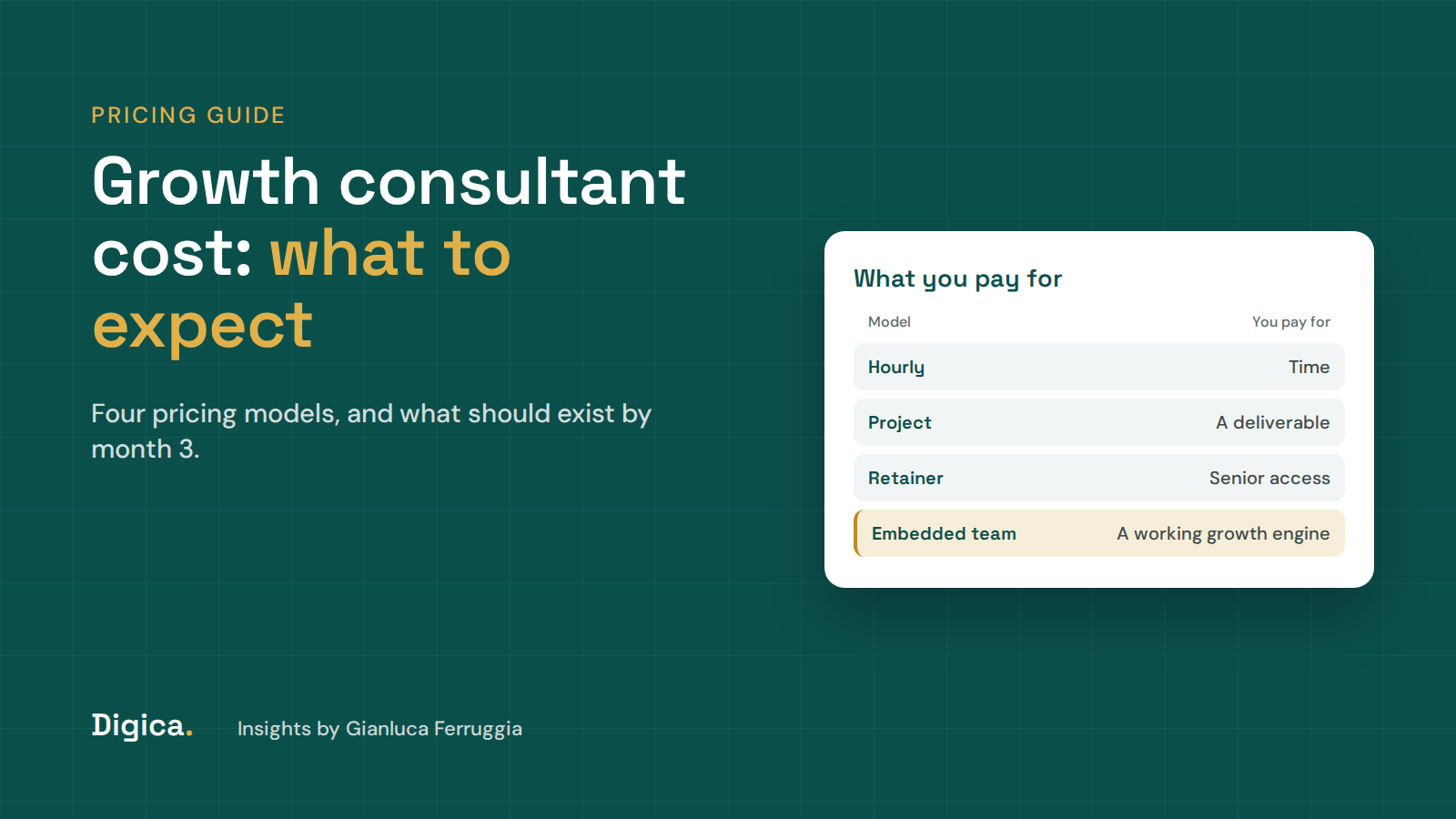
The embedded growth team. A small group that plugs into your company and does the work: SEO, content, partnerships, outbound, conversion fixes, reporting. Think of it as renting a working growth engine rather than a mechanic who tells you what is wrong with yours.
The confusion costs money. A company that needs execution hires an advisor and gets a sharp plan nobody has time to run. A company that needs direction hires an execution team and gets a lot of activity pointed nowhere. Decide which problem you have before you look at a single price.
A quick test. If your team has spare capacity and no clear plan, you need an advisor. If you have a plan, a budget and no one to own the number, you need a fractional CMO. If you have neither the people nor the time, you need a team that executes.
What the published rate data says
There is no single trusted index for growth consulting rates, so the honest move is to look at a few published data points and read them as a range, not a price list.
At the bottom of the market, freelance platforms show where generalist rates sit. Upwork's published data on marketing consultant hourly rates puts the median at $35 an hour, with most rates between $20 and $60. That is the price of a pair of hands on a defined task, often offshore and often junior. It is useful for execution you can specify precisely. It is rarely what a growth-stage company means when it says it needs a growth consultant.
Higher up, a specialist charging $150 to $300 an hour is common for senior operators, but treat any range like that as a negotiation anchor rather than a market fact. What matters more than the hourly number is how many hours you need, who does them and what you are measuring at the end.
In our experience, three patterns hold across most quotes we see:
- Hourly suits short, defined work: an audit, a pricing review, a second opinion.
- Monthly retainers dominate ongoing growth work, because growth is a system, not a task.
- Pure performance deals are rare for senior work, because the consultant does not control your product, pricing or sales team.
Not sure what to budget?
We will look at your funnel and tell you which engagement shape and budget make sense, before any proposal.
If a quote is far below the ranges above, ask who will actually do the work. If it is far above, ask what is included that the others leave out. A low hourly rate attached to a senior name usually means the senior name sells and someone else delivers. A high retainer should come with named people, written monthly outputs and a clear exit point if the numbers do not move.
The four pricing models
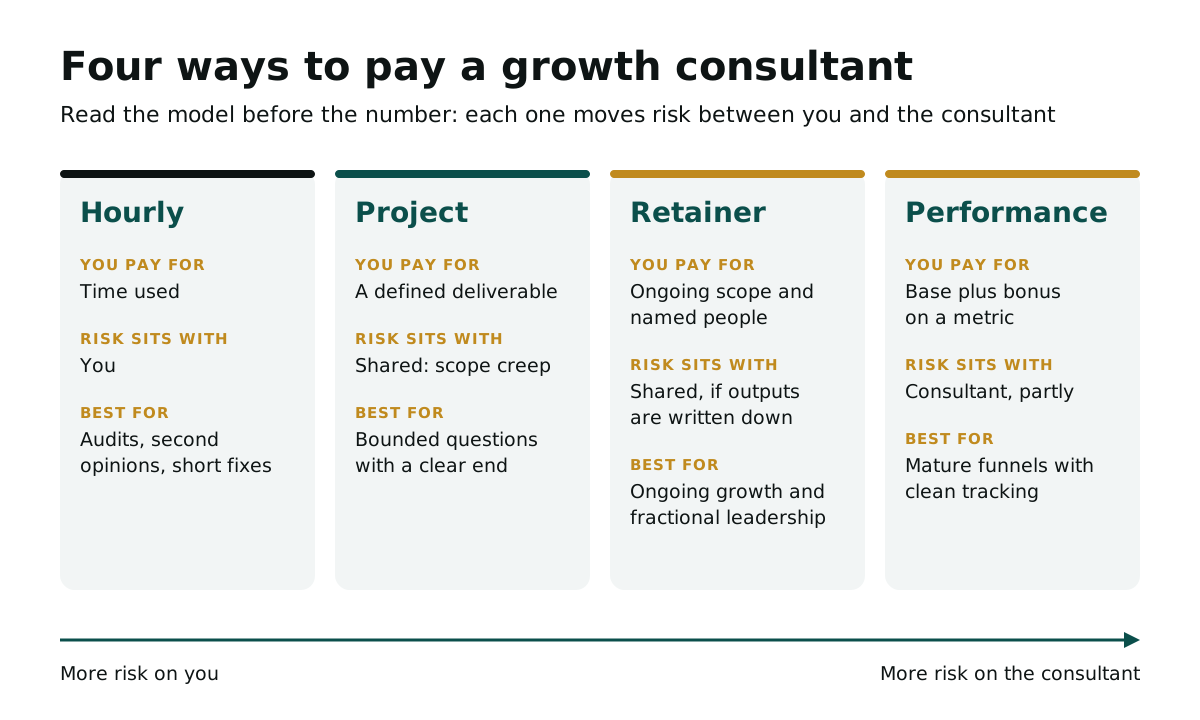
Every growth engagement is priced in one of four ways, or a blend. Each one moves risk between you and the consultant in a different way. Read the model before you read the number.
1. Hourly or daily. You pay for time. Simple, flexible, easy to stop. The risk sits with you: if the work takes longer, you pay more, and nobody is accountable for outcomes.
2. Project. A fixed fee for a defined deliverable, such as a growth audit, a GTM plan or a site migration. Good for a bounded question. The risk is scope: anything outside the brief becomes a change order.
3. Monthly retainer. A fixed fee for an agreed scope of ongoing work, usually with a minimum term. This is how most fractional CMO and embedded team engagements run. The risk is drift: without clear monthly outputs, a retainer can turn into a subscription to meetings.
4. Performance or hybrid. A lower base plus a bonus tied to a metric, such as qualified leads, new paying vendors or revenue. It aligns incentives, but only when the metric is one the consultant can genuinely move and you can measure cleanly.
| Pricing model | How cost is set | Main risk | Who carries it | Best for |
|---|---|---|---|---|
| Hourly or daily | Rate times hours used | Hours grow, outcomes unclear | You | Audits, second opinions, short fixes |
| Project | Fixed fee per deliverable | Scope creep and change orders | Shared | Bounded questions with a clear end |
| Monthly retainer | Fixed monthly fee, minimum term | Activity without output | Shared, if outputs are written down | Ongoing growth and fractional leadership |
| Performance or hybrid | Base plus bonus on a metric | Gaming the metric, attribution fights | Consultant, partly | Mature funnels with clean tracking |
A practical rule. Use a project to answer "what is wrong and what should we do". Use a retainer to answer "who is going to do it". Add a performance element only once you have six months of clean data on the metric you want to reward. If you skip that last step, you end up arguing about attribution instead of fixing the funnel, and both sides lose trust in the numbers within a quarter.
What moves the price up or down
Two quotes for "growth consulting" can differ by a factor of five and both be fair. The difference sits in a handful of variables.
Seniority. The person who designs the strategy costs more than the person who executes a task. Ask how many hours each level of seniority will spend on your account each month.
Scope. One channel costs less than four. A consultant who owns SEO, partnerships, outbound and conversion is doing the work of several specialists.
Hands or heads. Advice is cheaper per month than execution, but execution produces assets you keep: pages, content, partner contracts, sequences, dashboards.
Domain fit. A consultant who has grown a marketplace before skips months of learning. Two-sided growth has its own traps: supply without demand, demand without supply, liquidity that looks fine in aggregate and terrible per category.
How the market prices it. In a Consulting Success study of nearly 1,000 consultants, project fees were the most common model at 30%, hourly billing came second at 29%, monthly retainers 16%, value-based pricing 15% and day rates 10%. Specialists earned more: 52% of them charged $10,000 or more per project, against 18% of generalists. For a buyer, that is the useful signal. The pricing model tells you what the consultant is paid to optimise for, and specialism, not the hourly rate, is what moves the price.
The pattern we see most often is under-buying, not over-buying. A company signs a small retainer, gets a few hours a week, and expects the outcomes of a full team. Nothing breaks. Nothing compounds either. If the budget only covers a few hours, buy a sharp diagnosis and run the plan yourself, rather than a thin slice of ongoing work that never reaches critical mass.
What you should have by month 3
The price of an engagement only makes sense against what it produces. Here is the bar we hold ourselves to, and the one we suggest you hold any consultant to.
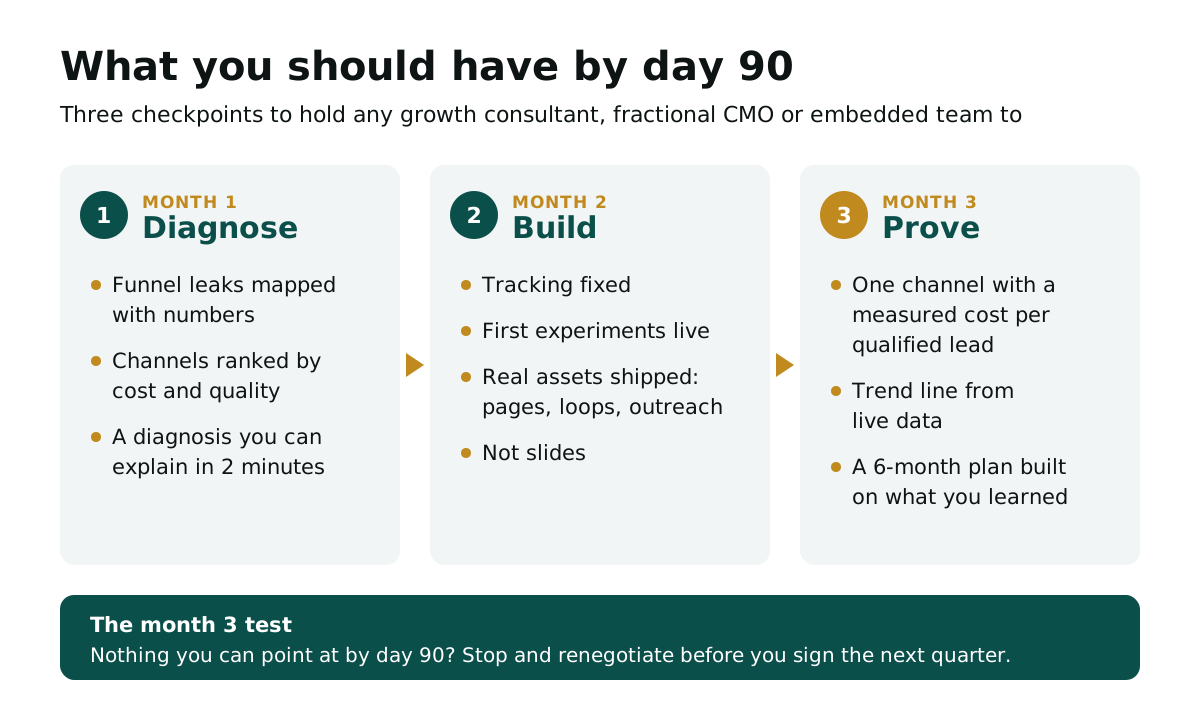
By the end of month 1: a diagnosis you agree with. A written view of where the funnel leaks, with numbers. Which channels bring qualified demand, what each costs, where conversion drops, what the competition does better. If you cannot repeat the diagnosis to your board in two minutes, it is not finished.
By the end of month 2: the engine is built. Tracking is fixed. The first experiments are live. On a marketplace, that might mean the top revenue category pages are rewritten, a vendor referral loop is running, and a partner shortlist is in outreach. Agencies and SaaS platforms will see different plays, but the principle holds: real assets shipped, not slides.
By the end of month 3: one channel with a measured unit cost. At least one channel should show a measured cost per qualified lead or per new paying account, with a trend line. Not a forecast. A number from live data. Alongside it, a six-month plan built on what the first 90 days actually showed.
Some channels take longer. Organic search and earned media compound over six to twelve months. On a water and wastewater B2B marketplace, organic impressions grew more than tenfold within six months, but the first 90 days were mostly groundwork. That is fine, as long as the groundwork is visible: pages shipped, placements earned, indexation fixed. What is not fine is month 3 arriving with nothing you can point at. If that happens, stop and renegotiate before you sign the next quarter.
The checkpoints look slightly different by business model. A B2B community should see member activation and sponsor pipeline by month 3. An agency should see qualified discovery calls from a channel it did not have before. A SaaS platform with a directory should see partner or referral signups arriving as real accounts, which in one partner motion we ran took about six weeks. Whatever the model, the test is the same: a number from live data that did not exist on day 1.
Consultant vs full-time hire vs agency
The real comparison is not one consultant against another. It is a consultant against the two alternatives you would otherwise choose: a full-time hire or an agency.
The full-time hire. The US Bureau of Labor Statistics reports that the median annual wage for marketing managers was $166,790 in May 2025. That is the median for managers, not for a head of growth or a CMO, who typically cost more. Add benefits, payroll taxes, tools and recruiting time, and a worked example makes the point. Assume a 25% load on top of salary and a three-month search: the first year costs roughly $208,000 in cash, and the role produces little for the first quarter while the person learns your market. You also take on the risk of a bad hire, which usually surfaces around month six.
The agency. Agencies are good at executing a channel you have already chosen: paid media, SEO production, design. They are less good at deciding which channel to choose, because they sell the channel they run. Expect to manage them, which means someone senior on your side still has to own strategy.
The fractional leader or embedded team. Senior judgement plus, in the embedded model, the hands to execute. You can start in weeks, scale up or down by quarter and end the engagement without severance. The trade-off is availability: they are not in your office every day, so you need clear owners on your side. In practice that means one internal owner for the growth number, a weekly working session and shared access to analytics, CRM and the website from week one. Engagements stall far more often on access than on ideas, and that delay is billed like any other week.
There is also a hidden cost in every option: your own management time. A full-time hire needs onboarding and a manager. An agency needs a brief, reviews and someone to challenge its reports. A fractional or embedded team needs decisions made quickly when it asks for them. Price that time in before you compare fees, because a cheap option that eats eight hours of a founder's week is not cheap.
| Option | Year-one cost basis | Time to impact | Main risk | Best for |
|---|---|---|---|---|
| Full-time head of growth | Salary plus roughly 25% load, see BLS median above | 4 to 6 months after hire | Wrong hire, slow ramp | Companies past product-market fit with a proven channel mix |
| Agency | Monthly retainer per channel | 1 to 3 months | Channel bias, no strategy owner | Executing a channel you have already validated |
| Advisor | Hourly or small retainer | Immediate advice, slow execution | Plan without hands | Teams with capacity and no direction |
| Fractional CMO | Monthly retainer, 1 to 3 days a week | 1 to 2 months | Thin presence if days are too few | Owning the plan and the team before a full-time hire |
| Embedded growth team | Monthly retainer with defined outputs | 1 to 3 months | Dependence if knowledge is not handed over | Full-funnel growth without building a team first |
Hire, agency or embedded team?
Bring your current team and budget and we will map which option gets you to a measured channel fastest.
For most B2B marketplaces between seed and Series B, we see the same sequence work: a diagnosis first, an embedded or fractional engagement for 6 to 12 months, then a full-time hire into a function that already has a working playbook. The hire ramps faster because the engine is already running. Companies that hire first often spend the first year building what a fractional team would have handed them.
Three failure scenarios
These are the three ways growth engagements most often go wrong, and what each one costs.
1. Buying advice when you needed hands. A marketplace hires a senior advisor on a light retainer. The diagnosis is excellent. The internal team is already at capacity, so nothing ships for two quarters. Worked example: if the plan would have added 30 paying vendors at $300 a month by month six, the delay costs about $9,000 in monthly revenue that never starts compounding. The fix: match the engagement to your execution capacity, not your ambition.
2. Paying for activity, not output. An agency retainer delivers 20 blog posts and a monthly report. Traffic goes up. Qualified leads do not. Nobody defined what a qualified lead was before the work started. The fix: write the month 3 output into the contract, in numbers, before kick-off.
3. Performance pricing on a broken funnel. A company insists on paying only per lead. The consultant optimises for volume, lead quality falls, and sales stops trusting marketing. Worked example: 200 leads a month at $50 each is $10,000 a month, but if only 5% are qualified, each qualified lead costs $1,000. The fix: pay on qualified outcomes only once tracking and definitions are agreed and stable.
In all three cases the visible fee was not the problem. The problem was what the fee bought. A cheaper engagement that ships nothing is the most expensive option on the table.
How to compare two proposals
When you have two or three quotes on the table, normalise them before you compare them. Ask each consultant the same five questions.
- Who does the work, and for how many hours a month? Get names and seniority, not "the team".
- What will exist at day 30, day 60 and day 90? Assets and numbers, not meetings.
- Which metric will you report every month, and how is it defined? One north star, two or three supporting metrics.
- What have you grown that looks like us? Ask for the shape of the result and the timeline, not just a logo.
- What happens if month 3 misses? A good partner has an answer before you ask.
Then score each proposal on cost per month, expected output by day 90 and the risk you carry. The cheapest monthly fee is often not the cheapest cost per outcome. For a broader view of who works in this space, see our comparison of B2B marketplace growth consultants.
One credibility check we suggest everyone run, including on us: ask what the consultant has built from the inside. For context on where our numbers come from, our founder took a B2B agency marketplace from five people to a 150-person international team, 3,200% growth and more than 40,000 listed agencies. That is the kind of specific, checkable answer you should expect from anyone you hire.
The payback maths
Every growth engagement should have a payback period you can write on one line. Here is a worked example. The figures are assumptions for illustration, not our pricing.
Assume a B2B marketplace with 400 paying vendors at $250 a month, so $100,000 in monthly recurring revenue. Assume a growth engagement costs $8,000 a month, and that by month six it adds 40 net new paying vendors through better category pages, a referral loop and partner outreach. That is $10,000 in new monthly revenue. Over the first six months the engagement costs $48,000. From month seven, the new revenue alone covers the monthly fee, and the cumulative investment pays back around month eleven or twelve, assuming vendors stay.
Retention matters as much as acquisition here. In one SaaS partner programme we ran, 94% of referred accounts were still active after onboarding. When retention holds, every month of new revenue keeps paying after the engagement ends.
Want your own payback number?
Share your current funnel and we will model a realistic payback period for a growth engagement on your numbers.
Run the same maths for doing nothing. Using the same assumptions, every quarter you delay the work is a quarter in which those 40 vendors do not arrive. Over a year that is up to $120,000 in revenue you did not book, before counting what it would have compounded into. The cost of doing nothing is not zero. It is just harder to see on the invoice.
FAQ
How much does a growth consultant cost? It depends on seniority and scope. Freelance marketing consultants on Upwork show a median of $35 an hour. Specialists price far higher: in a Consulting Success study of nearly 1,000 consultants, 52% of specialists charged $10,000 or more per project. Senior growth operators and embedded teams usually work on monthly retainers.
How much does a fractional CMO cost compared with a full-time CMO? A fractional CMO is paid a monthly retainer for one to three days a week, with no benefits, equity or recruiting cost. A full-time marketing leader typically costs more than the BLS median wage for marketing managers of $166,790, before benefits, taxes and recruiting.
Is a retainer or a project better for growth consulting? Use a project for a bounded question, such as an audit. Use a retainer for ongoing growth, where the work is a system that needs running every week.
Should I pay a growth consultant on performance? Only once your tracking is clean and the metric is agreed. A hybrid of a base fee plus a bonus on qualified outcomes works better than pure pay per lead.
What should a growth consultant deliver in the first 90 days? A diagnosis by month 1, live experiments and fixed tracking by month 2, and at least one channel with a measured cost per qualified lead by month 3.
When should I hire full-time instead? When you have a proven channel mix and need someone to scale it every day. Many companies use a fractional or embedded engagement first, so the hire inherits a working playbook.