Top lesson for new founders: If you build it, they won't come
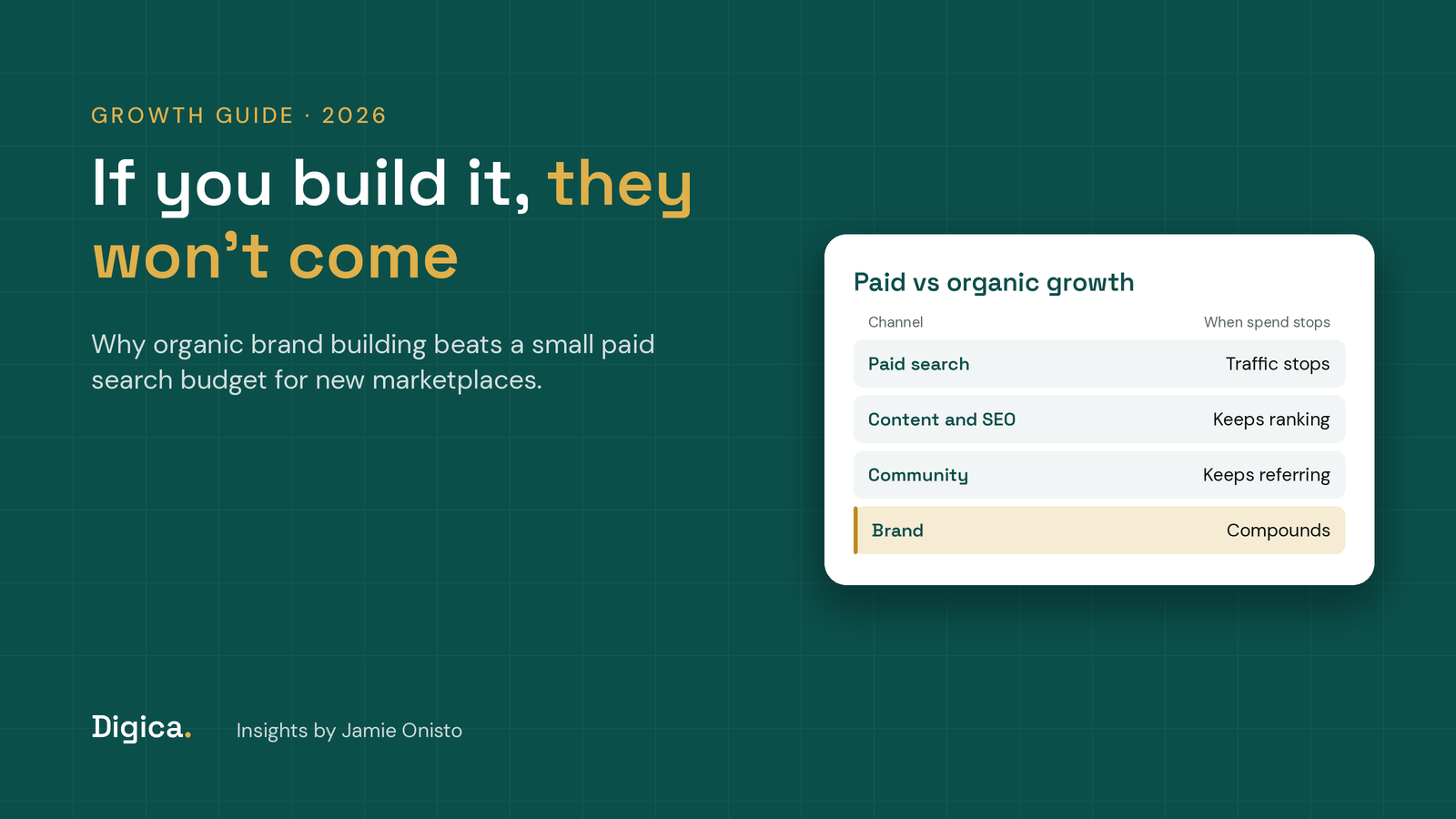
Most new marketplace founders believe a great product plus a few hundred dollars of Google Ads is a launch plan. It is not. At an assumed $4 per click, a $300 monthly budget buys about 75 visits, and on a two-sided platform those visits have to convince buyers and suppliers at the same time.
The product is rarely the problem. Distribution is. A platform nobody has heard of earns exactly what a platform that does not exist earns, and a small paid budget rents attention for a week without building anything that lasts.
This guide covers why the "build it, buy some clicks" plan stalls, what organic brand building does that paid cannot, where paid genuinely helps, and how to split a launch budget between the two. It is part of how we approach B2B marketplace growth at Digica, and it starts with a conversation I had a few weeks ago.
Quick Navigation
- The three-step plan that stalls most launches
- Why a great product is not a growth strategy
- What a few hundred dollars of paid search actually buys
- Organic brand building: the engine of incremental growth
- Where paid search earns its place
- Paid vs organic, side by side
- Three failure scenarios
- Where to start: a decision framework
- What a compounding brand is worth on the same budget
- FAQ
The three-step plan that stalls most launches
The most common launch plan we hear has three steps: build a great product, put a few hundred dollars of paid search behind it, and wait for growth. Step one usually works. Step two rarely does.
A few weeks ago I sat down with a founder who was weighing up working with us. Deeply technical, sharp, and genuinely talented. He had just launched a new B2B marketplace, and it was good. Properly good.
The problem: almost nobody was using it.
When I asked about the go-to-market plan, he laid it out with total confidence:
- Build a great product.
- Put a few hundred bucks of Google paid search behind it.
- Retire young and rich.
Step one was done. Step two was live. Step three was nowhere in sight. He couldn't understand why.
He is not unusual. In the marketplaces we speak to at this stage, the pattern repeats: months of engineering, a polished platform, a small paid budget switched on at launch, and then a dashboard that barely moves. The founder concludes that the market is not ready, or that the ads are set up wrong. Usually neither is true. The plan never had a mechanism for people to find, trust and return to the platform on their own.
Why a great product is not a growth strategy
A great product is the entry ticket, not the growth strategy. Quality decides whether people stay once they arrive. It does nothing to make them arrive in the first place.
This is the most common mistake I see from new founders, and it hits technical founders hardest. When you've spent months building something excellent, it feels like quality should speak for itself.
It doesn't. A great product nobody has heard of is, commercially, the same as a product that doesn't exist. If you build it, they won't come. Not on their own.
Marketplaces make this harder than a normal software launch, for three reasons:
- Two audiences, one budget. Every dollar has to persuade buyers and suppliers, and each side only cares once the other side is there. We covered the sequencing problem in marketplace go-to-market when both sides are customers.
- Trust is the product. Buyers are trusting you to vet suppliers. Suppliers are trusting you to send real demand. Nobody extends that trust to a name they saw once in an ad.
- Empty pages convert badly. A visitor who lands on a category with three listings leaves. Paid traffic sent to thin pages is money spent proving the platform is not ready yet.
None of this is a product problem. It is a distribution problem, and distribution has to be designed as deliberately as the product was.
What a few hundred dollars of paid search actually buys
A few hundred dollars of paid search buys a few dozen clicks from people who have never heard of you. It does not buy awareness, trust or repeat visits, and it stops the moment the budget does.
Here is the arithmetic on the plan from that conversation, using assumptions you should replace with your own account data:
- Budget: $300 a month.
- Cost per click: $4 (an assumption; B2B terms often cost more).
- Clicks: $300 ÷ $4 = 75 visits a month.
- Visit to signup rate: 3% (an assumption for a new, unknown platform).
- Signups: 75 × 3% = about 2 a month.
Over a year that is $3,600 for roughly 27 signups, split across buyers and suppliers, on a platform that needs density on both sides before either side gets value. When the spend stops, the signups stop with it.
There is a second problem. Paid search often takes credit for people who would have found you anyway. In a large field experiment on eBay's own paid search, economists found that brand-keyword ads produced no measurable short-term benefit, and that ads on other keywords mainly influenced new and infrequent users. Frequent users, who made up most of the spend, bought regardless. The study was later published in Econometrica in 2015.
The lesson for a young marketplace is not that paid never works. It is that small budgets mostly buy clicks, and clicks are not a brand.
Is your launch budget building anything? We review where your first growth dollars are going in a 30-minute call. Book a growth call
You've rented attention for a week. You haven't built anything that lasts. And because the budget was small, you also haven't learned much: 75 clicks a month is too few to tell whether the problem is the keyword, the ad, the landing page or the offer. The founder was spending real money every month and getting neither growth nor a clear signal. The rest of this guide is about what does build something.
Organic brand building: the engine of incremental growth
Organic brand building is the single most important factor for incremental growth. It is also the reason we have been able to help build companies to millions of monthly users.
Paid spend buys you a moment. Brand compounds. Every useful article, every search ranking you earn, every community you show up in, every customer who tells a friend, keeps working long after the effort that created it. Over time it lowers what you pay for every new user, because people arrive already knowing who you are and why you matter.
Investors who study marketplaces expect exactly this curve. In its guide to marketplace metrics, a16z notes that CAC should fall and the organic share of users should grow over time in a healthy network business. A marketplace whose growth still depends entirely on paid after two years is telling diligence something about its brand.
In practice, organic brand building for a B2B marketplace means:
- Content that earns its place. Answer the questions your buyers and suppliers are already asking, better than anyone else does.
- Search you own, not rent. Category and listing pages that rank keep delivering traffic without a meter running. Our guide to category page SEO for marketplaces covers the pages that matter most.
- Answers AI engines cite. Buyers increasingly ask an assistant before they search. Pages built to be quoted, as described in GEO for marketplaces, get named in those answers.
- Showing up where your audience already is. Industry communities, partners, newsletters and events.
- Turning users into advocates. Word of mouth is still the cheapest acquisition channel there is.
None of this is instant. All of it is durable. That's the trade, and it's the right one.
Where paid search earns its place
Paid search earns its place when you need results this week, not this year. Its real strength is speed, and early on speed has genuine value.
So is paid a waste of money? No. Paid has its place, and used well it's a powerful tool.
Organic takes time to build, and sometimes you can't wait. When you need traction from day one, paid delivers immediate results that organic simply can't. The cases where we recommend it:
- Validating demand. A two to four week test on a handful of high-intent terms tells you whether anyone searches for what you built.
- Testing messaging. Ad copy is the fastest, cheapest way to learn which value proposition buyers respond to before you write it into every page.
- Proving a channel. A board or investor update sometimes needs a number now. Paid can produce one.
- Seeding the first transactions. A few early paying customers on one side can be what convinces the other side to join.
The key is treating it as an accelerant, not the engine. Use paid to start the fire and learn what resonates. Use what you learn to sharpen the brand. Then let organic carry the long-term growth.
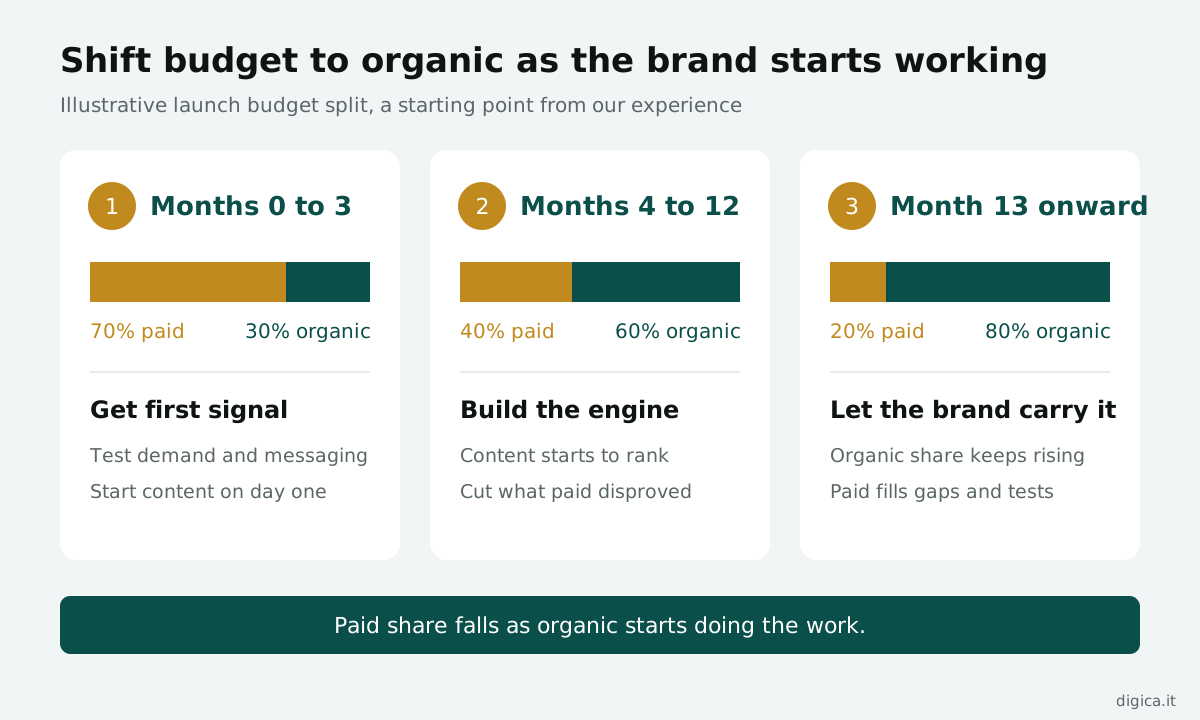
The split above is a starting point from our experience, not a public benchmark. No reliable industry figure exists for marketplaces at this stage, so treat it as a default to adjust against your own numbers. What matters is the direction: paid share falls as the brand starts doing the work.
Paid vs organic, side by side
Paid and organic are not rivals. They do different jobs on different timelines, and the right mix depends on which job you need done first.
Five ways to spend an early marketplace growth budget, compared by monthly cost, time to results, main risk and best use (cost ranges from our experience).
| Approach | Monthly cost (from experience) | Time to first results | Main risk | Best for |
|---|---|---|---|---|
| Small paid search test | $300 to $1,000 | Days | Too few clicks to learn anything | Checking whether anyone searches for the category |
| Paid search at scale | $3,000 to $10,000+ | Days | Traffic stops when spend stops | Hitting a short-term number, filling one side fast |
| Content and SEO | $2,000 to $6,000 | 3 to 9 months | Abandoned before it compounds | Durable traffic from both sides of the market |
| Community and partnerships | $500 to $3,000 | 1 to 3 months | Hard to measure, easy to deprioritize | Trust and supply-side credibility |
| Brand and PR | $1,000 to $5,000 | 1 to 6 months | Awareness without a page worth landing on | Making every other channel convert better |
Two things stand out. Every paid row has the same weakness: nothing remains when the budget ends. And every organic row has the same weakness: patience. Most launches fail on the second, not the first, which is why the next section matters.
Three failure scenarios
Most launch budgets fail in one of three predictable ways. Each one is avoidable if the decision is made early.
Scenario one: the paid-only launch. A founder puts the full growth budget into search ads. Signups trickle in at a steady cost, the board sees activity, and nobody builds content or rankings. Eighteen months later, every new user still costs the same, and pausing ads to save runway takes traffic close to zero overnight. The right call: from month one, ring-fence a share of budget for organic work, even if paid is doing the heavy lifting for now.
Scenario two: paying for people who were coming anyway. The paid account is dominated by bids on the marketplace's own brand name, and the reported return looks excellent. In reality, most of those clicks would have arrived through the free organic listing directly below the ad, which is what the eBay experiment found at scale. The right call: test pausing brand-keyword bids in one region or for a few weeks, measure total traffic, and move the savings into organic.
Scenario three: giving up on organic at month four. A team publishes content for three months, sees little movement, and declares that SEO does not work for their market. The budget moves back to ads, just before the work would have started paying. The right call: commit to organic on a 9 to 12 month horizon with leading indicators (pages indexed, rankings, impressions) reviewed monthly, and judge results on that horizon only.
Which of these is happening on your platform? Our growth audit shows where your traffic comes from and what it really costs. Request a growth audit
All three share a root cause: treating growth as a spend decision rather than a build decision. Spend can be switched on and off. A brand has to be built, and it has to be built before you need it, because the months of slow progress at the start are the price of the compounding later. Founders who accept that cost early are the ones whose acquisition costs fall in year two instead of rising.
Where to start: a decision framework
Start from runway and urgency, not from channel preference. These thresholds come from our experience working with early marketplaces; adjust them to your numbers.
- If you need a number within 30 days, run a capped paid test of $1,000 to $3,000 over 2 to 4 weeks on high-intent terms, and decide in advance what result counts as a pass.
- If your runway is above 12 months, put at least 60% of your growth budget into organic work from month one. Below 12 months, start at 30% and raise it as paid proves or fails its case.
- If paid cost per acquired customer exceeds the first-year revenue that customer brings in, stop scaling paid. Keep it only for testing.
- If more than 30% of paid spend goes on your own brand terms, run a holdout test before spending another month on them.
- If organic accounts for less than 20% of new users after 12 months, the brand engine is not working. Fix the content and page quality before adding budget anywhere.
Google's own guidance is that some changes show up in hours while others take several months to be reflected in search. That is why rule two starts organic on day one: the clock only starts when you do.
What a compounding brand is worth on the same budget
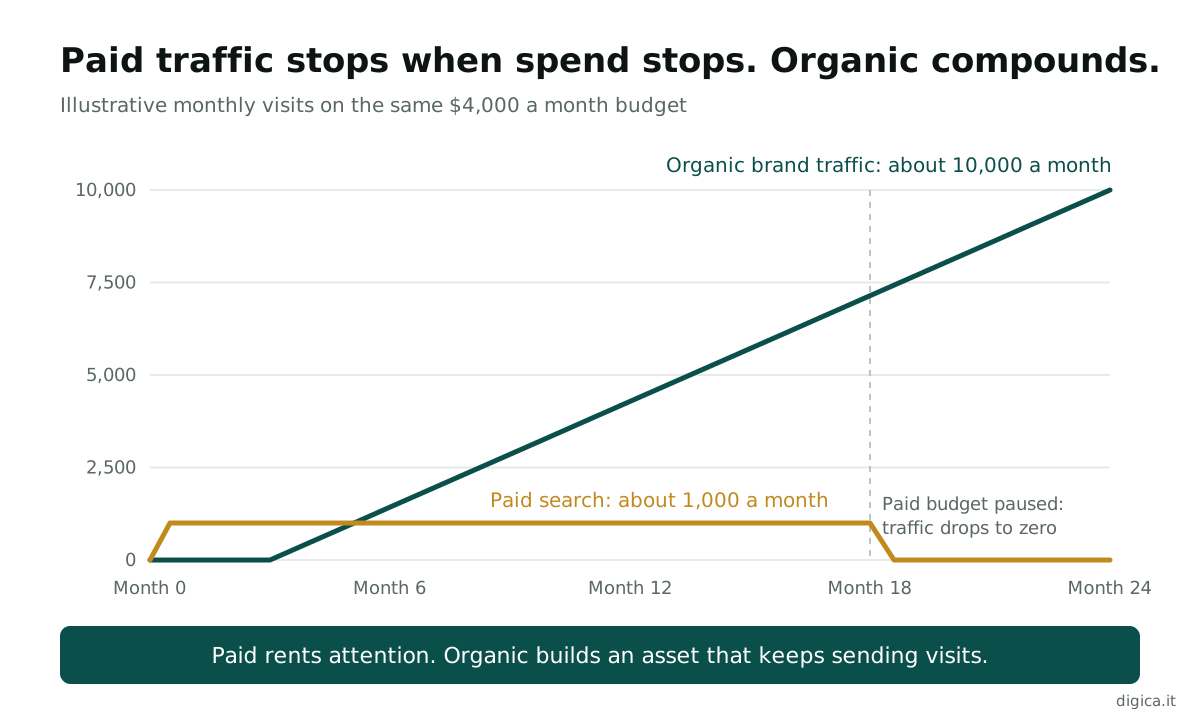
On the same budget, a compounding brand ends up worth several times what paid buys. Here is an illustrative comparison over 24 months, with every assumption stated so you can rerun it.
Assumptions (illustrative): $4,000 a month for 24 months on each approach, $4 per paid click, and an organic program that produces nothing for 3 months, then grows steadily to 10,000 visits a month by month 24.
- Paid only: $4,000 ÷ $4 = 1,000 visits a month. Over 24 months that is $96,000 for 24,000 visits, and zero visits the month spend stops.
- Organic: the same $96,000 builds to about 10,000 visits a month by month 24, roughly 110,000 visits in total. At the $4 you would otherwise pay per click, that traffic is worth about $440,000.
- Payback: the cumulative value of organic visits overtakes cumulative spend around month 9.
The cost of doing nothing is the number to take into your next leadership meeting. A marketplace that stays paid-only would need to spend about $40,000 a month to buy the 10,000 monthly visits the organic program is still delivering at month 24, and those visits keep arriving whether or not anyone renews the budget.
Want this model run on your own numbers? We will rebuild it with your real click costs and conversion rates in one call. Book a growth call
The founder from that conversation did not have a product problem. He had a distribution problem. Most early-stage marketplaces do. The good news is that distribution can be designed: a small, capped paid budget to learn fast, and a deliberate organic program that starts on day one and is given long enough to work. Build the product, then build the reasons people will find it.
FAQ
Is Google Ads worth it for a new marketplace?
Yes, for specific jobs: validating demand, testing messaging and seeding first transactions. It is rarely worth it as the main growth engine, because traffic stops when spend stops and small budgets buy too few clicks to build density on both sides.
How long does organic growth take for a marketplace?
Plan on a 9 to 12 month horizon for organic work to compound, with early signals such as indexing and rising impressions in the first few months. Google's own documentation says some search changes take several months to be reflected.
Should a marketplace startup spend more on paid or organic?
It depends on runway and urgency. As a starting point from our experience, a platform with more than 12 months of runway should put at least 60% of its growth budget into organic from month one, and shift further toward organic as content starts ranking.
What is brand building for a B2B marketplace?
It is the work that makes buyers and suppliers find, trust and return to the platform without paying for each visit: useful content, ranking category pages, citations in AI answers, community presence and word of mouth. Its defining feature is that it keeps working after the effort stops.
Why is paid search traffic not enough to launch a two-sided platform?
Because both sides must arrive in enough volume for either to get value, and paid budgets at launch scale rarely buy that density. Visitors who land on thin categories leave, so paid spend on an empty marketplace mostly proves it is not ready.
Do brand-keyword ads help marketplaces grow?
Often less than the reported numbers suggest. A large field experiment on eBay found no measurable short-term benefit from brand-keyword ads, because most of those users would have clicked the free organic result anyway.
Related Articles
- Marketplace go-to-market when both sides are customers
- Category page SEO for marketplaces: the money page guide
- GEO for marketplaces: turn category and listing pages into AI citations
- How to attract vendors to a B2B marketplace and keep them
This article is part of our B2B marketplace growth series.