The best AI agent marketplaces in 2026, compared on reach and vetting
An AI agent marketplace is now where enterprise software budgets meet agent builders, and the stakes are rising fast. Gartner predicts that 40% of enterprise applications will feature task-specific AI agents by the end of 2026, up from less than 5% in 2025. Every one of those agents has to be found, approved and paid for somewhere.
The obvious way to compare AI agent marketplaces is by how many agents they list. That number tells you very little. AWS says it carries thousands of agents and tools, Microsoft says more than 4,000 AI apps and agents, and Google says thousands of pre-vetted agents. What separates them is who is already standing in the aisle, and what an agent has to pass before that buyer sees it. A listing in front of the wrong buyer, or one stuck in review, earns nothing.
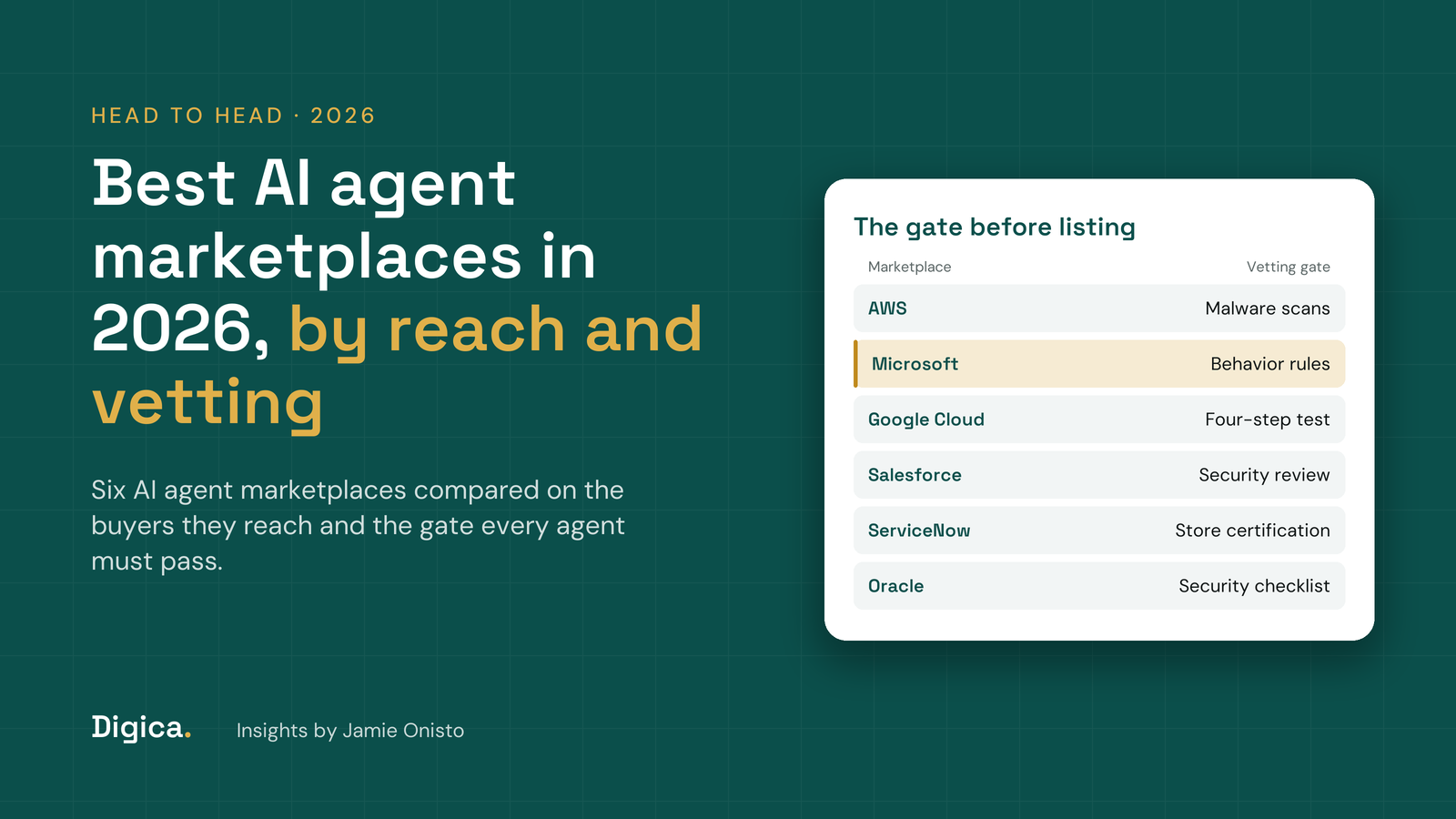
So this guide compares six AI agent marketplaces head to head on two things: buyer reach, meaning which buyers each one puts in front of you and how they pay, and vetting, meaning the gate a listing must clear. It is written for teams buying agents and for teams selling them, using each platform's own announcements and documentation, checked on October 13, 2026. It is the same lens we use when we help AI marketplaces grow both sides at once.
Quick Navigation
- Six AI agent marketplaces, head to head
- Two kinds of AI agent marketplace
- AWS Marketplace and Microsoft Marketplace: the cloud bill
- Google Cloud and the Gemini Enterprise Agent Gallery
- Salesforce AgentExchange: the biggest in-app store
- ServiceNow Store and Oracle: agents inside the workflow
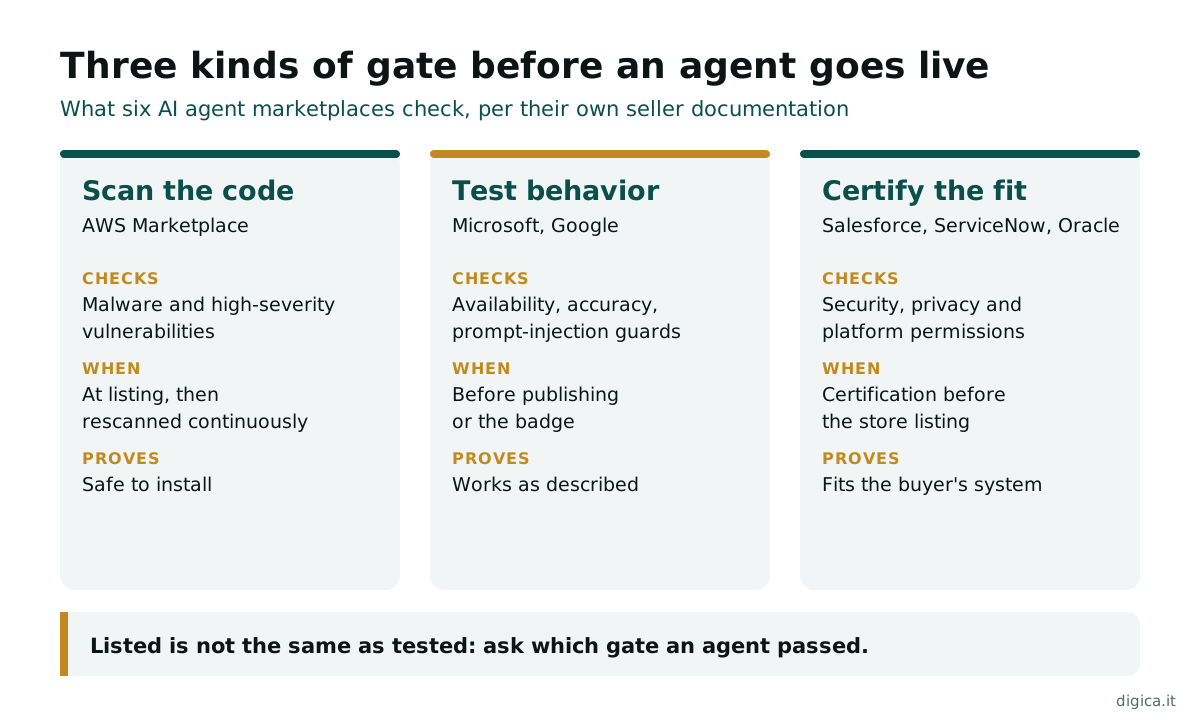
- What each gate actually checks
- Three ways an agent listing goes nowhere
- Which AI agent marketplace to start with
- The number for your next planning meeting
- FAQ
- Related Articles
Six AI agent marketplaces, head to head
The short answer: AWS, Microsoft and Google win on breadth of buyers, because purchases count toward cloud commitments companies have already signed. Salesforce, ServiceNow and Oracle win on depth, because the agent runs inside software the buyer uses every day.
Six AI agent marketplaces compared on reach, how buyers pay, vetting and fit
| AI agent marketplace | Stated scale | Buyer reach | How buyers pay | Vetting gate | Main risk for a seller | Best for |
|---|---|---|---|---|---|---|
| AWS Marketplace (AI Agents and Tools) | Thousands of agents and tools; 30,000+ listings overall | AWS customers buying through their AWS account | Counts toward existing AWS spend commitments | Malware and vulnerability scans, rescanned continuously | A big catalog where discovery is hard | Agents that run on AWS infrastructure |
| Microsoft Marketplace and Agent Store | 4,000+ AI apps and agents | Azure buyers, plus Microsoft 365 Copilot users | 100% of eligible spend counts toward an Azure commitment | Published agent validation rules, including Responsible AI checks | The strictest behavior tests to pass | Agents that work inside Copilot and Teams |
| Salesforce AgentExchange | 1,000+ agents, tools and MCP servers; 10,000+ apps and experts | Salesforce and Slack customers, in their own org | Private offers, unified billing | Security review on every solution | Value tied to the Salesforce data model | Sales, service and Slack agents |
| Google Cloud Marketplace and Agent Gallery | Thousands of pre-vetted agents | Google Cloud buyers and Gemini Enterprise users | Existing Google Cloud account; commit drawdown on qualifying offers | Four-step evaluation for the Gemini Enterprise badge | Admin approval for each deployment | Agents built on the A2A protocol |
| ServiceNow Store | 2,700+ partners | ServiceNow customers | Through the Store | Store certification under the Build Program | No public agent count to benchmark | IT, HR and service workflow agents |
| Oracle Fusion AI Agent Marketplace | Launch partners incl. IBM, Infosys, Box, Stripe | Oracle Fusion Applications customers | One-click deploy inside Fusion | Oracle's own security checklist | A narrower, partner-led catalog | Finance, HR and supply chain agents |
Read the table by row, not by column. Every AI agent marketplace here can reach a large buyer base. The question is whether the buyer it reaches is the one with the budget and the problem your agent solves, and whether your team can pass its gate in the time you have.
Two kinds of AI agent marketplace
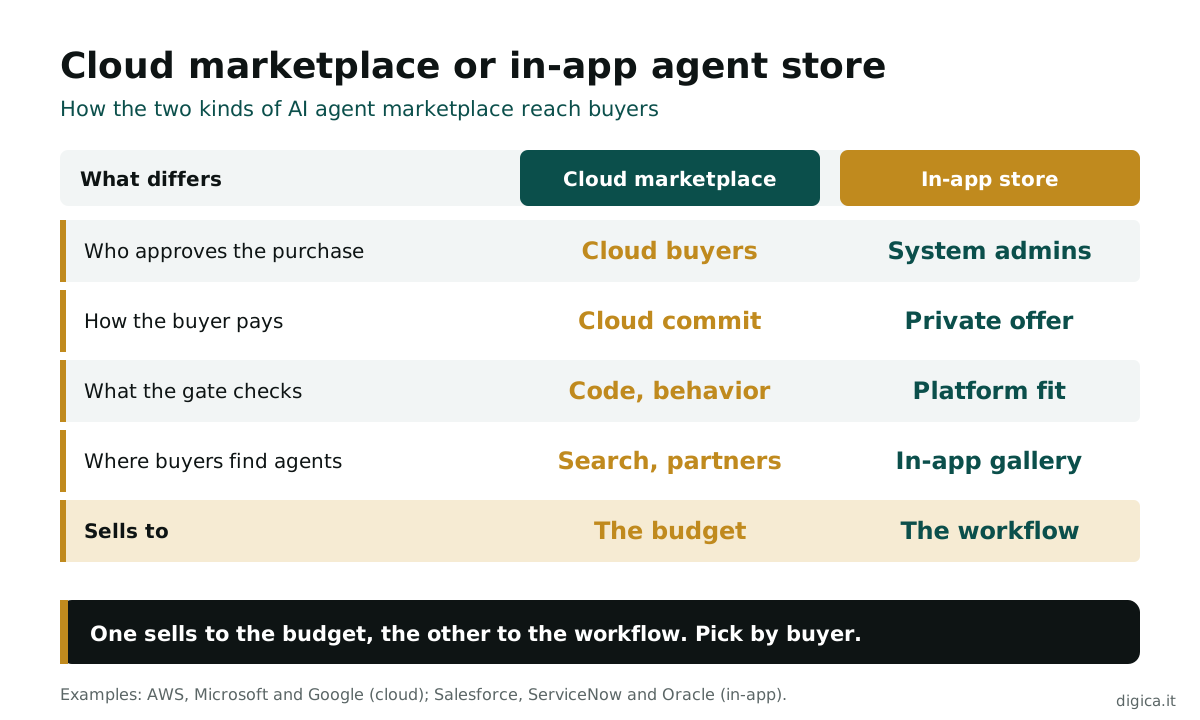
Search results lump two different things together under "AI marketplace". A cloud marketplace sells software of every kind, and agents are now a category in it: AWS, Microsoft and Google run the largest. An in-app agent store sells agents that run inside one company's business software: Salesforce, ServiceNow and Oracle are the examples here.
The difference decides distribution. A cloud marketplace reaches the procurement team that controls a cloud commitment, which can be a very large pool of pre-approved spend. An in-app store reaches the administrator of one system of record, who can switch an agent on for thousands of users at once. One sells to the budget, the other sells to the workflow. Smaller independent agent directories also exist, but they list agents for discovery rather than handling enterprise procurement, so they sit outside this comparison.
AWS Marketplace and Microsoft Marketplace: the cloud bill
AWS and Microsoft compete on the same promise: buy agents through the account and the commitment you already have. For an enterprise buyer that removes the hardest step, a new vendor contract.
AWS Marketplace opened its AI Agents and Tools category on July 16, 2025, at AWS Summit New York. Its solutions page says it carries thousands of agents, tools and services from AWS Partners, and in July 2026 AWS's vice president of marketplace said launch partners had grown from 900 to over 3,400. Agents can be listed as software as a service (SaaS), containers, machine images or APIs, and AWS says purchases count toward existing AWS spending commitments. In November 2025 it added an agent mode that searches more than 30,000 listings and produces a downloadable purchasing proposal for the buyer's approval process.
Microsoft Marketplace launched on September 25, 2025, merging Azure Marketplace and AppSource, with more than 3,000 AI apps and agents at launch. By December 2025 Microsoft put the figure at more than 4,000, and at Ignite 2025 it made the store globally available to a partner base of more than 500,000. Two features drive its reach: 100% of spend on eligible offers counts toward an Azure consumption commitment, and the Agent Store sits inside Microsoft 365 Copilot, where employees already work.
Listing agents on an AI agent marketplace and seeing few buyers?
In 30 minutes we look at where your buyers already are, and which AI agent marketplace reaches them first.
Both cloud stores carry the same weakness for a seller: size. A listing among tens of thousands is easy to buy and hard to find, so the sellers that grow here bring their own demand, usually through the AWS or Microsoft partner teams that co-sell with them, and use the store to close.
The verdict: AWS is the better fit when your agent runs on AWS infrastructure and you sell to engineering-led buyers. Microsoft is the better fit when the agent lives in Copilot, Teams or Outlook, because there the buyer is every employee with a Copilot license, not only the cloud team.
Google Cloud and the Gemini Enterprise Agent Gallery
Google runs two shelves. Google Cloud Marketplace, which announced its AI agent marketplace in October 2025, says it offers thousands of pre-vetted AI agents that buyers purchase through their existing Google Cloud account on a single bill. To list, an agent needs an Agent2Agent (A2A) Agent Card, the open standard Google backs for agents that call other agents.
The second shelf is newer and closer to the user. Since April 2026, partner agents can appear in the Agent Gallery inside the Gemini Enterprise app, and Google says partners can reach millions of Gemini Enterprise users there. Admins approve or deny each deployment, so an employee can find an agent but cannot switch it on alone.
Google also gives sellers a commercial reason to choose it. Since June 9, 2025, qualifying purchases through partner private offers count 100% toward a buyer's Google Cloud commitment, capped at 25% of that commitment. Google says listing in the Agent Gallery can shorten purchasing cycles by up to 50%.
The verdict: Google is the best fit for agents built to work with other agents through A2A, and for sellers who want a badge that tells buyers the agent passed a quality test, not just a security scan.
Salesforce AgentExchange: the biggest in-app store
Salesforce has the largest in-app catalog, and the longest track record of selling third-party software inside its own product. AgentExchange launched on March 4, 2025, with more than 200 partners, on top of AppExchange's more than 13 million app installs. In April 2026 Salesforce merged AppExchange, Slack Marketplace and the Agentforce ecosystem into one AgentExchange.
Are buyers finding your agents but not deploying them?
A growth audit maps your listings, reviews and conversion on each AI agent marketplace you sell through.
The merged store reports more than 10,000 apps and expert partners, more than 1,000 agents, subagents, tools and Model Context Protocol (MCP) servers, more than 2,600 Slack apps and agents, and more than 186,000 reviews, ratings, use cases and compliance indicators. That last figure is the trust signal buyers lean on most: a long public review history is hard for a new agent to fake.
Salesforce says every solution goes through a security review covering security, privacy and compliance, and admins control data permissions and API scopes by user, role and profile. Buyers get private offers with custom pricing, unified billing and automatic provisioning once an offer is accepted.
The verdict: for sales, service and Slack agents there is no larger in-app audience. The trade-off is depth over portability: an agent built around Salesforce data does not move easily to another store.
ServiceNow Store and Oracle: agents inside the workflow
ServiceNow and Oracle took the same route as Salesforce, inside their own software, with smaller catalogs and tighter control. Both suit agents that automate one specific business process.
In January 2026 ServiceNow repositioned the ServiceNow Store as a global marketplace for partner-built AI agents. It has more than 2,700 partners globally, and more than 1,000 of them are moving into a reworked Build Program that covers how partners build, test, certify and distribute agents. ServiceNow does not publish an agent count for the Store, which makes it hard to benchmark against the others.
Oracle launched its AI Agent Marketplace on October 15, 2025, at Oracle AI World, inside AI Agent Studio for Fusion Applications. Customers deploy agents with one click, and Oracle says every agent is validated through a comprehensive checklist that applies the same security standards Oracle uses for its own agents. Launch partners included system integrators such as IBM Consulting, Infosys and Wipro, and software companies such as Box and Stripe.
The verdict: pick ServiceNow for IT, HR and customer service workflows, and Oracle for finance, HR and supply chain inside Fusion. Expect fewer competitors on the shelf and a heavier certification path.
What each gate actually checks
The six AI agent marketplaces vet very different things, and a buyer who treats "listed" as "trusted" is making an assumption the store never promised.
AWS checks what a listing contains. Its seller rules say machine images must not contain critical or high-severity unpatched vulnerabilities or malware, container images are scanned layer by layer on every new version, and AWS keeps scanning after a product goes live. That protects the buyer's infrastructure, but it says nothing about whether the agent gives good answers.
Microsoft checks how an agent behaves. Its agent validation guidelines, updated in August 2026, require 99.9% availability, a response time of 9 seconds or less at the 99th percentile, HTTPS on a verified domain, and explicit user confirmation before any action that changes data. Descriptions are screened for instructions or hidden characters that could hijack Copilot, and agents that fail Responsible AI validation cannot be published.
Google checks output. Its Gemini Enterprise badge requires a four-step evaluation of basic function, output accuracy, autonomous execution and enterprise standards. Salesforce, ServiceNow and Oracle certify against their own platforms, which protects the buyer's data model and permissions.
For sellers, the practical rule is to pass the strictest gate first. An agent that meets Microsoft's behavior rules has already done most of the work any other AI agent marketplace on this list will ask for. For buyers, the rule is the reverse: ask what the gate checked, then test the rest yourself. A malware scan and an accuracy test are not the same promise.
Three ways an agent listing goes nowhere
Most agent listings that fail do so for reasons that have little to do with the agent. These three patterns recur across vendors of every size.
- Listing everywhere at once. A small team lists on all six AI agent marketplaces in one quarter, spreads its review and partner work thin, and ends up with six thin profiles and no reviews on any of them. One well-reviewed listing in the store where its buyers already work would have outsold all six.
- Treating the listing as the launch. The agent clears review, the listing goes live and nothing happens, because nobody told the buyer's cloud or platform team it exists. Marketplace procurement removes the contract step; it does not create demand. Our guide to GTM strategy for AI marketplaces covers how to seed the first buyers.
- Ignoring the admin. On Google's Agent Gallery and in every in-app store, an administrator approves the deployment. A pitch aimed only at end users stalls at that step. The listing has to answer the admin's questions on data access, permissions and support before it answers the user's.
The common thread is that the store solves the buying step and nothing before it. Discovery, reviews and the internal champion are still the seller's job, which is why the vendors that grow on these platforms invest in their listing pages as much as their agents.
Which AI agent marketplace to start with
Choose by where your buyer's budget and workday already sit, using these thresholds.
- If your target customers already spend on AWS and your agent runs on AWS, start with AWS Marketplace. The spend commitment is the shortcut.
- If the agent is used inside email, documents or meetings, start with Microsoft Marketplace and the Agent Store, and build to its validation rules from day one.
- If more than half your target accounts run Salesforce or Slack, AgentExchange beats any cloud marketplace, because the agent ships where the data lives.
- If your agent calls or coordinates other agents, start with Google, where an A2A Agent Card is the entry ticket.
- If you automate one process inside ServiceNow or Oracle Fusion, go to that store first and plan for its certification work.
- If you cannot name the system your buyers use for this job, do not list yet. Find out first.
Building or growing an AI agent marketplace?
We grow buyers and builders for AI marketplaces, from the first listings to repeat deployments.
Whichever store you choose, give it two quarters before adding a second. The reviews, the private offers and the partner relationships compound inside one store, and they reset to zero in the next one. The same logic applies to anyone running their own AI agent marketplace: our guide to GEO for marketplaces shows how listing pages get found by AI answer engines as well as by buyers.
The number for your next planning meeting
Gartner predicts that over 40% of agentic AI projects will be canceled by the end of 2027, because of escalating costs, unclear business value or inadequate risk controls. That is the number to bring into the room. A listing on an AI agent marketplace that has already tested behavior, permissions and accuracy answers the risk question before it is asked. The cost of doing nothing is being in the 40%.
FAQ
What is an AI agent marketplace? An AI agent marketplace is a store where businesses find, buy and deploy AI agents built by third parties. The largest are run by cloud providers, such as AWS Marketplace, Microsoft Marketplace and Google Cloud Marketplace, and by business software companies, such as Salesforce AgentExchange, the ServiceNow Store and Oracle's AI Agent Marketplace.
Which AI agent marketplace has the most agents? None publishes a like-for-like count. Microsoft says more than 4,000 AI apps and agents, Salesforce more than 1,000 agents, tools and MCP servers, and AWS and Google say thousands. Buyer reach and vetting matter more than the count.
How are agents vetted before they are listed? It depends on the store. AWS scans listings for malware and vulnerabilities. Microsoft tests behavior, availability and Responsible AI rules. Google runs a four-step evaluation for its Gemini Enterprise badge. Salesforce, ServiceNow and Oracle certify agents against their own platforms.
Can I buy AI agents with my cloud commitment? Often, yes. AWS says purchases count toward existing AWS spend commitments, Microsoft counts 100% of eligible spend toward an Azure commitment, and Google counts qualifying private-offer purchases toward a Google Cloud commitment, up to 25% of it.
Is Salesforce AgentExchange the same as AppExchange? Since April 2026 they are one store. Salesforce merged AppExchange, Slack Marketplace and the Agentforce ecosystem into a single AgentExchange covering apps, agents, tools and expert partners.
Should a startup list on every AI agent marketplace? No. List first where your buyers already work and spend, build reviews and private offers there, then expand. Spreading a small team across six review processes usually produces six weak listings.
Related Articles
- AI marketplace growth
- GTM strategy for AI marketplaces
- GEO for marketplaces: category and listing pages
- Best data marketplaces in 2026
- Best B2B marketplaces in 2026: 7 examples by industry
This article is part of our B2B marketplace growth series. Browse more on the Digica blog.