The best AI tools directories in 2026, compared head to head on traffic and visibility
An AI tools directory is often the first place a new AI product gets seen, and the first place its founders spend money on visibility. The stakes have shifted. G2's Answer Economy research, a March 2026 survey of 1,076 B2B software buyers, found that 51% now start their research with an AI chatbot more often than with Google, and that one in three bought from a vendor they had never heard of before. A listing has to be found by people and by the assistants they ask.
Most comparisons of AI tools directories list features and stop there. The number a founder needs is traffic: how many people a directory actually reaches, and how much of that attention a single listing can capture. Here the numbers do not agree. Several directories report far more traffic on their own submission pages than independent estimates show, and one shows more on Semrush than it claims for itself.
So this guide puts seven AI tools directories head to head on traffic and visibility: Semrush visit estimates next to each directory's own claims, newsletter reach, what a paid listing buys, and whether anyone reviews it. Everything was checked on October 14, 2026. It is the same supply-side lens we use when we help AI marketplaces and directories grow the traffic that makes a listing worth paying for.
Quick Navigation
- Seven AI tools directories, head to head
- There's An AI For That and Toolify: the paid-listing leaders
- Product Hunt: the biggest audience, the least control
- AIxploria and TopAI.tools: the second tier
- Futurepedia and Future Tools: audiences built around people
- Claimed traffic versus measured traffic
- Three ways an AI tool listing wastes money
- Where to list an AI tool first
- The number for your next marketing review
- FAQ
- Related Articles
Seven AI tools directories, head to head
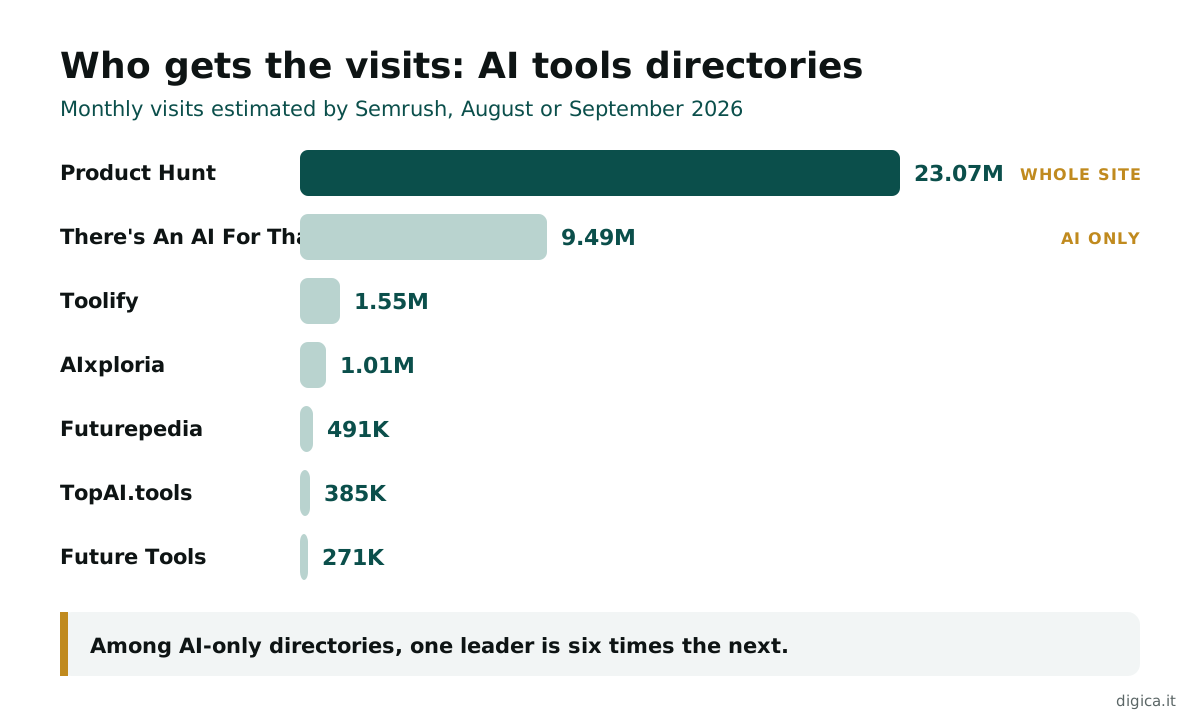
The short answer: There's An AI For That is the largest AI-only directory by a wide margin, Product Hunt has the biggest audience overall but does not guarantee a feature, and Toolify, AIxploria and TopAI.tools form a cheaper second tier. The table puts the visibility numbers side by side.
Seven AI tools directories compared on traffic, audience, what a listing costs and how it is reviewed
| AI tools directory | Semrush visits | What it claims | Newsletter or audience | Paid listing | Review and links | Main risk | Best for |
|---|---|---|---|---|---|---|---|
| Product Hunt | 23.07M (Sep 2026, whole site) | 644 products in its AI category | Launch-day community | Homepage curated by staff | No guaranteed feature | Traffic spikes for one day | Launches with a community behind them |
| There's An AI For That | 9.49M (Aug 2026) | 5M+ monthly visitors, 50,000+ tools | 2.5M+ newsletter subscribers | $49 basic; $437 with a newsletter feature | Every submission manually reviewed | Price rises for real exposure | Maximum reach in one listing |
| Toolify | 1.55M (Aug 2026) | 5.1M+ monthly visits | 700K+ subscribers | $99, listed within 48 hours | At least 6 dofollow links | Claims far above the estimate | Search visibility and backlinks |
| AIxploria | 1.01M (Aug 2026) | 400K to 500K monthly visitors | Not stated | $79 to $279; featured ads $399 for 3 days | Manual review; all links nofollow | No link value for SEO | Cheap reach with human review |
| Futurepedia | 490.96K (Aug 2026) | 4,000+ curated tools | 300K+ newsletter readers, 2M+ YouTube subscribers | No public paid submission | Editorial review; part of HubSpot since April 2026 | No way to buy a listing today | Being picked by editors |
| TopAI.tools | 385.12K (Sep 2026) | 1M+ monthly users, 3M+ page views | Not stated | $47 fast track; $229 featured for 7 days | Editorial review | Smallest measured audience here | Low-cost launches |
| Future Tools | 271.27K (Aug 2026) | 60K+ monthly visitors, 4,388+ tools | 250,000+ newsletter subscribers | Free submission; featured slots on request | Reviewed by founder Matt Wolfe | Two featured slots a week | Reaching a creator's audience |
Read across each row, not down the first column. Semrush estimates and self-reported claims measure different things, and Product Hunt's figure covers the whole site, not only AI. What a listing buys you depends on three things together: the audience, how long your listing stays visible, and whether a newsletter or a link carries it further.
There's An AI For That and Toolify: the paid-listing leaders
These two have built the clearest business around selling visibility to AI tool makers, and they make an instructive pair: one is larger than it claims, the other claims more than independent tools can see.
There's An AI For That, founded by Andrei Nedelcu in Bucharest and launched in December 2022, now maps more than 50,000 tools to over 11,000 tasks and 5,000 job roles. It reports more than 5 million monthly visitors and 2.5 million newsletter subscribers, and says Semrush puts it at about six times the next-largest AI directory. Semrush's own page shows 9.49 million visits for August 2026, which supports that claim. It got 100,000 visits in its first week, and a beehiiv case study says its newsletter reached 1.7 million subscribers without paid advertising.
Its pricing is built around exposure. A basic listing costs $49 once, with an estimated 50 to 100 clicks in the first week. The "Maximum Exposure" package costs $437 once, adds a guaranteed newsletter feature, and estimates 700 to 10,000 or more clicks. Staff review every submission by hand, usually within one to two days, and refund any tool that is not published.
Paying for AI tool listings and not seeing sign-ups?
In 30 minutes we look at where your buyers discover tools today, and which listings are worth keeping.
Toolify sells a simpler product: $99 for a permanent listing, published within 48 hours, with at least six dofollow links back to your site. It claims 5.1 million monthly visits, 8 million page views and 700,000 subscribers. Semrush estimates 1.55 million visits for August 2026, a third of the claim. The links still have value for search, but plan around the independent number.
The verdict: There's An AI For That is the strongest single listing for reach, especially with the newsletter package. Toolify is the better buy when backlinks matter as much as clicks.
Product Hunt: the biggest audience, the least control
Product Hunt is not an AI tools directory, but no list of where AI tools get seen is complete without it. Semrush estimates 23.07 million visits to the whole site in September 2026, more than double There's An AI For That. Its AI category held 644 products on the day we checked.
The catch is control. Product Hunt's help center says its homepage is curated by its team and that it cannot guarantee any product will be featured. A rejected product can resubmit after six months. A launch that reaches the homepage gets a day of very high attention; one that does not gets little.
That makes Product Hunt a launch event rather than a listing. It rewards makers who arrive with a community ready to try the product and comment on launch day, and it gives little to a tool that simply posts and waits.
The verdict: the biggest single audience available to an AI tool, worth a planned launch day. Do not count on it as a steady source of traffic.
AIxploria and TopAI.tools: the second tier
Below the leaders sit directories with smaller audiences and lower prices. They suit tools on a budget, but each has a trade-off that matters.
AIxploria, launched in February 2023, lists more than 6,000 tools in over 50 categories. Its About page says 400,000+ monthly visitors and its submission page says 500,000+, while Semrush estimates 1.01 million for August 2026, so it may be understating. A fast listing costs $79, a verified listing $279 with 60 days in its homepage selection, and featured ads $399 for three days. Every site is reviewed by hand. The catch for search: its FAQ states that all outbound links are nofollow, so a listing passes no ranking value.
TopAI.tools claims more than 1 million monthly users and 3 million page views. Semrush estimates 385,120 visits for September 2026. A fast-track listing costs $47 and goes live within 48 hours in its "Just landed" section; a featured listing costs $229 for seven days on the homepage. All submissions get an editorial review.
Is your AI tool listed everywhere but cited nowhere?
A growth audit maps your directory listings, reviews and AI citations, and shows which ones send real buyers.
The two make sense together for a tool launching on a small budget: $126 buys a listing on both, with human review on each. Neither should be the only place a tool appears.
The verdict: AIxploria for cheap reach with a large measured audience, accepting no link value. TopAI.tools for the lowest-cost launch slot. Both work best as part of a launch week, listed on the same days as a newsletter mention or a Product Hunt launch, so that the short burst of homepage visibility each one sells lands while people are already talking about the tool.
Futurepedia and Future Tools: audiences built around people
The last two built their audiences around creators and editors rather than paid listings, and that changes what a founder can buy.
Futurepedia says it lists more than 4,000 curated tools and reaches over 300,000 newsletter readers and more than 2 million YouTube subscribers. It became part of HubSpot in April 2026. On the day we checked, it offered no public paid submission: every submit and advertise path returned an error, and only a form to update an existing tool remained. Semrush estimates 490,960 visits for August 2026. A place in Futurepedia now depends on its editors.
Future Tools began as Matt Wolfe's personal spreadsheet in late 2022. It indexes more than 4,388 tools and reaches over 250,000 newsletter subscribers. Submission is free and reviewed by Matt himself. Featured placement pins a tool to the top of the directory and category pages for a week, with a maximum of two slots a week and pricing on request. Its own site says 60,000+ monthly visitors; Semrush estimates 271,270 for August 2026.
Both are worth more than their visit counts suggest, because the audience follows a person. A mention in a newsletter or video from a trusted creator reaches readers who act on recommendations.
There is a second reason they matter. Creator-led directories tend to be read by people who also follow the creator elsewhere, on YouTube, in newsletters and on social channels. A tool that earns a mention once can be picked up again in a video or a weekly roundup months later. That kind of repeat exposure is hard to buy on a paid directory, where a featured slot ends after a fixed number of days.
The verdict: submit to both for free. Treat any feature as earned media, not a purchase.
Claimed traffic versus measured traffic
Self-reported traffic is the number most directories lead with, and it is the number to trust least. The gap runs both ways.
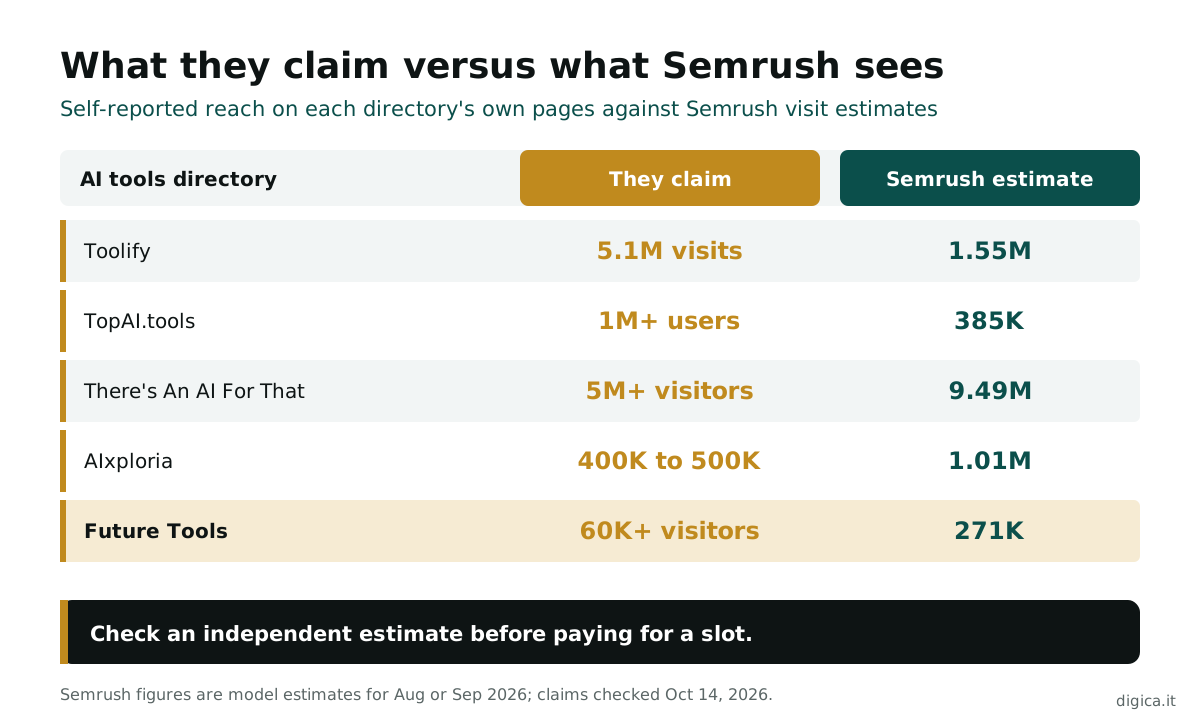
Toolify claims 5.1 million monthly visits against a Semrush estimate of 1.55 million. TopAI.tools claims more than 1 million users against 385,120 estimated visits. In the other direction, There's An AI For That, AIxploria and Future Tools all show higher estimates on Semrush than on their own pages. Third-party estimates are models, not counts, but a claim three times higher than the estimate deserves a question before you pay.
The bigger shift is where buyers look. The Stanford AI Index Report 2026 counts 1,953 newly funded AI companies in the United States in 2025 alone, and organizational adoption at 88%. With that many tools competing, a directory's value increasingly comes from whether AI assistants read and cite it, not only from human visits. A listing on a directory that assistants trust can surface in an answer long after the launch week ends.
Three ways an AI tool listing wastes money
Most money wasted on AI tools directories follows one of three patterns. None is about the directory.
- Buying on the claimed number. A founder pays for a featured slot on the strength of a traffic claim three times higher than any independent estimate, and gets a fraction of the clicks expected. Checking a third-party estimate first takes five minutes.
- Paying for links that pass nothing. A listing bought partly for search value turns out to carry a nofollow link. That is fine for clicks, useless for rankings. Read the directory's link policy before paying for SEO.
- A listing with nothing behind it. The tool appears in ten directories with a one-line description, no screenshots and no pricing. Visitors arrive, cannot tell what it does, and leave. A good listing page answers what it does, who it is for and what it costs, the same questions an AI assistant needs answered before it will recommend a tool.
The common thread is treating a listing as the marketing, rather than as one entry point to it. The listing only works when the product page it sends visitors to does the rest.
Where to list an AI tool first
Choose by budget, goal and how much attention you can drive yourself, using these thresholds.
- If you can spend under $150, list on TopAI.tools ($47) and AIxploria ($79), and submit free to Future Tools and Futurepedia.
- If backlinks for search matter, Toolify's $99 listing includes at least six dofollow links; AIxploria's are nofollow.
- If you want the largest AI-only audience in one purchase, buy There's An AI For That's $437 package with the newsletter feature.
- If you have a community ready to show up on one day, plan a Product Hunt launch and treat everything else as follow-up.
- If a directory claims more than three times its Semrush estimate, ask for proof of clicks before buying a featured slot.
Running an AI tools directory or AI marketplace?
We grow traffic, listings and paying vendors for AI marketplaces and directories, from search to AI answers.
Whatever you buy, track it. Use a tagged link for every listing, compare sign-ups after 30 days, and drop the directories that send none. In our experience, two or three directories usually send most of the directory traffic, and the rest send close to nothing. Those two or three are where any further money should go, whether that is a featured slot, a newsletter placement or simply a better listing page with screenshots, pricing and a clear description of who the tool is for. The same thinking applies to operators: our guide to GEO for marketplaces covers how directory pages get cited by AI answer engines, which is now part of what a listing is worth.
The number for your next marketing review
G2's 2025 Buyer Behavior Report found 29% of B2B buyers already started research in tools like ChatGPT more often than in Google; a year later that figure was 51%. Buying the top listing at each of the four directories here that sell them, There's An AI For That, Toolify, AIxploria's fast listing and TopAI.tools, costs $662 in total, once. The biggest cost of doing nothing is invisibility: a tool that appears in no directory and no AI answer is a tool the 51% never meet.
FAQ
What is the best AI tools directory? By measured traffic, There's An AI For That, with 9.49 million visits in August 2026 by Semrush's estimate, 50,000+ tools and 2.5 million newsletter subscribers. Product Hunt has more visits overall, but it covers all products and does not guarantee a feature.
How much does it cost to list an AI tool in a directory? From free to a few hundred dollars. Future Tools takes free submissions, TopAI.tools charges $47, AIxploria $79, Toolify $99 and There's An AI For That $49 to $437. Futurepedia had no public paid submission in October 2026.
Are AI tools directory traffic claims accurate? Not always. Toolify claims 5.1 million monthly visits against a Semrush estimate of 1.55 million. Others, such as There's An AI For That and AIxploria, show more on Semrush than they claim. Check an independent estimate before paying.
Do AI tools directories give dofollow backlinks? Some do. Toolify says its listing includes at least six dofollow links. AIxploria states that all its outbound links are nofollow. Others do not publish a policy, so ask before paying for search value.
Is Futurepedia still accepting submissions? Futurepedia became part of HubSpot in April 2026. In October 2026 it showed no public paid submission page, only a form to update existing tools, so new listings depend on its editorial team.
Is Product Hunt good for launching an AI tool? Yes, for a launch day with a community behind it. Product Hunt's homepage is curated by its team and features are not guaranteed, so the traffic is large but concentrated on launch day.
Related Articles
- AI marketplace growth
- Best AI agent marketplaces in 2026: reach and vetting
- GEO for marketplaces: category and listing pages
- How to get cited by AI answer engines
- GTM strategy for AI marketplaces
This article is part of our B2B marketplace growth series. Browse more on the Digica blog.