The best aviation parts marketplaces in 2026, judged on inventory and certification
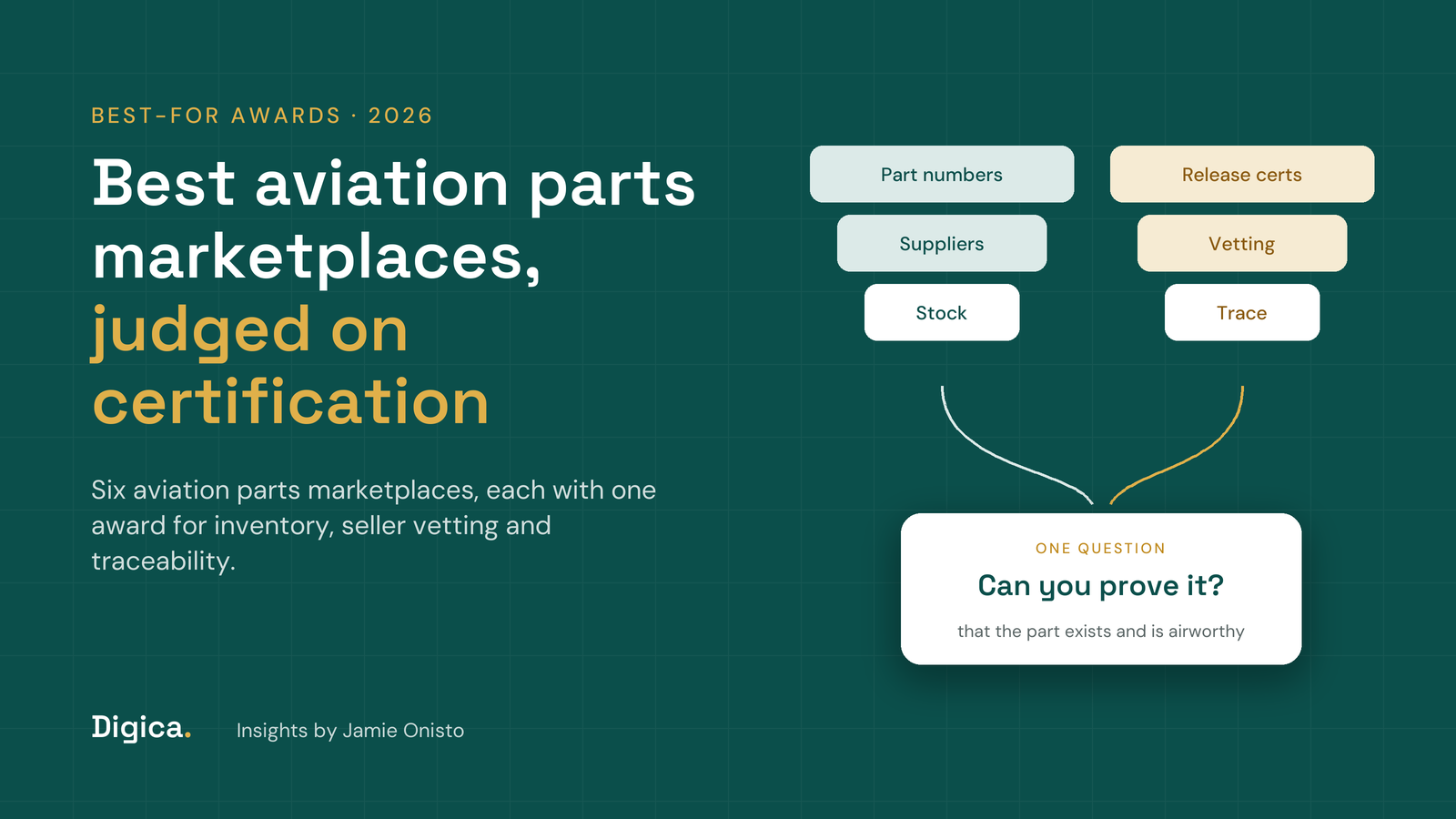
An aviation parts marketplace has to answer two questions before a buyer sends a purchase order. Does anyone have this part in stock, and can they prove it is airworthy? A platform with millions of listings is useless to a maintenance team if half the sellers cannot produce a valid release certificate, and a platform full of trusted suppliers is useless if the part is not there.
The pressure on both questions is rising. IATA and Oliver Wyman estimated that supply chain problems would cost airlines more than $11 billion in 2025, including $3.1 billion in extra maintenance costs and $1.4 billion in the cost of holding surplus spare parts (IATA). When new parts are scarce, airlines and maintenance, repair and overhaul (MRO) shops buy more from the aftermarket, and the aftermarket is where paperwork goes wrong.
This guide gives six aviation parts marketplaces one award each, judged on parts inventory and certification: how much stock each platform claims, how it vets sellers and how it handles traceability documents. It is written for buyers at airlines, MRO shops and parts distributors, and for the people who run aviation parts platforms. Figures are each company's own, checked on October 29, 2026. For the wider category of used and surplus industrial stock, see our ranking of surplus equipment marketplaces.
Quick Navigation
- What an aviation parts marketplace has to prove
- Six aviation parts marketplaces, side by side
- ILS: best for the largest inventory search
- PartsBase: best for pay-as-you-go AOG access
- StockMarket.aero: best free open marketplace
- Locatory.com: best for a European MRO network
- Satair Market: best for OEM and used parts in one place
- Aeroxchange: best for digital release certificates
- Aviation parts marketplace or aviation directory?
- Three failure scenarios
- Choosing an aviation parts marketplace: a decision framework
- FAQ
- Related Articles
What an aviation parts marketplace has to prove
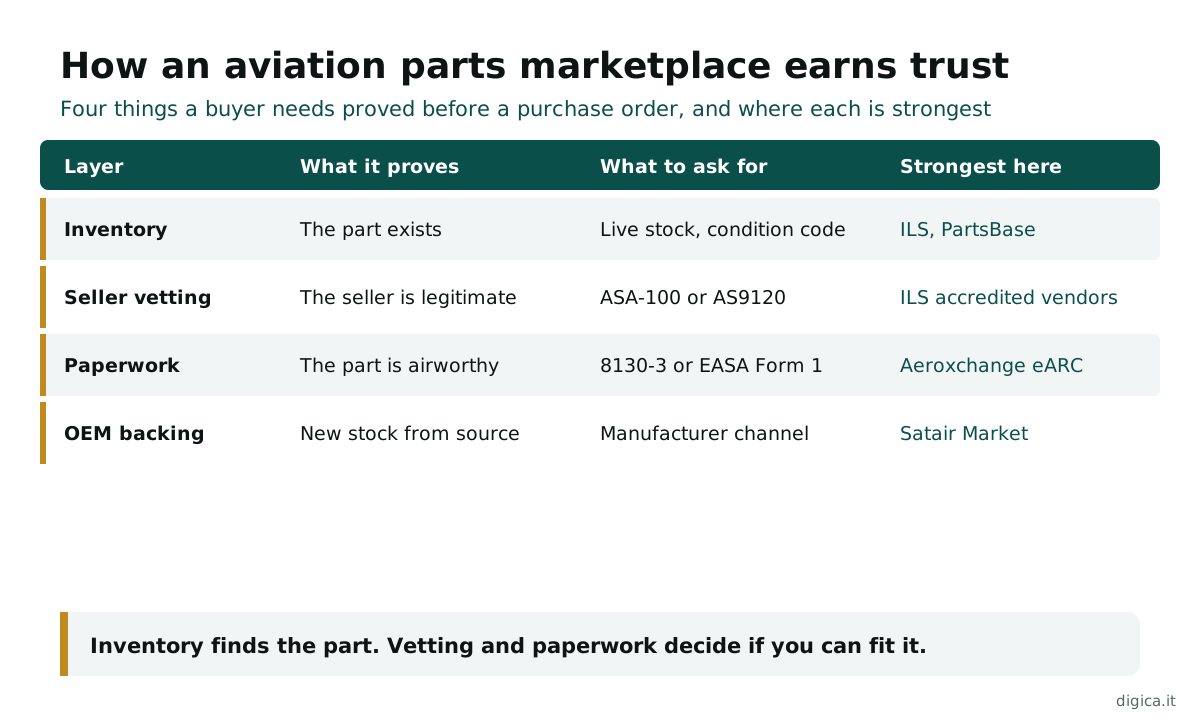
The short answer: it has to prove three things. That the stock exists, that the seller is who they claim to be, and that each part comes with paperwork showing it is airworthy. Most aviation parts marketplaces are strong on the first and vary widely on the other two.
Inventory is the easy claim. Platforms count line items, part numbers or price points, and the numbers run into the millions or billions. Those counts measure how many listings exist, not how many parts are available and certified today. A buyer facing an aircraft on ground (AOG) needs live stock, not a historical listing.
Seller vetting is the second layer. In the United States, the Federal Aviation Administration's voluntary accreditation program for parts distributors recognizes audits against the ASA-100 standard from the Aviation Suppliers Association and the AS9120 quality standard. An aviation parts marketplace that shows which sellers hold those accreditations, or runs its own audits, saves the buyer a step.
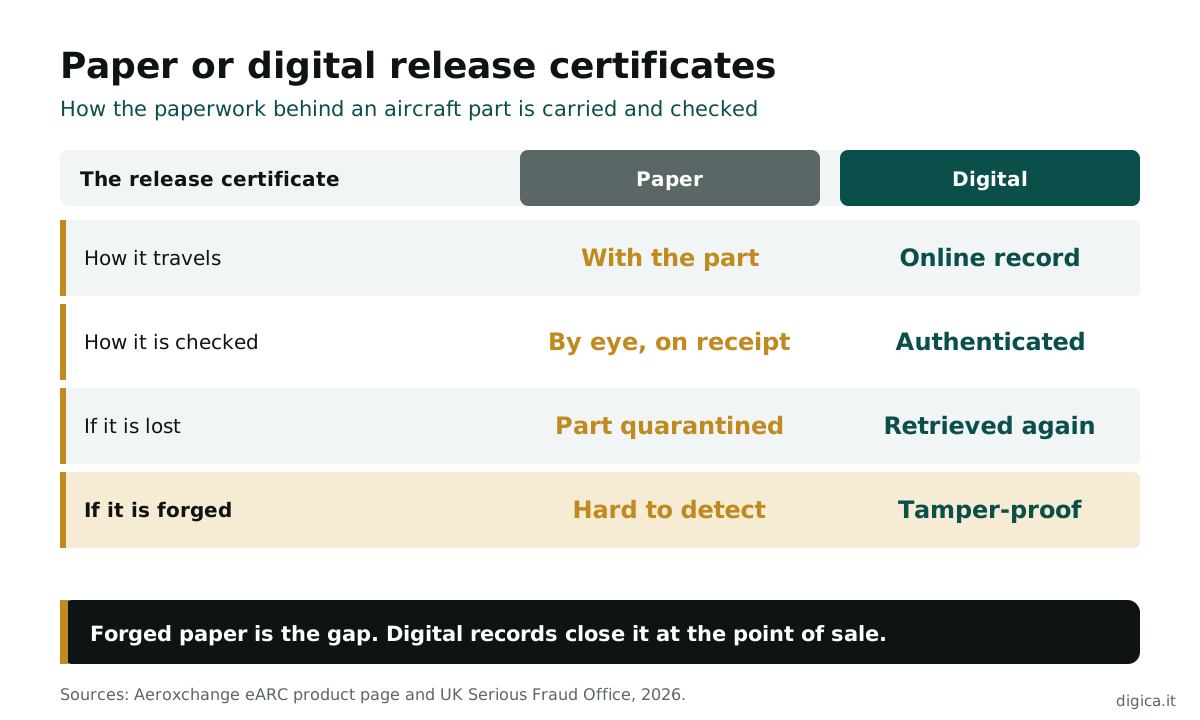
Traceability is the third. Serviceable parts normally travel with an authorized release certificate: FAA Form 8130-3 in the United States or EASA Form 1 in Europe. Condition codes such as new, new surplus, overhauled, serviceable and as removed tell a buyer what they are getting. Paper certificates can be lost or forged, which is why the newest platforms are moving them into digital, verifiable form.
Our view: judge an aviation parts marketplace on certification first and inventory second. A smaller platform whose sellers are vetted is worth more to a maintenance team than a larger one that leaves every check to the buyer.
Six aviation parts marketplaces, side by side
The short answer: ILS leads on inventory and seller screening, PartsBase on flexible access, StockMarket.aero on cost, Locatory.com on European reach, Satair Market on OEM-backed supply and Aeroxchange on digital paperwork.
Six aviation parts marketplaces compared on inventory, certification and vetting, access cost, main risk and best fit
| Marketplace | Inventory claimed | Certification and vetting | Access cost | Main risk | Best for |
|---|---|---|---|---|---|
| ILS | 1B+ parts and services, 29K+ customers, 125+ countries | KYC checks, daily denied-party screening, accredited vendor audits, guaranteed listings | Not published; 14-day free trial | Subscription cost for small buyers | Widest search and seller screening |
| PartsBase | 90M+ parts, 270K+ daily inventory updates | Verified and pre-vetted sellers, process not described | $300 for 60 days of locator access; storefront free for buyers | Vetting criteria not published | Occasional and AOG buyers |
| StockMarket.aero | Not published | Integrity commitment, no published audit | Free for buyers and sellers | Buyer does all checks | Cost-sensitive buyers and sellers |
| Locatory.com | 10M components listed, used in 118 countries | Not published | Not published | Little public detail | European airlines and MROs |
| Satair Market | 5M Airbus proprietary part numbers added in 2025 | Airbus-owned distributor plus third-party sellers | Not published | Airbus-centric range | Airbus operators |
| Aeroxchange | Airline network, counts not published | Digital release certificates covering 8130-3 and EASA Form 1 | Not published | Network, not open listings | Airlines digitizing paperwork |
Every figure is the company's own claim. None publishes an independent audit of its full inventory, so treat totals as reach, not as stock you can buy today.
ILS: best for the largest inventory search
The short answer: ILS, the Inventory Locator Service, says it lists more than 1 billion parts and services for more than 29,000 customers in over 125 countries, and it has the most detailed published approach to seller screening of the six.
ILS is part of CAMP Systems. It says buyers run more than 180,000 part searches a day and that more than $7 billion in parts request-for-quote (RFQ) value passes through the platform. Buyers search, send RFQs, bid in its auctions and use its market intelligence on more than 6 billion demand and supply price points.
The award is for scale combined with screening. ILS's trust page describes know-your-customer (KYC) checks on business registration and ownership, daily screening of every user and organization against export-control and denied-party lists, and on-site inventory reviews at selected suppliers. Its Accredited Vendor Program uses an independent third-party audit and gives accredited sellers higher search priority. Guaranteed listings come from suppliers that guarantee new or new surplus parts, are registered with the US government's System for Award Management and are screened against the Government-Industry Data Exchange Program for counterfeit parts. ILS also shows back-to-birth trace timelines from partners beside some listings.
Running an aviation parts marketplace?
In 30 minutes we look at how airline and MRO buyers find platforms like yours, on Google and in AI answers, and where suppliers drop off before they list.
The gap is that the trust page does not set out how release certificates or condition codes are checked. Buyers still need to request and review the paperwork for each part. ILS does not publish subscription prices, though it offers a 14-day free trial.
Why it wins. The widest search in this list, with the most detailed published seller screening.
PartsBase: best for pay-as-you-go AOG access
The short answer: PartsBase says its locator holds more than 90 million parts, updated more than 270,000 times a day, and it sells short-term access: $300 for 60 days, with a free storefront for buyers.
PartsBase serves more than 6,000 customers in over 140 countries and says 1,000 airlines use it for sourcing. Its buyer pages also list more than 2.8 million overhaul capabilities, which helps when a buyer needs a repair rather than a replacement part. The PBExpress pass is the award: a one-time $300 for 60 days of locator access, rather than an annual subscription. For a small operator or an MRO shop with an occasional AOG, that is the cheapest way into a large paid locator.
Its PartStore is free for buyers, with no subscription or membership fees, and sellers can list there without a subscription. That lowers the barrier on both sides.
On certification, PartsBase describes verified sellers, pre-vetted sources and a trusted supplier network "verified through our rigorous process", but does not publish what the process checks. Ask any seller for its accreditation and the release certificate before you issue a purchase order, as you would on any open platform.
Why it wins. The lowest-commitment route into a large paid parts locator, for buyers who need it for weeks, not years.
StockMarket.aero: best free open marketplace
The short answer: StockMarket.aero calls itself the world's largest free open marketplace for aircraft parts. Buyers and sellers list, search, send unlimited RFQs and issue purchase orders without paying.
The platform launched in 2006 and is run by Component Control, a subsidiary of CAMP Systems, which makes it a sister company of ILS. Sellers using Component Control's Quantum Control software can sync their inventory automatically, so listings update as stock moves. Buyers can set alerts for part numbers they need. The platform earns its revenue from premium placement, banner advertising and sponsored listings, not from access fees.
Free access is the strength and the limit. Anyone can list, so the work of checking a seller falls on the buyer. StockMarket.aero says it adheres to product integrity, but publishes no seller audit or accreditation filter. It also publishes no current listing or vendor count, which makes it hard to compare its reach with the paid locators.
For a buyer with a well-run approved vendor list, that is a fair trade: use the free search to find stock, then buy only from sellers already on your list. For a buyer without one, a platform that screens sellers is worth paying for.
Why it wins. The only platform here that charges neither buyers nor sellers for access.
Locatory.com: best for a European MRO network
The short answer: Locatory.com, part of Avia Solutions Group, says it lists 10 million components and records more than 2 million spare part searches a year from users in 118 countries.
Locatory.com is based in Vilnius, Lithuania, and belongs to Avia Solutions Group, an aviation services group. That gives it a natural user base among European airlines and MRO shops.
Do airline buyers find your parts platform first?
A growth audit maps how airline, MRO and distributor buyers search for parts platforms like yours, on Google and in AI answers, and which of your part and category pages they never reach.
The platform publishes less detail than the US-based locators, and its site blocks automated reading, so we could verify only the group's own figures. We found no published description of how it vets sellers or handles release certificates. Ask for both before relying on it for anything safety-critical.
For a European buyer, the case is reach in the right time zones and among suppliers used to EASA paperwork. For a US buyer, Locatory.com is a useful second search when a part cannot be found on the larger locators.
Why it wins. The strongest European-rooted parts locator, backed by a large aviation services group.
Satair Market: best for OEM and used parts in one place
The short answer: Satair, an Airbus company, runs a parts platform that combines Airbus proprietary parts, parts from other original equipment manufacturers (OEMs), used serviceable material and surplus stock from third-party sellers in one place.
In April 2025 Satair added 5 million Airbus proprietary part numbers to the platform, migrated from the old Airbus Spares site. The marketplace feature lets third-party sellers offer used serviceable material and surplus alongside new parts sold by Satair itself. In May 2026 Satair completed its acquisition of Unical Aviation, a supplier of used serviceable material, which deepens its own aftermarket stock.
The award is for the blend. An Airbus operator can buy a new proprietary part and a used alternative from the same platform, with an OEM-owned distributor behind the new stock. That is a different kind of trust from an audit: the certification chain for new parts starts with the manufacturer.
The limit is range. The platform is built around Airbus fleets, so operators of other aircraft types get less from it. Satair does not publish how many third-party sellers it admits or how it vets them, so treat third-party listings with the same checks as any other marketplace.
Why it wins. The only platform here that pairs manufacturer-backed new parts with a used and surplus marketplace.
Aeroxchange: best for digital release certificates
The short answer: Aeroxchange is an electronic business network founded in 2000 by 13 airlines, and its eARC product turns authorized release certificates, covering FAA Form 8130-3 and EASA Form 1, into digital, verifiable records.
Aeroxchange is not an open listing site. Airlines and their suppliers use it to send RFQs, place orders, manage repairs and arrange AOG loans, exchanges and borrows, and it says RFQs reach 100% of a member's supplier network. Its strength is the paperwork that travels with the part.
That matters because the paperwork is where fraud happens. On February 23, 2026, the director of AOG Technics, a UK parts supplier, was sentenced to four years and eight months in prison after the company sold more than 60,000 engine parts using doctored authorized release certificates and fake shipment records between 2019 and 2023 (UK Serious Fraud Office). American Airlines and Ethiopian Airlines were among the airlines affected. A tamper-proof digital certificate, checked at the point of sale, closes the gap that case exploited.
The limit is access. Aeroxchange serves airlines and their contracted suppliers, and does not publish member counts or prices. For an independent distributor, it is a network to join through customers, not a place to find new ones.
Why it wins. The most direct answer to forged paperwork among the six.
Aviation parts marketplace or aviation directory?
The short answer: an aviation parts marketplace lists stock, while an aviation directory lists companies. Buyers need both, for different jobs.
A parts marketplace answers "who has part number X in stock, in what condition, at what price?" An aviation directory answers "who repairs landing gear in Europe?" or "which distributors hold ASA-100 accreditation?" Directories are where buyers build approved vendor lists. Marketplaces are where they buy from them.
Most of the platforms above blur the line. ILS and PartsBase list repair capabilities as well as parts, and ILS's vendor accreditation works like a directory of audited suppliers inside a marketplace. For a buyer, the practical rule is to use a directory to decide who you trust, and a marketplace to find what they have.
For an operator building a platform, the line matters more. A directory competes on the quality of its company profiles. A marketplace competes on live inventory and on how quickly a buyer can verify a seller. The platforms that combine both, with vetting visible on every listing, are the ones buyers return to. That is the same pattern we see across B2B marketplaces in every industry.
Three failure scenarios
These are the patterns that recur when parts buyers rely on a marketplace without checking what it actually verifies.
- The listing that was not stock. A regional airline with an aircraft on ground finds the part on three platforms, sends RFQs and learns that two of the listings were sold weeks ago. The aircraft stays grounded another day. Searching platforms that update inventory daily, and calling the top two sellers directly, would have found the live stock faster.
- The certificate nobody checked. An MRO shop buys an overhauled component from a new seller on an open platform at a good price. The release certificate looks right but cannot be traced back to the repair station named on it. The part is quarantined and the job is delayed. Buying only from accredited sellers, or asking for the certificate before the purchase order, would have caught it.
- The subscription bought for one part. A small operator signs an annual locator subscription to find one hard-to-source part, finds it in a week and never logs in again. Global MRO demand reached $136 billion in 2025, up 8% from 2024, according to Oliver Wyman (Oliver Wyman), and suppliers are busy. A short-term pass or a free open marketplace would have found the same part for a fraction of the cost.
Each buyer found a platform with inventory. None matched the platform's checks to the risk of the purchase.
Choosing an aviation parts marketplace: a decision framework
The short answer: start from how often you buy and how much checking you can do yourself, then choose the platform whose vetting fills the gap.
- If you buy parts every day across many fleet types, subscribe to ILS and filter to accredited and guaranteed sellers by default.
- If you need a large locator for fewer than three months a year, buy PartsBase's 60-day pass at $300 rather than an annual subscription.
- If you already run a strict approved vendor list, use StockMarket.aero to find stock for free, and buy only from sellers on your list.
- If you operate mainly in Europe, add Locatory.com as a second search, and confirm EASA Form 1 paperwork before ordering.
- If more than half your fleet is Airbus, check Satair Market first for both new proprietary parts and used alternatives.
- If you are an airline replacing paper release certificates, start with Aeroxchange's eARC through your existing supplier network.
- If a seller cannot send the release certificate before you issue a purchase order, do not buy, whatever platform it is on.
Building an aviation parts marketplace?
We help aviation parts marketplaces recruit the suppliers that make inventory worth searching, and reach the airline and MRO buyers comparing them.
The number to take into your next budget meeting is the cost of a day on the ground against the cost of access. A $300 locator pass that finds one AOG part a day sooner pays for itself many times over on almost any aircraft. A free platform that sells you one part with paperwork that cannot be traced costs far more, in quarantine, delays and audit findings. The biggest cost of doing nothing is relying on whichever platform is open in the browser, rather than the one whose checks match the risk.
FAQ
What is an aviation parts marketplace? An aviation parts marketplace is an online platform where airlines, MRO shops and distributors search for aircraft parts across many sellers, send requests for quote and buy. The largest, such as ILS and PartsBase, list tens of millions of parts or more.
What is the largest aircraft parts locator? By its own figures, ILS is the largest, claiming more than 1 billion parts and services, more than 29,000 customers and over 180,000 part searches a day. PartsBase says its locator holds more than 90 million parts.
Is StockMarket.aero free? Yes. StockMarket.aero says buyers and sellers can list inventory, search, send unlimited requests for quote and issue purchase orders free of charge. It earns revenue from premium placement, banner advertising and sponsored listings.
What is an 8130-3 tag? FAA Form 8130-3 is the authorized release certificate that certifies a part's airworthiness in the United States. Its European equivalent is EASA Form 1. Buyers should see a valid certificate, traceable to the issuing organization, before buying any serviceable part.
How do I check an aircraft parts supplier? Ask whether the supplier is accredited to ASA-100 or AS9120, request the release certificate and trace documents before issuing a purchase order, and prefer platforms that screen sellers, such as ILS's Accredited Vendor Program.
What is the difference between an aviation directory and a parts marketplace? An aviation directory lists companies and their capabilities, such as repair stations or distributors. An aviation parts marketplace lists specific parts in stock, with condition and price, and lets buyers request quotes or buy.
Related Articles
- Aviation parts marketplace growth
- Best surplus and used industrial equipment marketplaces
- Best procurement marketplaces for B2B buyers in 2026
- Best supplier databases and directories for B2B in 2026
- Best B2B marketplaces in 2026: 7 examples by industry
Where this connects
This article is part of our B2B marketplace growth series. Browse more on the Digica blog.