The best surplus and used industrial equipment marketplaces in 2026, grouped by how they sell and compared on listings volume
A surplus marketplace is a B2B marketplace where companies sell machinery, tooling and other industrial assets they no longer need, and where other companies buy them for less than new. There is plenty of idle equipment to sell. The Federal Reserve reported that US manufacturing capacity utilization was 75.9% in September 2026, 2.3 percentage points below its 1972 to 2025 average.
For a plant manager selling a press or buying a used lathe, the first number most platforms show is volume: listings live, lots sold, registered buyers. Volume matters, but it hides the more important choice. Some of these platforms sell by auction, with a fixed end date and a price set by bidders. Others list equipment at a price and wait for an enquiry. A surplus marketplace that suits a whole plant closure is often the wrong tool for one machine you want full value for.
This guide groups seven of the leading surplus and used industrial equipment marketplaces by how they sell, and compares them on the listings, lots and buyers each one can show, using company filings and the companies' own pages, checked on October 22, 2026. It is the same liquidity test we apply when we help industrial B2B marketplaces grow their seller supply and buyer demand together.
Quick Navigation
- What listings volume tells you about a surplus marketplace
- Seven surplus and used equipment marketplaces compared
- Auction marketplaces: Ritchie Bros. and BidSpotter
- Surplus liquidation: AllSurplus
- Listing search engines: Machinio and Machineseeker
- Dealer directories and brokers: Surplus Record and Exapro
- Lots sold against listings live
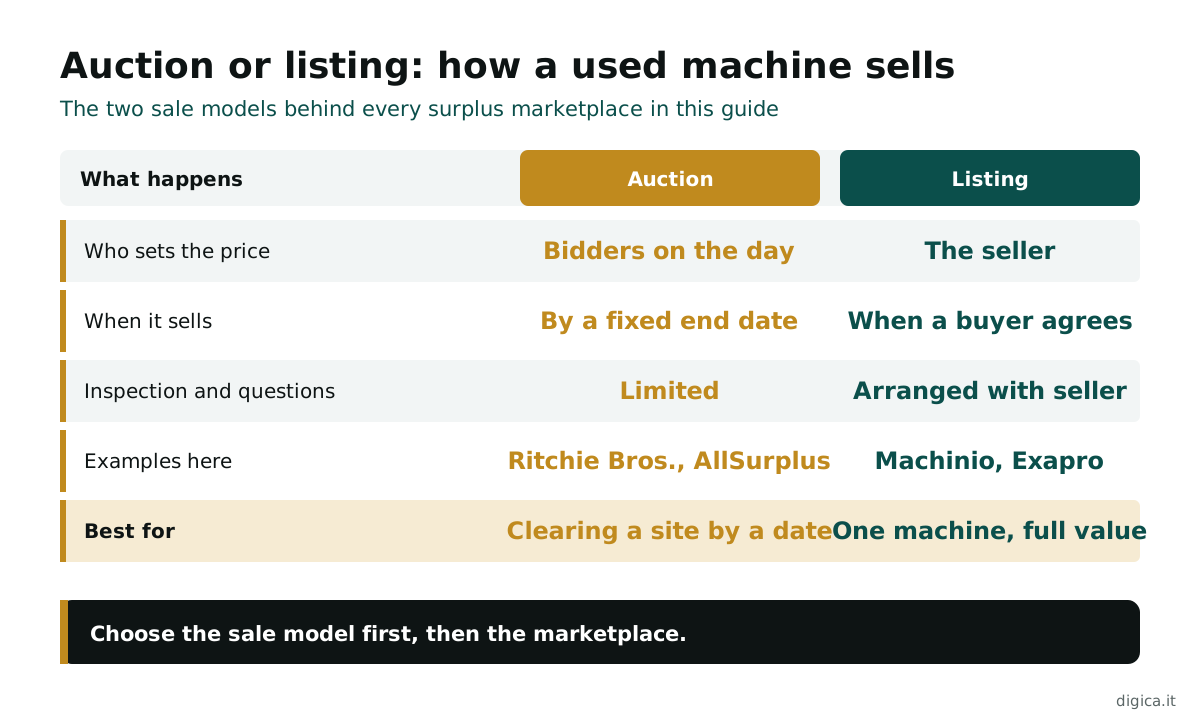
- Auction or listing: choosing a sale model
- Three failure scenarios
- Which surplus marketplace fits your equipment
- FAQ
- Related Articles
What listings volume tells you about a surplus marketplace
The short answer: volume tells you how many buyers and sellers a surplus marketplace has already gathered, and the useful version of it is the count for your type of equipment, in your region, sold your way.
Used equipment marketplaces publish three kinds of volume. Auction platforms publish lots sold and the value of goods that went under the hammer. Liquidation marketplaces publish registered buyers and auction participants. Listing sites publish listings live and monthly visitors. All three are real numbers. They are not the same number.
The difference matters most to sellers. Lots sold measures completed sales. Listings live measures stock waiting for a buyer, some of which may have been waiting for months. A registered buyer may have bid once, years ago. In our experience, the best question to put to any surplus marketplace is "how many machines like mine sold here last quarter, and how long did they take?"
Buyers face a different problem. A listing site with hundreds of thousands of machines gives breadth and the chance to inspect and negotiate. An auction gives a deadline, a lower expected price and less room to check the machine. The right choice depends on whether you need the machine this month or the best price this year.
Seven surplus and used equipment marketplaces compared
The short answer: Ritchie Bros. and BidSpotter lead on auctions, AllSurplus on surplus liquidation with the largest registered buyer base, Machinio and Machineseeker on listing search, and Surplus Record and Exapro on dealer listings and brokered sales.
Seven surplus and used industrial equipment marketplaces compared by type, sale model, volume claimed, main risk and best fit
| Marketplace | Type | Sale model | Volume claimed | Main risk | Best for |
|---|---|---|---|---|---|
| Ritchie Bros. and IronPlanet | Auction marketplace | Onsite and online auction, fixed price, negotiated sale | 3.39M lots sold in 2025 | Construction and transport heavy | Fleets and heavy equipment |
| BidSpotter | Auction platform for auction houses | Live webcast and timed online auctions | $2.5B industrial GMV across its segment | Quality depends on the auction house | Plant closures and factory sales |
| AllSurplus | Surplus liquidation | Timed online auction, Buy Now | 6.0M registered buyers | Sold as is, buyer inspects | Corporate surplus and idle assets |
| Machinio | Listing search engine | Dealer listings, buyer enquiry | 1M+ monthly visits, 190+ countries | No transaction, seller follows up | Buyers searching many dealers at once |
| Machineseeker | Listing marketplace | Dealer listings, some auctions | 200,000+ listings, 8,100+ sellers | European focus | Machine tools in Europe |
| Surplus Record | Dealer directory | Paid dealer listings, buyer enquiry | 90,000+ listings, 2,000+ categories | Dealer-led, fewer private sellers | North American dealer stock |
| Exapro | Brokered marketplace | Free listing, success fee on sale | About 58,000 machines | Slower than an auction | Single machines sold for full value |
Read the volume column as different measurements. The section on lots sold against listings live explains why they do not rank against each other.
Auction marketplaces: Ritchie Bros. and BidSpotter
The short answer: Ritchie Bros. is the largest auctioneer of used equipment on this list, and BidSpotter is the platform many independent industrial auction houses use to sell online.
Ritchie Bros. and IronPlanet belong to RB Global, established in 1958 and headquartered in Westchester, Illinois. Its 2025 annual report says total gross transaction value rose 2% to $16.2 billion, with 3.39 million lots sold across the group and customers in approximately 170 countries. Its commercial construction and transportation segment, closest to industrial equipment, sold 376,100 lots worth $5.66 billion, a 13% fall in lots from 2024.
RB Global runs every sale model on this list under one roof. RB Auction sells onsite and online. IronPlanet is an online marketplace for used equipment. Marketplace-E sells at a fixed price, and Ritchie Bros. Private Treaty handles confidential negotiated sales of large equipment. For a fleet owner selling 40 machines, that range is the reason to call them first.
Running a surplus or used equipment B2B marketplace?
In 30 minutes we look at where your buyer demand is thin, category by category, and how plant managers find platforms like yours before they find you.
BidSpotter works differently. It is owned by Auction Technology Group (ATG), based in London, which bought BidSpotter.com in 2013. Independent industrial auction houses run their sales on it, as live webcast auctions or timed online auctions with a fixed closing time. ATG's results for the year to September 2025 put gross merchandise value in its industrial and commercial segment, which includes BidSpotter.com, BidSpotter.co.uk and Proxibid, at $2.5 billion, down 1%. Across all its platforms, ATG listed 26.8 million lots and facilitated more than 99,000 auctions.
The verdict. Ritchie Bros. for heavy equipment and fleets. BidSpotter when an industrial auctioneer is selling a whole factory and you want to reach bidders across many auction houses at once.
Surplus liquidation: AllSurplus
The short answer: AllSurplus is the surplus marketplace with the largest registered buyer base here, built for companies clearing idle assets rather than dealers selling stock.
AllSurplus and its government twin GovDeals belong to Liquidity Services, headquartered in Bethesda, Maryland. Its fiscal 2025 annual report says its marketplaces had 6.0 million registered buyers at September 30, 2025, and 4.1 million auction participants during the year. Total gross merchandise volume was about $1.57 billion, of which GovDeals accounted for about $903 million. Its commercial seller business, which sells heavy equipment, industrial manufacturing, oil and gas and biopharma assets on AllSurplus and GovDeals, grew to about $249 million from about $210 million.
The sale model is the timed online auction, with a Buy Now option on some lots. Liquidity Services says AllSurplus hosts more than 15,000 sellers in more than 900 business and industrial asset categories, and GovDeals listings are automatically cross-listed to AllSurplus.com for extra exposure.
For a manufacturer closing a line, that buyer base is the point. Idle assets need bidders, not a slow trickle of enquiries. The trade-off is control: assets typically sell as is, and the final price is whatever the auction delivers.
The verdict. Best for corporate surplus and idle assets where clearing the floor by a date matters more than the last dollar per machine.
Listing search engines: Machinio and Machineseeker
The short answer: listing search engines gather dealer stock from many sellers into one search, which is where buyers who want to compare and negotiate start.
Machinio, founded in 2013 and also owned by Liquidity Services, runs a global search engine for equipment listings across construction, machine tools, processing, transportation, printing, agriculture and laboratory and medical. Liquidity Services says it connects sellers with buyers in more than 190 countries and records more than 1 million monthly visits. Revenue for its Machinio and software segment, according to Liquidity Services' fiscal 2025 annual report on Form 10-K, grew 22.2% to about $19.7 million in fiscal 2025, helped by price increases and more subscribers.
Machinio does not run auctions. Dealers subscribe, list their stock and receive enquiries. In September 2026 it added dealer profiles, a dealer directory and a service directory, so buyers can see who is behind each listing.
Do buyers find your equipment marketplace first?
A growth audit maps how plant managers and dealers search for used machinery, on Google and in AI answers, and which of your category pages they never reach.
Machineseeker, run by Machineseeker Group from Essen, Germany, is the European counterpart. Its homepage reports more than 8,100 sellers, more than 200,000 listings and more than 11 million visitors a month, and it runs online auctions alongside the listings. For a buyer of machine tools in Europe, that depth is hard to match.
The verdict. Machinio for a global search across dealers. Machineseeker for machine tools and production equipment sold in Europe.
Dealer directories and brokers: Surplus Record and Exapro
The short answer: these two sell slower and closer to full value, Surplus Record through a long-established dealer directory and Exapro through brokered sales with a success fee.
Surplus Record, based in Chicago, has been publishing machinery listings since 1924, when its print directory held 5,000 listings. It now reports more than 90,000 listings across more than 2,000 categories. Dealers pay for membership tiers to list, and buyers contact sellers directly through an enquiry form on each listing. For a North American buyer looking for dealer stock in a specific category, the depth of its category structure is the advantage.
Exapro, founded in 2005 in Saumur, France, with operations in Prague, runs a brokered marketplace for used industrial machinery in metalworking, packaging, food, printing, plastics and pharma. It says it gives access to approximately 58,000 used machines and serves more than 600,000 monthly visitors. Sellers list free of charge, and Exapro earns a success fee when a sale completes. It bought the Kitmondo marketplace in 2021.
The verdict. Surplus Record for dealer stock in North America. Exapro for a seller with one valuable machine who wants qualified buyers and is willing to wait for the right price.
Lots sold against listings live
The volume figures in this guide measure four different things, and putting them side by side shows why they cannot be ranked against each other.
RB Global's 376,100 construction and transportation lots are completed sales in one year. Machineseeker's 200,000 listings, Surplus Record's 90,000 and Exapro's 58,000 are stock available today. AllSurplus's 6.0 million is registered buyers, a measure of demand rather than supply. Machinio's 1 million monthly visits is traffic.
Each figure is the one that suits the model. An auction house shows what it sold, because it sells by a date. A listing site shows what is available, because breadth is what a buyer searches for. A liquidation marketplace shows buyers, because idle assets need bidders. The chart below puts the supply-side figures on one scale.
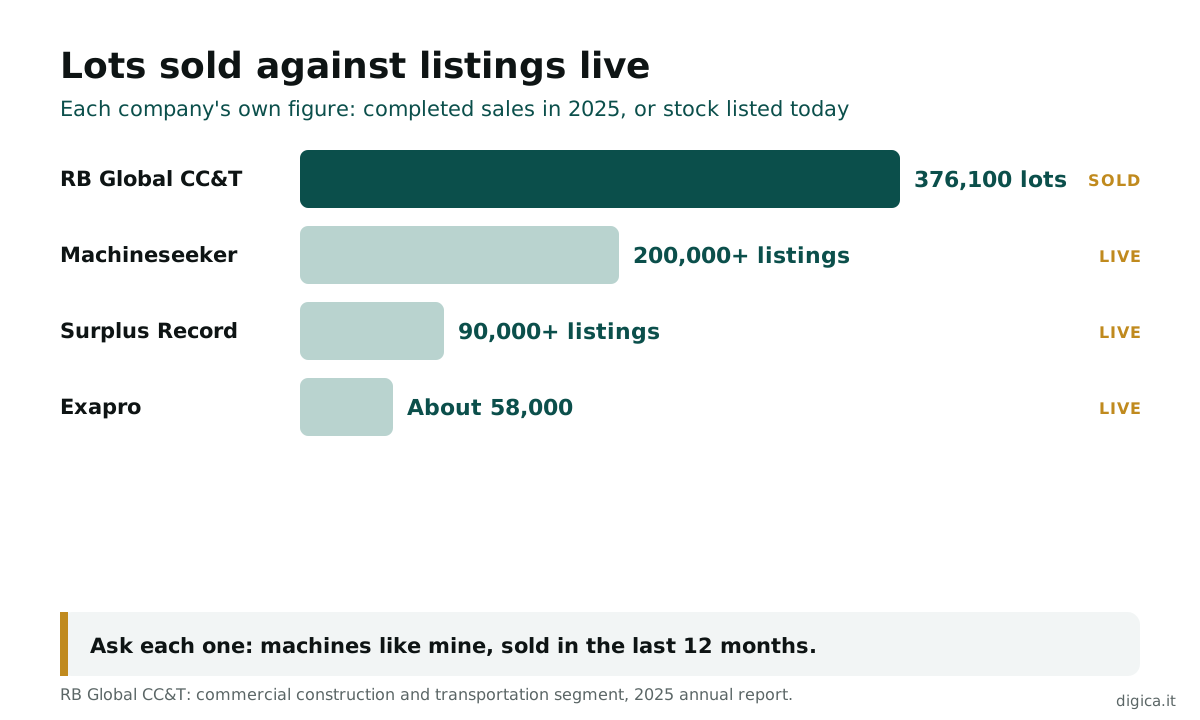
For a seller, the fix is to ask every platform the same question about your own equipment. How many machines of this type and age sold here in the last 12 months, at what share of the asking price, and in how many days? A platform that can answer that from its own data is worth more than one with a bigger headline.
For anyone building a surplus marketplace, there is a lesson in the same numbers. Sellers judge you on buyers for their category, and buyers judge you on stock in theirs. A used equipment marketplace that is deep in five categories usually beats one that is thin in 500.
Auction or listing: choosing a sale model
The short answer: auctions trade price for speed and certainty of sale, while listings trade speed for price and control. The right model depends on how many assets you are selling and how fast the floor has to be clear.
An auction sets a date. Everything sells, usually as is, to the highest bidder on the day. That suits a plant closure, a fleet replacement or a lab moving out by the end of a lease, where the cost of keeping assets for another three months is higher than any extra price a slower sale might bring.
A listing keeps control with the seller. The machine sells only when a buyer meets the price, and the seller can answer questions, arrange inspections and negotiate. That suits a single high-value machine, such as a five-axis machining center or a packaging line in good condition, where the difference between an auction price and a negotiated price can be large.
The market for new machines also shapes what used machines are worth. US machine tool orders rose 22.5% in 2025 to $5.74 billion, according to the Association for Manufacturing Technology, and when new machines are in demand, good used ones often sell faster on listing sites too.
Many sellers use both. They list the best machines on a listing marketplace for 60 to 90 days, then send what has not sold to auction.
Three failure scenarios
These are the patterns that recur when a company picks a surplus marketplace on the headline volume.
- The single machine sent to auction. A job shop puts one late-model machining center into a general industrial auction to clear space quickly. It sells to the only two serious bidders on the day, well below what a dealer would have paid. Listing it on a brokered marketplace for a few weeks first would likely have found a buyer who needed exactly that machine.
- The plant closure listed machine by machine. A manufacturer closing a site lists 300 assets individually on a listing marketplace. Months later, half are still there, and the building lease runs on. A single timed auction would have cleared the floor by a fixed date.
- The buyer who trusted the listing count. A maintenance manager searches the marketplace with the most listings, finds a used press that matches the specification and pays without arranging an inspection. The machine needs repairs on arrival. Asking for inspection reports, or choosing a platform with inspection built in, would have caught it.
Each team read a real number. Each read it as an answer to a question it was not asking.
Which surplus marketplace fits your equipment
The short answer: start with what you are selling or buying, then how fast the deal has to close. These decision points make it specific.
- If you are clearing more than 50 assets by a fixed date, run a timed auction through AllSurplus or an industrial auction house on BidSpotter.
- If you are selling heavy equipment or a fleet, start with Ritchie Bros. and choose between auction, fixed price and negotiated sale.
- If you are selling one machine worth more than $50,000, list it on Exapro or with Surplus Record dealers before you consider auction.
- If you are buying machine tools in Europe, search Machineseeker first.
- If you are buying and want to compare dealers worldwide, search Machinio and contact several sellers for the same model.
- If a platform cannot show sales of equipment like yours in the last 12 months, test it with one lot before you commit a whole site.
Growing an industrial or used equipment B2B marketplace?
We help industrial B2B marketplaces build the seller supply and buyer demand that make each equipment category worth searching.
The number to take into your next asset review is the size of the market waiting for your idle machines. RB Global's 2025 annual report puts its gross transaction value at $16.2 billion for the year, and Liquidity Services handled about $1.57 billion of surplus through its marketplaces. Buyers for used equipment are there. The biggest cost of doing nothing is leaving machines idle on the floor, where they lose value every quarter, take up space you are paying for and save nobody anything.
FAQ
What is a surplus marketplace? A surplus marketplace is a B2B marketplace where companies sell equipment, inventory and assets they no longer need, usually by online auction or fixed-price listing. AllSurplus, Ritchie Bros. and BidSpotter are examples.
What is the best site to sell used industrial equipment? It depends on the sale. For a whole plant or fleet by a fixed date, an auction marketplace such as AllSurplus, BidSpotter or Ritchie Bros. For a single valuable machine, a listing or brokered marketplace such as Exapro or Surplus Record usually gets closer to full value.
Is it better to auction or list used machinery? Auctions sell everything by a date, usually at a lower price per machine. Listings take longer but let the seller set the price and negotiate. Many sellers list their best machines first, then auction what has not sold.
Which used equipment marketplace has the most listings? Of the listing sites in this guide, Machineseeker reports the most, with more than 200,000 listings from more than 8,100 sellers. Surplus Record reports more than 90,000 listings and Exapro about 58,000 machines.
How many buyers use AllSurplus and GovDeals? Liquidity Services, which runs both, reported 6.0 million registered buyers across its marketplaces at September 30, 2025, and 4.1 million auction participants during its 2025 fiscal year.
What is Machinio? Machinio is a global search engine for new and used equipment listings, owned by Liquidity Services. Dealers subscribe to list their stock, and buyers in more than 190 countries search it and contact sellers directly.
Related Articles
- Industrial B2B marketplace growth
- Best agriculture marketplaces in 2026, by reach
- Best supplier databases and directories for B2B in 2026
- Best B2B marketplaces in 2026: seven examples by industry
- Liquidity is the only marketplace metric that compounds
Where this connects
This article is part of our B2B marketplace growth series. Browse more on the Digica blog.