The best software marketplaces for SaaS vendors in 2026, compared on what they charge
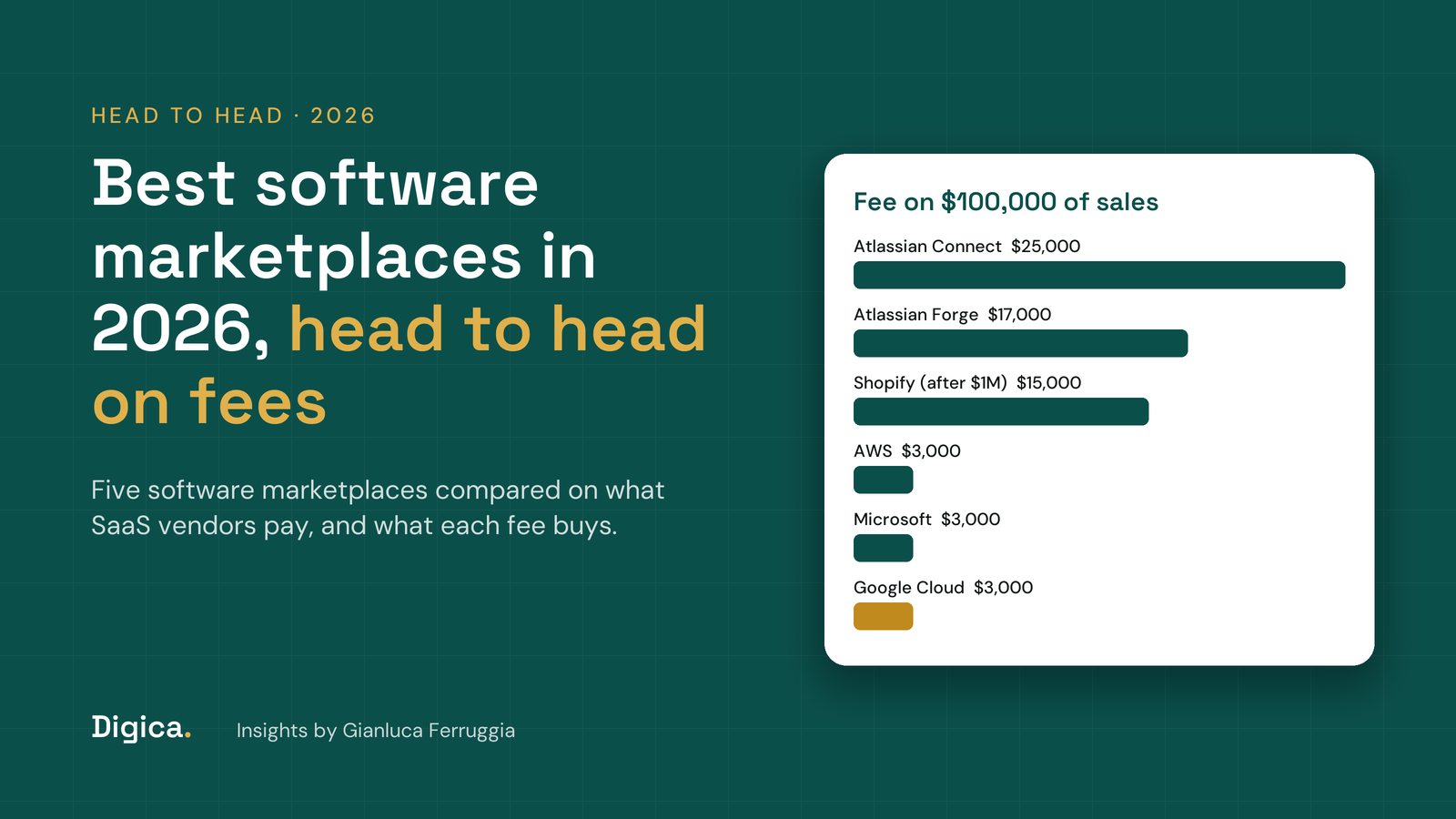
A software marketplace can take as little as 1.5% of a SaaS deal or as much as 25%. On $100,000 of sales, that is the difference between paying $1,500 and paying $25,000 for the same customer. Which software marketplace a SaaS vendor lists on first is a pricing decision long before it is a marketing one, and most vendors make it by habit.
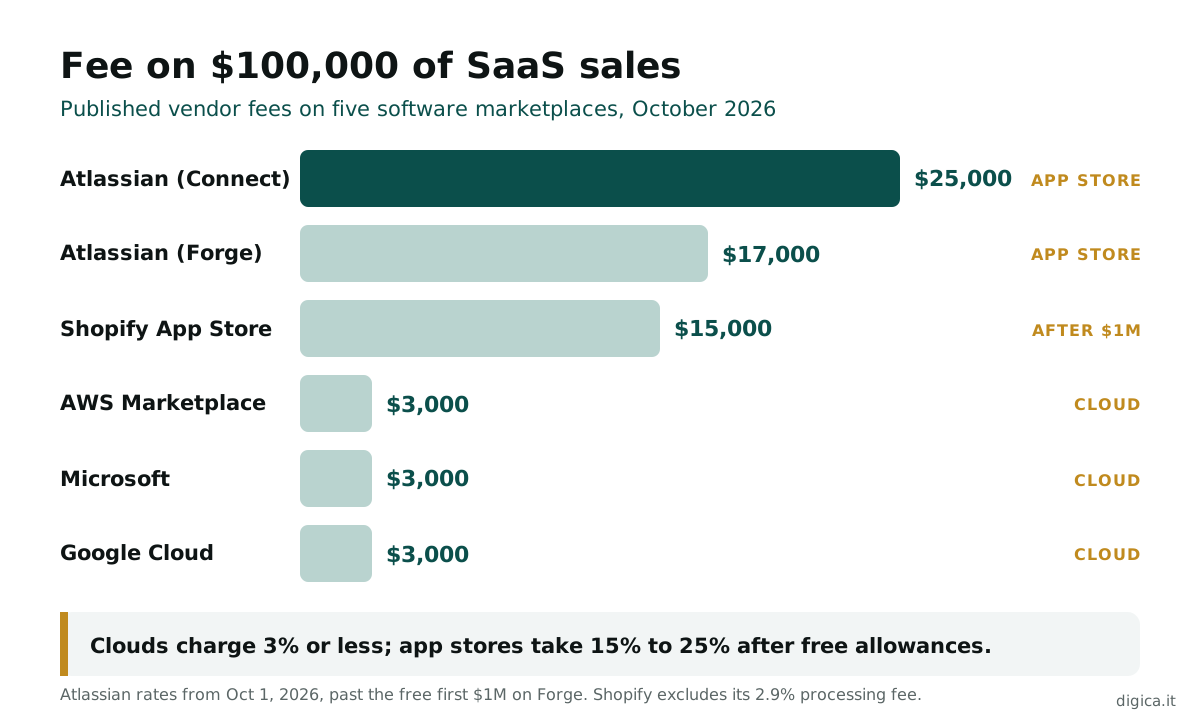
The two kinds of software marketplace look alike from the outside and work very differently. The cloud marketplaces run by AWS, Microsoft and Google charge 3% or less, because their real business is cloud spend and a marketplace sale keeps a customer's budget on their platform. The app stores run by Atlassian and Shopify charge 15% to 25% once a free allowance runs out, because the marketplace is part of how they make money. A vendor that compares them on fee alone picks the cloud every time, and is often wrong.
This guide puts five software marketplaces head to head on commission and listing cost: what each charges, what it handles for the fee, and which buyers it reaches. Every fee comes from each platform's own seller documentation, checked on October 15, 2026. It is the same supply-side lens we use when we help SaaS and software marketplaces grow their vendor base.
Quick Navigation
- The five software marketplaces head to head
- AWS Marketplace: the cheapest fee at scale
- Microsoft Marketplace: one storefront since 2025
- Google Cloud Marketplace: tiered like AWS
- Atlassian Marketplace: free to $1 million, then a real cut
- Shopify App Store: the largest free allowance
- Cloud marketplace or app store: what the fee buys
- Three ways a SaaS marketplace listing costs more than it earns
- Which software marketplace to list on first
- The number for your next channel review
- FAQ
- Related Articles
The five software marketplaces head to head
The short answer: AWS Marketplace, Microsoft Marketplace and Google Cloud Marketplace charge SaaS vendors 3% or less and fall to 1.5% on large deals and renewals. Atlassian Marketplace and the Shopify App Store let a vendor keep everything up to $1 million in lifetime revenue, then take 15% to 25%.
Five software marketplaces compared head to head on fees, what the fee covers and fit
| Software marketplace | Listing cost | Fee on SaaS sales | Fee on $100,000 | What the fee covers | Main risk for a vendor | Best for |
|---|---|---|---|---|---|---|
| AWS Marketplace | No listing fee | 3% public offers; private offers 3%, 2% from $1M, 1.5% from $10M; renewals 1.5% | $3,000 | Billing, private offers, deals that count for AWS sellers | Integration work before the first sale | Enterprise SaaS sold to AWS customers |
| Microsoft Marketplace | No listing fee | 3% store service fee; half that on private-offer renewals | $3,000 | Billing and collections, private offers, contracts up to five years | Technical rules: multitenant, Entra ID, fulfillment APIs | SaaS sold to Azure and Microsoft 365 buyers |
| Google Cloud Marketplace | No listing fee | 3% on usage pricing, 2% on large private offers, 1.5% on renewals | $3,000 | Private offers, auto-renewal, reseller offers | Only helps where buyers commit Google Cloud spend | SaaS sold to Google Cloud customers |
| Atlassian Marketplace | No listing fee | Vendor keeps 100% of the first $1M on Forge, then 83%; 75% on Connect and Data Center | $17,000 to $25,000 | Billing, licensing, a catalog Jira and Confluence teams browse | The highest fee here once past $1M | Apps that extend Jira or Confluence |
| Shopify App Store | $19 once | 0% on the first $1M lifetime, then 15%, plus a 2.9% processing fee | $0 under $1M lifetime; $15,000 after, plus processing | Billing API, a store merchants browse | Large developers pay 15% from the first dollar | Apps sold to Shopify merchants |
Read the fee column against the "what the fee covers" column. A 3% cloud fee buys billing and a route into a customer's committed cloud budget. A 15% to 25% app store fee buys distribution inside a product the buyer already uses every day. Both can be good value, for different products.
AWS Marketplace: the cheapest fee at scale
AWS Marketplace has the lowest published fee for large SaaS contracts of any software marketplace in this guide. Its seller documentation sets a 3% fee on public SaaS offers, and private offers on a sliding scale: 3% under $1 million, 2% from $1 million to under $10 million, and 1.5% at $10 million and above. Every renewal is 1.5%, whatever its size. These rates took effect on January 5, 2024.
There are two additions to know. A channel partner private offer, where a reseller sells your product through AWS Marketplace, adds 0.5% to the fee. Since April 1, 2025, sales to buyers in South Korea add 1%. AWS invoices its fee on the pre-tax total contract value, so a three-year deal pays the fee on all three years.
What the fee buys is the reason enterprise SaaS vendors list here. AWS says its customers hold more than 3 million subscriptions from AWS Marketplace, and that AWS field teams are compensated on AWS Marketplace transactions. A deal through the B2B marketplace counts for the AWS seller in the room, and many enterprise buyers can pay from a cloud budget they have already committed. That turns a new vendor approval into a purchase on an existing contract.
Listed on a cloud marketplace and still waiting for the first private offer?
In 30 minutes we look at how buyers find your listing, and which software marketplace should carry your next deal.
The cost is integration work and time. A SaaS listing needs metering or entitlement integration before AWS can bill for you, and the value only arrives once your sales team learns to route deals through private offers. Analysts expect a lot of money to move this way: Omdia forecasts hyperscaler cloud marketplace sales rising from $30 billion in 2024 to $163 billion by 2030, with partners facilitating nearly 60% of marketplace transactions by 2030.
The verdict: the best software marketplace for enterprise SaaS with buyers on AWS. At 1.5% on renewals, it is also the cheapest place to keep a customer.
Microsoft Marketplace: one storefront since 2025
Microsoft Marketplace became a single storefront on September 25, 2025, when Microsoft merged Azure Marketplace and AppSource. Microsoft describes it as offering tens of thousands of cloud and industry solutions, including more than 3,000 AI apps and agents, to millions of customers.
The fee matches AWS at the headline. Microsoft's commercial marketplace documentation sets a 3% standard store service fee on transactable offers, deducted when Microsoft pays the publisher, and halves that fee on private-offer renewals. Microsoft acts as the agent for billing and collections, and supports private plans, metered billing and contracts of up to five years. Eligible purchases also count toward a customer's Azure consumption commitment, the same budget logic that makes AWS attractive.
The friction is technical. A transactable SaaS offer must be multitenant, sign users in with Microsoft Entra ID, and integrate Microsoft's SaaS fulfillment APIs. A product built on its own authentication needs real engineering before the first sale. That work is a one-time cost, and for a vendor whose buyers already run on Azure and Microsoft 365, it is the price of entry to their procurement process.
The verdict: the best software marketplace for SaaS sold to Microsoft-centered IT teams. Budget the Entra ID and fulfillment work before you promise sales a date.
Google Cloud Marketplace: tiered like AWS
Google Cloud Marketplace follows a tiered schedule close to AWS, in place since April 21, 2025. Google's own revenue-share examples show the vendor keeping 97% on usage-based pricing, 98% on a new $4.25 million private offer, and 98.5% on renewals, which works out to fees of 3%, 2% and 1.5%.
Google supports private offers, auto-renewal and private offers sold through resellers. It does not publish a customer count for the marketplace. The figure it does publish comes from a study it commissioned: in a June 2025 Futurum study, software vendors selling through Google Cloud Marketplace reported a 112% increase in deal size. Treat that as a vendor-funded number, not an independent benchmark.
The practical question is where your buyers' cloud budget sits. Google Cloud Marketplace matters most when buyers have already committed spend to Google Cloud, a pattern we see most often with data and analytics teams. For those buyers, it is the same budget argument as AWS at the same price.
The verdict: a strong second or third cloud marketplace, and the first one for SaaS sold into Google Cloud data and AI teams.
Atlassian Marketplace: free to $1 million, then a real cut
Atlassian Marketplace charges the most in this guide once a vendor passes its free allowance, and it is also the only software marketplace here where buyers browse apps from inside the product they use every day. Atlassian last published 5,700+ apps, about 20,000 installs a week and more than $5 billion in lifetime sales, all 2024 figures.
Selling an app through a software marketplace and paying more than you planned?
A growth audit maps your listings, pricing pages and installs on each software marketplace, and where buyers drop off.
The rates depend on how an app is built. Atlassian's developer documentation pays vendors 100% of their first $1 million in lifetime Forge revenue, a change that took effect on January 1, 2026. Past that, the vendor share on cloud apps for Jira, Jira Service Management and Confluence is scheduled to be 83% for Forge apps and 75% for Connect apps from October 1, 2026, with Data Center apps at 75%. On $100,000 of sales past the allowance, that is a $17,000 fee on Forge and $25,000 on Connect.
Atlassian pays once a vendor's balance reaches $500, within 30 days of the end of the month, so cash arrives 30 to 60 days after a sale. The fee gap between Forge and Connect is now large enough to justify a migration on its own for an established app.
The verdict: the best software marketplace for apps that extend Jira or Confluence, especially new Forge apps under $1 million. Above that, plan your pricing around a 17% to 25% fee.
Shopify App Store: the largest free allowance
The Shopify App Store has the most generous allowance for small developers. Shopify's revenue share documentation charges 0% on the first $1 million of lifetime gross app revenue, counted from January 1, 2025, and 15% after that, plus a 2.9% processing fee. Registering as a developer costs $19, once.
The allowance does not apply to everyone. A developer that earned $20 million or more on the App Store in the previous year, or whose company has $100 million or more in revenue, pays 15% on everything. For a large SaaS company adding a Shopify app, the free allowance is not there.
Reach is the reason to pay. Shopify says its App Store lists over 16,000 apps used by millions of merchants, and that it paid $1.3 billion to partners in 2025. Like Atlassian, buyers meet an app inside the admin they already work in, so a good listing and strong reviews do most of the selling.
The verdict: the best software marketplace for SaaS built for commerce merchants, and close to free for a developer still under $1 million in lifetime revenue.
Cloud marketplace or app store: what the fee buys
The five software marketplaces split into two models, and choosing the model matters more than choosing the platform.
A cloud marketplace (AWS, Microsoft, Google Cloud) is a procurement channel. The buyer has usually found you already; the marketplace lets them pay through an existing cloud contract instead of a new vendor process. Fees are low because the cloud provider earns on the customer's wider spend. Tackle's 2025 State of Cloud GTM report found respondents expect marketplaces to carry 32% of revenue in the next year, up from 20%, and that multi-cloud companies get 29% of revenue through marketplaces against 3% for single-cloud companies.
An app store (Atlassian, Shopify) is a discovery channel. The buyer often meets your product for the first time inside the host product, installs it in minutes and pays on the host's bill. Fees are higher because the platform is doing the finding as well as the billing.
So the question is not which fee is lower. It is whether you need help being found or help being bought. A vendor that already wins enterprise deals and loses months in procurement needs a cloud marketplace. A vendor whose product only makes sense inside Jira or Shopify needs the app store, whatever it costs.
Three ways a SaaS marketplace listing costs more than it earns
These patterns recur across SaaS vendors that list on a software marketplace and see little return.
- Listing on a cloud marketplace and waiting for buyers. A vendor publishes on AWS or Microsoft Marketplace and expects inbound demand. Cloud marketplaces close deals; they rarely start them. Without a sales team routing existing deals through private offers, the listing sits idle while the integration cost is already spent.
- Pricing an app as if the fee did not exist. An Atlassian vendor sets prices for a 0% fee during the free $1 million allowance, then passes it and loses 17% to 25% of revenue overnight. The fix is a price that still works after the allowance, or a plan for when to raise it.
- Building on the expensive framework. On Atlassian, a Connect app keeps 75% past the allowance while a Forge app keeps 83%. On $500,000 a year above the allowance, that gap is $40,000 a year, every year, for a decision made once at build time.
In each case the fee itself was public. The cost came from treating the listing as a launch, not as a channel with its own economics.
Which software marketplace to list on first
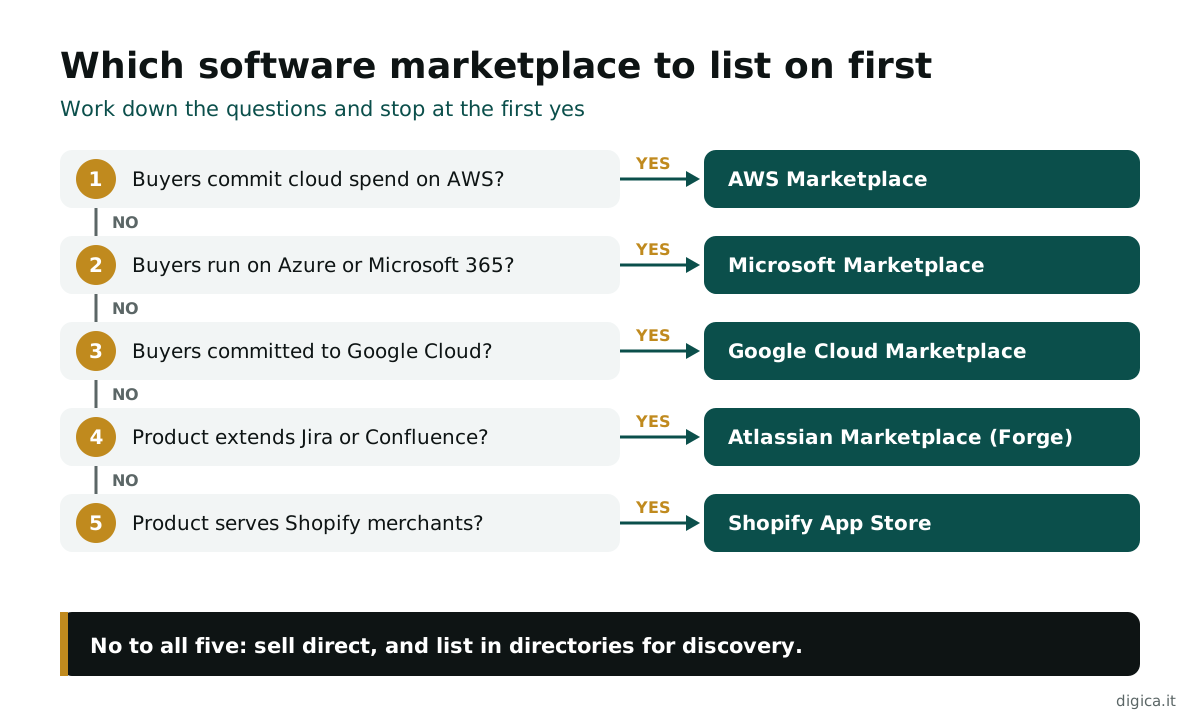
Work through these in order and stop at the first yes.
- If your buyers commit cloud spend on AWS, list on AWS Marketplace first and train sales to close deals over $1 million as private offers at 2%.
- If your buyers run on Azure and Microsoft 365, list on Microsoft Marketplace, and plan the Entra ID and fulfillment work before the first deal.
- If your buyers are data or AI teams on Google Cloud, list on Google Cloud Marketplace, alone or after AWS.
- If your product extends Jira or Confluence, build on Forge and list on Atlassian Marketplace; the first $1 million is free.
- If your product serves Shopify merchants, list on the Shopify App Store and price for the 15% fee that starts after $1 million.
- If none of these is true, sell direct, and list in software directories for discovery rather than paying a marketplace fee.
Running a software marketplace and need more vendors?
We grow supply and demand for SaaS and software marketplaces, from the first vendors to repeat buyers.
Most enterprise SaaS vendors end up on two or three of these, not one. The order matters because each listing takes engineering time and sales training. Start where your largest current deals already sit. An IDC study for AWS found that vendors' AWS Marketplace business grew 41% faster than their overall software business, and co-selling partners saw twice the sales growth. That study is sponsored by AWS, but the pattern behind it is simple: the first software marketplace pays when sales uses it on deals that already exist.
The number for your next channel review
On $1 million a year of SaaS sales, a cloud marketplace fee of 3% is $30,000, and 1.5% on renewals is $15,000. The same $1 million through an app store past its free allowance costs $150,000 to $250,000. Choosing the right software marketplace for each product line can save more than $100,000 a year on that revenue alone. The biggest cost of doing nothing is paying an app store rate on enterprise deals that would have closed through a cloud marketplace at 3%.
FAQ
What is a software marketplace? A software marketplace is a platform where businesses find, buy and pay for software from many vendors on one bill. Cloud marketplaces such as AWS Marketplace sell to cloud customers; app stores such as Atlassian Marketplace sell apps that extend one product.
What is a SaaS marketplace? A SaaS marketplace is a software marketplace for subscription software. The marketplace bills the buyer, takes a fee and pays the vendor. AWS, Microsoft and Google Cloud charge 3% or less; Atlassian and Shopify charge 15% to 25% after a free allowance.
How much does AWS Marketplace charge SaaS vendors? AWS charges 3% on public SaaS offers. Private offers cost 3% under $1 million, 2% from $1 million and 1.5% from $10 million. Renewals cost 1.5%. Channel partner private offers add 0.5%.
Does Microsoft Marketplace charge a fee? Yes. Microsoft charges a 3% standard store service fee on transactable offers and halves it on private-offer renewals. Azure Marketplace and AppSource merged into Microsoft Marketplace on September 25, 2025.
Which software marketplace has the lowest fees? For large SaaS contracts, AWS Marketplace and Google Cloud Marketplace, at 1.5% on private offers of $10 million or more and on renewals. For small developers, Atlassian (on Forge) and Shopify charge nothing on the first $1 million in lifetime revenue.
Is it worth listing on a cloud marketplace? It is worth it when your buyers already have committed cloud spend and your sales team will route deals through private offers. It rarely pays as a source of new inbound demand on its own.
Can a SaaS company sell on more than one software marketplace? Yes, and most enterprise vendors list on two or three. Start with the marketplace where your largest current deals already sit, because each listing needs integration work and sales training.
Related Articles
- SaaS and software marketplace growth
- Best API marketplaces and directories in 2026
- Best AI agent marketplaces in 2026: reach and vetting
- Marketplace business models
- How to attract vendors to a B2B marketplace
This article is part of our B2B marketplace growth series. Browse more on the Digica blog.