The best B2B food marketplaces for restaurants and retailers, compared head to head on suppliers and delivery
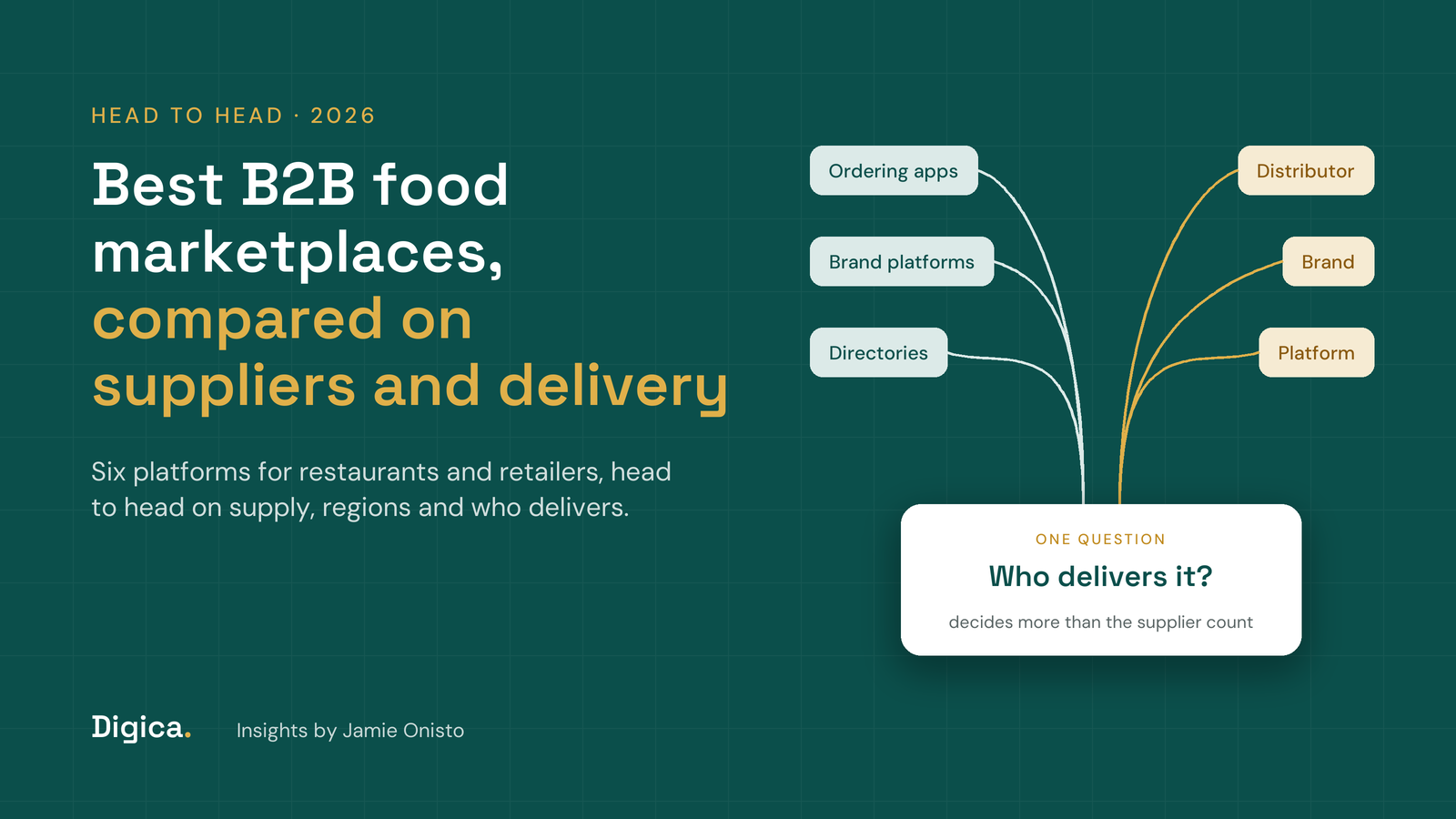
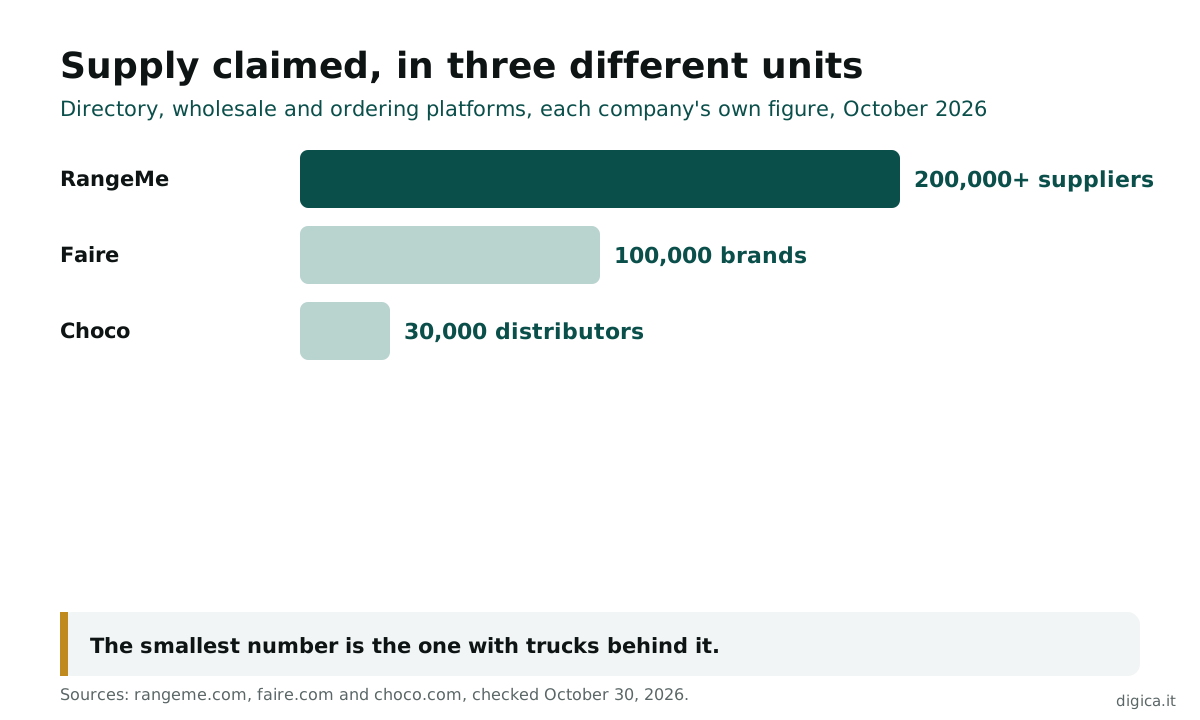
A B2B food marketplace promises a restaurant or a shop one place to find and order from suppliers. What it actually delivers varies more than the pitch suggests. Choco says 30,000 distributors use it. RangeMe says 200,000 suppliers list on it. GrubMarket says it operates in all 50 US states. Those numbers describe three different businesses, and only one of them puts the food on a truck itself.
The stakes are large and rising. Food away from home accounted for 56.3% of total US food spending in 2025, out of $2.51 trillion spent on food overall, according to the US Department of Agriculture (USDA ERS). Every restaurant, cafe and independent grocer in that market buys from dozens of suppliers, and the B2B food marketplace that handles those orders well becomes part of how the kitchen runs.
This guide compares six B2B food marketplaces head to head on supplier coverage and delivery: how much supply each one carries, where it operates and who actually delivers the order. It is written for restaurant operators and retail buyers choosing where to order, and for founders growing a food B2B marketplace. Figures are each company's own, checked on October 30, 2026. For non-food wholesale, see our guide to wholesale marketplaces for retailers.
Quick Navigation
- What counts as a B2B food marketplace
- Six B2B food marketplaces, scored side by side
- Choco against Rekki: ordering apps for restaurants
- Faire against RangeMe: finding brands for your shelves
- Pod Foods against GrubMarket: platforms that run the logistics
- Supplier coverage: what each number counts
- Three failure scenarios
- Choosing a B2B food marketplace: a decision framework
- FAQ
- Related Articles
What counts as a B2B food marketplace
The short answer: a B2B food marketplace is a platform where restaurants, cafes, retailers or grocers find and order food and drink from many suppliers in one place. A single distributor's webshop does not count, and neither does a consumer grocery app.
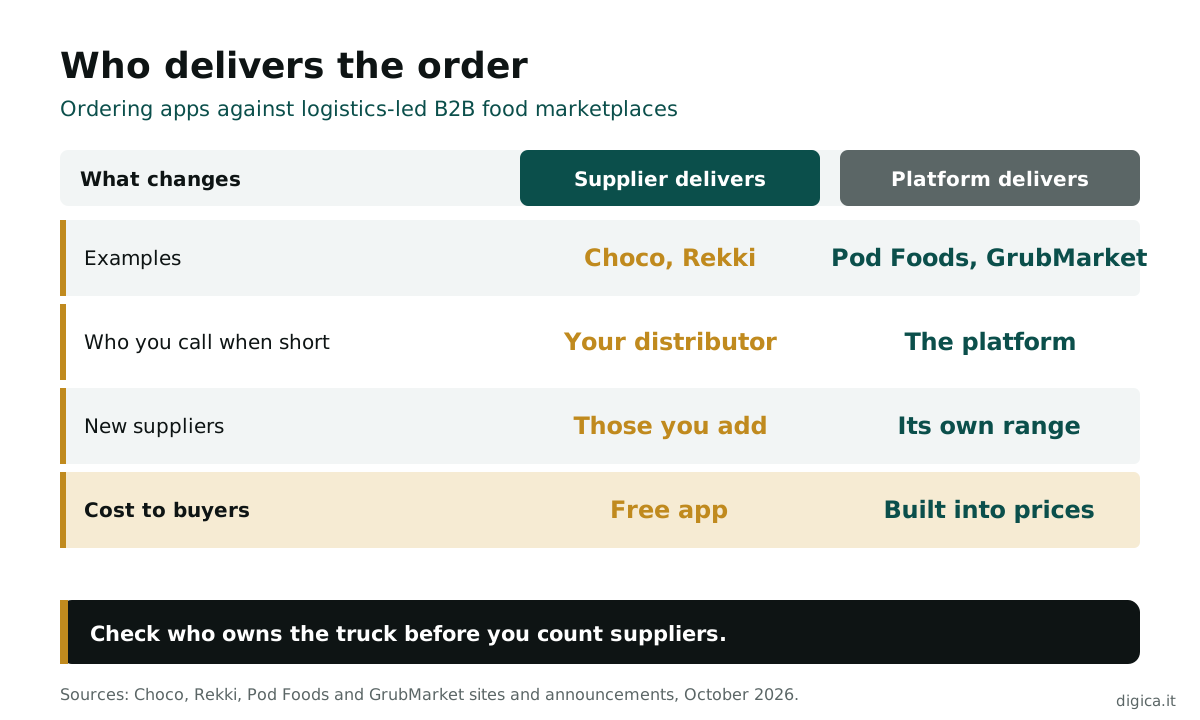
The category splits three ways, and the split decides what a buyer gets. Ordering apps, such as Choco and Rekki, sit between a restaurant and the distributors it already uses. They replace phone calls, texts and voicemails with one order list, and the distributor still delivers. Brand discovery platforms, such as Faire and RangeMe, help a shop or a chain find new food and drink brands to stock. Logistics-led platforms, such as Pod Foods and GrubMarket, hold or move the product themselves.
All three are B2B marketplaces in the full sense. Suppliers are one side, buyers are the other, and the platform earns its place when both keep coming back. The tests we apply to every B2B marketplace apply here too: how much supply it carries, whether buyers really order through it and how well it matches the two.
A food directory is related but narrower. It lists suppliers and products so buyers can find them, and leaves the order and the delivery to the two parties. RangeMe works closest to that model, which is why its supplier count is the largest in this guide.
Our view: judge a B2B food marketplace on who delivers first, and on supplier count second. A restaurant needs its order on time more than it needs another 10,000 suppliers it will never use.
Six B2B food marketplaces, scored side by side
The short answer: Choco has the widest distributor network for restaurants, Rekki the simplest free app in the UK, Faire the easiest terms for independent shops, RangeMe the most suppliers for chain buyers, Pod Foods the most hands-off delivery for emerging brands into grocers, and GrubMarket the largest physical supply chain.
Six B2B food marketplaces compared on supply claimed, regions, who delivers, cost to buyers, main risk and best fit
| Marketplace | Supply claimed | Regions | Who delivers | Cost to buyers | Main risk | Best for |
|---|---|---|---|---|---|---|
| Choco | 30K distributors | Germany, Spain, France, US, UK | Your distributor | Free for restaurants | Only as good as your distributors | Restaurants ordering from many distributors |
| Rekki | Suppliers you already use, plus a UK marketplace | Ordering worldwide, marketplace UK only | Your supplier | Free for restaurants | Marketplace limited to the UK | UK restaurants, cafes and bars |
| Faire | 100,000 brands across categories | North America, UK and Europe | Each brand ships | 60 days to pay, interest free | Food is one category of many | Independent shops stocking packaged food |
| RangeMe | 200,000+ suppliers, 800,000+ products | US, Canada, UK, Europe, Australia, Mexico, New Zealand | Not handled, discovery only | Free buyer account | No ordering or delivery | Chain and category buyers sourcing new products |
| Pod Foods | Emerging brands, 2,000+ customers | Nine US logistics hubs | Pod delivers, or the brand | Brands pay the fees | Narrower brand range | Grocers stocking emerging brands |
| GrubMarket | All 50 US states, 70+ countries | US plus nine other countries | GrubMarket's own network | Varies by business | Less a marketplace, more a distributor | Buyers who want one supplier with wide reach |
Every figure is the company's own claim, and none of the six publishes an independent audit. The column that matters most is "Who delivers", because it decides who you call when an order is short.
Choco against Rekki: ordering apps for restaurants
The short answer: Choco wins on distributor network and the number of countries, Rekki on simplicity for UK venues. Both are free for restaurants, and both leave delivery to the supplier.
Choco
Choco started as an ordering app for restaurants and has grown into software for food distributors. Its US site says 30,000 distributors are on Choco and that it processes more than 1 million orders a month, with regional sites for Germany, Spain, France, the United States and the United Kingdom. For restaurants the pitch is simple: Choco says it is free for restaurants, with no catches and no hidden fees.
Running a B2B food marketplace or ordering platform?
In 30 minutes we look at how restaurants, retailers and suppliers find platforms like yours, on Google and in AI answers, and where they drop off before they order.
The coverage comes from the supplier side. Choco says it connects with more than 200 enterprise resource planning (ERP) systems, so orders land straight in a distributor's own software, and in 2025 it partnered with UniPro, a foodservice distribution group with more than 450 US distributor members. The more distributors run their order desk on Choco, the more of a restaurant's suppliers it can reach. The trade-off is that Choco does not deliver anything itself. A late truck is still a call to the distributor.
Rekki
Rekki is a London ordering app that says it is trusted by more than 10,000 cafes, restaurants, bars and schools, and that it is completely free for restaurants. A venue can order from its existing suppliers anywhere in the world, with each order passed to the supplier in a format they already use. Rekki's own marketplace, where venues find new suppliers, is available only in the UK.
Like Choco, Rekki has moved toward the supplier side, with an order processing product it sells to wholesalers. For a restaurant that matters only indirectly: suppliers who use it confirm orders faster. The limit is coverage. Outside the UK, Rekki is a tidy way to send orders, not a way to find new supply.
The verdict. A multi-site group in Germany, Spain, France or the United States should start with Choco. A UK venue that wants one free app for every supplier, and a place to find new ones, should start with Rekki.
Faire against RangeMe: finding brands for your shelves
The short answer: Faire is where an independent shop buys from food and drink brands with easy terms, and RangeMe is where a chain buyer discovers new products before negotiating offline. One is a checkout, the other a catalog.
Faire
Faire is a wholesale B2B marketplace for independent retailers, founded in 2017 and based in San Francisco. It says 100,000 brands sell on it, across food and drink, home, gifts and more, and that hundreds of thousands of retailers and brands use it. Its pitch to shops is the terms: 60 days to pay, interest free, and free returns on a first order with a brand. Many brands set low or no minimums.
Each brand ships its own orders, so delivery speed depends on the brand, not on Faire. That suits shelf-stable packaged food, such as snacks, sauces, coffee and confectionery, far better than fresh or chilled lines. For a deli, gift shop or independent grocer adding a few new brands a month, Faire's terms are hard to beat. For a kitchen ordering produce twice a week, it is the wrong tool.
RangeMe
RangeMe, an ECRM company, is a product discovery platform for retail buyers. It says more than 15,000 retail buyers use it to discover more than 800,000 products from more than 200,000 suppliers, with sites for the United States, Canada, the United Kingdom, Europe, Australia, Mexico and New Zealand. Buyers search, request samples and contact suppliers, and the account is free.
That is the largest supply figure in this guide, and it measures something different. RangeMe does not take the order or arrange delivery. It is the front of a category review: a buyer at a grocery chain shortlists products there and then negotiates through the normal buying process. As a food directory, it is very good. As a way to restock next week, it does not apply.
The verdict. An independent shop should use Faire to buy. A chain or category buyer should use RangeMe to find. Brands growing into retail often need both.
Pod Foods against GrubMarket: platforms that run the logistics
The short answer: Pod Foods moves emerging brands into grocery stores through its own logistics partners, and GrubMarket runs a national food supply chain through companies it owns. Both deliver, which is the rarest promise in this category.
Pod Foods
Pod Foods is an Austin, Texas wholesale platform that connects emerging food and beverage brands with grocery retailers. It says it has more than 2,000 customers, can get a brand onto shelves in about four weeks and runs through logistics partner locations in Sacramento, Los Angeles, Denver, Phoenix, Chicago, Dallas, Atlanta, Philadelphia and Ocala, Florida.
The model is visible in its pricing. With Pod Express, a brand sends inventory to Pod and Pod delivers to retailers, for a fee of 18% of the direct to retail price. With Pod Direct, the brand ships to stores itself for 8%. For a grocer, that means small brands arrive through one supplier relationship instead of 30. For a brand, it means paying for distribution it could not otherwise build.
GrubMarket
GrubMarket is a San Francisco food supply chain business that sells online and runs its own distribution. It raised about $50 million at a $4.5 billion pre-money valuation in February 2026, says it operates in all 50 US states and does business in more than 70 countries. In 2025 it bought Coast Citrus, its largest acquisition, and Procurant, a produce software company with more than 850 customers across 14 countries.
GrubMarket grows supply by acquiring the companies that hold it, which gives it physical reach no pure marketplace has. It is better understood as a technology-led distributor than as an open B2B food marketplace: buyers get one supplier with very wide range, not a choice between many independent ones.
The verdict. A grocer that wants new local and emerging brands without new delivery headaches should look at Pod Foods. A buyer that wants one large supplier with national reach and software around it should talk to GrubMarket.
Supplier coverage: what each number counts
The short answer: B2B food marketplaces count supply in four units: distributors, brands, suppliers and places served. Only the first maps to a delivery a restaurant can rely on next week.
Distributors, as in Choco's 30,000, are companies with trucks and routes, so the number tells a restaurant how likely its own suppliers are already connected. Brands, as in Faire's 100,000, are producers who ship their own orders, often by parcel. Suppliers, as in RangeMe's 200,000, include anyone who has listed a product, whether or not they can serve your region. Places served, as in GrubMarket's 50 states, describe a footprint, not how many suppliers you can choose from. None of the four is wrong. Each is simply an answer to a different question, and a buyer who compares them directly is comparing distributors with listings.
Do restaurants and retailers find your food marketplace before a rival's?
A growth audit maps how buyers search for B2B food marketplaces like yours, on Google and in AI answers, and which of your supplier, category and location pages they never reach.
Demand on the buyer side is not the problem. The National Restaurant Association projects total restaurant and foodservice sales of $1.55 trillion in 2026, across more than 1 million restaurant and foodservice outlets (National Restaurant Association). The same research says more than 9 in 10 operators cite food, labor, insurance, energy and swipe fees as significant challenges. Buyers that stretched have little patience for missed deliveries, which is why the delivery model outweighs the headline supply number.
The useful question to ask any B2B food marketplace is not how many suppliers it has. Ask how many of them deliver to your postcode, on your days, at your order size. A platform that can answer that knows its own coverage.
Three failure scenarios
These are the patterns that recur when buyers choose a B2B food marketplace on headline supply numbers.
- The directory used as a supplier. A small grocery chain shortlists 40 new snack brands on a discovery platform and expects stock within a month. Half the brands have no distributor in its region and cannot ship direct at its volume. Starting from a platform that delivers to its stores, and using the directory for the brands it would chase anyway, would have filled the shelf a quarter earlier.
- The app with no suppliers on it. A restaurant group moves all ordering to an ordering app because it is free, without checking which of its 15 distributors already use it. Four do. The rest still get orders by email, and the kitchen now checks two systems. Asking for a supplier match before switching would have shown the real coverage.
- Fresh food on parcel terms. An independent deli buys chilled cheese and charcuterie from brands on a general wholesale B2B marketplace because the payment terms are generous. Parcels arrive warm on a hot week and the stock is written off. Keeping chilled lines with a cold chain distributor, and using the marketplace for shelf-stable products, would have kept both the terms and the stock.
Each buyer picked a real B2B food marketplace. None of them matched the platform's delivery model to what they were buying.
Choosing a B2B food marketplace: a decision framework
The short answer: start from what you are buying and who will deliver it, then pick the platform that matches.
- If you are a restaurant ordering from 5 or more distributors, use Choco or Rekki, after checking how many of your current suppliers are already on it.
- If you are in the UK and want to find new suppliers as well as order, start with Rekki's marketplace.
- If you run an independent shop stocking shelf-stable food and drink, use Faire for its 60-day terms, and order from brands with low minimums first.
- If you are a chain or category buyer reviewing new products, use RangeMe to shortlist, and buy through your normal supply chain.
- If you are a US grocer that wants emerging brands without managing 30 small suppliers, look at Pod Foods.
- If you want one supplier with national reach rather than a choice of many, talk to GrubMarket.
Traceability is becoming part of the choice. The US Food and Drug Administration has proposed extending the compliance date of its food traceability rule by 30 months, to July 20, 2028, and covered firms will have to provide records as an electronic sortable spreadsheet within 24 hours of a request (FDA). A B2B food marketplace that keeps clean order records will make that easier for buyers and suppliers alike.
Growing a food or agriculture B2B marketplace?
We help food and agriculture B2B marketplaces recruit the suppliers that make ordering worth switching for, and reach the restaurants and retailers comparing them.
The number to take into your next supplier review is the share of your spend that arrives through the platform, not its supplier count. If a restaurant spending $40,000 a month on food moves half of it to an app that cuts errors and phone time, even a 1% saving on wrong or missing items is $200 a month, or $2,400 a year, for an app that costs the restaurant nothing. The biggest cost of doing nothing is the hour a day a chef spends on the phone placing orders.
FAQ
What is a B2B food marketplace? A B2B food marketplace is a platform where restaurants, cafes, retailers and grocers find and order food and drink from many suppliers in one place. Some only handle ordering, some help buyers discover brands and some run delivery themselves.
Which B2B food marketplaces deliver the food themselves? In this guide, Pod Foods delivers through its own logistics partners when brands use Pod Express, and GrubMarket delivers through its own distribution network. Choco and Rekki pass orders to the buyer's own suppliers, who deliver.
Is Choco free for restaurants? Yes. Choco says it is free for restaurants, with no hidden fees. It earns from software it sells to food distributors.
What is the difference between a food directory and a food marketplace? A food directory lists suppliers and products so buyers can find them, and leaves ordering and delivery to the two parties. A B2B food marketplace also handles the order, and sometimes payment terms or delivery. RangeMe works like a directory, Faire like a marketplace.
Can restaurants buy wholesale food on Faire? Faire is built for independent retailers, and its food and drink range leans to shelf-stable packaged products such as snacks, sauces and coffee. Restaurants ordering fresh produce, meat or dairy are better served by their distributors through an ordering app.
How do B2B food marketplaces make money? Most charge the supply side. Ordering apps sell software to distributors and wholesalers, wholesale marketplaces take a commission from brands, and logistics-led platforms charge brands fees for distribution, such as Pod Foods' 18% for its delivered service.
Related Articles
- Food and agriculture B2B marketplace growth
- Best wholesale marketplaces for retailers in 2026
- Best agriculture marketplaces in 2026, by reach
- Best procurement marketplaces for B2B buyers in 2026
- Liquidity is the only marketplace metric that compounds
Where this connects
This article is part of our B2B marketplace growth series. Browse more on the Digica blog.