The best beauty industry directories for salons and suppliers, head to head on supplier coverage
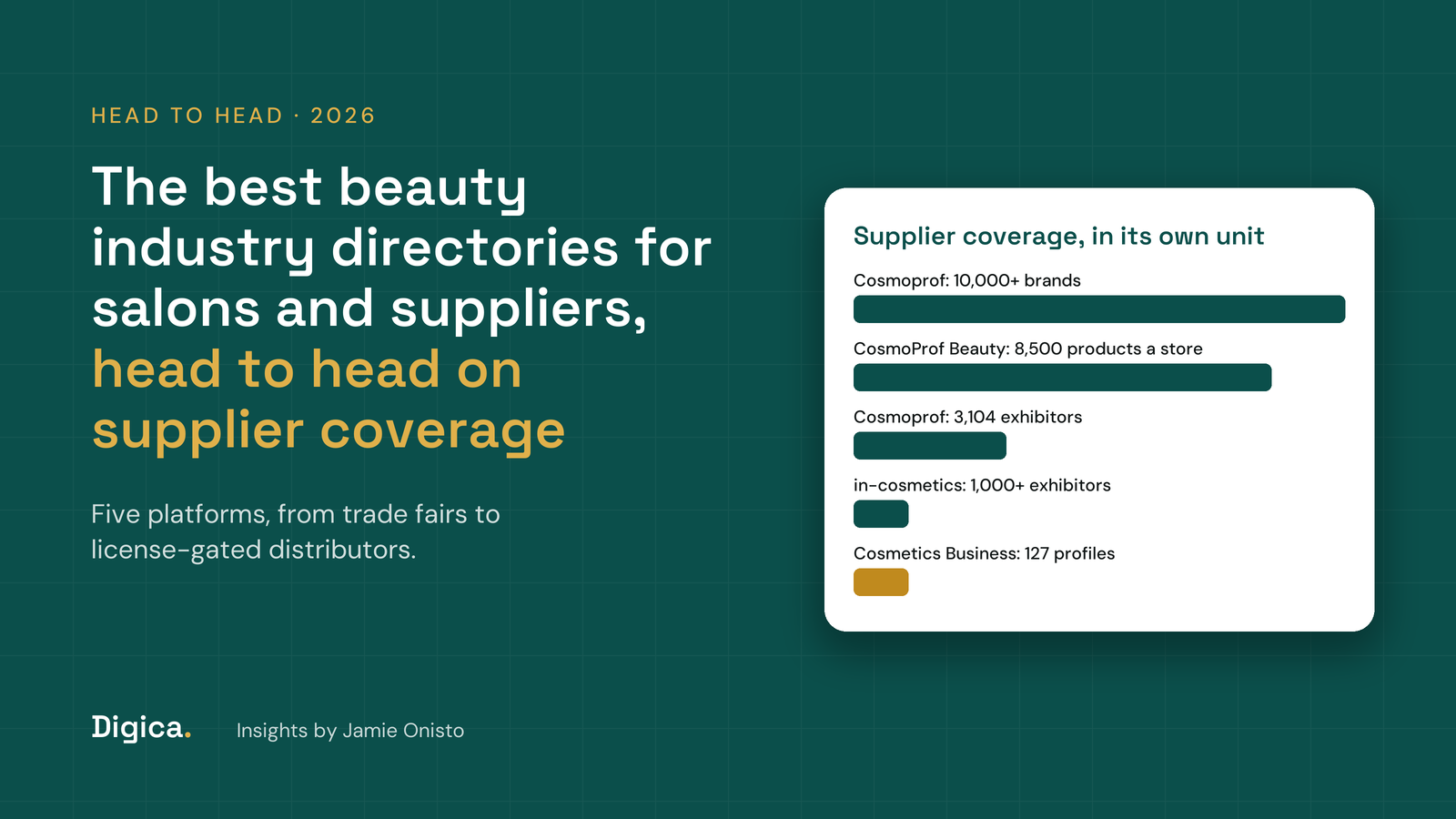
Search for a beauty directory and most of what comes back helps consumers find a hairdresser. That is no help to a salon owner looking for a new color line, or to a brand founder looking for a filler, a packaging supplier or an ingredient. On the supply side, coverage is what matters. Cosmoprof Worldwide Bologna gathered 3,104 exhibitors from 68 countries and more than 10,000 brands in 2026. An editorial supplier directory may hold about 127 profiles. Both are useful, for different jobs.
The stakes are real on both sides. In the US alone there were 670,800 barbers, hairstylists and cosmetologists in 2025, and every state requires them to be licensed (US Bureau of Labor Statistics). Licensing shapes who may buy what, and from whom. Pick the wrong beauty directory and a salon pays retail for professional stock, or a brand spends months on suppliers that cannot meet its volumes. For anyone building one of these platforms, this is a beauty supply marketplace problem as much as a sourcing one.
This guide compares five beauty industry directories head to head on supplier coverage: how many suppliers, brands or products each one covers in its own unit, which categories and countries, who gets in, and how access is checked. It is written for salon owners, brand founders and product developers, and for founders growing a beauty B2B marketplace. Figures come from each platform's own pages, filings or press releases, checked on November 16, 2026.
Quick Navigation
- How we compared supplier coverage
- The scorecard: five beauty directories
- Cosmoprof vs in-cosmetics: breadth or depth
- CosmoProf Beauty vs SalonCentric: where salons buy
- Cosmetics Business against the trade show catalogs
- Who gets in: trade-only and license checks
- Three failure scenarios
- Choosing a beauty directory by what you need
- What supplier coverage is worth
- FAQ
- Related Articles
How we compared supplier coverage
We asked each beauty directory one question: when a salon or a brand goes looking for a supplier, how much of the market can it actually reach here? Every platform answers in its own unit. Trade fairs count exhibitors and brands. Distributors count stores and products. Editorial directories count company profiles. We kept each figure in its own unit rather than forcing a single ranking.
We then recorded which categories each one covers, from ingredients and packaging to finished products and salon supplies, which countries, who uses it, and how access is checked: trade-only registration, a cosmetology license or nothing at all. We left out consumer booking platforms that help people find a salon, because they list salons rather than suppliers. We also left out general wholesale platforms, covered in our guide to wholesale marketplaces.
One naming note before the comparison. Cosmoprof, the Italian trade fair organized by BolognaFiere Cosmoprof, and CosmoProf Beauty, the US professional distributor owned by Sally Beauty Holdings, are unrelated businesses. Both appear in this guide.
Our view: in beauty, supplier coverage only counts if you are allowed to use it. A directory with 10,000 brands is no help to a salon that needs stock on Tuesday, and a distributor with thousands of products is no help to a founder who needs a contract manufacturer.
The scorecard: five beauty directories
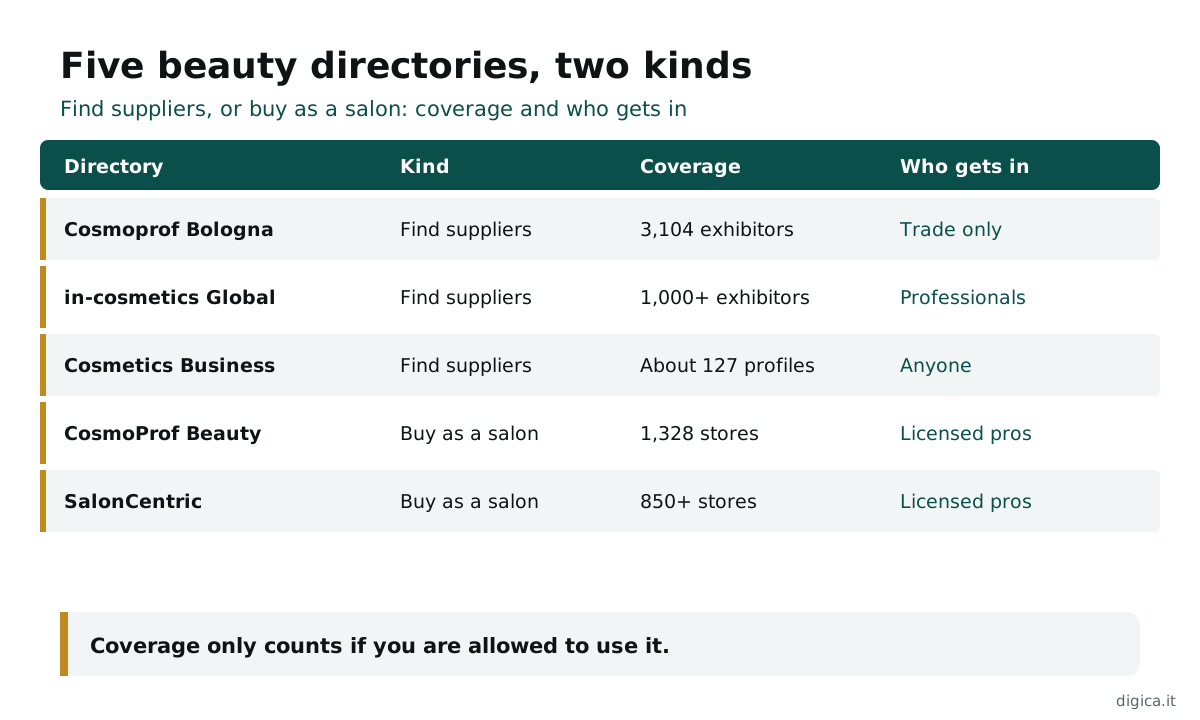
The scorecard puts supplier coverage, access and the main risk side by side. Use it to shortlist before the head-to-head sections.
| Beauty directory | Type | Supplier coverage, in its own unit | Categories | Where | Who gets in | Cost to use | Main risk | Best for |
|---|---|---|---|---|---|---|---|---|
| Cosmoprof Worldwide Bologna | Trade fair, exhibitor catalog, matchmaking | 3,104 exhibitors, 10,000+ brands, 68 countries (2026) | Packaging and contract manufacturing, finished products, hair, nail and salon | Global, held in Italy | Trade only, registered professionals | Ticket per visit, price not published | Built around a four-day show | Brands and buyers sourcing across the whole chain |
| in-cosmetics Global | Ingredient trade fair and exhibitor directory | More than 1,000 exhibitors, 12,559 unique visitors (2026) | Ingredients, formulation, testing | Global, moves city each year | Business professionals | Free if pre-registered, about $80 late | Ingredients only | Formulators and brand founders |
| CosmoProf Beauty | License-gated pro distributor | 1,328 stores, about 8,500 products per store | Pro hair color and care, nail, skin, tools | USA and Canada | Licensed professionals and students | Free account, wholesale prices | One distributor's brand list | Salons in the US and Canada |
| SalonCentric | License-gated pro distributor | 850+ stores, 445 sales consultants | Pro hair, color, nail, skin, tools | USA | Licensed cosmetologists | Free account, wholesale prices | US only, one group's brand mix | US salons using prestige pro brands |
| Cosmetics Business directory | Editorial supplier directory | About 127 company profiles in 16 categories | Ingredients, packaging, manufacturing, regulatory, marketing | International | Open to anyone | Free to browse | A shortlist, not a census | A first look at supply partners |
Two patterns stand out. The trade fairs cover the most suppliers and the most categories, but only for professionals who register. The distributors cover far fewer brands but are where salons actually buy, and both check a license first.
Cosmoprof vs in-cosmetics: breadth or depth
Both are trade fairs with year-round exhibitor directories, and both are trade only. Cosmoprof covers the whole chain from packaging to salon. in-cosmetics goes deep on one link: ingredients.
Cosmoprof Worldwide Bologna
The 2026 edition of Cosmoprof Worldwide Bologna, held in March, brought together 3,104 exhibitors from 68 countries and more than 10,000 brands, with over 255,000 professionals visiting from more than 150 countries. It is organized in three areas: Cosmopack for the supply chain (packaging, contract manufacturing, private label, machinery and raw materials), finished perfumery and cosmetics, and hair, nail and beauty salon.
Running a beauty supply or salon B2B marketplace?
In 30 minutes we look at how salons and brands find platforms like yours, on Google and in AI answers, and how to turn your supplier coverage into more buyers and sellers.
Buyers plan meetings through Cosmoprof My Match, its B2B matchmaking tool, which matched buyers from 94 countries before the 2026 show. The wider network adds Cosmoprof North America in Las Vegas, which drew more than 950 exhibitors from 39 countries in July 2026. The trade-off is timing. The catalog is built around a four-day event, so it works best for planning a sourcing trip, less well as a database to search on a random Wednesday.
in-cosmetics Global
in-cosmetics Global, organized by RX, said its 2026 Paris show would host more than 1,000 exhibitors, including most of the world's leading ingredient suppliers, and it recorded 12,559 unique visitors, 67% of them from outside France. The full exhibitor list lives in its online exhibitor and product directory, which is where formulators search for actives, emulsifiers and functional ingredients between shows.
Entry is for business professionals, free if you pre-register and about $80 on the day. For a brand founder briefing a contract manufacturer or a chemist reformulating a range, no other platform here covers ingredient suppliers as deeply. The trade-off is scope: nothing for finished products, salon supplies or packaging-led sourcing.
Verdict: choose Cosmoprof for breadth across the chain and in-cosmetics for depth in ingredients. A brand launching a new range often needs both, in that order: in-cosmetics to fix the formula, Cosmoprof to find packaging, a filler and distributors.
CosmoProf Beauty vs SalonCentric: where salons buy
This pairing is not about finding suppliers to talk to. It is about where a licensed salon buys professional stock, and both are the biggest answers in North America.
CosmoProf Beauty
CosmoProf Beauty is the professional arm of Sally Beauty Holdings, through its Beauty Systems Group. Its fiscal 2026 annual report counts 1,328 stores across the US, including Puerto Rico, and Canada, figures that include franchised stores. Those stores offer about 8,500 professional beauty products on average, backed by 547 salon business consultants. Company stores serve licensed beauty professionals only, and online accounts need verified professional or student status.
SalonCentric
SalonCentric, created by L'Oréal USA in 2008 and based in St. Petersburg, Florida, calls itself the largest US distributor of salon professional products. Its January 2026 announcements put its reach at more than 850 stores, counting more than 775 SalonCentric and franchise stores and more than 180 State|RDA stores, with 445 sales consultants. That is up from 650+ own and franchise stores and about 400 consultants in July 2025. Shopping requires an account, and applying asks for a cosmetology license number.
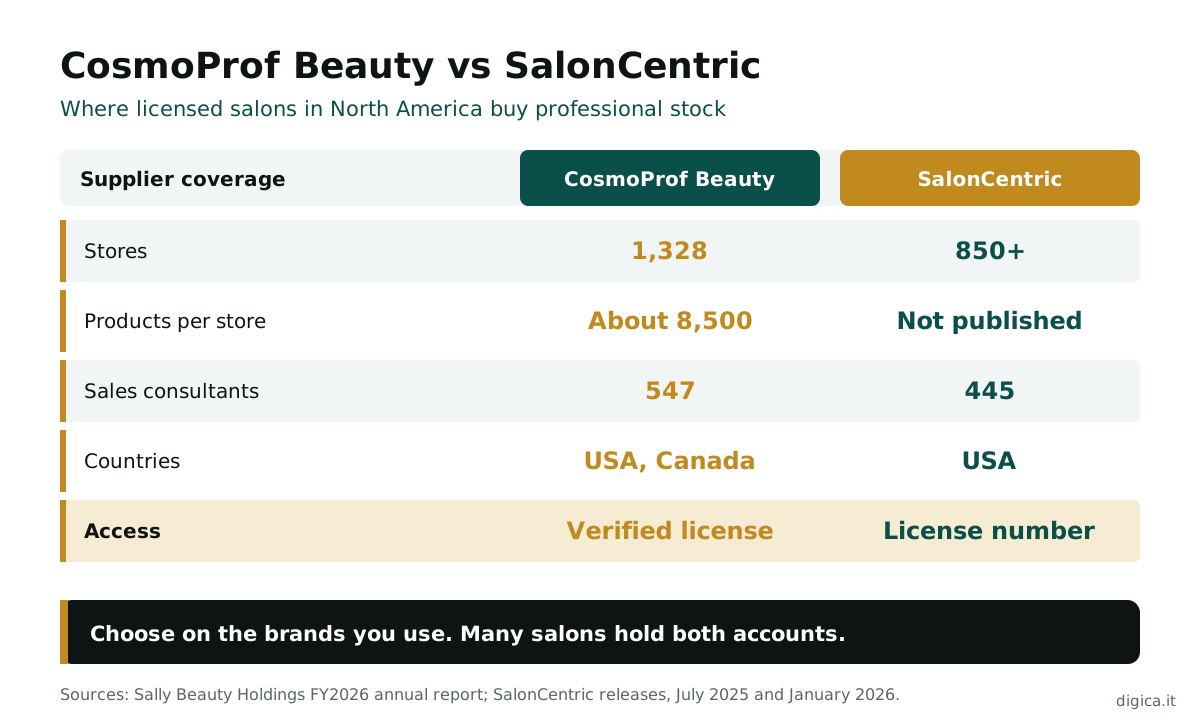
Verdict: for a salon in Canada, CosmoProf Beauty is the only one of the two. In the US, choose on brands rather than store count: SalonCentric's mix reflects L'Oréal group distribution plus a growing list of independent prestige brands added in 2025 and 2026, while CosmoProf Beauty carries a broad portfolio of third-party brands. Many salons hold accounts with both.
Cosmetics Business against the trade show catalogs
The Cosmetics Business company directory, published by HPCi Media in the UK, is the opposite of a trade fair catalog: small, free and open all year. We counted about 127 company profiles across 16 categories on November 16, 2026, from ingredients, packaging and manufacturing to regulatory, logistics, marketing and recruitment, with listings from Europe, the US and Korea.
Against Cosmoprof's 3,104 exhibitors, that is a shortlist, not a census. The directory does not state how listings are checked or what they cost, and profiles are supplied by the companies themselves. Its strength is editorial context: each profile sits next to the trade coverage a product developer already reads, which makes it a quick first look before committing to a trip.
Verdict: use Cosmetics Business to see who is active in a category this month, then use a trade show catalog for breadth and a meeting plan. A founder who only browses the free directory sees a small slice of the supply base.
Who gets in: trade-only and license checks
Access rules decide what a directory's coverage is worth to you. The five platforms in this guide use three levels of check.
The trade fairs check that you are a professional. Cosmoprof tickets are personal and tied to registration data, and professional schools must upload proof of registration. in-cosmetics is intended for business professionals and vets press registrations. Neither asks for a license, because their buyers are brands, retailers and distributors, not only salons.
The distributors check a license. CosmoProf Beauty's company stores serve only licensed professionals, and SalonCentric asks for a cosmetology license number at registration. That protects professional brands from diversion into retail channels and gives salons pricing the public cannot get. The cost of that protection is time: a new salon owner without a current license number in hand cannot open an account at all.
Are salons finding your beauty platform?
A growth audit shows how salon owners and brand founders search for platforms in your category, what AI answers say about your supplier coverage, and which pages would win more of both.
Regulation is tightening the supply side too. Under the Modernization of Cosmetics Regulation Act, the US Food and Drug Administration recorded 16,398 active cosmetic facility registrations and 1,298,361 active product listings as of June 30, 2026, up from 9,528 and 589,762 at the start of 2025 (US Food and Drug Administration). For a brand founder, a supplier's registration status is now a basic check, and directories that do not show it leave that work to the buyer.
Three failure scenarios
These are illustrative patterns, not accounts of named companies. The costs are typical, not audited.
- The founder who sourced from a shortlist. A new skincare brand picks a contract manufacturer from a free online directory with a few dozen manufacturing profiles. The manufacturer cannot handle the brand's second order size, and switching costs six months of reformulation and stability testing. A trade fair catalog with hundreds of contract manufacturers would have shown three suppliers sized for the brand's growth plan before the first order.
- The salon that bought retail. A new salon opens before its owner's license transfer to the state clears, and buys its first stock at retail prices because no professional account will open. Margins on backbar and retail products are thin for the first two months. Starting the distributor application, with license details ready, a month before opening would have avoided it.
- The brand that missed the show window. A brand planning to launch into Europe waits for the next fair to meet distributors and misses the registration deadline for buyer matchmaking. Its first distributor meetings slip a full year. Booking matchmaking as soon as registration opens, or working the exhibitor directory between shows, would have kept the launch on plan.
The pattern behind all three is the same. The buyer judged a directory by how easy it was to use, not by how much of the right supply it actually opened up, and who was allowed in. Coverage and access decide the outcome. Check both before you build a sourcing or buying plan around one platform, and put a date on each access step.
Choosing a beauty directory by what you need
Start with the job, then match the beauty directory. These thresholds are a starting point, not rules.
- If you need ingredients or a formulation partner, start with the in-cosmetics Global exhibitor directory and pre-register for the next show while entry is free.
- If you need packaging, a contract manufacturer and distributors for a new range, use Cosmoprof Worldwide Bologna and book My Match meetings as soon as registration opens.
- If you sell into the US and need distributors in more than five states, add Cosmoprof North America in Las Vegas to the plan.
- If you run a licensed salon in Canada, open a CosmoProf Beauty account; in the US, open accounts with CosmoProf Beauty and SalonCentric and compare the brands you use most.
- If you want a free first look at suppliers in one category, browse the Cosmetics Business directory, then move to a trade show catalog for more than a dozen options.
- If a supplier will make products for the US market, check its FDA facility registration before you sign.
- If your sourcing budget is above $50,000 a year, plan at least one trade show a year rather than relying on online directories alone.
Europe's scale explains why the European fairs dominate supplier coverage. Cosmetics Europe says the European cosmetics and personal care industry employs more than 265,000 people directly and 2.78 million across its value chain (Cosmetics Europe). That concentration of ingredient, packaging and contract manufacturing suppliers is why Bologna and the in-cosmetics shows draw buyers from more than 100 countries.
What supplier coverage is worth
Run an illustrative case. A brand founder spends $60,000 on a first production run. If the chosen manufacturer cannot scale and the brand has to reformulate with another, a six-month delay and a second round of stability testing can easily cost $20,000 to $40,000, plus the lost sales of a season. Seeing three properly sized suppliers before choosing costs a trade show ticket and a few days.
For a salon, the arithmetic is simpler. Professional pricing through a license-gated distributor is the difference between a healthy retail margin and none. Opening the right accounts before the doors open is worth more than any discount negotiated later.
For founders, the lesson runs the other way. A beauty B2B marketplace or directory wins salons and brands by publishing coverage the way they search: suppliers by category, country and minimum order, with clear access rules. That belongs on the category pages that rank for "cosmetic contract manufacturer" and in the answers AI assistants give when a founder asks where to find a supplier.
Growing a beauty supply B2B marketplace or directory?
We help beauty marketplaces and directories win salons, brands and suppliers through search, AI answers and the proof that makes a supplier feel safe to call.
The number to take into your next sourcing review is 3,104: the exhibitors one trade catalog put in front of buyers in 2026, against about 127 in a free online directory. If you source from the smaller list alone, the biggest cost of doing nothing is a supplier chosen from a fraction of the market, and a reformulation or delay when it cannot keep up. Widening the search costs a few days, so the payback starts with the first order placed with the right supplier.
FAQ
What is a beauty directory for businesses? A business beauty directory lists suppliers, brands or distributors for salons and beauty brands, rather than helping consumers find a salon. Trade fair catalogs, professional distributors and editorial supplier directories are the main types.
Which beauty supplier directory covers the most suppliers? Among the platforms in this guide, Cosmoprof Worldwide Bologna covers the most, with 3,104 exhibitors from 68 countries and more than 10,000 brands at its 2026 edition, across packaging, finished products and salon.
Do I need a license to buy from salon suppliers? For professional distributors, yes. CosmoProf Beauty's company stores serve licensed professionals only, and SalonCentric asks for a cosmetology license number to open an account. Trade fairs ask for professional registration instead.
Are Cosmoprof and CosmoProf Beauty the same company? No. Cosmoprof is a trade fair network organized by BolognaFiere Cosmoprof in Italy. CosmoProf Beauty is a US and Canadian professional distributor owned by Sally Beauty Holdings.
Where do brand founders find cosmetic ingredient suppliers? The in-cosmetics Global exhibitor directory is the deepest source among the platforms here, with more than 1,000 exhibitors, almost all ingredient suppliers. Entry to the show is free for professionals who pre-register.
How do I check a cosmetics supplier for the US market? Ask for the supplier's FDA facility registration under the Modernization of Cosmetics Regulation Act. The FDA recorded 16,398 active facility registrations as of June 30, 2026.
Related Articles
- Beauty supply marketplace growth
- The best wholesale marketplaces
- The best chemical marketplaces
- The best packaging marketplaces for brands
- The best supplier databases
Where this connects
This article is part of our B2B marketplace growth series. Browse more on the Digica blog.