The best chemical marketplaces in 2026, ranked on how they check suppliers and how deep their catalogs go
Buying chemicals online looks easy until a drum arrives without the right paperwork. The best chemical marketplaces now carry hundreds of thousands of products: Knowde lists 230,000 chemicals and raw ingredients from 8,000+ supplier storefronts, and UL Prospector covers 260,000+ materials from 10,000+ suppliers. Catalog depth is no longer the hard part. Knowing who checked the supplier, and what they checked, is.
The category has also been thinning out. Lanxess discontinued its CheMondis chemical marketplace on May 1, 2026, and several venture-backed platforms from the last cycle no longer trade. Meanwhile the market they serve is shrinking in Europe: the EU produced 224 million tonnes of chemicals in 2024, 15% less than in 2014, and 172 million tonnes of that were chemicals hazardous to health, according to Eurostat (Eurostat). A buyer handling that much hazardous product needs suppliers it can trust, not just suppliers it can find.
This ranking puts seven chemical marketplaces and directories in order, judged first on how they verify suppliers and second on how deep their catalogs go. It is written for procurement and R&D teams sourcing chemicals and ingredients, and for founders growing a chemical B2B marketplace. Figures are each company's own, checked on October 31, 2026. For non-chemical industrial sourcing, see our guide to supplier databases and directories.
Quick Navigation
- What a chemical marketplace has to prove in 2026
- Seven chemical marketplaces at a glance
- 1. Knowde: best for specialty ingredients and samples
- 2. ECHEMI: best for audited trading suppliers
- 3. UL Prospector: best for materials by specification
- 4. SpecialChem: best for formulators comparing grades
- 5. ChemicalBook: best chemical directory by CAS number
- 6. LookChem: best for long-tail intermediates
- 7. Guidechem: best for collecting quotes fast
- Three failure scenarios
- Choosing a chemical marketplace: a decision framework
- FAQ
- Related Articles
What a chemical marketplace has to prove in 2026
The short answer: a chemical marketplace earns trust by showing how it checks suppliers and how buyers get documents such as safety data sheets, technical data sheets and certificates of analysis. Catalog size matters only after that.
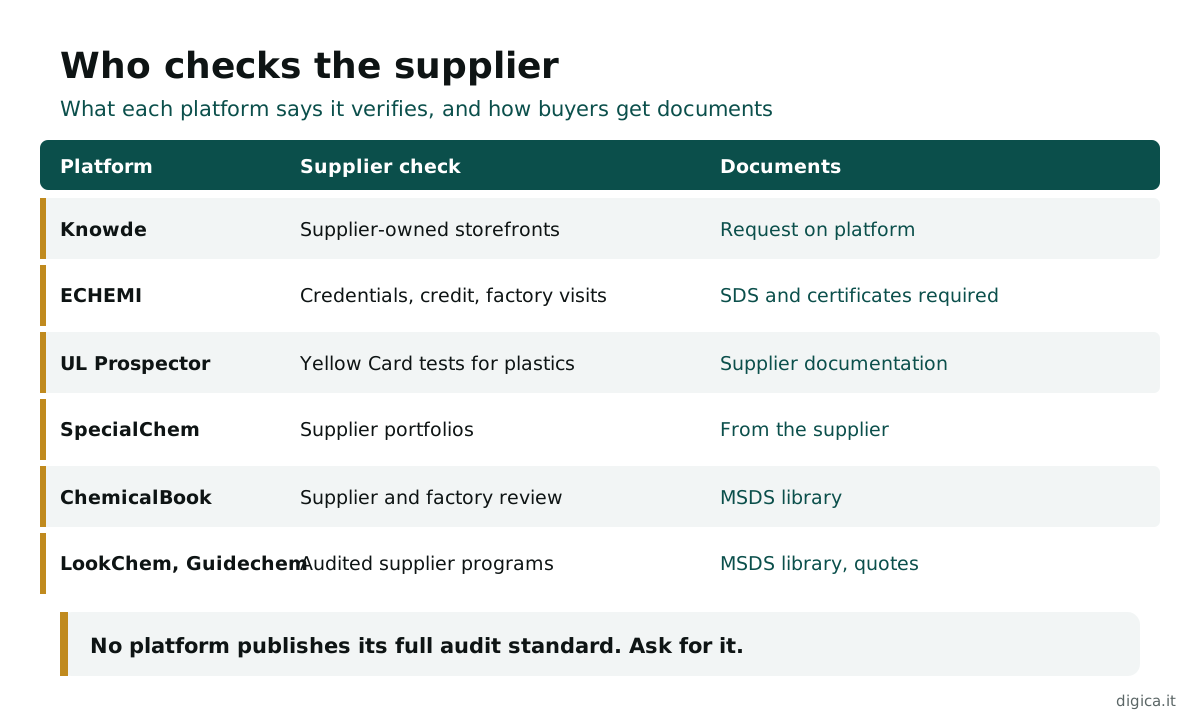
We ranked on two tests, in that order. Supplier verification asks what the platform itself checks: business registration, manufacturing capability, factory visits, credit checks or certifications, and whether it publishes the standard. Catalog depth asks how many products and suppliers it carries, and what the unit counts: supplier-owned storefronts, registered accounts or catalogued substances.
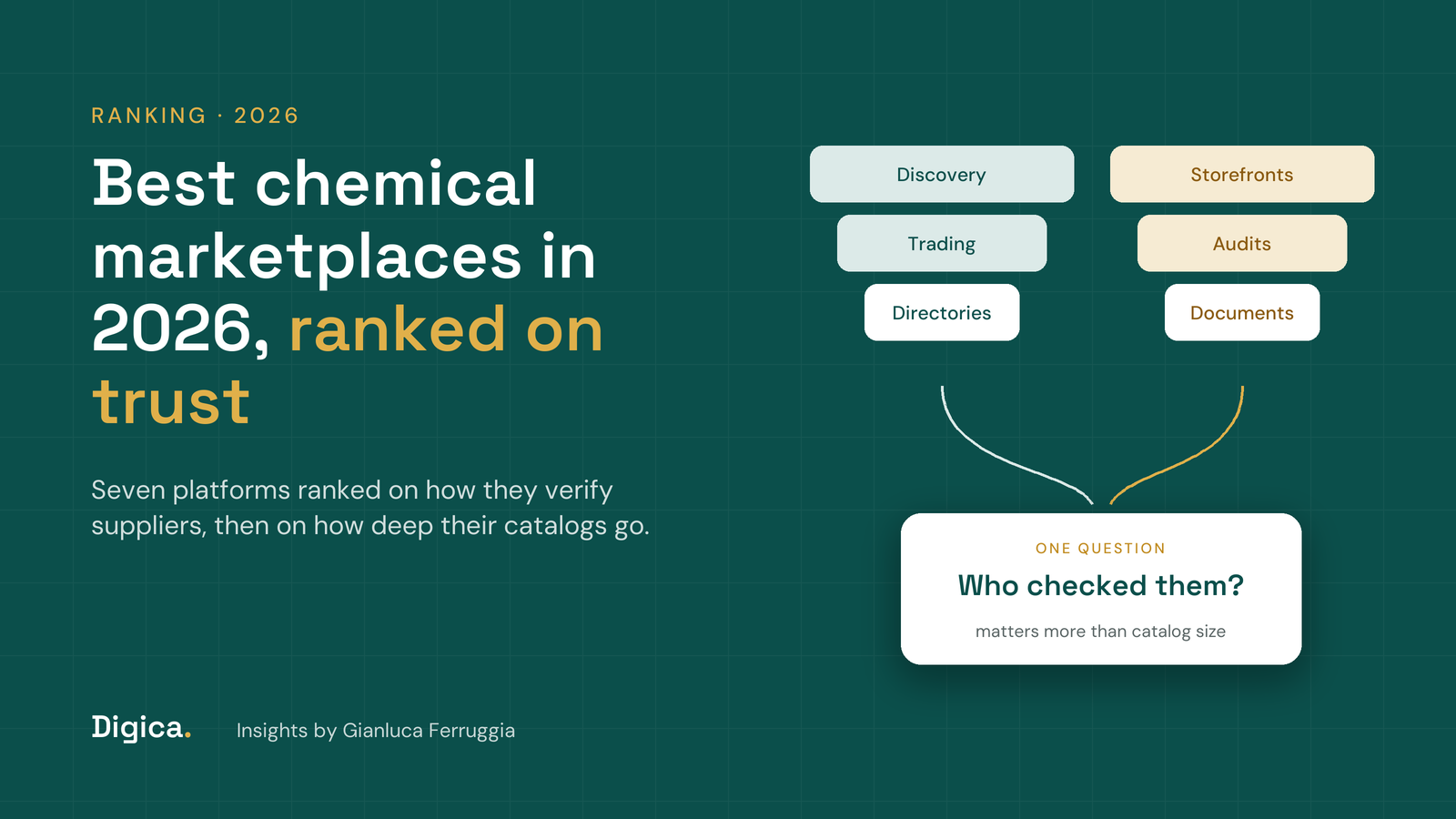
The category splits three ways. Discovery marketplaces, such as Knowde, UL Prospector and SpecialChem, help formulators and engineers find specialty ingredients and request samples, documents and quotes. Trading platforms, such as ECHEMI, connect buyers and suppliers of industrial chemicals and promise vetting on the supply side. Chemical directories, such as ChemicalBook, LookChem and Guidechem, list who sells a given substance and leave the deal to the two parties. All three are B2B marketplaces in the sense that matters: two sides that need each other, and a platform that earns its place when they keep meeting there.
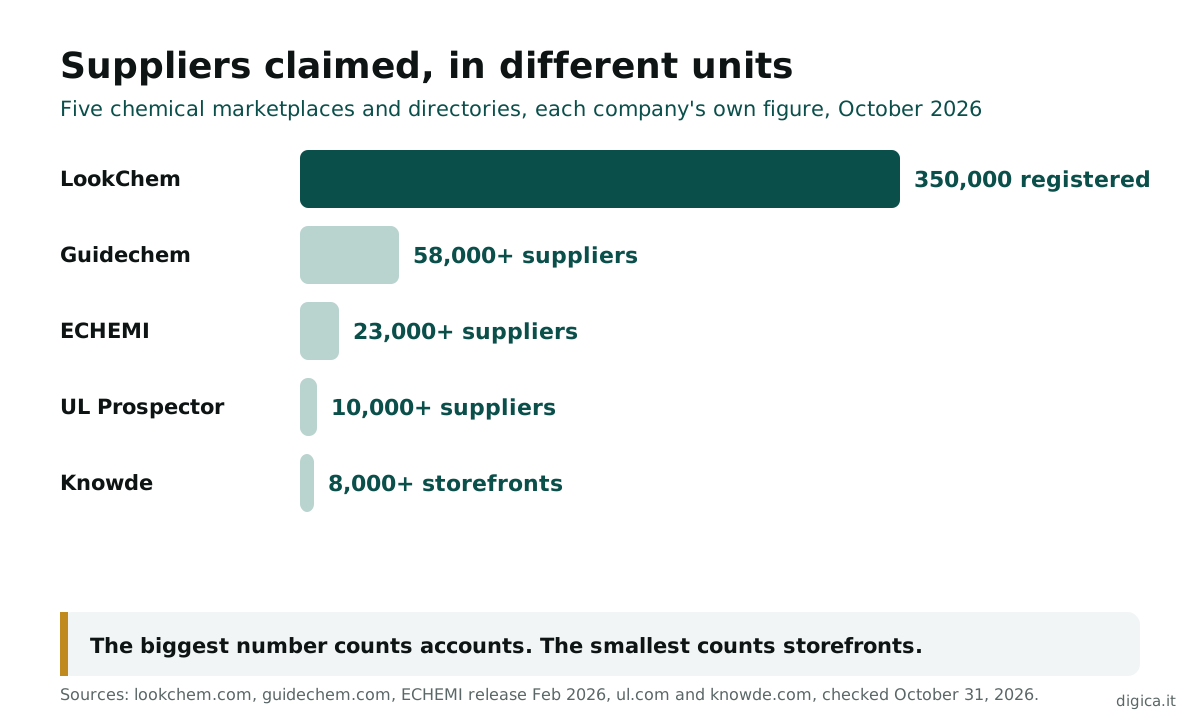
Our view: a chemical directory that lists 350,000 suppliers and audits a few thousand is more useful than one that claims to audit everyone and publishes nothing. Ask any platform the same question: who checked this supplier, against what, and when?
Seven chemical marketplaces at a glance
The short answer: Knowde leads on specialty ingredients with supplier-run storefronts, ECHEMI on a stated vetting process for traders, UL Prospector on independently tested material data, SpecialChem on formulation depth, and ChemicalBook, LookChem and Guidechem on breadth of substances and suppliers.
Seven chemical marketplaces and directories compared on type, catalog depth claimed, supplier verification, how buyers buy, main risk and best fit
| Rank | Platform | Type | Catalog depth claimed | Supplier verification | How buyers buy | Main risk | Best for |
|---|---|---|---|---|---|---|---|
| 1 | Knowde | Discovery marketplace | 230,000 products, 8,000+ storefronts | Supplier-owned storefronts, no published vetting standard | Samples, documents, quotes, purchase | Data maintained by suppliers | Specialty ingredient sourcing |
| 2 | ECHEMI | Trading platform | 23,000+ suppliers, 120,000+ buyers | Credentials, manufacturing capability, credit checks, factory inspection | Inquiries and trade | Figures self-reported in press releases | Industrial chemicals from Asia |
| 3 | UL Prospector | Material directory | 260,000+ materials, 10,000+ suppliers | UL Yellow Card data for plastics | Documents, supplier contact, samples | No checkout | Materials by specification |
| 4 | SpecialChem | Ingredient selection | 30,500+ adhesive grades, 1,050+ suppliers | Supplier portfolios, no published standard | Supplier contact, samples | No site-wide total | Formulators comparing grades |
| 5 | ChemicalBook | Chemical directory | 136,861 members | Supplier and factory qualification review | Inquiry form, off-platform deals | Paid badges are not audits | Finding suppliers by CAS number |
| 6 | LookChem | Chemical directory | 350,000 suppliers, 1.1M MSDS | Audited supplier program | Inquiries | Audit criteria not published | Intermediates and fine chemicals |
| 7 | Guidechem | Chemical directory | 58,000+ suppliers, 9M+ chemicals | Audited supplier program | Request for quote to many suppliers | Audit criteria not published | Fast multiple quotes |
Every figure is the company's own claim, and the units differ. Read the verification column before the catalog column, because a deep catalog of unchecked suppliers moves the risk to your quality team.
1. Knowde: best for specialty ingredients and samples
The short answer: Knowde is the deepest discovery marketplace for specialty chemicals and ingredients, built on storefronts that suppliers run themselves.
Knowde, founded in 2017 and based in the San Francisco Bay Area, says it carries 230,000 chemicals and raw ingredients through more than 8,000 supplier-owned storefronts. Its marketplace counters show more than 1.1 million searches completed, 38,400 samples requested and 18,800 quotes received. Buyers can search, order samples, request documents, get quotes and purchase, with a Knowde concierge handling requests. It raised a $60 million Series C in August 2024.
Running a chemical marketplace or directory?
In 30 minutes we look at how buyers, formulators and suppliers find platforms like yours, on Google and in AI answers, and where they drop off before they request a quote.
Verification works through ownership. Suppliers set up storefronts with Knowde's customer success team, and they maintain their own product data and documents. If a technical or safety data sheet is missing, the buyer requests it and the supplier responds. Knowde does not publish a supplier vetting standard, which does not mean there is no vetting, only that a buyer cannot see it.
Why rank it first? Because the supplier who owns the storefront is accountable for what it says, and the sample and document flow happens on the platform, where it leaves a record. For formulators in personal care, food, coatings and adhesives, that combination is the closest thing to a full chemical marketplace in this list.
2. ECHEMI: best for audited trading suppliers
The short answer: ECHEMI is an open B2B chemical trading platform that states the most detailed supplier checks in this ranking, though its figures come from the company's own releases.
ECHEMI is run by Qingdao Echemi Technology and launched in October 2015. In a February 2026 release it said it had more than 23,000 suppliers and 120,000 buyers, and in November 2025 that it has a presence in more than 110 countries. It describes a strict verification process covering business credentials and manufacturing capabilities, with credit checks and factory inspections, and says it only hosts chemical items with regulatory compliance certificates and safety data sheets.
That is the most specific verification promise among the seven, and it is why ECHEMI ranks second. The caveat is that every figure comes from paid press releases, and the site itself could not be checked independently. How certificates of analysis are handled is not described. Treat the checks as a strong first filter, then run your own qualification on any supplier before a first order.
Best for: buyers sourcing commodity and industrial chemicals from China and Asia who want a vetting promise before the first conversation.
3. UL Prospector: best for materials by specification
The short answer: UL Prospector is a material search engine and directory with more than 20 years of supplier data, and the only one here that pairs listings with independently tested data, for plastics.
UL Prospector, part of UL Solutions, says engineers and formulators can scan more than 260,000 materials across 10 industries, with data and documentation from more than 10,000 global suppliers, in 8 languages. A free membership lets users view technical documentation, contact suppliers and request samples for certain material types.
Verification is strongest for plastics. Engineers can research UL Yellow Card certifications, which carry UL's own tested data, rather than relying only on what a supplier says. For other material types the data is supplier-provided, and UL does not publish a general supplier vetting process. There is no checkout: UL Prospector is where a material gets shortlisted, not where it gets bought.
Best for: engineers and formulators who choose materials by specification and certification, and buy through their existing supply chain.
4. SpecialChem: best for formulators comparing grades
The short answer: SpecialChem is a specialty ingredient selection platform with 25 years of structured product data, built for formulators comparing commercial grades.
SpecialChem, based in Paris, publishes catalog figures by segment rather than as one total. In adhesives alone it lists more than 30,500 commercial grades from more than 1,050 active suppliers, and it recorded more than 500,000 product searches by formulators and product developers in 2025. Suppliers keep joining in 2026, with new portfolios added through the year.
Listings are supplier portfolios, and SpecialChem does not publish a supplier verification standard. Sample and quote requests go to the supplier. Its strength is depth within each formulation segment: coatings, adhesives, plastics and cosmetics ingredients, with selection guides that help a formulator narrow the field before contacting anyone.
Best for: formulators comparing grades within one application, who want technical depth more than a checkout.
5. ChemicalBook: best chemical directory by CAS number
The short answer: ChemicalBook is a long-running chemical directory and property database that has added supplier and factory qualification reviews, and it is where many buyers start a search by CAS number.
ChemicalBook, run from Beijing and founded in 2006, says on its Chinese site that it has more than 500,000 registered users and more than 1 million searches a day. Its English site shows 136,861 members. Since 2014 it has added supplier qualification review, and later factory qualification review so that manufacturers with production capability are easier to find. Buyers send inquiries with the product name, CAS number, amount and port, and deals happen off the platform.
The Chemical Abstracts Service (CAS) number is the reason this matters. The US Environmental Protection Agency lists 42,698 chemicals on the Toxic Substances Control Act (TSCA) Inventory as active in US commerce, with more than 86,000 on the inventory overall (US EPA). A chemical directory that maps substances to suppliers at that scale saves days of searching. ChemicalBook also warns that buyers of hazardous materials should hold valid qualifications, a reminder that the directory does not take that responsibility for you.
Best for: finding who lists a given CAS number, and checking properties and safety data before an inquiry. Treat paid badges as visibility, not as an audit.
6. LookChem: best for long-tail intermediates
The short answer: LookChem is a large chemical directory and B2B portal with an audited supplier program and a deep safety data library, strongest for intermediates and fine chemicals.
LookChem, based in Hangzhou, says it has 350,000 registered suppliers, 650,000 registered buyers, 20 million chemical data records and 1.1 million material safety data sheets. Its audited suppliers are recommended members that it says are authenticated and verified by LookChem's own auditing, and listings show badges such as assessed supplier, years on the platform, and product and enterprise certification.
The 350,000 figure counts registered accounts, which is why it is the largest supplier number here and not the most meaningful one. The useful subset is the audited suppliers, and LookChem does not publish its audit criteria. Its about page also credits Guidechem as a supporter, so buyers comparing the two should not assume they are fully independent sources.
Best for: buyers sourcing long-tail intermediates and fine chemicals, mostly from Chinese suppliers, who need safety data alongside the listing.
7. Guidechem: best for collecting quotes fast
The short answer: Guidechem is a chemical sourcing directory with a request for quote tool that sends one request to many suppliers, and an audited supplier program.
Guidechem, based in Zhejiang, says it has 58,000+ suppliers serving 190+ countries, 9 million+ chemicals and 83,000+ registered customers. Suppliers can apply for audited status, and the site shows audited suppliers with years-on-platform badges. Its request for quote flow promises one request, multiple quotes, matched to verified suppliers, with quotes compared side by side.
Do buyers find your chemical marketplace before a rival's?
A growth audit maps how procurement teams and formulators search for chemical marketplaces and directories like yours, on Google and in AI answers, and which of your product, supplier and CAS pages they never reach.
As with LookChem, the audit criteria are not published, so audited status is a signal, not a certificate. For a buyer who already knows the substance and the specification, the quote tool shortens the first round from days to hours. Every quote still needs its own documents checked before the order.
Best for: buyers who know exactly what they need and want several quotes quickly for catalogued chemicals.
Three failure scenarios
These are the patterns that recur when buyers choose a chemical marketplace on catalog size.
- The badge taken as an audit. A coatings manufacturer finds a solvent supplier with a paid gold badge on a chemical directory and places a trial order without asking for a certificate of analysis. The batch is off specification and a production run is scrapped. Asking for the certificate and a recent audit report before ordering, as its own qualification process required, would have caught it for the cost of an email.
- The platform that closed. A distributor moves its online sales of specialty chemicals to a single marketplace and lets its own product pages lapse. When the marketplace shuts down, its buyers and their order history go with it. Keeping its own catalog pages live, and listing on more than one platform, would have kept the demand it had built.
- The registered supplier count. A procurement team shortlists a directory because it claims hundreds of thousands of suppliers, then finds most of its inquiries go unanswered. The audited subset, a fraction of the total, answers quickly. Filtering to audited or verified suppliers from the start would have saved weeks.
Each buyer used a real chemical marketplace. None of them checked what the verification actually covered before relying on it.
Choosing a chemical marketplace: a decision framework
The short answer: start from what you are buying and how much of the supplier checking you can do yourself, then pick the platform that covers the rest.
- If you are a formulator sourcing specialty ingredients and need samples, start with Knowde, and use SpecialChem to compare grades within your application.
- If you are selecting plastics or engineered materials by specification, use UL Prospector and filter for Yellow Card data.
- If you are sourcing industrial chemicals from Asia and want a vetting promise up front, start with ECHEMI, then run your own supplier qualification.
- If you know the CAS number and need to see who supplies it, start with ChemicalBook, and check safety data there.
- If you need several quotes quickly for a catalogued chemical, use Guidechem's request for quote, filtered to audited suppliers.
- If the substance is hazardous, regulated or going into a regulated product, ask every supplier for a certificate of analysis, a safety data sheet and evidence of its own qualifications, whatever badge it carries.
Scale explains why this matters. The European chemical industry alone had a turnover of EUR 635 billion, about $686 billion, and employed 1.2 million people, while China now accounts for 46% of global chemical sales, according to Cefic's 2025 figures (EU Chemicals Transition Pathway). As more supply comes from further away, the verification a chemical marketplace publishes becomes part of the buying decision.
Growing a chemical or raw materials B2B marketplace?
We help chemical B2B marketplaces recruit verified suppliers buyers trust, and reach the procurement teams and formulators comparing them.
The number to take into your next supplier review is the cost of one bad batch, not the size of the catalog. If an off-specification delivery scraps a $40,000 production run, an hour of document checks per new supplier pays back the first time it catches one. The biggest cost of doing nothing is trusting a badge that nobody has defined.
FAQ
What is the largest online chemical marketplace? By products listed with supplier storefronts, Knowde, with 230,000 chemicals and ingredients from 8,000+ storefronts. By registered suppliers, LookChem claims 350,000, though that counts accounts, not audited suppliers. UL Prospector covers 260,000+ materials from 10,000+ suppliers.
How do I verify a chemical supplier found on a marketplace? Ask for a certificate of analysis for the batch, a current safety data sheet, and evidence of business registration and quality certifications. Prefer suppliers the platform has audited, and ask the platform what its audit covers. Run your own qualification before the first order.
What is the difference between a chemical marketplace and a chemical directory? A chemical marketplace handles some of the transaction, such as samples, quotes or purchase. A chemical directory lists suppliers and substances so buyers can find them, and leaves the deal to the two parties. Knowde works like a marketplace, ChemicalBook like a directory.
Where can I find chemical suppliers by CAS number? Chemical directories such as ChemicalBook, LookChem and Guidechem let you search by CAS number and see which suppliers list the substance, along with property and safety data.
Can you buy chemical samples online? Yes. Knowde lets buyers order samples from supplier storefronts, and UL Prospector and SpecialChem let users request samples for certain material types directly from suppliers.
Is a chemical suppliers directory safe for hazardous chemicals? It can be a starting point, but the directory does not carry your compliance duties. Buyers of hazardous materials should hold the right qualifications and check every supplier's documents, whatever badge the listing shows.
Related Articles
- Chemical marketplace growth
- Best supplier databases and directories for B2B in 2026
- Best procurement marketplaces for B2B buyers in 2026
- Best manufacturing directories: Thomasnet alternatives
- Best B2B marketplaces in 2026: 7 examples by industry
Where this connects
This article is part of our B2B marketplace growth series. Browse more on the Digica blog.