The best B2B and business communities to join in 2026, by what membership costs and who gets in
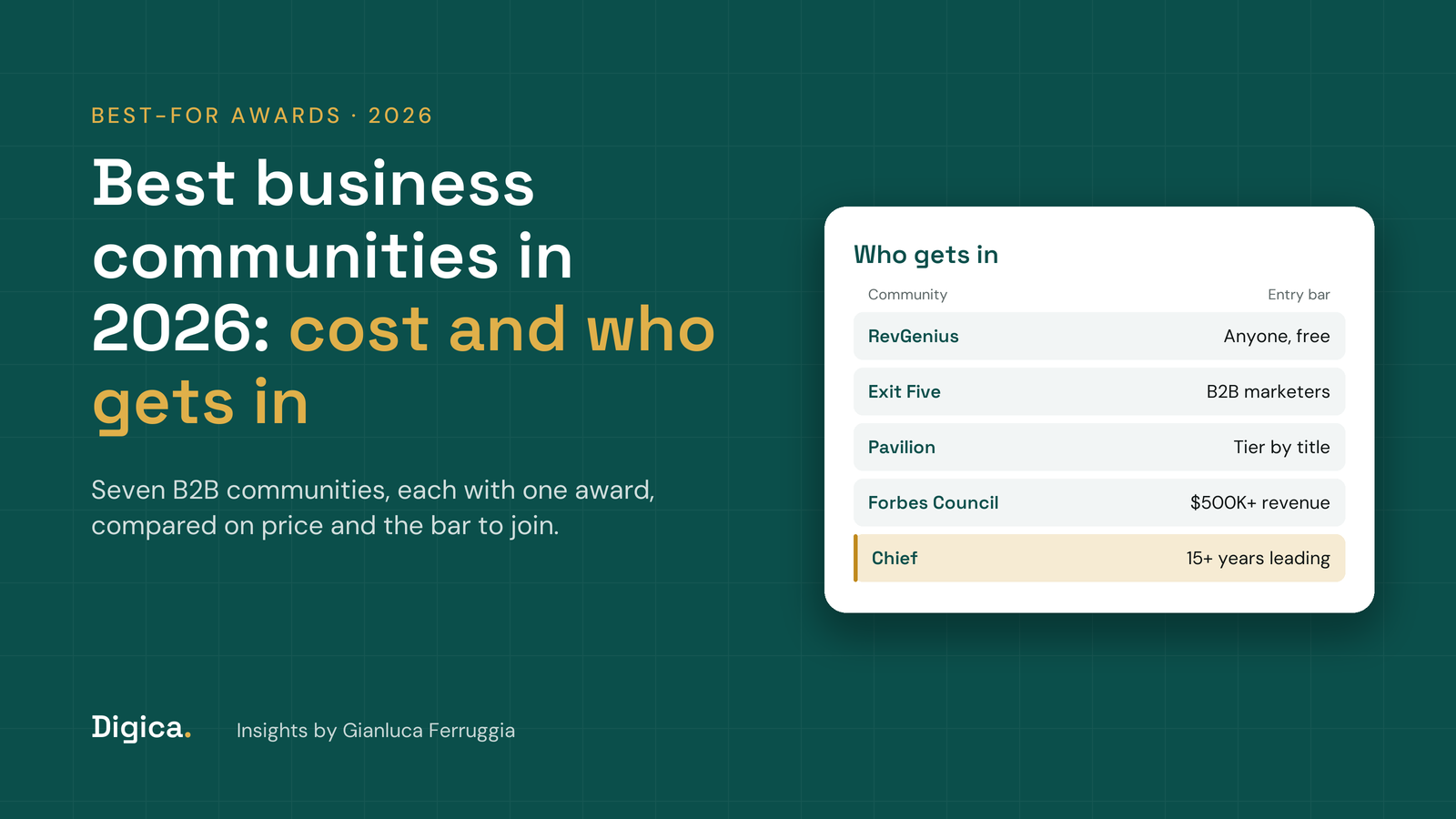
A business community is a group of professionals who meet, online or in person, to trade advice, introductions and benchmarks with peers who face the same problems. Some are free Slack groups anyone can join. Others charge thousands of dollars a year and turn most applicants away. The price gap between the cheapest and the most expensive options in this guide runs from zero to $7,400 a year for a single published tier, and higher for the networks that do not publish a price at all.
Price and exclusivity usually rise together, but they are not the same thing. A high fee can buy a vetted room of peers, or it can buy a logo and a byline. A free community can be noisy, or it can be the most useful room you are in. Communities themselves are under pressure: the CMX 2025 Community Industry Report found 17% of community teams have no one working on community full time, the highest share it has recorded. That makes it worth checking who actually runs the room before you pay.
This guide gives seven B2B and business communities a "best for" award each, and compares them on what a year of membership costs and who is allowed in. Prices and entry rules come from each community's own pages, checked on October 18, 2026. It is the same lens we use when we help B2B communities grow paid membership.
Quick Navigation
- What you pay for in a business community
- Seven communities by price and entry bar
- Best free options: RevGenius and Gartner Peer Community
- Best value for B2B marketers: Exit Five
- Best for revenue leaders: Pavilion
- Best for visibility: Forbes Business Council
- Best for senior women: Chief
- Best for CEOs: Vistage
- Three failure scenarios
- Choosing a community: a decision framework
- What a membership is worth
- FAQ
- Related Articles
What you pay for in a business community
The short answer: you pay for the filter. Content, events and Slack channels are cheap to provide. What costs money is a room where every other member was checked against the same bar you were.
That filter takes three forms. The first is an open door: anyone with an email address can join, so the value depends on how well the community is moderated. The second is a self-selecting price: no application, but a fee high enough that only people with a budget, or an employer who pays, will join. The third is an application or invitation, where the community checks your title, company size or revenue before it takes your money.
Each form suits a different job. An open community is good for answers to common questions and for job leads. A paid community without an application is good for structured learning in one function. An application-only network is good when you want peers at your level, in companies of your size, who will not try to sell to you.
The mistake is to pay for the third when you need the first, or to stay in the first long after you need the third. The table below sorts the seven by both price and entry bar.
Seven communities by price and entry bar
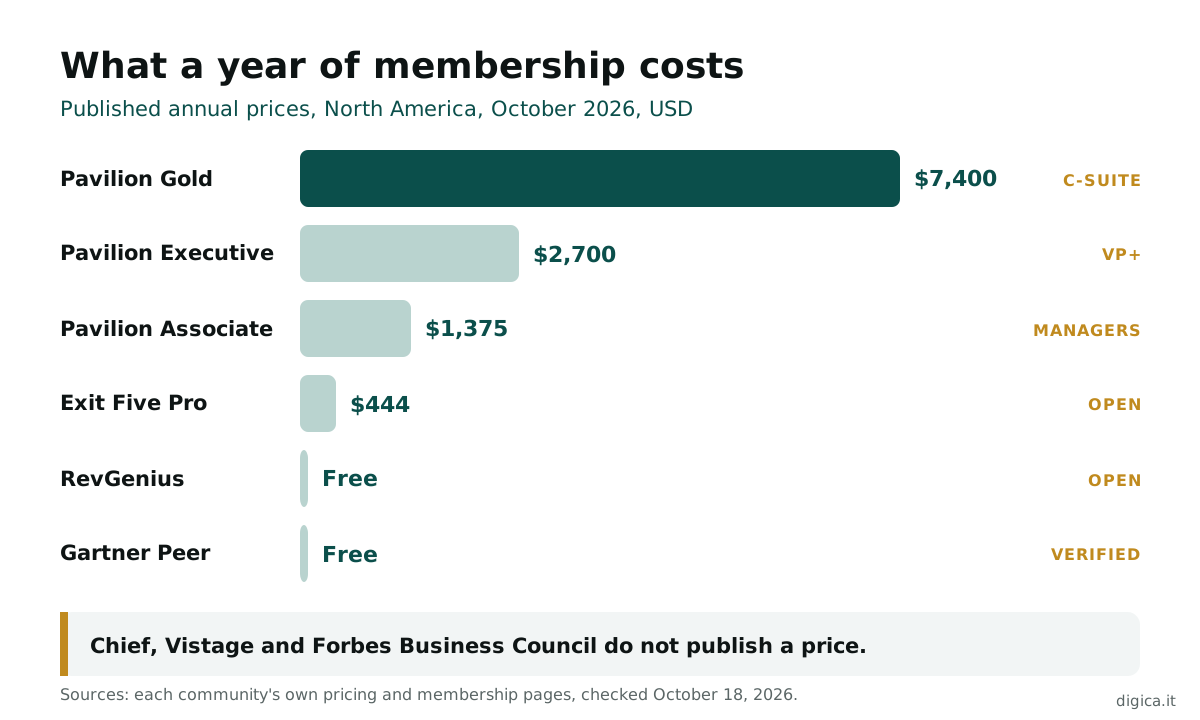
The short answer: RevGenius and Gartner Peer Community are free, Exit Five is the cheapest paid option at $444 a year, Pavilion publishes prices from $1,375 to $7,400 a year in North America, and Chief, Vistage and Forbes Business Council charge fees they do not publish.
Seven B2B and business communities compared on annual price, entry rule, size, main risk and fit
| Community | Annual price | Who gets in | Size it reports | Main risk | Best for |
|---|---|---|---|---|---|
| RevGenius | Free | Open sign-up | 50,000 to 60,000 members | Open Slack attracts pitching | Sales, marketing and RevOps answers |
| Gartner Peer Community | Free | Identity verification | Not published | Q&A only, no peer groups | Verified IT and tech leaders |
| Exit Five | $444, or $49 a month | Open to B2B marketers | 5,700+ members | Skews to SaaS marketing | B2B marketers on a budget |
| Pavilion | $1,375 to $7,400 (North America) | Tier set by seniority | 5,000+ executives | Pricing changed often in 2026 | Revenue and go-to-market leaders |
| Forbes Business Council | Fee not published | $500K+ revenue or funding, by application | Not published | Seen as pay-to-play | Owners who want bylines |
| Chief | Not published | 15+ years of leadership, by application | Not published | Opaque, high price | Senior women executives |
| Vistage | Not published: enrollment fee plus monthly dues | CEOs of $1M+ companies, by interview | 45,000 members | Full day a month | CEOs who want a standing board |
Read the "who gets in" column before the price. Two communities at the same price can give you very different rooms.
Best free options: RevGenius and Gartner Peer Community
Two free communities are worth joining before you pay for anything. They solve different problems.
RevGenius
RevGenius, founded in 2020 and based in Brooklyn, New York, is free to join and open to anyone in sales, marketing, customer success or revenue operations. Its homepage claims a community of 60,000, while its footer still says 50,000, so treat the size as self-reported. Members get a Slack community, cohorts, a monthly Demo Day, a jobs board and events; its Revolt conference ran in October 2026 with free registration.
Running a B2B community and struggling to turn members into paid members?
In 30 minutes we look at how professionals find and choose communities in your niche, and what stops free members from paying.
The trade-off of an open door is noise. RevGenius itself launched "micro-communities" because its main Slack had become too busy to follow. It also runs a separate Executive Community, described as curated, whose price it does not publish.
The award: best free option for sales and revenue teams who want quick answers and a big network.
Gartner Peer Community
Gartner Peer Community, run by Gartner from Stamford, Connecticut, is free to join and free to use. Unlike RevGenius, it asks every member to pass a verification process, and verified members carry a check mark. Gartner clients get extra features.
It is a question-and-answer platform with polls and short reports, not a network of peer groups. There are no dinners and no forums. What it does well is give you verified answers from IT, product and marketing leaders without paying a research subscription.
The award: best free, verified option for technology leaders who want peer answers, not peer friendships.
Best value for B2B marketers: Exit Five
Exit Five, founded by Dave Gerhardt and based in Burlington, Vermont, costs $49 a month or $444 a year billed annually. It has no application for its main membership, but the price and the B2B focus do most of the filtering.
Its pricing page lists 5,700+ members, 300+ training videos and 30+ local chapters. The paid membership includes the private community, industry subgroups for fintech, industrial, healthcare and HR tech, monthly one-to-one matching, a library of 75+ templates and a jobs board. It offers no startup or nonprofit discounts and no free preview.
Above the main membership sits Exit Five's own CMO Council, which is invite-only and open to chief marketing officers and vice presidents at B2B companies with $25 million or more in revenue. Its price is not published.
The award: best value for B2B marketers. At $444 a year, it is the cheapest paid community here, and the clearest about what you get.
Best for revenue leaders: Pavilion
Pavilion, founded in 2016 as Revenue Collective and based in New York, is the largest paid network for revenue and go-to-market leaders, with 5,000+ executives on its homepage. It is also the only paid community here that ties its price directly to your seniority.
Do the right members find your community before they find a rival?
A growth audit maps how professionals search for communities like yours, on Google and in AI answers, and which pages they never reach.
As of October 2026, its pricing page lists three North American tiers. Associate, for managers and directors, costs $1,375 a year or $150 a month. Executive, for vice presidents and the C-suite, costs $2,700 a year or $275 a month. Gold, for C-suite leaders and partners, costs $7,400 a year, annual only. Prices differ by region, and the page now asks for your seniority and location before it shows a price.
All tiers include a member directory, peer matching, local chapters, 200+ virtual events and a job board. Executive adds private functional groups, a legal hotline and compensation coaching. Gold adds retreats, private dinners and investment opportunities.
The award: best for revenue leaders. The tiers make the trade-off explicit: pay more, and you are placed with more senior peers.
Best for visibility: Forbes Business Council
Forbes Business Council is run by The Community Company, based in Boston, under a license from Forbes. It describes itself as a fee-based professional organization with one-year and two-year plans, but does not publish the fee.
The entry bar is clear. You must be an owner, founder or executive leader of a business with at least $500,000 in annual revenue or $500,000 in funding raised, and a selection committee reviews each application. Members can contribute to Expert Panel quotes and bylined articles on Forbes.com with editorial support, and get a profile, a member directory and virtual events.
That is the appeal and the risk. Membership buys a route to publishing on a well-known domain; it does not mean Forbes editors chose you. Buyers who know the model will read a council byline differently from a staff-written article.
The award: best for visibility. Join it for bylines, not for peer advice.
Best for senior women: Chief
Chief, founded in 2019 and based in New York, is a private network for senior women executives. It does not publish its price; press coverage has reported dues starting at $5,800 a year, but ask for a current quote, since Chief changed its tiers and criteria in 2025.
Its entry bar is the most detailed here. Since October 2025, Chief looks for 15 or more years of leadership experience and one of three profiles: a C-suite role at an organization with 1,000+ employees or a public board seat; a senior leader such as a chief executive, vice president or founder at a mid-market or enterprise company; or a "builder" with past executive roles, or a business with $2 million or more in revenue or venture funding. It also says it is not for people who want to solicit new business.
There is research behind the model. A study in PNAS by Yang, Chawla and Uzzi found that women who were highly central in their network and had a female-dominated inner circle reached leadership positions with an expected placement level 2.5 times higher than women with low centrality and a male-dominated inner circle.
Members get guided peer advisory sessions or executive coaching, access to clubhouses in four cities and executive education courses.
The award: best for senior women executives who want a vetted room of peers and can get the fee sponsored.
Best for CEOs: Vistage
Vistage, founded in 1957 and based in San Diego, is the oldest and largest network here, with 45,000 members in 40 countries. It is also the biggest time commitment.
Vistage does not publish its fees. It says membership usually includes a one-time enrollment fee and monthly dues that vary by program and location. Its CEO programs are for companies with $5 million or more in revenue, with a small-business program for companies with $1 million to $4 million. You apply, interview with a Chair, and join a group of 12 to 16 non-competing members who meet monthly, plus one-to-one coaching with the Chair.
Running a B2B community or peer network?
We grow B2B communities and expert networks, from the members who join to the search and AI answers that send them.
Vistage has been buying. It acquired Smart Business Network in October 2025 and its Canadian licensee, TEC Canada, in May 2026. For members, consolidation means a larger network to draw on, and also more groups led by Chairs who joined through an acquisition, so ask how long your Chair has run a group.
The award: best for CEOs who want a standing advisory board of peers and can give it a full day a month. The quality of the Chair decides the value, so meet yours before you sign.
Three failure scenarios
These are the patterns that recur when professionals join the wrong community.
- The premium room you did not need. A vice president of marketing at a 40-person company joins a $7,000-a-year network for C-suite peers. Most members run teams ten times larger, the advice does not fit, and the renewal is cancelled after a year. Exit Five at $444 would have answered the same questions.
- The free room you outgrew. A head of sales stays in an open Slack community for three years after becoming a chief revenue officer. Every thread is a junior question or a vendor pitch, and the peers who could help with a board-level problem are in a paid network they never joined.
- The byline mistaken for proof. A founder joins a fee-based council to publish articles, then uses them as the main proof in sales decks. A buyer recognizes the format, and the founder's credibility drops rather than rises.
The fix is the same in each case: match the entry bar to your current level, and decide whether you want advice, answers or visibility before you look at the price.
Choosing a community: a decision framework
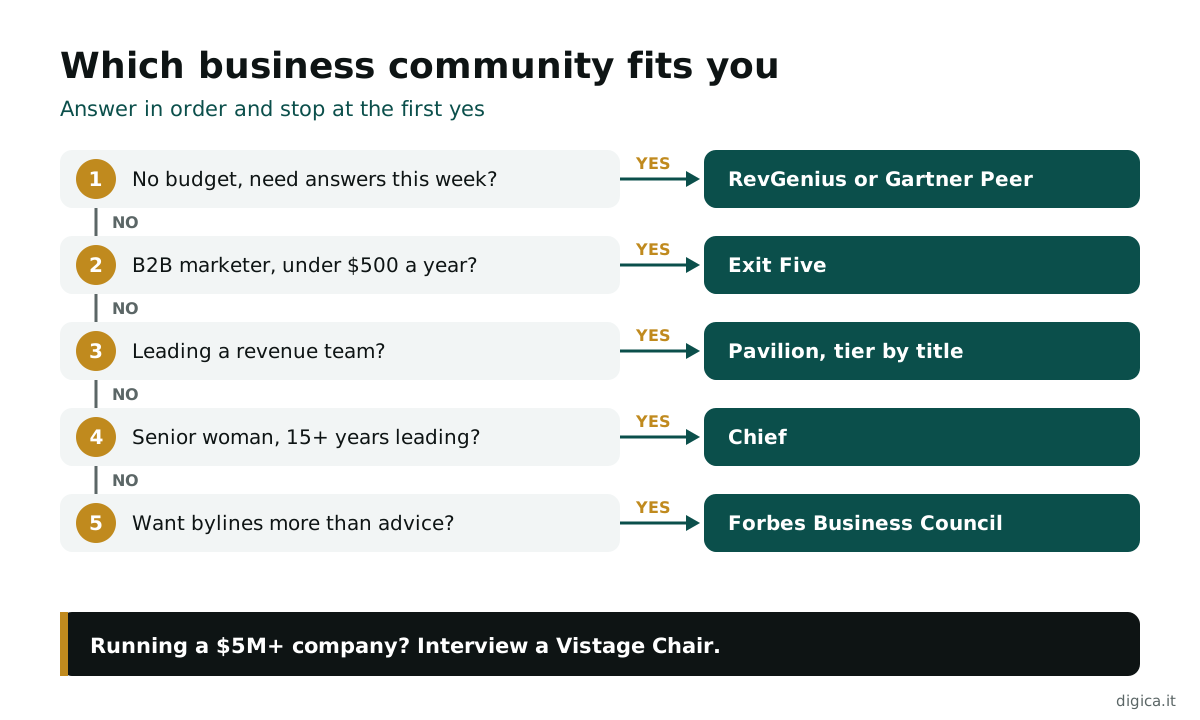
Use these decision points to choose where to start.
- If you need answers this week and have no budget, join RevGenius or Gartner Peer Community.
- If you are a B2B marketer and can spend under $500 a year, join Exit Five.
- If you lead a revenue team of 10 or more, compare Pavilion's Associate and Executive tiers against your title.
- If you run a company with $5 million or more in revenue, interview a Vistage Chair before you decide.
- If you are a senior woman executive with 15 or more years of leadership, apply to Chief, and ask your employer to sponsor it.
- If your goal is published bylines rather than peer advice, Forbes Business Council fits, as long as you present the bylines honestly.
- If you would pay more than $2,500 a year, ask for two member references in a company like yours first.
Whichever you choose, give it two quarters and keep a short record: introductions made, questions answered, and one decision you made better because of the community. If that list is empty after six months, the price was not the problem. The room was wrong for where you are now, and the best move is to step up or step down a tier.
What a membership is worth
The strongest evidence for paid peer groups comes from the communities themselves, so read it with care. Vistage published an analysis of Dun & Bradstreet data on its member companies showing they grew revenue 2.2 times faster than comparable small and midsize businesses. That is a vendor's own study, not independent research. The number to take into a budget conversation is simpler: published prices in this guide run from $0 to $7,400 a year, and the biggest cost of doing nothing is staying in a room you have outgrown while peers at your level compare notes elsewhere.
FAQ
What is a business community? A business community is a group of professionals who share advice, introductions and benchmarks with peers in similar roles. Examples include RevGenius, Exit Five, Pavilion, Chief and Vistage.
What is the best free B2B community? RevGenius is the largest free option for sales, marketing and revenue operations, with a self-reported 50,000 to 60,000 members. Gartner Peer Community is free and verifies every member, which suits technology leaders.
How much does Pavilion cost? As of October 2026, Pavilion lists North American prices of $1,375 a year for Associate, $2,700 a year for Executive and $7,400 a year for Gold. Prices vary by region and seniority.
How much does Vistage cost? Vistage does not publish its fees. It says membership includes a one-time enrollment fee and monthly dues that vary by program and location.
Is Forbes Business Council worth it? It suits owners who want bylines and visibility. It is fee-based and requires $500,000 in revenue or funding, but membership does not mean Forbes editors selected you.
Who can join Chief? Chief looks for women with 15 or more years of leadership experience in C-suite, senior leadership or founder roles, and admits members by application.
What is the difference between a business community and a community platform? A business community is the group of people you join. A community platform is the software a community runs on, such as Circle or Discourse.
Related Articles
- B2B communities and expert networks
- Best startup communities in 2026, ranked by members
- Best community platforms for B2B communities in 2026
- Best expert networks in 2026, by pool and compliance
- Best talent marketplaces in 2026: who vets hardest
This article is part of our B2B marketplace growth series. Browse more on the Digica blog.