The best expert networks for consultants and investors in 2026, grouped by type and compared on pool size and compliance
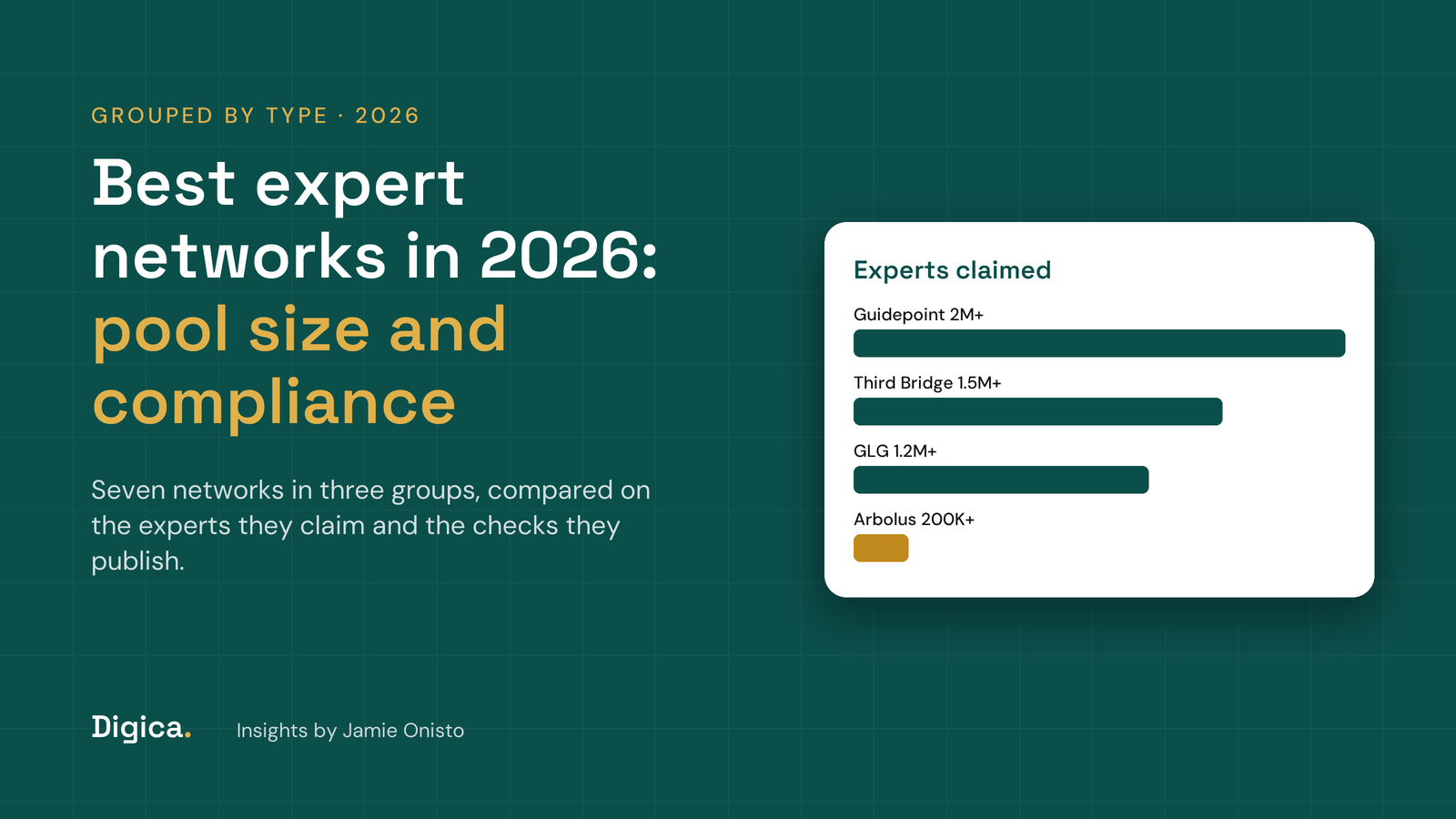
An expert network connects people who need an answer, usually investors and consultants, with people who know it from the inside: former executives, customers, suppliers and operators. The client pays the network for a short call or a transcript, and the network pays the expert. It is a large business. IBISWorld's Expert Networks in the US industry report puts US revenue at $1.8 billion in 2025, after five years of 7.0% annual growth.
Every expert network sells two things at once. The first is reach: how many experts it can put in front of you, and how fast. The second is protection: the screening that keeps a call from turning into a leak of confidential or material non-public information. Pool size is easy to advertise and hard to compare. Compliance is hard to advertise and decides whether a call is safe to take.
This guide groups seven of the biggest expert networks by type and compares them on those two things: the expert pool each one claims, and the vetting and compliance controls each one publishes. Figures come from each firm's own pages and announcements, checked on October 16, 2026. It is the same supply and trust lens we use when we help expert networks grow.
Quick Navigation
- Seven expert networks in three groups
- Full-service call networks: GLG and Guidepoint
- Full-service call networks: AlphaSights and Dialectica
- Transcript libraries: AlphaSense with Tegus, and Third Bridge
- Tech-enabled platforms: Arbolus
- Why the biggest pool is not always the best
- What a compliance program actually checks
- When an expert call goes wrong
- Picking a network for your next project
- What to tell the investment committee
- FAQ
- Related Articles
Seven expert networks in three groups
The short answer: Guidepoint claims the largest pool at 2 million+ experts, Third Bridge and GLG follow at 1.5 million+ and 1.2 million+, and AlphaSights and Dialectica publish no pool size at all. On compliance, all seven publish controls, but they differ in what they check and when.
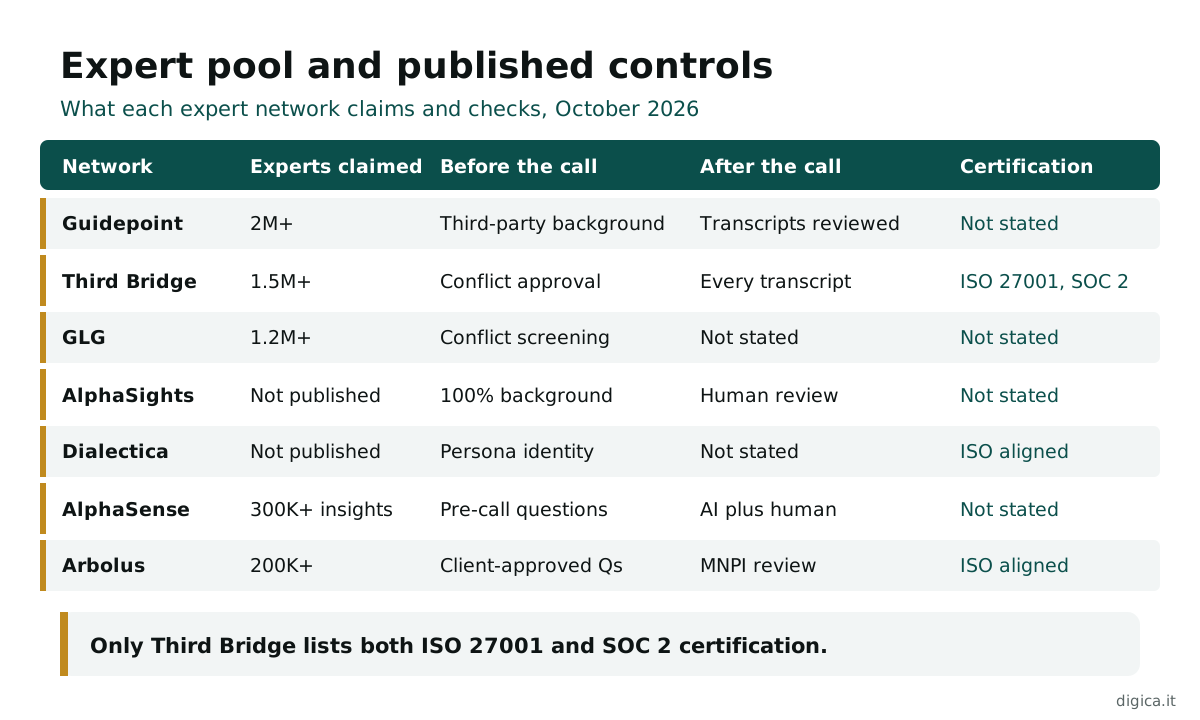
Seven expert networks compared on type, expert pool, vetting and compliance, risk and fit
| Network | Type | Experts claimed | Vetting and compliance | Main risk to weigh | Best for |
|---|---|---|---|---|---|
| Guidepoint | Call network with transcript library | 2M+, 15,000+ added a month | Third-party background checks, yearly tutorial, employer opt-out registry | Breadth can mean more screening work per project | Broad coverage across sectors |
| Third Bridge | Transcript library and calls | 1.5M+ | Conflict filtering, review of every transcript, ISO 27001:2022 and SOC 2 | Library depth varies by company | Due diligence that starts from transcripts |
| GLG | Call network | 1.2M+ members | 50+ compliance staff, yearly tutorial in 20 languages | Premium positioning, cost set per project | Regulated clients who want the longest track record |
| AlphaSights | Call network | Not published | 100% of experts background checked before any interaction | No public pool figure to compare | Fast, managed call programs |
| Dialectica | Call network | Not published | Identity checks via Persona, sanctions screening | No public pool figure to compare | Fast-growing coverage in Europe and beyond |
| AlphaSense (Tegus) | Transcript library | 300,000+ expert insights, 8,000+ added a month | Training, pre-call questionnaire, AI and human transcript review | You read calls others ran, not your own questions | Investors who want to search before they call |
| Arbolus | Tech-enabled platform | 200,000+ experts | Client-approved questions, MNPI review of answers | Smaller pool than the call networks | Fast, structured answers from many experts |
Pool size and compliance pull in different directions. A larger pool reaches more niche experts, but every new expert is a new person to screen. Read the vetting column first, then the pool.
Full-service call networks: GLG and Guidepoint
The full-service networks recruit an expert for your question, screen them and set up a call. They are the oldest and largest part of the market.
GLG
GLG, founded in New York in 1998, says its network membership passed 1.2 million in 2025, with thousands of new experts recruited every week. It says it built the industry's first comprehensive compliance system in 2004, and today its compliance team has more than 50 professionals.
Its controls are the most detailed in public view. Experts sign and re-sign terms every year and complete an annual sector-specific compliance tutorial offered in 20 languages. They agree not to share confidential or material non-public information, current employees cannot take projects about their own employer, and GLG screens for conflicts and removes conflicted experts. In 2025 it launched an AI-powered client portal, myGLG, and a mobile app for experts.
The verdict: the choice for regulated clients who want the longest compliance track record in the market.
Guidepoint
Guidepoint, founded in New York in 2003, claims the largest pool in this guide: 2 million+ vetted experts, with 15,000+ new experts recruited every month. It says it has 2,000+ professionals in 20 offices and serves 5,000+ client organizations. It also runs a transcript library of 130,000+ expert transcripts covering 80,000+ companies, with 7,000 added each month and every one compliance-reviewed.
Running an expert network and losing deals on speed or trust?
In 30 minutes we look at how clients find and choose expert networks in your niche, and where your pool or proof falls short.
Its compliance page is specific. Every new advisor who completes a consultation gets a third-party background check, covering criminal history, FDA debarment and the US government's excluded parties list, and a random sample is rechecked every year. Advisors take an interactive tutorial every 12 months and affirm before each project that they will not share confidential information. An employer registry blocks employees of companies that prohibit participation. In May 2026 Guidepoint repositioned itself around real-time expert insights.
The verdict: the broadest pool with published, specific background checks. Use it when coverage matters more than anything else.
Full-service call networks: AlphaSights and Dialectica
These two compete on service and speed rather than on a published pool number.
AlphaSights
AlphaSights, founded in London in 2008, does not publish an expert pool size. It does publish a strict compliance claim: 100% of experts are background checked and signed up to its legal framework before any interaction. Its legal and compliance team works across nine cities, vetting answers are cross-checked automatically, and people review content for confidential or sensitive information, with escalations that go up to its General Counsel.
Its expert code of conduct bans disclosing employer information, sharing material non-public information and acting with a conflict of interest. It also tells experts not to rely on AI chatbots as their only source. The firm is in a trademark dispute with AlphaSense; in August 2025 a New York court denied AlphaSense's motion to dismiss key claims.
The verdict: a strong choice for managed call programs where the screening happens before the first call, not after.
Dialectica
Dialectica, founded in 2015 in London and Athens with three employees, is the fastest-growing firm here by its own numbers. It says it has 1,600+ professionals, $100 million+ in revenue, 60% annual revenue growth from 2019 to 2024 and 50,000 client engagements a year. It changed its domain from dialecticanet.com to dialectica.io in July 2025.
It does not publish a pool size. Its vetting runs identity verification through Persona, then employment history screening, background and negative-news research and global sanctions-list checks before any engagement.
The verdict: a fast-growing alternative with clear identity checks. Ask for coverage numbers in your sector, since none are public.
Transcript libraries: AlphaSense with Tegus, and Third Bridge
A transcript library sells calls that have already happened. You search hundreds of thousands of interviews before you decide whether to pay for a call of your own.
AlphaSense (Tegus)
AlphaSense bought Tegus in July 2024 and now offers its expert library inside a research platform used by 7,000+ enterprises. The library holds 300,000+ investor-led insights, with 8,000+ transcripts added each month across 29,000+ companies. In June 2026 AlphaSense raised $350 million at a $7.5 billion valuation.
Its compliance rules are written for transcripts that many clients will read. Experts agree to terms, complete insider-trading training and a pre-call questionnaire, and follow call-specific protocols. AI-led interviews follow the same rules and are labelled as AI-generated. Every transcript is scanned by AI and reviewed by a person before it is published.
The verdict: the best starting point for investors who want to read what experts have already said before they book anyone.
Third Bridge
Third Bridge, founded in 2007 and based in London, says its expert network is over 1.5 million strong and its Library, formerly Forum, covers 65,000+ companies. It says it has 1,500+ employees in 12 offices on four continents, and it now offers 100,000+ expert transcripts inside AI assistants through an MCP connection.
It filters out conflicted experts through an approval process, reviews every transcript with people and technology, and holds ISO 27001:2022 and SOC 2 certifications, the only firm in this guide that lists both. In August 2026 it added an Expert Commentary layer to Library transcripts.
The verdict: the transcript library with the clearest security certifications. Check its coverage of your target companies before you subscribe.
Tech-enabled platforms: Arbolus
The newest group uses software to collect structured answers from many experts at once, rather than booking one long call at a time.
Do clients compare your expert network on trust and never get to your proof?
A growth audit maps how clients search for expert networks in your sector, on Google and in AI answers, and which compliance and coverage pages they never see.
Arbolus, founded in 2018 by Sam Glasswell and Will Leeming, says it has a community of 200,000+ experts, with offices in London, Barcelona, New York, New Delhi and San Jose. It closed a $20 million Series B in 2024 to fund US growth and launched a Customer Library in 2025.
Its compliance model fits its format. Clients edit and approve questions before they reach experts, experts get compliance training, and expert answers are reviewed for material non-public information before the client sees them. It follows ISO 27001 standards for information security.
The verdict: a smaller pool, but a fast way to collect views from many experts in a structured form.
Why the biggest pool is not always the best
A pool figure is a count of people who signed up at some point. It does not tell you how many are active, how many fit your question or how many will pass screening this week.
That is why the number that matters is reach into your niche. A network with 2 million experts can still struggle to find five former procurement heads at mid-size chemical distributors, while a smaller firm that recruits for each project may find them faster. Ask each network how many experts it put in front of clients for a similar question last quarter, and how long that took.
There is also a cost in the other direction. Research by Liu, Merkley, Pacelli and Volant on expert networks as information intermediaries in private capital markets found that private firms covered by expert calls were about 60% more likely to raise capital later, and that deals preceded by expert calls raised 73% more. Expert calls move money, and that is exactly why regulators and employers care what is said on them.
Speed is part of reach. Guidepoint says it recruits 15,000+ new experts a month and GLG says it adds thousands every week, which means both networks are recruiting for live briefs as well as drawing on people already signed up. A pool that grows weekly is closer to a recruiting engine than a fixed list, so the useful question is how quickly the engine works in your sector.
The practical rule: treat the pool as a ceiling, and judge the network on the experts it can put in front of you, screened and on time.
What a compliance program actually checks
Every network in this guide publishes controls, but they sit at different points in the process.
Most controls fall into five checks. Identity: is this person who they say they are (Dialectica uses Persona). Background: criminal history, debarment and sanctions (Guidepoint, AlphaSights, Dialectica). Conflicts: does their current or former employer forbid this (GLG, Guidepoint's employer registry, Third Bridge's approval process). Training and attestation: yearly tutorials and a promise before each project not to share confidential or material non-public information (GLG, Guidepoint, AlphaSense). Content review: someone reads the call or the transcript for anything that should not be there (AlphaSense, Third Bridge, Arbolus, AlphaSights).
One gap stands out. None of the seven networks states a fixed cooling-off period for former employees on the pages we read. Several screen current employees out of projects about their own employer, but how long after leaving someone can discuss that employer is left to project-level screening. If your compliance team has a rule, give it to the network in writing.
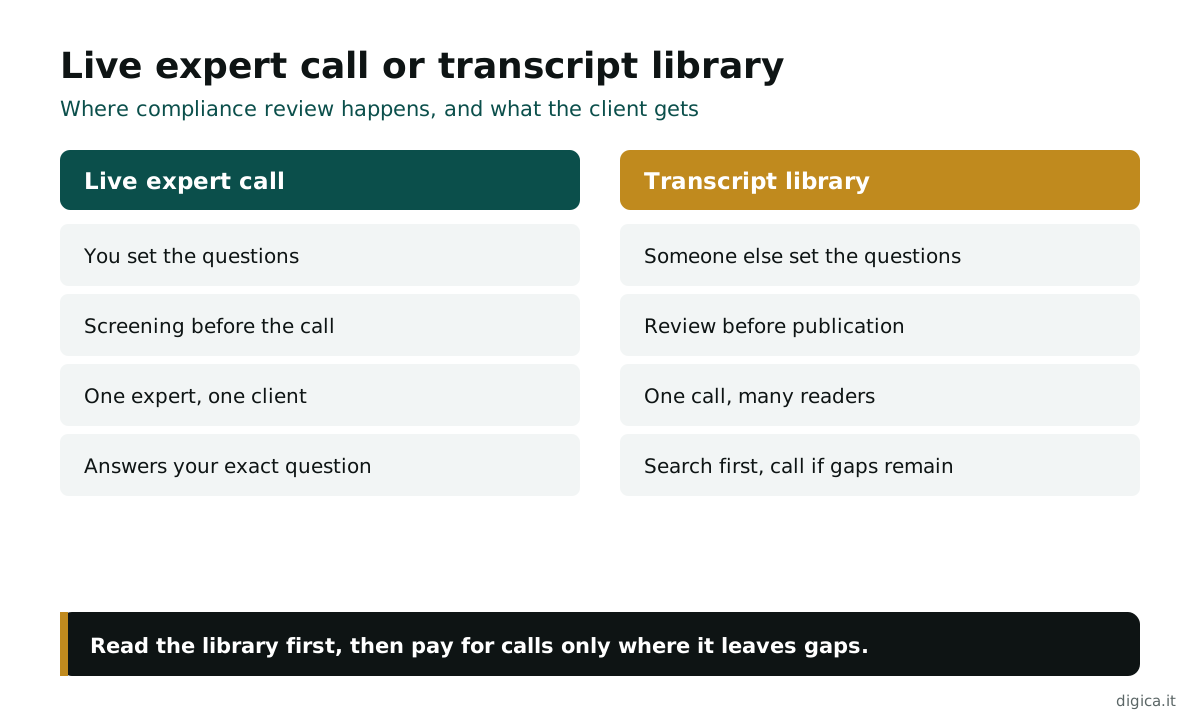
The order matters too. Checks before the call protect you from the wrong expert. Review after the call protects you from the wrong words. Transcript libraries need both, because one call becomes a document many clients will read.
When an expert call goes wrong
The failures that cost the most are rarely dramatic. These are the patterns that recur.
- The expert who should not be there. A recently departed employee joins a call about their former employer, the client's compliance team never set a cooling-off rule, and the notes from the call can no longer be used. The fee is lost, and so is the week.
- The pool that looked big and was not. A team picks a network on its headline pool, asks for former buyers in a narrow segment and gets three profiles in ten days. A rival who asked two networks for the same brief had calls booked in three.
- The transcript nobody read twice. A transcript library is used as the only source for a decision, but the call was run by someone else with different questions. The answer that mattered was never asked.
The fix in each case is the same: write down your own compliance rules, test two networks on one live brief, and treat transcripts as the start of the work, not the end.
Picking a network for your next project
Use these decision points to choose where to start.
- If you need niche experts across many sectors, start with Guidepoint or GLG, which publish the largest pools and the most detailed controls.
- If your compliance team needs certifications in writing, start with Third Bridge, which lists ISO 27001:2022 and SOC 2.
- If you want to read before you call, start with AlphaSense (Tegus) or Third Bridge's Library, then book calls only where the transcripts leave gaps.
- If you need a managed program with screening before every call, add AlphaSights to the shortlist.
- If you need views from 20 or more experts in a few days, try Arbolus's structured format.
- If you run more than ten projects a quarter, test two networks on the same live brief and compare profiles sent, time to first call and screening outcomes.
Running an expert network or expert-call platform?
We grow both sides of expert networks, from the experts who join to the clients who book calls.
Whichever you choose, keep a short scorecard for every project: profiles received, profiles rejected on compliance grounds, days to first call and whether the call answered the question. After a quarter, that scorecard tells you more than any pool figure. It also gives your compliance team a record of every expert you spoke to, how they were screened and which network supplied them, which is the first thing an auditor or a limited partner will ask for if a call is ever questioned.
What to tell the investment committee
Integrity Research reports that global expert network revenue passed $2.5 billion in 2024, up 9% on the year. That money buys two things: reach and protection. Pool size is the number every network advertises, from Guidepoint's 2 million+ to Arbolus's 200,000+, but compliance decides whether a call is usable. The biggest cost of doing nothing is a call your compliance team rejects after the fee is paid, so settle the screening rules before you compare the pools.
FAQ
What is an expert network? An expert network is a firm that connects investors, consultants and companies with industry experts for paid calls, surveys or transcripts. GLG, Guidepoint, AlphaSights, Third Bridge and Dialectica are among the largest.
Which expert network has the most experts? Guidepoint claims the largest pool, with 2 million+ vetted experts and 15,000+ added each month. Third Bridge claims 1.5 million+ and GLG 1.2 million+ members. AlphaSights and Dialectica do not publish a figure.
How do expert networks handle compliance? Most combine identity and background checks, conflict screening, yearly compliance training, a promise before each project not to share confidential or material non-public information, and review of calls or transcripts. GLG says its compliance team has more than 50 professionals.
What is the difference between an expert network and a transcript library? An expert network books a live call with an expert who answers your questions. A transcript library, such as AlphaSense with Tegus or Third Bridge's Library, lets you search interviews other clients already ran, before you pay for a call.
How big is the expert network industry? Integrity Research reports global expert network revenue passed $2.5 billion in 2024, up 9%. IBISWorld puts US revenue at $1.8 billion in 2025.
Do expert networks have a cooling-off period for former employees? None of the seven networks in this guide states a fixed cooling-off period on its public pages. They screen current employees out of projects about their own employer, so set your own rule for former employees and share it with the network.
Related Articles
- Expert network growth
- Best talent marketplaces in 2026: who vets hardest
- Best freelance marketplaces for businesses in 2026
- Best data marketplaces in 2026
- Best community platforms for B2B communities
This article is part of our B2B marketplace growth series. Browse more on the Digica blog.