The best developer communities in 2026, ranked on activity you can verify, not the member count on the homepage
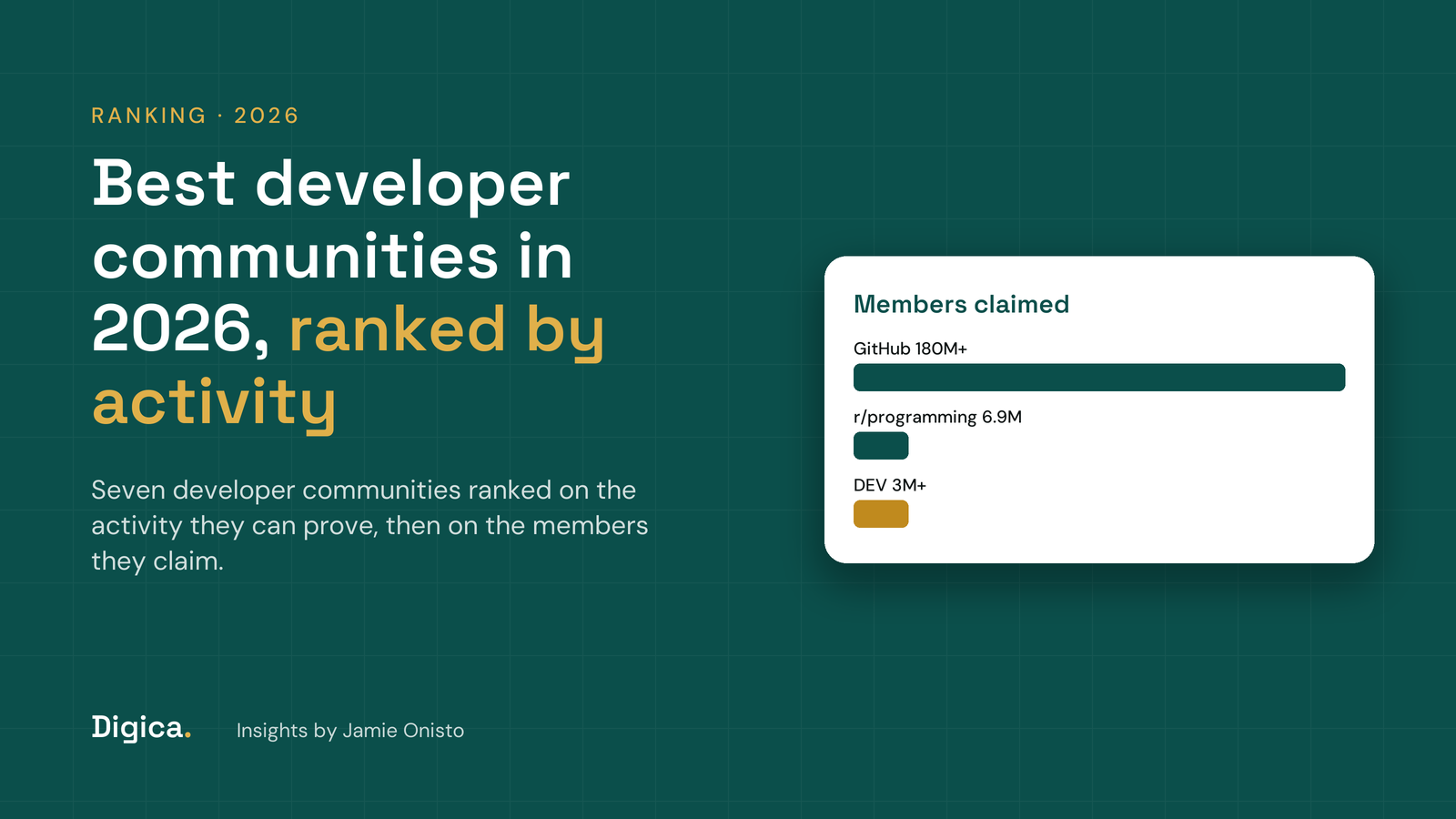
A developer community is a place where software developers ask questions, share code, publish tutorials and argue about tools. The biggest numbers in this space are enormous and mostly misleading. GitHub reports more than 180 million developers on its platform. SlashData's developer population estimate puts the number of developers in the world at 48.4 million. One platform's account count is almost four times the size of the profession.
That gap is the whole point of this ranking. Member counts measure everyone who ever signed up. Activity measures who still turns up: questions asked, pull requests merged, stories submitted, posts written. In 2026 the two numbers are moving in opposite directions on some of the best-known developer communities, and the difference decides where a software company should spend its developer relations time.
This guide ranks seven developer communities on activity you can verify first and members second. It is written for software companies, developer-tool vendors and B2B SaaS teams deciding where to show up, not for individual developers choosing where to hang out. Facts come from each community's own reports, public data and named research, checked on October 20, 2026. It is the same lens we use when we help B2B communities and expert networks grow the audience that keeps a community alive.
Quick Navigation
- Members versus activity: how this ranking works
- Seven developer communities at a glance
- 1. GitHub: the biggest community, and the busiest
- 2. Hacker News: no member count, rising activity
- 3. Stack Overflow: the largest archive, the steepest fall
- 4. Reddit r/programming: millions of members, strict moderators
- 5. DEV Community: the writing community with a new owner
- 6. freeCodeCamp: a learning community measured in output
- 7. daily.dev: a news feed turned community
- Where member counts mislead
- Which developer community to show up in first
- FAQ
- Related Articles
Members versus activity: how this ranking works
The short answer: a developer community is only as useful as the number of people who still post, answer and ship there this month. So each community below is scored on the activity it can prove, then on the members it claims.
Activity comes in different units, and that is fine. On GitHub the activity is code: pull requests merged and commits pushed. On Stack Overflow it is questions asked and answered. On Hacker News it is stories submitted and the comment threads underneath them. On DEV it is articles published. A community that publishes no activity figure at all, and only a member count, ranks lower than one that lets you check.
Members still matter, because reach still matters. A post on a community with three million members can be found by far more people than one on a community with thirty thousand. But a member count is a lifetime number. It includes the developer who signed up in 2014 for one answer and never came back.
There is a second reason to care about activity in 2026. Developers now ask AI assistants many of the questions they used to post in public. That has moved some activity away from Q&A sites and towards places where developers share work, opinions and launches. The communities that gained are the ones where the activity cannot be replaced by a chatbot answer.
A practical rule follows from this. Before you put a community in your developer relations plan, find one activity number for it, dated within the last 12 months. If you cannot find one, treat the member count as a ceiling, not an audience.
Seven developer communities at a glance
The short answer: GitHub is the largest and busiest, Hacker News is busy but publishes no member figures, Stack Overflow has the biggest archive and the sharpest fall in new questions, and the rest each suit a narrower job.
Seven developer communities compared on members claimed, activity you can verify, main risk and best use
| Rank | Community | Members claimed | Activity you can verify | Main risk | Best for |
|---|---|---|---|---|---|
| 1 | GitHub | 180 million+ developers | 43.2 million pull requests merged a month | Accounts include dormant users | Open source and product feedback |
| 2 | Hacker News | Not published | About 1,250 stories submitted a day | One front page, overt marketing gets flagged | Launches to senior engineers |
| 3 | Stack Overflow | Not published as a total | 3,862 new questions in December 2025 | New questions down 78% in a year | Being the answer in a searchable archive |
| 4 | Reddit r/programming | About 6.9 million members | Moderated, AI posts restricted in 2026 | Hostile to self-promotion | Listening to unfiltered opinion |
| 5 | DEV Community | 3 million+ members | No public posting figure | Ownership changed in 2026 | Tutorials and developer blogging |
| 6 | freeCodeCamp | Not published as a total | 129 free courses and 4,279 commits in 2025 | Audience skews junior | Reaching learners and career changers |
| 7 | daily.dev | 500,000+ daily users, self-reported | No independent figure | Mostly passive reading | Paid reach in a developer news feed |
Read the "activity you can verify" column first. It is the column that changes the ranking, and it is the one most vendor slide decks leave out.
1. GitHub: the biggest community, and the busiest
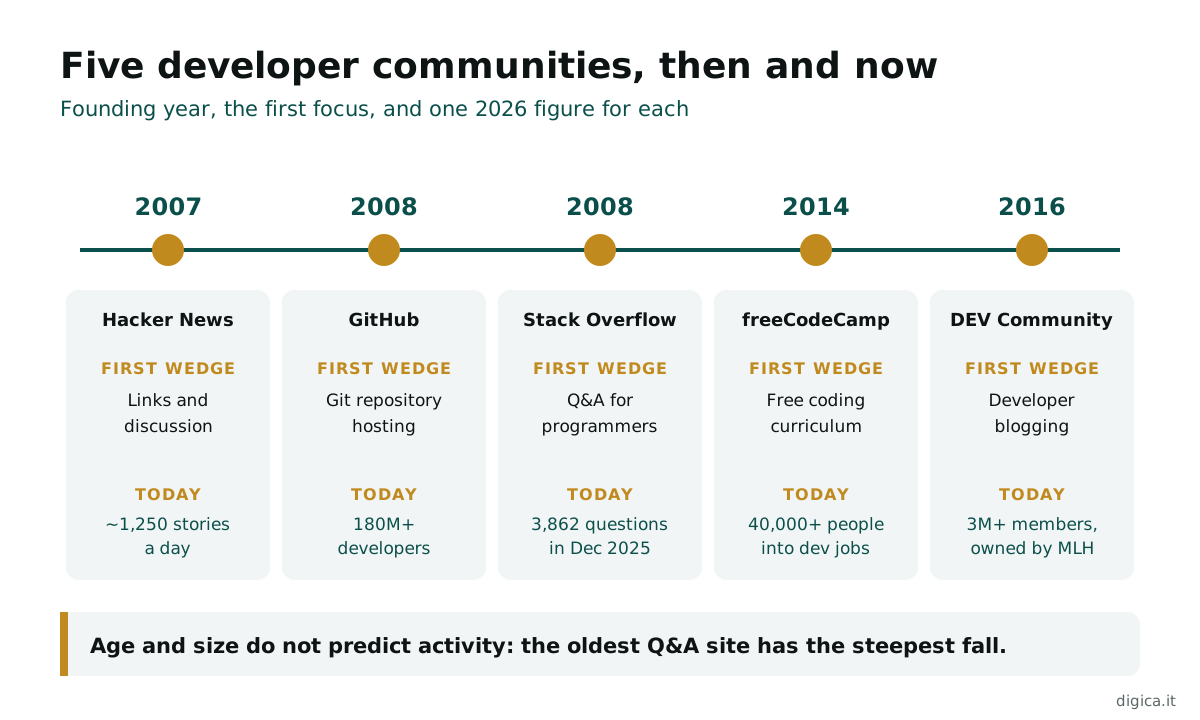
GitHub, founded in 2008 and owned by Microsoft since 2018, is the largest developer community by members and by measured activity. Its Octoverse 2025 report counts more than 180 million developers, with more than 36 million joining in a single year, about one every second.
The activity numbers are just as large. GitHub reports an average of 43.2 million pull requests merged a month, up 23% on the year before, and nearly 1 billion commits in 2025. Developers created more than 121 million new repositories in the year, taking the total to 630 million, and made 1.12 billion contributions to public and open source projects.
Building a developer community or developer B2B marketplace?
In 30 minutes we look at where your developers already gather, which searches and AI answers send them to competitors, and what we would do first.
The growth is increasingly outside the US. GitHub counts 21.9 million developers in India, with more than 5 million added in 2025, about 14% of all new accounts. For a vendor selling to developers, that shifts where documentation, examples and support need to work well.
GitHub is different from every other community here because the work itself is the participation. A developer who opens an issue on your repository, comments in GitHub Discussions or sends a pull request is engaging with your product, not just talking about it. That is why so many developer-tool companies run their community where their code already lives.
The caution is the member count. 180 million accounts against a world population of 48.4 million developers means many accounts are students, occasional users or long dormant. Count stars, issues and contributors on your own repositories instead.
Why it ranks first: the highest verified activity of any developer community, in the place where developers actually work.
2. Hacker News: no member count, rising activity
Hacker News, run by Y Combinator since 2007, publishes no member or traffic figures at all. What it does publish is an open API, and the numbers in it show a busy community. The highest item number on the site, which counts every story, comment and poll since launch, passed 50 million on October 20, 2026.
A public analysis of the Hacker News dataset counted 769,222 stories submitted between January 1, 2025 and September 2, 2026. That works out at about 1,250 new stories a day. Show HN, the section where people present something they built, reached about 4,800 posts a month by January 2026, about 15% of all stories, according to a third-party analysis.
That same analysis found the share of Show HN posts stuck at a single point rose to about 37%. More people are launching, and more launches go unseen. The front page is one list of 30 links, shared by every submission of the day.
The audience is what makes it worth the risk. Hacker News draws senior engineers, technical founders and investors, and its comment threads are often more useful than the article they sit under. Overt marketing gets flagged quickly, so the posts that work are genuine: a technical write-up, an open source release or an honest launch.
Why it ranks second: strong, measurable activity and a senior audience, even with no member count to quote.
3. Stack Overflow: the largest archive, the steepest fall
Stack Overflow, founded in 2008 and owned by Prosus since 2021, is the clearest example of members and activity moving apart. Developers still use it heavily: in the Stack Overflow Developer Survey 2025, with more than 49,000 responses from 177 countries, 82% said they visit at least several times a month.
New questions tell a different story. Public data reported by DevClass shows 3,862 questions posted in December 2025, down 78% from December 2024. At its peak in early 2014, the site saw more than 200,000 new questions a month. Question volume is now back near the level of the site's first year.
The same survey explains why. 84% of respondents use or plan to use AI tools, and 46% said they distrust the accuracy of AI output, up from 31% the year before. 35% said they visit Stack Overflow after running into problems with AI answers. Developers ask the assistant first and come to Stack Overflow to check.
That changes what Stack Overflow is for a vendor. It is less a place to start a conversation and more a reference archive that search engines and AI assistants read. If your product generates questions, the answers already on Stack Overflow shape how developers, and the tools they use, understand it.
Why it ranks third: heavy reading, a vast archive and still the default place to check an answer, but live activity has fallen faster than anywhere else on this list.
4. Reddit r/programming: millions of members, strict moderators
r/programming is the main general programming forum on Reddit, the platform run by Reddit, Inc. A third-party community directory lists it at about 6.9 million members. Around it sit hundreds of smaller subreddits for individual languages, frameworks and tools.
Its 2026 story is about moderation. On April 1, 2026, the moderators announced a trial ban on content about large language models, citing a flood of low-effort AI posts. Reports since then say the ban gave way to quality and relevance rules aimed at low-effort AI submissions. Either way, the moderators decide what activity is allowed, and they changed the rules within a year.
That is why the member count misleads here more than anywhere. 6.9 million is a count of everyone who has joined, not the people who read the front page this week, and the moderators filter what those people see. Self-promotion is unwelcome, and a link that looks like marketing is likely to be removed.
Do developers find your product, or your competitors?
A growth audit maps how developers search for tools like yours, on Google, in developer communities and in AI answers, and which of your pages they never reach.
The value for a software company is listening. The smaller language and framework subreddits are where developers say plainly what frustrates them about a tool, including yours. Read them before you write documentation or plan a launch, and post only when you have something useful to add.
Why it ranks fourth: a very large reach with unfiltered opinion, but activity is gated by moderators and no reliable active-user figure exists.
5. DEV Community: the writing community with a new owner
DEV Community, at dev.to, was founded in 2016 by Ben Halpern, Jess Lee and Peter Frank and runs on its own open source software, Forem. On February 18, 2026, Major League Hacking (MLH), the student hackathon league, bought it. MLH said DEV has more than 3 million developer members, and that together the two reach about 5 million developers.
DEV is a writing community. Developers publish tutorials, project write-ups and opinion pieces, and readers follow tags for the languages and tools they use. That makes it the natural home for developer relations teams that publish how-to articles, as long as the article teaches something rather than sells.
DEV does not publish a monthly figure for posts or active readers, so its activity is harder to check than GitHub's or Hacker News's. The volume of AI-written posts is a quality concern on every open publishing platform, and DEV is no exception.
The ownership change is the thing to watch. MLH says it will support Forem's independence. A hackathon organizer with a student audience could pull DEV towards newer developers, which suits some vendors and not others.
Why it ranks fifth: a large, writing-first membership, held back by the lack of public activity figures and an open question about its direction.
6. freeCodeCamp: a learning community measured in output
freeCodeCamp, founded in 2014 by Quincy Larson and run as a US nonprofit, is a learning community. Its 2025 recap counts 129 free video courses, 452 tutorials and articles and 45 books published in the year, 4,279 commits merged into its open source platform, and 10,342 donors. It says its curriculum has helped more than 40,000 people get developer jobs.
Those are unusual activity figures. Most communities count posts. freeCodeCamp counts what its contributors built and published, which is a better measure of a healthy community than a member total. It does not publish a current total of members or monthly users; its press kit figure of more than 1 million daily users dates from 2022.
The audience skews towards learners and career changers. For a vendor with a free tier, an API that beginners use or a developer program aimed at new developers, that is the right audience. For a vendor selling infrastructure to platform teams, it is not.
Why it ranks sixth: strong, verifiable output from a dedicated community, with an audience that suits a narrower set of vendors.
7. daily.dev: a news feed turned community
daily.dev, based in Israel and founded by Nimrod Kramer, Ido Shamun and Tsahi Matsliah, started as a browser extension that shows developers a news feed in each new tab. It raised an $11 million seed round in 2023, led by Aleph, to build a professional network for developers. It now hosts topic communities called Squads.
Its reach claims are large and self-reported. Its business site says more than 1 in 50 developers worldwide start their day on daily.dev, and its Chrome Web Store listing claims more than 500,000 developers use it every day. There is no independent figure for either.
The model is mostly passive. Developers scroll the feed, open articles and move on. Discussion happens in Squads, which are far smaller than the feed audience. For a software company, daily.dev is closer to a media channel than a community: it sells native advertising to reach developers in the feed.
Why it ranks seventh: a large claimed audience and a useful paid channel, but the activity that makes a community is the smallest part of it.
Where member counts mislead
Most mistakes with developer communities start from one confusion: treating the member count as the audience. The diagram below sets the claimed number and the measurable activity side by side for five of the communities above.
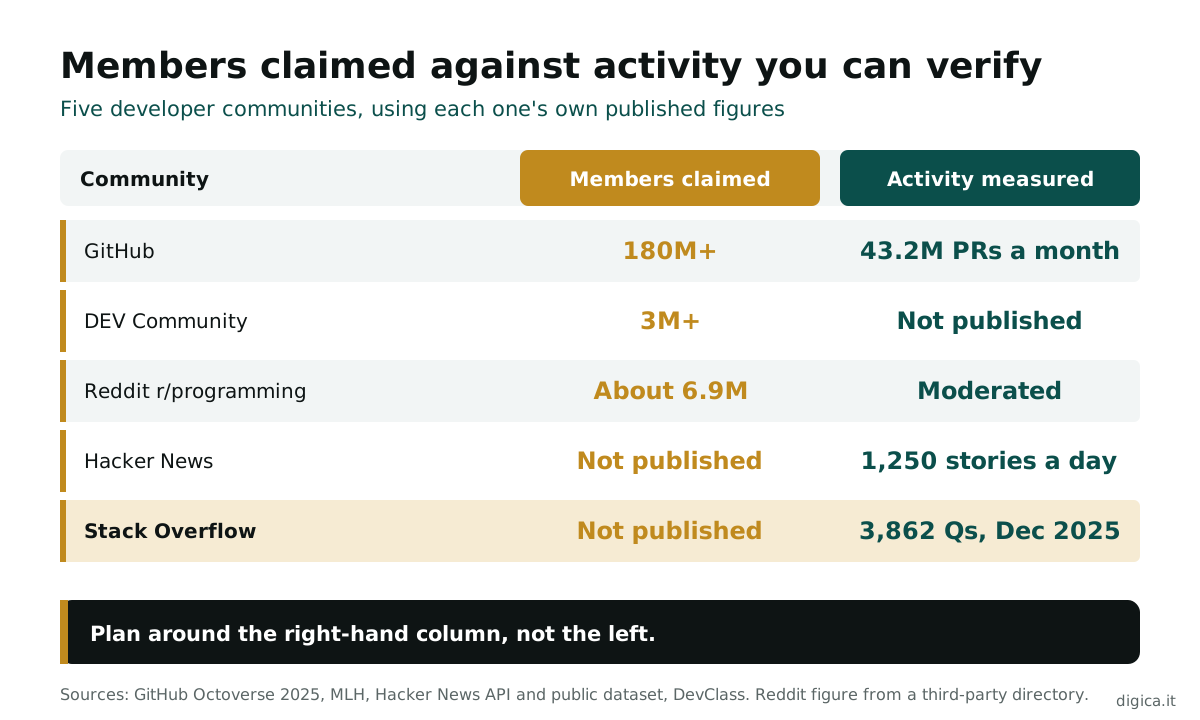
Three patterns recur when software companies plan developer relations around member counts.
- The Q&A strategy built on 2019 traffic. A developer-tool company plans its community around answering questions on Stack Overflow, because that is where its developers went five years ago. New questions in its tag have fallen by most of the 78% seen across the site. The team spends a year answering a handful of questions a month while its developers ask AI assistants instead. A searchable FAQ, a public GitHub Discussions board and examples that AI tools can read would have reached more of them.
- The launch that bet on the front page. A startup times its entire launch around one Show HN post. With 37% of Show HN posts stuck at one point, the post sinks in an hour. The launch had no second channel, so there was no second chance. The right call was a technical write-up on DEV, a GitHub release and a newsletter mention in the same week, with Hacker News as one of several bets.
- The subreddit announcement. A company posts its product announcement to r/programming because of its 6.9 million members. The moderators remove it within minutes and the comments that remain are hostile. Months of listening in the smaller language subreddits, and a useful answer when the moment came, would have built credibility instead.
None of these involves a bad community. Each involves a company that read a membership number as an audience it could reach on demand.
Which developer community to show up in first
The short answer: start where your developers already do the work, then add one community for reach and one for listening. These decision points make that specific.
- If your product has a public repository or SDK, start on GitHub. Put issues, Discussions and examples there before you build anything elsewhere.
- If you are launching something technical in the next 90 days, plan a Show HN post, but give it a second and third channel in the same week, such as a DEV tutorial and a release note on GitHub.
- If more than 1,000 questions about your product already exist on Stack Overflow, keep the top answers accurate. They are read by developers and by the AI tools that answer them.
- If your buyers are new developers or students, look at freeCodeCamp course sponsorship and the post-acquisition DEV, where MLH's student audience now sits.
- If you need reach more than conversation, test paid placement in daily.dev's feed and judge it as a media buy, on clicks and signups.
- If you cannot find an activity number dated within 12 months, do not plan around the community. Listen there, but spend your time elsewhere.
Running a developer community or B2B community?
We help B2B communities grow the members who post, answer and come back, through search, AI answers and earned placements.
The cost of getting this wrong is mostly people's time. The US Bureau of Labor Statistics puts the median pay of US software developers at $134,040 a year, about $64 an hour. A developer advocate who spends 10 hours a week in a community where activity has collapsed costs about $33,500 a year in salary time alone, before tools or travel. Move those hours to the community where your developers still post and ship, and the same budget buys real conversations. The biggest cost of doing nothing is a year of developer relations work measured in members who no longer turn up.
FAQ
What is a developer community? A developer community is a place where software developers ask questions, share code, publish tutorials and discuss tools. Examples include GitHub, Stack Overflow, Hacker News, Reddit's programming forums, DEV Community and freeCodeCamp.
What is the largest developer community? GitHub, by both members and activity. Its Octoverse 2025 report counts more than 180 million developers and an average of 43.2 million pull requests merged a month.
Is Stack Overflow still active in 2026? Yes, but far less for new questions. Public data shows 3,862 questions in December 2025, down 78% in a year, while 82% of surveyed developers still visit at least several times a month.
Who owns DEV Community? Major League Hacking (MLH) bought DEV Community on February 18, 2026. DEV has more than 3 million developer members and runs on the open source Forem software.
How many members does Hacker News have? Hacker News does not publish member or traffic figures. Public data shows about 1,250 new stories a day between January 2025 and September 2026.
How should a software company engage with developer communities? Start where your developers already work, usually GitHub, then add one community for reach and one for listening. Lead with useful technical content, avoid overt promotion, and judge each community on recent activity rather than total members.
Related Articles
- B2B communities and expert networks
- Best startup communities in 2026, ranked by members
- Best community platforms for B2B communities in 2026
- Best B2B and business communities to join in 2026
- Best SaaS directories to list your product in 2026
- Community SEO
This article is part of our B2B marketplace growth series. Browse more on the Digica blog.