The best SaaS directories to list your product in 2026, sorted by who actually visits them
A SaaS directory is a website that lists software products so that people can find, compare and review them. There are hundreds of them. One list published in June 2026 counts more than 260, and most founders submit to dozens in the week they launch. Very few of those listings ever produce a paying customer, because most directories send the wrong visitor for the stage the product is at.
The visitor is the whole point. A review site is read by a buyer with a budget who is comparing three vendors. A launch platform is read by makers and early adopters looking for something new to try. An alternatives finder is read by someone who already uses a rival and wants to switch. Each of these people is valuable, but only at the right moment. List in the wrong place and you get a spike of signups that never pay, or a profile with no reviews that sits on page four of its category.
This guide groups six of the biggest SaaS directories by the audience they serve, and compares them on who visits, how a listing gets seen and what it takes to list. Facts come from each directory's own pages, checked on October 19, 2026. It is the same audience-first test we apply when we help SaaS and software marketplaces grow.
Quick Navigation
- Who actually visits a SaaS directory
- Six SaaS directories side by side
- Review sites: where budget holders compare
- Launch platforms: Product Hunt
- Alternatives finders: AlternativeTo and SaaSHub
- What a free listing gets you, and what paid buys
- Three failure scenarios
- Which SaaS directory to list on first
- What the right directory is worth
- FAQ
- Related Articles
Who actually visits a SaaS directory
The short answer: three different people, at three different points in a buying decision. The directory you choose decides which of them sees you.
The first is the evaluator. They have a problem, a budget and usually a deadline. They read reviews, filter by company size and compare pricing pages before anyone on the vendor side hears from them. Gartner's March 2026 survey of 646 B2B buyers found that 67% of B2B buyers prefer a rep-free buying experience, and 45% had used AI during a recent purchase. Review sites exist to serve that buyer.
The second is the early adopter. They are founders, developers and product people who enjoy trying new tools. They will sign up on the day you launch, give you feedback and tell their friends. They rarely sign a contract with procurement attached.
The third is the switcher. They already pay for a competitor and are unhappy with it. They search for "alternatives to" a product they know by name. Their intent is high, but they arrive with a fixed comparison in mind, so your listing has to answer one question: why are you better than the tool they are leaving?
A SaaS directory that matches the first person is worth more to a product with a sales team. One that matches the second is worth more in the first month after launch. The third suits any product with a clear rival. The mistake we see most often is a founder who treats them as the same channel and measures them all on signups.
Six SaaS directories side by side
The short answer: G2 and the sites it now owns reach the most buyers, TrustRadius is the most enterprise-focused, Product Hunt gives the biggest one-day launch, and AlternativeTo and SaaSHub catch people who are leaving a rival.
Six SaaS directories compared on audience, how a listing gets seen, cost to list, main risk and fit
| Directory | Type | Audience it claims | How a listing gets seen | Cost to list | Main risk | Best for |
|---|---|---|---|---|---|---|
| G2 | Review site | 100M+ software buyers | Reviews, category grids, paid ads | Free profile; Starter $2,999 a year | Thin profile ranks below rivals with more reviews | Products with a sales team |
| Capterra, GetApp, Software Advice | Review sites, owned by G2 since February 2026 | Part of G2's 200M+ annual buyers | Reviews and pay-per-click sponsored profiles | Free listing; paid clicks and leads | Click costs add up in busy categories | Small business software |
| TrustRadius | Review site | 12M+ annual B2B technology evaluators | Long-form reviews and Top Rated awards | Not published | Fewer visitors than G2 | Enterprise and mid-market tools |
| Product Hunt | Launch platform | Not published | Community upvotes on launch day | No fee stated | One-day spike, little buyer intent | Launch week and early users |
| AlternativeTo | Alternatives finder | "Millions of people" | User recommendations against a named rival | Free | Rankings set by users, not you | Products with a well-known rival |
| SaaSHub | Alternatives finder | 251,049 products listed | Comparison pages and alternatives lists | Free; paid premium placement | Busy categories, hard to stand out | Indie and long-tail SaaS |
Read the "how a listing gets seen" column first. It tells you what work the listing needs after you submit it, and that work is where the cost really sits.
Review sites: where budget holders compare
Review sites are where a SaaS directory listing turns into pipeline, because the people reading them are already in a buying cycle. They also need the most work: a profile with three reviews loses to one with three hundred.
G2
G2, founded in 2012 by Godard Abel and four co-founders and based in Chicago, is the largest software review site. Its seller plans page describes "the marketplace trusted by over 100M software buyers" and more than 3 million reviews. Its basic profile "will always be free": you claim it, collect reviews and share them. If your product is not listed yet, you request a profile and G2's research team checks it in about three to five business days.
Paid plans start with Starter at $299 a month or $2,999 a year, and G2 also sells pay-per-click ads and promotions. The bigger change came in 2026. G2 agreed in January to buy Capterra, Software Advice and GetApp from Gartner, and Gartner's annual report says the sale closed on February 5, 2026, for about $110 million. The combined business reports nearly 6 million verified reviews and more than 200 million annual software buyers. In June, G2 extended its buyer intent data across all four sites under the name G2 Digital Markets.
Who it suits: any product sold to businesses with a sales or success team that can ask happy customers for reviews. G2 rewards review volume and recency, so it suits companies that can run a steady review program, not a one-off push.
Capterra, GetApp and Software Advice
These three sites spent a decade inside Gartner and now sit inside G2. Capterra, founded in 1999 in Arlington, Virginia, says it lists all software providers, not only the ones that pay, and reports more than 2 million reviews from verified users. Vendors can create a free listing. Those who pay buy sponsored profiles on a pay-per-click basis, which push them up category pages and send visitors to their site.
Software Advice works differently. It offers free phone advisors to buyers, mostly at smaller companies, and vendors pay for the leads those advisors pass on. GetApp, built in Barcelona, focuses on app comparisons for small businesses.
Listed on review sites but not seeing pipeline from them?
In 30 minutes we look at where buyers in your category compare software, and why your profile is not on their shortlist.
Who they suit: small and mid-size business software, where buyers compare many cheap tools quickly. The pay-per-click model means visibility is a budget decision, so set a cost-per-lead ceiling before you start.
TrustRadius
TrustRadius, founded in 2012 in Austin, Texas, was bought by HG Insights in June 2025. HG Insights describes it as home to more than 12 million annual B2B technology evaluators. That is fewer people than G2 reaches, but its reviews are long and detailed, which suits buyers running a formal evaluation.
Its Top Rated awards show what it values. To win in 2026, a product needed at least 10 new or updated reviews in the past 12 months, at least 0.5% of the traffic in its category, and a trScore of 7.5 or higher. That year, 375 products from 209 vendors won across 519 categories.
Who it suits: enterprise and mid-market software with a long sales cycle, where one detailed review from a known company does more than twenty short ones.
Launch platforms: Product Hunt
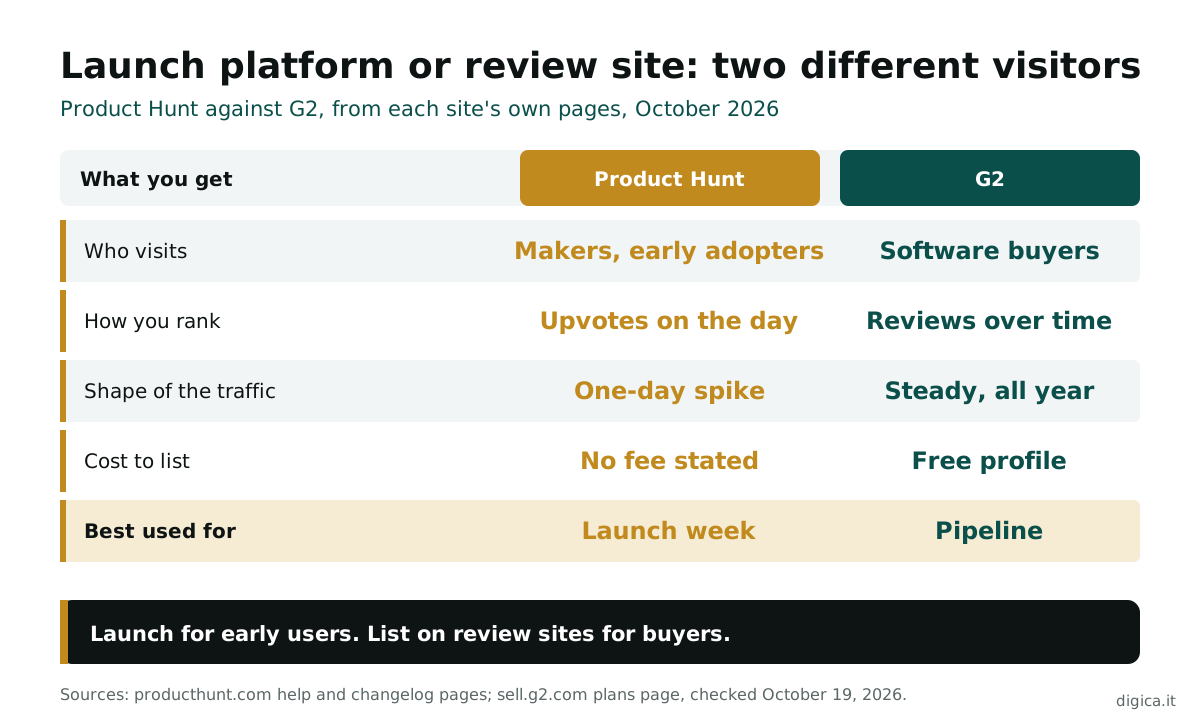
Product Hunt is the best SaaS directory for a launch, and a weak one for steady buyer demand. It sends a large crowd on one day, and most of that crowd is other makers.
Product Hunt was launched in November 2013 by Ryan Hoover, bought by AngelList in 2016, and is based in San Francisco; its current chief executive is Rajiv Ayyangar. Launches go live at 12:01 AM Pacific Time and run on a 24-hour cycle. A company account cannot post a product, so a person on your team has to do it. Since December 2025, the leaderboard has shown points "based primarily on upvotes with comments as an additional factor", and the moderation team still chooses which launches to feature at the top of the page.
The rules keep changing, so check them before you plan a launch. Product Hunt replaced "Launch Now" with scheduled drafts in September 2025, removed its "Featured | All" toggle in October 2025, and retired "Coming Soon" pages in August 2026.
The value of a launch is concentrated in a few hours. A good day brings signups, feedback and a badge you can show on your site. It rarely brings a buyer with a procurement process, and the traffic falls away within days. Treat Product Hunt as a launch event with a measurable goal, such as 200 activated trial accounts, not as a listing that keeps working.
Who it suits: a new product or a major release that needs early users, feedback and social proof in its first week.
Alternatives finders: AlternativeTo and SaaSHub
Alternatives finders catch the switcher: someone who already pays for a rival and wants out. Their pages are built around a named competitor, so they suit any SaaS product with a well-known incumbent to position against.
AlternativeTo
AlternativeTo, run by 27 Kilobyte AB in Stockholm, launched publicly in March 2009. Its lists are based on user recommendations, "not from us, and not from the companies that make it". Its last published count, from 2023, was around 108,000 apps, games and services; in March 2026 it said it is used by millions of people.
You can add your product, but you cannot buy a higher place. Your position depends on how many users like it as an alternative to the tool they are leaving. That makes AlternativeTo slow to build and hard to fake.
SaaSHub
SaaSHub, based in Sydney and independent since 2014, lists 251,049 products and has identified 504,798 competitor relationships, according to its homepage today. Submitting a product is free; only approved products can buy a premium placement. Verified listings confirm their details every quarter.
Do buyers in your category find you, or only your competitors?
A growth audit maps where software buyers in your category search, on Google, on directories and in AI answers, and which pages they never reach.
SaaSHub's comparison pages rank for searches such as "X vs Y" and "X alternatives", which is where switchers start. A complete, verified listing with clear differences from your main rival is the minimum. The products that win here are the ones whose listing answers the switcher's question in the first two lines.
Who they suit: indie, long-tail and challenger SaaS products, and any team whose sales conversations start with "we are switching from".
What a free listing gets you, and what paid buys
The short answer: a free listing gets you indexed. Paid placement gets you seen in busy categories. Neither replaces reviews.
Every directory in this guide offers a free way in. G2 and Capterra give you a free profile, SaaSHub and AlternativeTo let you submit for free, and Product Hunt states no launch fee. What you get for free is a page that exists. What you do not get is position: in a category with 200 rivals, a free profile with no reviews sits on page four.
Paid options buy position in three ways. G2 sells plans and pay-per-click ads. Capterra's sponsored profiles are paid per click. Software Advice charges per lead. Each is a reasonable trade if you know what a lead is worth to you, and an expensive one if you do not.
The pattern we see across SaaS companies of every size is that reviews do more than ads. The TrustRadius 2026 B2B Buying Disconnect Report, published by its owner HG Insights, found that 74% of buyers consulted customer reviews during their purchase, and that review-site use rose from 58% in 2025 to 63% in 2026. Review volume also drives most directory rankings. A team that collects 25 good reviews in a quarter usually gets more from a free G2 profile than a team that pays for Starter with five reviews.
There is one further reason to keep listings complete. Review sites and alternatives pages are among the sources AI assistants read when a buyer asks which tool to use. A thin or outdated profile is now a problem in two places at once.
Three failure scenarios
These are the patterns that recur when SaaS teams choose directories by habit rather than by audience.
- The launch mistaken for a channel. A developer tool reaches the top five on Product Hunt, gets 3,000 signups in two days, and books the result as its main acquisition channel. By week three, daily signups are back to 20, most launch-day accounts never activate, and the next quarter's plan has a hole in it. The launch was a good event. It was never a channel.
- The paid profile with no reviews. A mid-market HR product buys a paid review-site plan before it has a review program. The profile looks polished but carries 6 reviews against rivals with 300. Buyers skip it, and the renewal conversation starts with a cost and no pipeline to show for it.
- The alternatives page left to chance. A challenger CRM never claims its alternatives listings. Its page on a comparison site shows an old logo, a dead pricing link and a description written three years ago. Switchers who searched for alternatives to the market leader see it, and pick the next tool down.
Growing a SaaS product or software marketplace?
We help SaaS teams win the searches, directories and AI answers their buyers use before they ever book a demo.
In each case, the directory was fine. The fit between the directory's visitor and the product's stage was wrong. A launch platform was asked to do the job of a review site, a paid plan was asked to do the job of a review program, and a free listing was left to do the job of a positioning page. None of those jobs is hard, but each one needs an owner and a number to hit.
Which SaaS directory to list on first
Start with the person you most need to reach this quarter, then pick the SaaS directory that serves them.
Most teams do this backwards. They start from a list of directories and work down it, submitting everywhere because each listing is free. The cost is not the fee. It is the hours spent keeping 40 profiles current, and the attention taken from the two or three listings that actually reach a buyer. Use these decision points instead.
- If you launch in the next 30 days and need early users, plan a Product Hunt launch, and set a target for activated accounts, not upvotes.
- If you sell to businesses with a sales team, claim your free G2 profile and Capterra listing first, and ask for 10 reviews before you pay for anything.
- If your average contract is above $25,000 a year, add TrustRadius and ask your best enterprise customers for detailed reviews.
- If prospects already pay for a named rival, complete and verify your AlternativeTo and SaaSHub listings, and state your difference from that rival in the first sentence.
- If you have 25 or more recent reviews on a review site, test paid placement in your top category with a cost-per-lead ceiling set in advance.
- If a directory sends fewer than five qualified leads in a quarter, stop paying for it and move the budget to reviews.
Whatever you choose, review it every quarter. Track three numbers per directory: qualified visitors, trials or demos started, and closed revenue. The directory with the most traffic is rarely the one with the most revenue, and the gap between them is where most directory budgets are wasted.
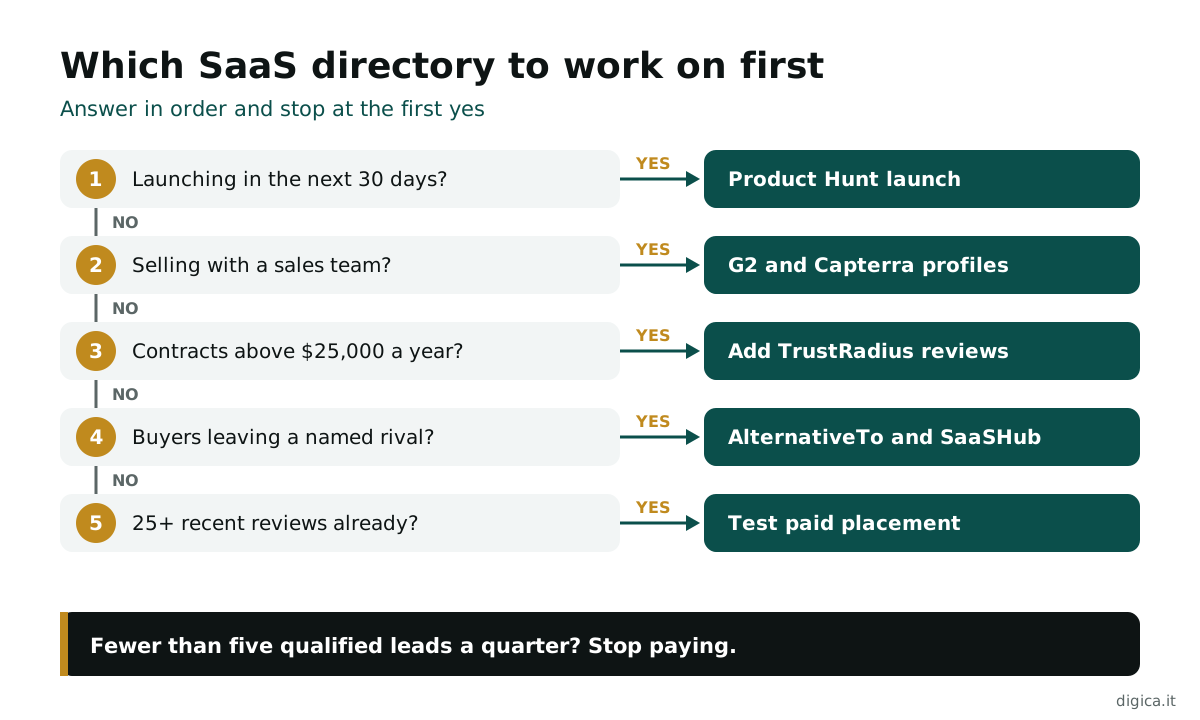
The tree above puts the same tests in order. Answer the questions from the top and stop at the first yes: that is the directory to work on this quarter. Come back to the tree when your stage changes, for example after your first enterprise deal or when a new rival starts to win the deals you used to win.
What the right directory is worth
Buyers decide early, and they decide from what they can find without you. The 6sense 2025 Buyer Experience Report found that buyers first contact a seller about 61% of the way through their journey, and that the vendor they eventually chose was on their day-one shortlist 95% of the time. Directories are one of the places that shortlist is built.
The number to take into your next budget meeting is simple. A free G2 profile with 25 recent reviews costs a review program and some customer goodwill. A paid G2 Starter plan costs $2,999 a year, and without reviews behind it, it buys visibility for a profile buyers will skip. The biggest cost of doing nothing is not the fee: it is being absent from the shortlist that 95% of buyers have already written before they talk to anyone.
FAQ
What is a SaaS directory? A SaaS directory is a website that lists software products so buyers can find, compare and review them. The main types are review sites such as G2 and Capterra, launch platforms such as Product Hunt, and alternatives finders such as AlternativeTo and SaaSHub.
Which SaaS directory gets the most traffic? G2 reports the largest audience, with 100M+ software buyers on its own site and more than 200 million annual buyers across G2, Capterra, Software Advice and GetApp combined since February 2026.
Is listing on G2 free? Yes. G2 says its basic profile will always be free, and you can claim it, collect reviews and share them. Paid plans start at $299 a month or $2,999 a year.
Does G2 own Capterra now? Yes. G2 agreed to buy Capterra, Software Advice and GetApp from Gartner in January 2026, and the sale closed on February 5, 2026.
Is Product Hunt worth it for B2B SaaS? It is worth it for a launch, to win early users, feedback and a badge. It is a weak source of steady buyer demand, because traffic falls away within days and most visitors are other makers.
How many SaaS directories should I list on? Start with three to five that match your buyer: one or two review sites, one alternatives finder, and Product Hunt in your launch week. Add more only when you can keep each listing complete and up to date.
Do SaaS directories help with SEO? They help most through visibility on their own pages, which rank for category and "alternatives" searches. Many directory links are nofollow, so treat them as a source of buyers, not of link value.
Related Articles
- SaaS and software marketplace growth
- Best AI tools directories in 2026
- Best software marketplaces in 2026, by commission and cost
- Best agency directories in 2026, ranked
- What is a cloud marketplace? AWS vs Azure vs Google
This article is part of our B2B marketplace growth series. Browse more on the Digica blog.