The best event and venue marketplaces for business events in 2026, with one award each for the venues it can actually show you
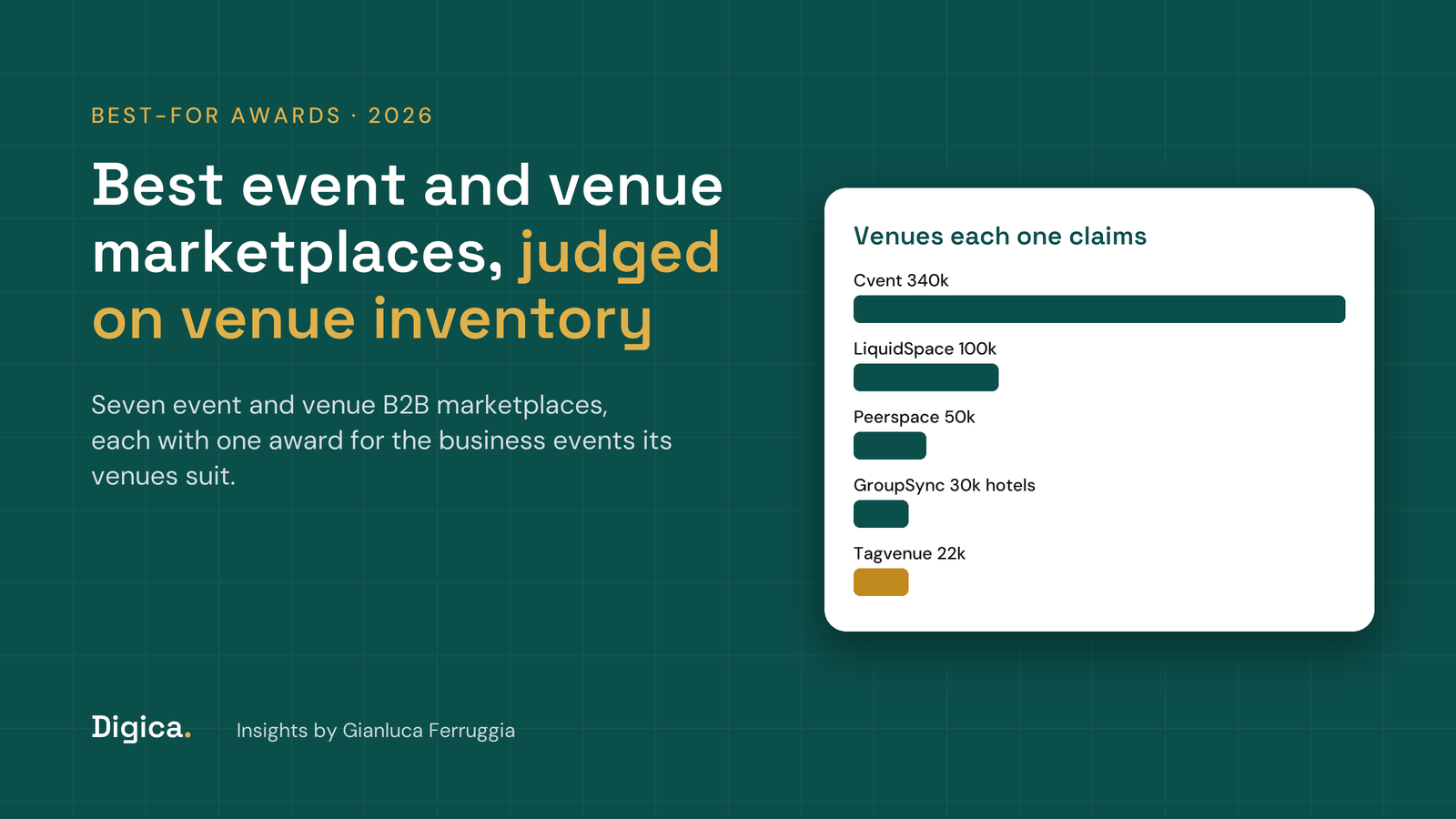
An event marketplace is a B2B marketplace where companies find, compare and book venues for meetings, offsites, conferences and corporate parties, instead of phoning venues one by one. The market behind it is very large. The Events Industry Council and Oxford Economics counted 1.65 billion business event participants across more than 180 countries in 2025, with $3.1 trillion in total business sales.
For the person organizing the event, the headline number on a venue marketplace is how many venues it lists. That number is less useful than it looks. A platform that lists 340,000 hotels and a platform that lists 22,000 bookable rooms are not a big and a small version of the same thing. One is built for a 500 person conference sent out as a request for proposal (RFP). The other is built for a 20 person board meeting booked tonight.
This guide gives seven of the leading event and venue marketplaces one award each, judged on venue inventory: how many venues each one says it lists, where they are, what kind of business event they suit, and how booking actually works. Every inventory figure is the company's own claim, checked on October 22, 2026. It is the same supply test we apply when we help event and venue B2B marketplaces grow their venue supply and their planner demand together.
Quick Navigation
- What venue inventory means on an event marketplace
- Seven event and venue marketplaces compared
- Best for large conferences and RFPs: Cvent Supplier Network
- Best for group hotel blocks: Groups360 GroupSync
- Best for spaces by the hour: Peerspace
- Best for self-serve UK venue hire: Tagvenue
- Best for managed sourcing and offsites: Hire Space and HeadBox
- Best for flexible meeting rooms: LiquidSpace
- Listed, searchable or bookable: reading the venue counts
- Three failure scenarios
- Which event marketplace fits which event
- FAQ
- Related Articles
What venue inventory means on an event marketplace
The short answer: venue inventory is the set of spaces a planner can actually reach through the platform, and the useful version of it is the count of suitable venues, in the right city, that can confirm a date quickly.
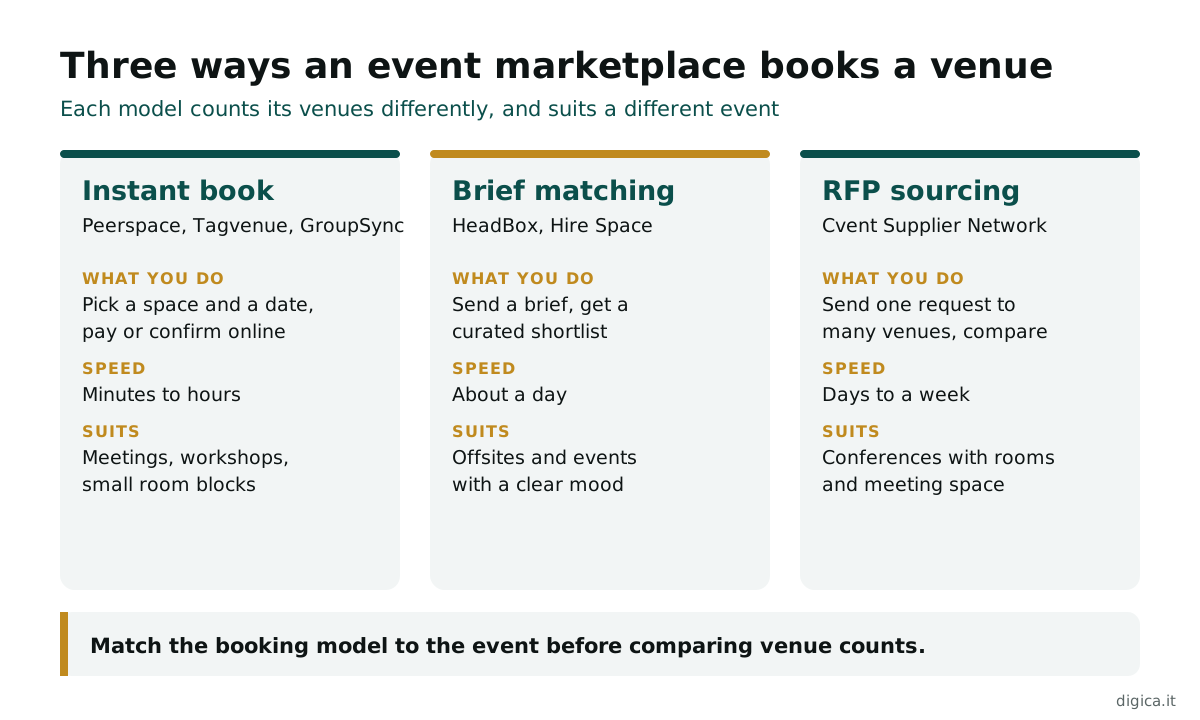
Event marketplaces sell three different kinds of inventory. Some list hotels and large venues and let a planner send one request to many of them, then compare proposals. Some list rooms and spaces that can be booked directly, sometimes instantly, often by the hour. And some take a brief, search a wider pool on the planner's behalf and come back with a shortlist.
Each model counts venues differently. An RFP network counts every property that can receive a request. An instant-book marketplace counts the spaces with live prices and calendars. A brief-matching service counts the venues it is able to search, which may include places that are not listed on its own site at all.
That is why the totals in this guide run from 22,000 to 340,000 and still do not rank the platforms. In our experience, the better question for any event marketplace is not "how many venues do you have?" but "how many venues that fit my headcount, my city and my date can confirm within a week?" A platform with 5,000 venues in your city beats one with 300,000 spread across the world.
Seven event and venue marketplaces compared
The short answer: Cvent Supplier Network has the largest venue and hotel network for RFPs, GroupSync the largest pool of instantly bookable group hotel rooms, Peerspace and Tagvenue the strongest self-serve inventory of bookable spaces, Hire Space and HeadBox the most hands-on sourcing, and LiquidSpace the widest spread of flexible meeting rooms.
Seven event and venue marketplaces compared by award, venue inventory claimed, coverage, booking model, main risk and best fit
| Marketplace | Award | Venue inventory claimed | Coverage | How booking works | Main risk | Best for |
|---|---|---|---|---|---|---|
| Cvent Supplier Network | Large conferences and RFPs | Nearly 340,000 hotels, resorts and venues | 14,000+ cities | One RFP to many venues, compare proposals | Slow for small, short-notice events | Conferences, incentives, multi-day meetings |
| Groups360 GroupSync | Group hotel blocks | 30,000 hotels, 1M+ rooms open for instant booking | 32,000 cities | Instant booking for small groups, RFP for larger | Hotel-led, fewer unique spaces | Room blocks for sales meetings and trainings |
| Peerspace | Spaces by the hour | 50,000+ unique spaces | US, Canada, UK, Australia, Europe | Hourly booking, all-inclusive venues in six cities | Inventory is creative spaces, not hotels | Workshops, launches, small offsites |
| Tagvenue | Self-serve UK venue hire | 22,000+ spaces | Six countries, UK strongest | Book direct with venue, many bookings instant | Smaller outside the UK | Meetings, parties and private dining |
| Hire Space | Managed enterprise sourcing | Venues in 12 cities | UK, US, Europe, Middle East, Asia | Instant quotes, one contract for every venue | Narrower city list | Enterprise events teams with programs |
| HeadBox | Offsites from a brief | Searches 100,000+ venues | UK, Australia, US | Submit a brief, receive a curated shortlist | Count is searchable, not listed | Offsites and away days |
| LiquidSpace | Flexible meeting rooms | 100,000+ workspaces | 120+ countries | Instant Book on partner spaces | Workspaces, not event venues | Meeting rooms and day offices |
Read the inventory column as three different measurements, not one ranking. The section on reading the venue counts explains why.
Best for large conferences and RFPs: Cvent Supplier Network
The short answer: when an event needs a hotel or convention venue with meeting space, catering and a block of rooms, Cvent Supplier Network has the deepest inventory and the most established RFP process.
Cvent, headquartered in Tysons, Virginia, was taken private by Blackstone in June 2023 at an enterprise value of about $4.6 billion. Its Supplier Network says it features nearly 340,000 hotels, resorts and special event venues, and Cvent's 2026 Top Meeting Destinations ranking evaluated more than 14,000 cities listed on the network, based on sourcing and RFP activity during 2025.
The booking model is the RFP. A planner shortlists venues, sends one request, then compares proposals side by side. Cvent says there is no commission and no fee for planners using the network. For a 300 person conference with breakout rooms and a room block, that is exactly what is needed: many qualified responses from hotels that already know the format.
The trade-off is pace. An RFP that waits on proposals from a dozen hotels is slower than booking a room online, and for a 15 person workshop next Thursday it is the wrong tool.
The award. Best for large conferences and RFP sourcing. If your event needs sleeping rooms and meeting space in the same place, start here and judge it on how many complete proposals come back within your deadline.
Best for group hotel blocks: Groups360 GroupSync
The short answer: GroupSync turns small group hotel bookings into an online checkout, with more than a million rooms open for instant booking.
Groups360, based in Nashville, Tennessee, runs the GroupSync Marketplace. Its homepage says GroupSync spans 30,000 hotels across brands including Marriott, Hilton, Choice, Wyndham and Omni, that more than a million guest rooms are open for instant booking today, and that planners can search 32,000 cities. It also says roughly 200,000 hotels can be reached by RFP in the same place.
The instant part is the point. When Wyndham rolled out GroupSync across 5,600 hotels, planners could book 10 to 50 rooms without contacting the hotel or running a traditional RFP. In October 2025 Hyatt said it would join for instant online booking, while noting that planners may still send an RFP for larger events.
Running an event or venue B2B marketplace?
In 30 minutes we look at where your venue supply is thin, city by city, and how planners find platforms like yours before they find you.
That split makes GroupSync a strong complement to an RFP network rather than a replacement. A sales team booking 25 rooms for a regional kickoff does not need ten proposals. It needs a confirmed rate and a booking reference before lunch.
The limit is the inventory type. GroupSync is hotel inventory. For a launch party in a gallery or a workshop in a loft, it is not where to look.
The award. Best for group hotel blocks. If your event is mostly about getting 10 to 50 people into the same hotel, test GroupSync first and send an RFP only when the group outgrows instant booking.
Best for spaces by the hour: Peerspace
The short answer: Peerspace has the largest self-serve pool of unique event and meeting spaces bookable by the hour, and it now sells some venues with food, drinks and staff in one price.
Founded in San Francisco in 2014, Peerspace says it connects guests with more than 50,000 unique spaces and, in a September 2026 announcement, that it had crossed $800 million in total booking value since launch. Its about page says more than 3 million people have used Peerspace locations. It runs country sites across the US, Canada, the UK, Australia and parts of Europe.
The newest change is its All Inclusive Venues: space, food, drinks and staff in one reservation, with one all-in price shown upfront rather than a contact form. Peerspace says they are live in New York, San Francisco, Los Angeles and London, with Chicago and Atlanta planned by the end of the year.
Peerspace's inventory skews toward lofts, studios, galleries and private rooms. That is a strength for a product launch, a team workshop or a client dinner where the room is part of the message. It is a weakness for a three-day meeting that needs bedrooms.
The award. Best for spaces by the hour. For events of 10 to 150 people that last an afternoon or an evening, Peerspace has the depth. Judge it on how many spaces in your city show availability for your date.
Best for self-serve UK venue hire: Tagvenue
The short answer: Tagvenue is the strongest self-serve venue marketplace for the UK, with instant booking on many listings and no booking fee.
Tagvenue started in London in 2015. Its about page says it now lists more than 22,000 spaces across six countries (the UK, Ireland, Australia, Singapore, Canada and the US), that more than 1,000,000 unique users visit each month, and that more than 40,000 events are booked through it every year.
Planners book directly with venue managers, and Tagvenue says its Stripe integration means many bookings happen instantly. It also says there are no booking or admin fees for the person booking. For a London office manager arranging a team dinner or a client breakfast, that combination of breadth and speed is hard to beat.
Inventory is the honest limit. 22,000 spaces is smaller than the global totals above, and the depth is concentrated in the UK. Outside its home market, check how many venues fit your headcount before you rely on it.
Do planners find your venue marketplace first?
A growth audit maps how planners search for venues, on Google and in AI answers, and which of your city and event-type pages they never reach.
The award. Best for self-serve UK venue hire. If your events are in UK cities and under about 200 guests, start with Tagvenue and filter on instant booking. Self-serve only works when the venue manager answers quickly, so judge Tagvenue on how many of your enquiries turn into confirmed bookings within a day. For a team that books the same kinds of rooms every month, that reply rate matters more than the total number of spaces listed.
Best for managed sourcing and offsites: Hire Space and HeadBox
The short answer: both are London-born venue platforms that will do the searching for you, Hire Space for enterprise events programs and HeadBox for offsites and away days built from a brief.
Hire Space calls itself a venue platform for business events. Its homepage says it is trusted by more than 800 enterprise events teams and that more than £100 million of events, about $127 million, are booked through it each year. It lists venues in 12 cities, from London, Manchester and Edinburgh to New York, Paris, Dubai, Tokyo, Singapore and Sydney. The booking pitch is speed and simplicity: an instant quote in about 10 seconds and one contract for every venue. Its concierge service is free for events of 100 or more people, budgets above £10,000 (about $12,700) or ongoing programs.
HeadBox says it has helped more than 100,000 bookers find venues. A planner submits a brief, and HeadBox combines software and human expertise to search more than 100,000 venues globally, then returns a curated shortlist. It marked its tenth anniversary in 2025, operates in the UK, Australia and the US, and launched in New York with Washington and San Francisco planned.
The two counts mean different things. Hire Space describes cities where it has venues and the value it books. HeadBox describes the venues it can search for you, which is a wider and looser number than spaces listed on its own site.
Managed sourcing is really a trade of planner time. The US Bureau of Labor Statistics counted about 172,100 meeting, convention and event planner jobs in 2025, with a median pay of $61,160 and 6% projected growth from 2025 to 2035. Every hour a planner spends chasing venue replies is an hour not spent on the program itself, which is the case these two services make.
The awards. Hire Space is best for managed enterprise sourcing, for a team running dozens of events a year that wants one contract and one supplier. HeadBox is best for offsites from a brief, for a team that knows the mood and the headcount but not the venue.
Best for flexible meeting rooms: LiquidSpace
The short answer: LiquidSpace is not an event venue marketplace in the traditional sense, but for meeting rooms, project rooms and day offices it has the widest spread on this list.
LiquidSpace, based in the San Francisco Bay Area, says it offers more than 100,000 workspaces in more than 120 countries, sourced and billed through one platform, from a desk for an afternoon to a meeting room for a week. In January 2026 it expanded its partnership with Industrious, which runs more than 250 locations in more than 65 cities, so LiquidSpace users can use Instant Book on thousands of Industrious spaces.
Its chief executive described Instant Book as being about speed and certainty, and that is the case for using it. A distributed team that needs a room for an eight person planning day in a city where nobody has an office can confirm one in minutes, on the company account.
The limit is the type of space. Workspaces rarely suit a dinner, a launch or anything with catering beyond coffee.
The award. Best for flexible meeting rooms. If your business events are mostly small working sessions in many cities, LiquidSpace's global reach is the reason to use it.
Listed, searchable or bookable: reading the venue counts
The seven inventory figures in this guide measure three different things. Some count venues that can receive a request, some count spaces that can be booked directly, and some count venues the platform will search for you. Mixing them up is how a planner picks the wrong platform.
Cvent's nearly 340,000 and GroupSync's 200,000 by RFP are request-ready inventory: properties that can answer a proposal. GroupSync's 30,000 hotels with instant booking, Peerspace's 50,000 spaces, Tagvenue's 22,000 and LiquidSpace's 100,000 workspaces are closer to bookable inventory. HeadBox's 100,000 is searchable inventory. None of these numbers is wrong. Each is the number that suits the model.
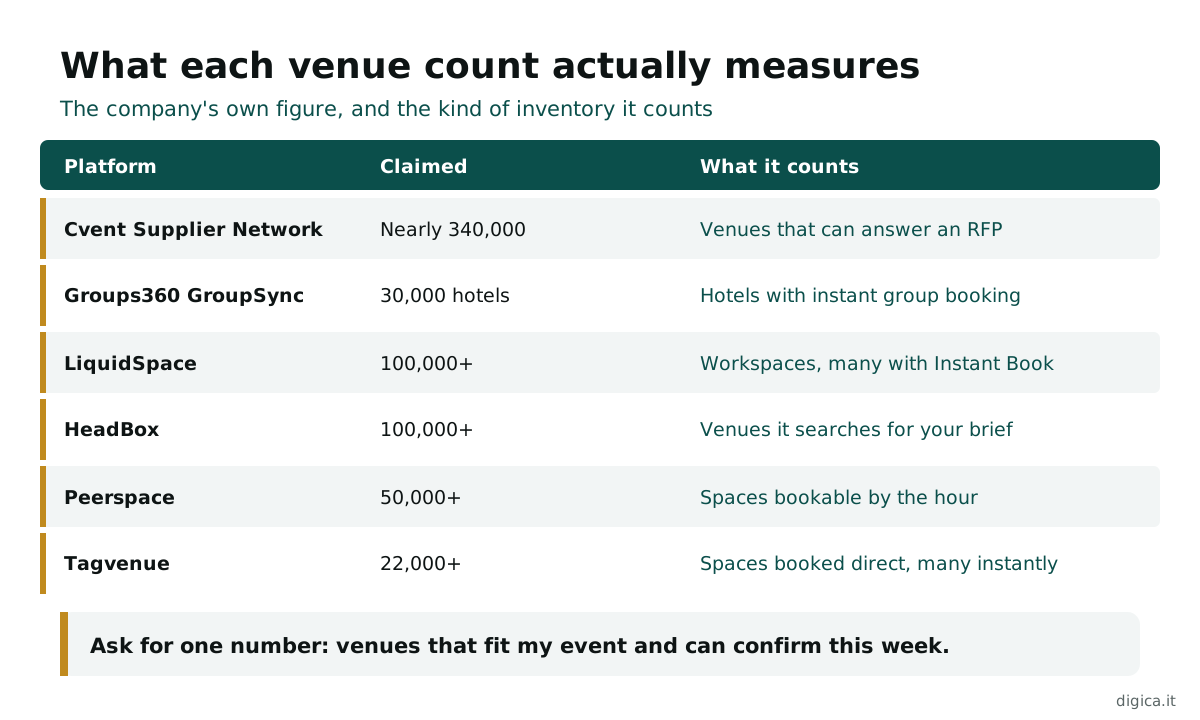
The fix is to turn every count into the same three questions. How many venues fit my headcount in my city? How many can confirm my date this week? How many can I book without waiting for a call back? Ask the platform to show you that number for one real event, and the comparison becomes fair.
There is a supply lesson here too, for anyone building one of these platforms. Planners judge an event marketplace on the venues they see for their city and date, not on the total on the homepage. A marketplace with deep supply in 10 cities often wins against one with thin supply in 100.
Three failure scenarios
These are the patterns that recur when a company chooses an event marketplace on the headline venue count.
- The small meeting sent as an RFP. A team assistant uses a large RFP network to find a room for a 12 person quarterly review, then waits days for hotel proposals that all quote full-day meeting packages. An hourly marketplace would have confirmed a room the same afternoon at a fraction of the effort.
- The conference booked one room at a time. A sales operations lead books a 40 person regional kickoff through a space-by-the-hour marketplace, then has to find hotel rooms for everyone separately. A group hotel booking would have put the meeting room and the room block under one confirmation.
- The global count with a thin local pool. An events team picks the platform with the largest total and finds only a handful of options in its chosen city that fit 150 guests on its date. Checking local inventory for that headcount before committing would have pointed it to a platform with deeper supply there.
Each team read a real number. Each read it as an answer to a question it was not asking.
Which event marketplace fits which event
The short answer: decide by the shape of the event first, then by how fast you need a confirmed date. These decision points make it specific.
- If the event needs sleeping rooms for more than 50 people, send an RFP through Cvent Supplier Network and compare complete proposals.
- If you need a block of 10 to 50 hotel rooms, try GroupSync's instant booking before you send any RFP.
- If the event lasts a few hours and the room is part of the message, search Peerspace in the US or Tagvenue in the UK and filter on instant booking.
- If you run more than 20 events a year and want one contract, talk to Hire Space about managed sourcing.
- If you know the mood and headcount but not the venue, send a brief to HeadBox and judge the shortlist.
- If you need small meeting rooms in many cities, use LiquidSpace on the company account.
Growing an event or venue B2B marketplace?
We help event and venue B2B marketplaces build the venue supply and planner demand that make a city worth searching.
The number to take into your next planning meeting is the gap between hours and days. A small meeting booked through an instant-book marketplace can be confirmed in an afternoon, while an RFP for a conference can take a week of proposals. The American Express Global Business Travel 2026 meetings and events forecast found that 85% of event professionals are optimistic about the year ahead, up from 74%, so venue demand is not getting quieter. Hire Space alone books more than $127 million of events a year. The biggest cost of doing nothing is running every event through one sourcing channel, and paying for it in planner hours, lost dates and venues that never fit.
FAQ
What is an event marketplace? An event marketplace is a B2B marketplace where companies find, compare and book venues and event spaces for meetings, offsites, conferences and parties. Examples include Cvent Supplier Network for RFPs, Peerspace and Tagvenue for spaces by the hour, and GroupSync for group hotel rooms.
What is the difference between a venue marketplace and a venue finding agency? A venue marketplace lets you search and book listed spaces yourself, often instantly. A venue finding service takes your brief and searches on your behalf. Hire Space and HeadBox offer both, which is why they suit teams that want help without giving up control.
Which venue marketplace has the most venues? Of the platforms in this guide, Cvent Supplier Network claims the largest network, with nearly 340,000 hotels, resorts and special event venues. That count is RFP-ready inventory, not spaces you can book instantly.
Can you book a group of hotel rooms online without an RFP? Yes. GroupSync says more than a million guest rooms at 30,000 hotels are open for instant booking, and Wyndham's rollout let planners book 10 to 50 rooms without contacting the hotel. Larger events usually still go through an RFP.
What is the best site to book a meeting room by the hour? For creative event and meeting spaces, Peerspace in the US and Tagvenue in the UK have the deepest bookable inventory here. For plain meeting rooms and day offices in many countries, LiquidSpace has the widest spread.
How many business events happen each year? The Events Industry Council and Oxford Economics counted 1.65 billion business event participants across more than 180 countries in 2025, supporting 9.7 million direct jobs.
Related Articles
- Event and venue B2B marketplace growth
- Best B2B marketplaces in 2026: seven examples by industry
- Best B2B and business communities to join in 2026
- How to attract vendors to a B2B marketplace
- Liquidity is the only marketplace metric that compounds
Where this connects
This article is part of our B2B marketplace growth series. Browse more on the Digica blog.