The best fabric and textile marketplaces for brands in 2026, grouped by type and judged on minimum order quantities
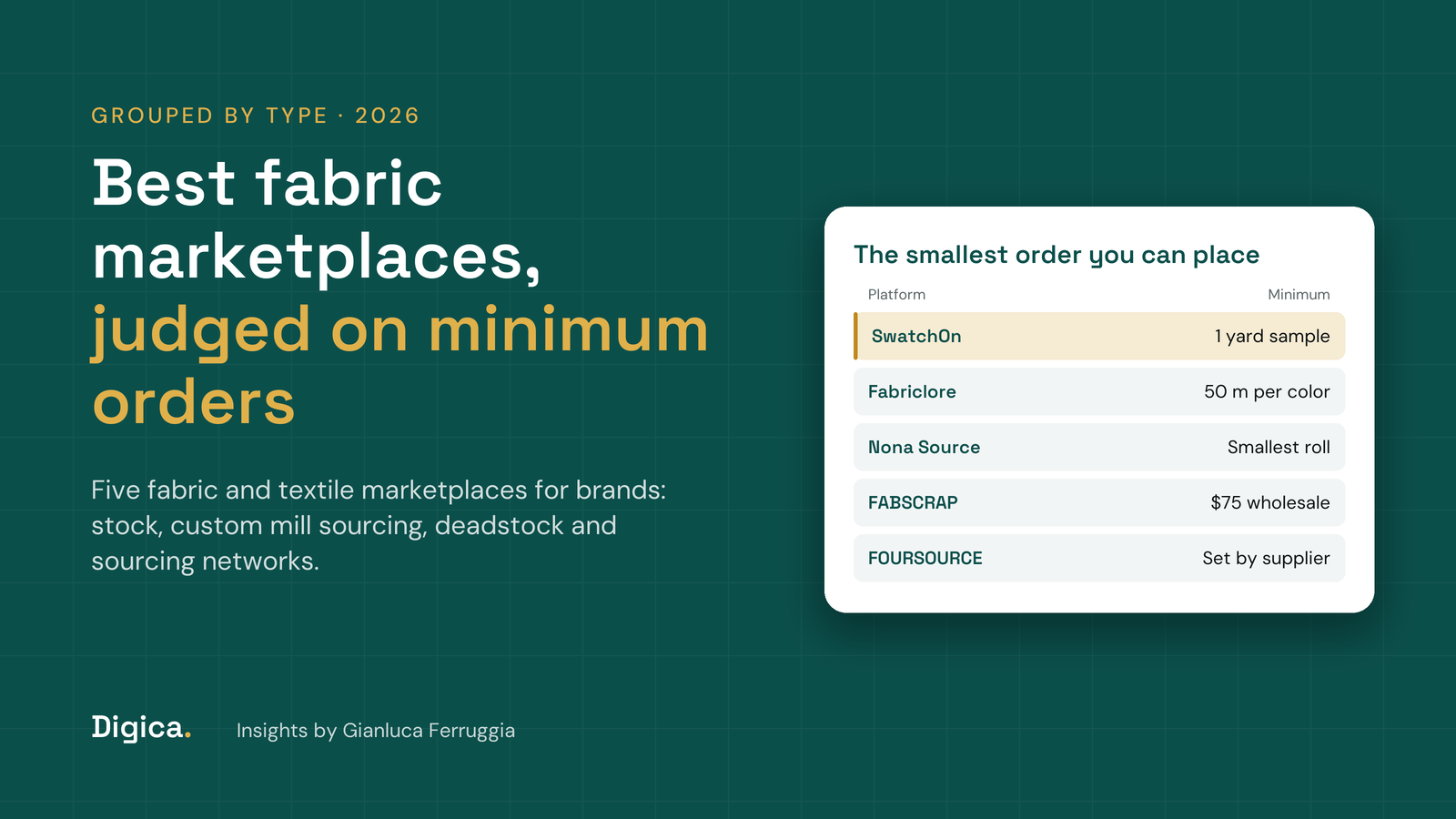
For a small fashion brand, the minimum order quantity decides more than the price. A mill that asks for 500 meters per color can make a 50-piece capsule impossible before the first sketch. A fabric marketplace that sells from 1 yard, or 50 meters per color, turns the same collection into something a brand can test, sell and reorder. The difference is not a discount. It is whether the product exists.
The market behind those orders is enormous and still growing. Global fiber output rose from 125 million tonnes in 2023 to 132 million tonnes in 2024, and recycled fibers held a 7.6% share, according to Textile Exchange's Materials Market Report 2025 (EU Transition Pathways). Most of that volume moves in large mill orders. The platforms in this guide exist to serve the brands that cannot buy that way.
This guide groups five fabric and textile marketplaces by type, stock fabric, custom mill sourcing, deadstock and sourcing networks, and judges each on its minimum order quantity: what the smallest order is, how sampling works and who that suits. It is written for brands and designers choosing where to buy, and for founders growing a textile B2B marketplace. Figures are each company's own, checked on October 30, 2026.
Quick Navigation
- What counts as a fabric marketplace
- Five fabric marketplaces compared on minimum orders
- Stock fabric marketplaces: SwatchOn
- Custom mill sourcing at low minimums: Fabriclore
- Deadstock and surplus: Nona Source and FABSCRAP
- Sourcing networks and fashion directories: FOURSOURCE
- Why minimum order quantities decide the shortlist
- Three failure scenarios
- Where to buy fabric first: a decision framework
- FAQ
- Related Articles
What counts as a fabric marketplace
The short answer: a fabric marketplace is a platform where brands and designers find and buy fabric from many mills, suppliers or surplus sources in one place. A single mill's webshop does not count, and neither does a consumer craft store.
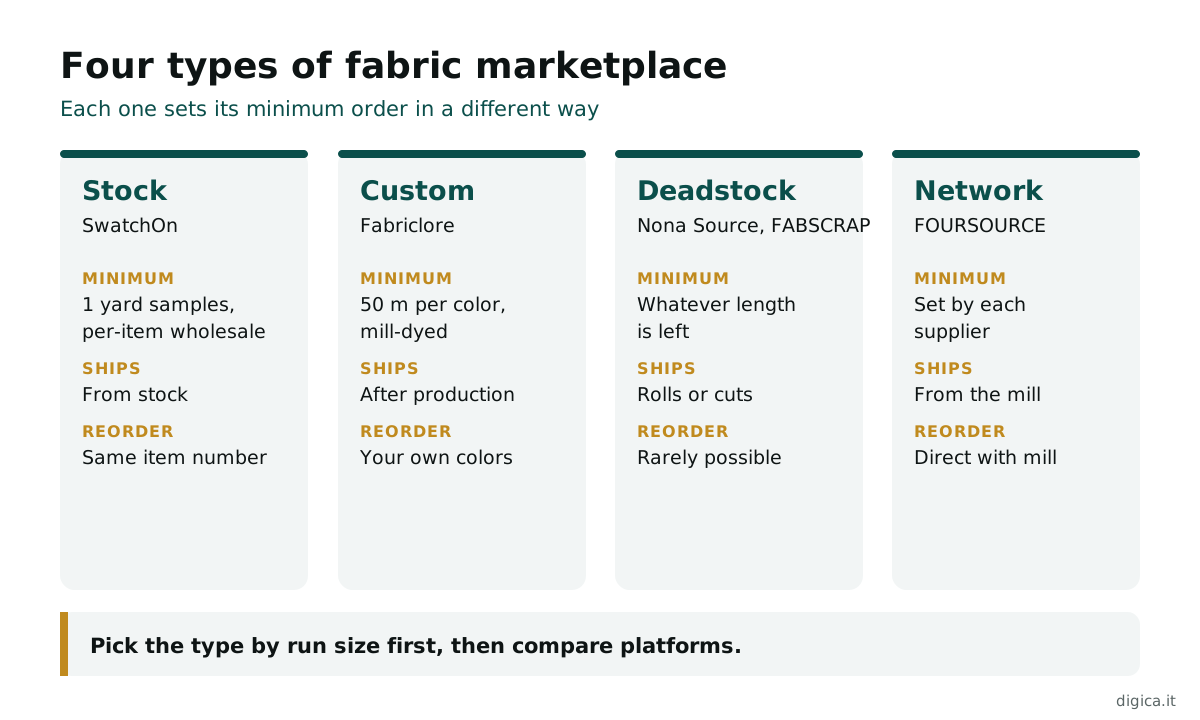
Four types matter to a brand buying for production. Stock fabric marketplaces sell ready-made fabrics that ship from inventory, often from a single yard. Custom sourcing platforms take an order to a mill and have it dyed, printed or woven to the brand's specification, at a lower minimum than the mill would accept directly. Deadstock platforms resell surplus fabric from fashion houses and mills, in whatever lengths are left. Sourcing networks and fashion directories connect buyers with suppliers and leave the order to them.
All four are B2B marketplaces. Mills and surplus holders are one side, brands are the other, and the platform earns its keep by making small orders worth both sides' time. The tests we apply to every B2B marketplace apply here: how much supply it carries, whether buyers really order through it and how well it matches the two.
A textile marketplace is the same thing seen from the trade side. Some platforms in the wider textile category serve mills buying yarn or fiber, which is a different buyer. This guide sticks to platforms that serve brands buying finished fabric.
Our view: judge a fabric marketplace on its minimum order first and its catalog size second. A catalog of 20,000 fabrics is no use to a brand if none of them can be bought in the quantity it needs.
Five fabric marketplaces compared on minimum orders
The short answer: SwatchOn has the lowest entry point for stock fabric, Fabriclore the lowest minimum for custom-dyed fabric, Nona Source the strongest luxury deadstock, FABSCRAP the cheapest US surplus and FOURSOURCE the widest supplier network for brands ready to buy at mill volume.
Five fabric and textile marketplaces compared on type, smallest order, sampling, main risk and best fit
| Marketplace | Type | Smallest order | Sampling | Main risk | Best for |
|---|---|---|---|---|---|
| SwatchOn | Stock fabric | Sample yardage from 1 yard, wholesale minimum per item | Swatch books for 1 to 3 credits | Wholesale minimums vary by item | Designers testing and reordering stock fabric |
| Fabriclore | Custom mill sourcing | From 50 meters per color for mill-dyed fabric | Sampling before bulk | Lead time for custom work | Brands that need their own colors at low volume |
| Nona Source | Luxury deadstock | No minimum, but the smallest roll on the product page | Samples ordered online | Rolls only, shipping costly for small orders | European brands buying limited luxury runs |
| FABSCRAP | Surplus, non-profit | Single cuts online, $75 minimum for wholesale | Buy small cuts first | Stock is one-off and mixed | US designers making samples and capsules |
| FOURSOURCE | Sourcing network | Set by each supplier | Through the supplier | No platform-wide minimum or checkout | Brands ready to buy at mill volume |
Every figure is the company's own, and minimums change by fabric, color and process. Use the table to pick where to look first, then check the product page before you plan a collection around it.
Stock fabric marketplaces: SwatchOn
The short answer: SwatchOn is a stock fabric marketplace for fashion brands and independent designers, with sample yardage from 1 yard and wholesale minimums shown on each fabric. It is the easiest place in this guide to test a fabric before committing.
SwatchOn is based in Seoul and describes itself as an online wholesale fabric marketplace for fashion brands and independent designers. Its homepage lists 20,000+ fabrics from 300+ verified mills. Catalog colors ship from stock, so there is no production wait, and a brand can reorder the same item number later.
The minimum order works in two steps. Sample yardage starts at 1 yard. Wholesale has its own minimum per item, shown in each fabric's price table along with price steps, so the price per yard falls as the order grows. Swatch books holding every color of a fabric cost 1 to 3 credits, swatch shipping is 3 credits per order with 3 to 5 days estimated delivery, and SwatchOn adds 20 credits once a company completes its profile.
Running a fabric or textile B2B marketplace?
In 30 minutes we look at how brands and designers find platforms like yours, on Google and in AI answers, and where they drop off before they order a sample or a first bulk run.
That structure suits the way a small brand develops a collection: swatch, sample, then a modest bulk order, then a reorder of what sold. The trade-off is that stock means somebody else chose the colors. A brand that needs its own shade has to move to custom sourcing, at a higher minimum and a longer lead time.
Best for: designers and small brands that want to touch, test and reorder fabric without negotiating with a mill.
Custom mill sourcing at low minimums: Fabriclore
The short answer: Fabriclore takes custom fabric orders to mills in India at minimums well below what mills ask directly, from 50 meters per color for mill-dyed fabric. It suits brands that need their own colors at small volume.
Fabriclore is a Jaipur-based fabric sourcing platform that says it has partnered with more than 400 fashion businesses and serves more than 20 countries. Its pitch is custom fabric sourcing at low minimums. In its own words, traditional vendors typically demand a minimum of 500 meters per color, while Fabriclore allows orders as low as 50 meters per color for mill-dyed fabric.
Fabriclore also says it bills only the meters actually delivered, so a brand that receives 95 meters of a 100-meter order pays for 95. That matters more than it sounds. Dyeing and finishing always lose some length, and on a small order the gap can be a meaningful share of the cost.
Minimums differ by process. Printed and hand-block fabrics carry different minimums from mill-dyed ones, and a brand should confirm the figure for its exact fabric and method before costing a collection. The trade-off for low volume is time: custom work means a production slot, not a parcel from stock.
Best for: brands with their own color story and a run too small for a mill, typically under a few hundred meters per color.
Deadstock and surplus: Nona Source and FABSCRAP
The short answer: deadstock platforms sell what fashion houses and mills have left over, so the minimum is whatever length is available. Nona Source sells luxury deadstock to professional buyers in Europe, and FABSCRAP sells surplus from US brands by the cut.
Nona Source
Nona Source is a Paris-based platform backed by LVMH that resells deadstock fabric and leather from luxury houses. In June 2026 LVMH said Nona Source had passed 20,000 orders in 2025, served more than 2,500 clients in 50 countries and sourced deadstock from more than 25 luxury Maisons.
Its minimum order is unusual. Nona Source says there is no minimum quantity, but because it does not cut fabric, the minimum is the smallest length available on each product page. Fabric ships on rolls, and the company notes that transport can be costly for small orders. Sales are reserved for professional buyers with a company registration number, and it ships to the EU, UK, Switzerland, Norway and Serbia.
FABSCRAP
FABSCRAP is a New York non-profit that collects production scraps, headers, swatches and unused yardage from brands and resells or recycles it. It says it has diverted more than 2.2 million pounds of textiles from landfill. Its online shop sells individual cuts by the yard, and wholesale buying happens by virtual appointment, with a $75 minimum order plus shipping.
That makes FABSCRAP the lowest-cost entry in this guide for US designers, and the least predictable. Every cut is a one-off, so it suits samples, capsule pieces and limited runs, not a style the brand expects to reorder.
Best for: Nona Source for brands that want a limited run in luxury fabric; FABSCRAP for US designers sampling and making small capsules on a tight budget.
Sourcing networks and fashion directories: FOURSOURCE
The short answer: FOURSOURCE is a sourcing network where brands find and contact fabric and apparel suppliers, with minimums set by each supplier. It is a fashion directory for brands ready to buy at mill volume, not a checkout for small orders.
FOURSOURCE is a Hamburg-based platform launched in 2017. It says it is trusted by 55,000+ companies and hosts virtual showrooms for 1,000+ suppliers, with a fabrics network covering woven, non-woven, knit, cotton, linen, hemp, silk and lace. Suppliers pay one-time fees to join, and buyers can try it for free.
The minimum order is the supplier's, not the platform's. That is the trade-off of a sourcing network: far more choice than a marketplace that holds stock, and no single rule on quantities. For a brand ordering a few thousand meters a season, that choice is the point. For a brand ordering 50 meters, most suppliers on a network will not be the right fit.
Best for: growing brands moving from small runs to direct mill relationships, and buyers comparing suppliers across countries.
Why minimum order quantities decide the shortlist
The short answer: the minimum order decides whether a collection can be made at all, how much cash it ties up and how much stock is left when it sells through. Price per meter comes after.
Run the arithmetic on one fabric. A brand needing 60 meters for a capsule faces a 500-meter mill minimum: it buys 440 meters it does not need, and carries them as stock or writes them off. At $8 a meter, that is $4,000 spent for $480 of fabric used, with $3,520 sitting on a shelf. The same brand at a 50-meter minimum buys what it uses: 60 meters at $12 a meter is $720. A lower price per meter at the mill rarely makes up for paying for eight times the fabric.
Do brands find your fabric marketplace before a rival's?
A growth audit maps how designers and sourcing teams search for fabric and textile marketplaces like yours, on Google and in AI answers, and which of your fabric, mill and category pages they never reach.
Regulation is pushing the same way. The EU's revised Waste Framework Directive entered into force on October 16, 2025 and introduces common rules for extended producer responsibility for textiles (EU Transition Pathways). The EU generated about 12.6 million tonnes of textile waste in 2019, and only one fifth of it was collected separately for reuse or recycling. As producers start to pay for what they put on the market, overbuying fabric becomes a cost twice: once at purchase and again at disposal.
Low minimums do carry a price. Small orders usually cost more per meter, sampling takes credits or fees, and shipping a short roll can cost more than the fabric. The useful question is total cost per finished garment, including the fabric you do not use.
Three failure scenarios
These are the patterns that recur when brands choose where to buy fabric on catalog size or price per meter alone.
- The mill minimum that became inventory. A new brand orders 500 meters per color from a mill to get the best price per meter, for a first collection that needs 120. The rest sits in storage for two seasons and is sold at a loss, and at $8 a meter the unused 380 meters per color tie up about $3,000 each. A custom sourcing platform at a 50-meter minimum would have cost more per meter and far less in total.
- The deadstock hit that could not be reordered. A brand builds its bestselling dress in a luxury deadstock fabric and sells out in a month. There is no more of it, and the style is gone. Using deadstock for limited pieces, and a stock or custom fabric for styles meant to repeat, would have kept the bestseller in the range.
- The directory treated as a shop. A designer signs up to a large sourcing network expecting to order 40 meters, and spends a month messaging suppliers whose minimums start in the thousands. A stock fabric marketplace would have shipped the same quantity within a week.
Each brand used a real fabric marketplace. None of them matched the platform's minimum order to the size of the run.
Where to buy fabric first: a decision framework
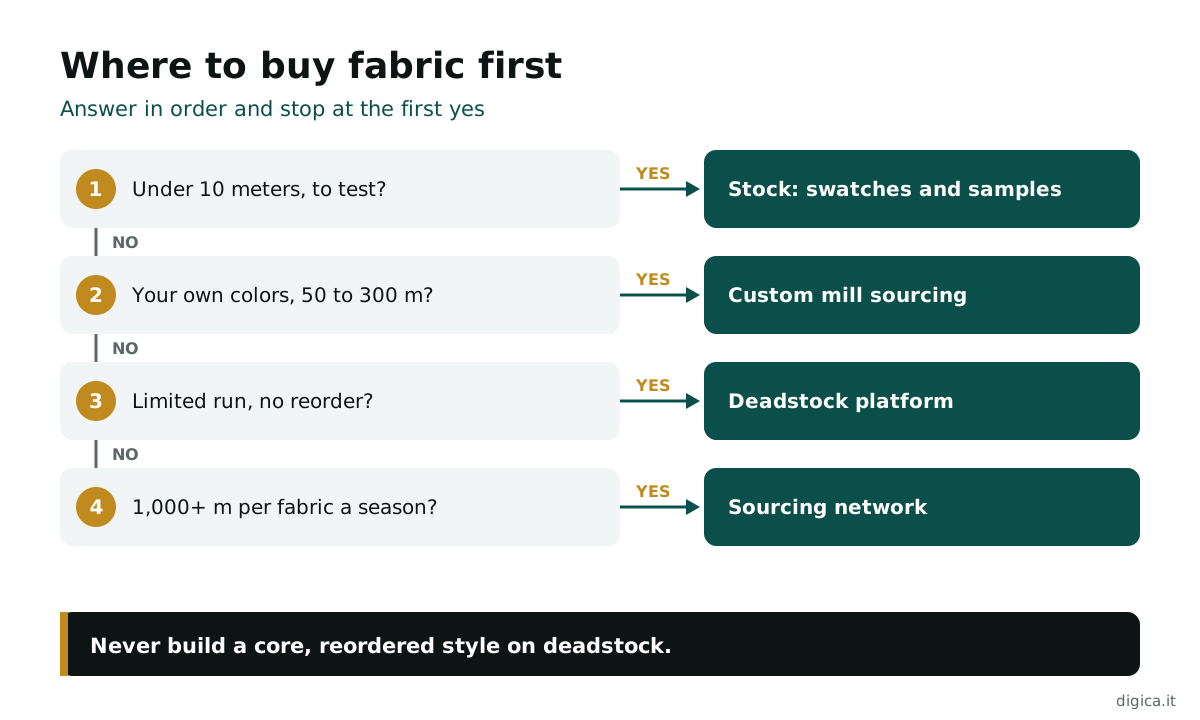
The short answer: start from the quantity per color and whether the style must repeat, then choose the type of platform.
- If you need under 10 meters to test a fabric, order swatches and sample yardage from a stock fabric marketplace such as SwatchOn.
- If you need your own colors at 50 to 300 meters per color, use a custom sourcing platform such as Fabriclore, and confirm the minimum for your exact process.
- If the run is limited and will not repeat, buy deadstock: Nona Source in Europe for luxury fabric, FABSCRAP in the US for low-cost cuts.
- If you order more than about 1,000 meters per fabric each season, use a sourcing network such as FOURSOURCE to build direct mill relationships.
- If a style is a core product you expect to reorder, never build it on deadstock.
- If a platform cannot tell you the minimum for a specific fabric before you sign up, treat its catalog size as marketing.
Growing a textile or fashion B2B marketplace?
We help textile and fashion B2B marketplaces recruit the mills and suppliers that make small orders possible, and reach the brands and designers comparing them.
Pressure on brands to buy carefully is rising. McKinsey and The Business of Fashion's State of Fashion 2026 found that 46% of fashion executives expect industry conditions to worsen in 2026, up from 39%, and 71% expect to raise prices (FashionUnited). In that market, every meter bought and not used is margin given away.
The number to take into your next sourcing meeting is fabric bought per garment sold, not price per meter. If a brand pays $8 a meter at a 500-meter minimum but uses 120, its real cost is about $33 a meter used, against perhaps $12 a meter at a 50-meter minimum. The biggest cost of doing nothing is a storeroom full of fabric that was cheap per meter and expensive in total.
FAQ
What is a fabric marketplace? A fabric marketplace is a platform where brands and designers buy fabric from many mills, suppliers or surplus sources in one place. Types include stock fabric marketplaces, custom sourcing platforms, deadstock platforms and sourcing networks.
What is a typical minimum order quantity for fabric? Mills often ask for several hundred meters per color. Fabriclore says traditional vendors typically demand 500 meters per color, against its own minimum of 50 meters for mill-dyed fabric. Stock fabric marketplaces such as SwatchOn sell sample yardage from 1 yard.
Where can small brands buy fabric with no minimum order? Deadstock platforms come closest. Nona Source has no minimum quantity beyond the smallest roll listed, and FABSCRAP sells single cuts online. For fabric you can reorder, SwatchOn's sample yardage from 1 yard is the lowest stock option in this guide.
What is deadstock fabric? Deadstock fabric is surplus fabric left over from fashion houses, mills and manufacturers, sold on rather than wasted. It is usually available in limited lengths, so it suits samples and limited runs rather than styles a brand plans to reorder.
Is a textile marketplace the same as a fashion directory? Not quite. A textile marketplace handles the order, and sometimes sampling and delivery. A fashion directory or sourcing network, such as FOURSOURCE, helps buyers find and contact suppliers, and the order and minimum are agreed with each supplier.
How do fabric marketplaces make money? Most earn a margin or commission on fabric sold, and some charge for samples or swatches. Sourcing networks often charge suppliers to join instead: FOURSOURCE charges suppliers one-time fees, and buyers can start for free.
Related Articles
- Textile marketplace growth: fabric and fashion sourcing
- Best wholesale marketplaces for retailers in 2026
- Best manufacturing directories: Thomasnet alternatives
- Best supplier databases and directories for B2B in 2026
- How to attract vendors to a B2B marketplace
Where this connects
This article is part of our B2B marketplace growth series. Browse more on the Digica blog.