The best manufacturing directories in 2026: Thomasnet alternatives, grouped by region
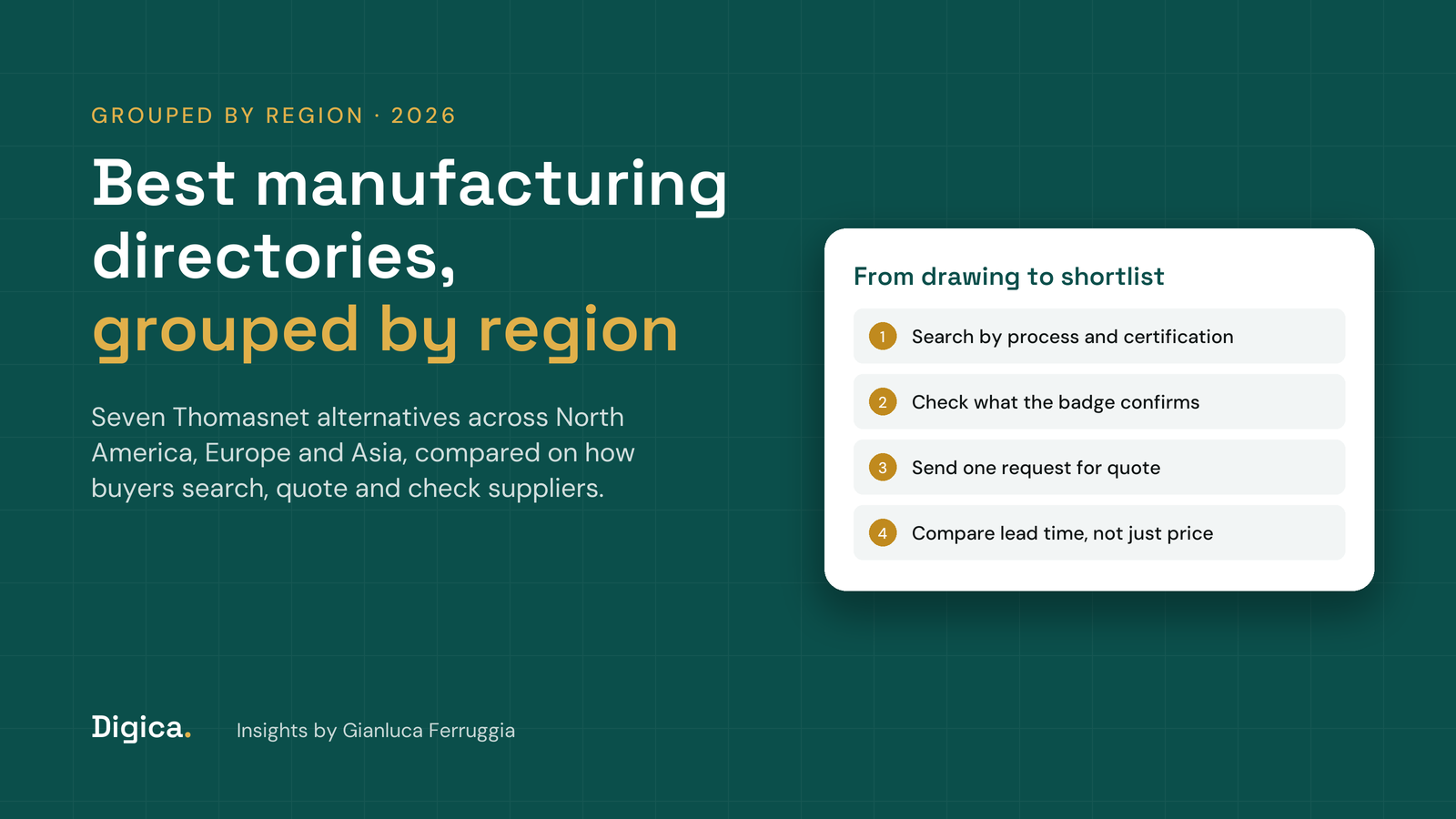
A manufacturing directory is where an engineer or buyer goes to find a shop that can make a part, and the best ones now do far more than list names. They let you search by process and certification, send one request for quote to many suppliers, and see who has been checked before you call. The gap between a directory that does this and one that does not is days of sourcing work on every new part.
That work has grown. In the National Association of Manufacturers' first-quarter 2026 survey, 54.6% of manufacturers said they rely on Canada or Mexico for critical parts, and 70.6% named trade uncertainty as their top challenge (NAM). When tariffs or lead times move, buyers go looking for a second source fast, and the directory they search decides which shops they find.
This guide groups seven manufacturing directories and Thomasnet alternatives by region and type: North American sourcing directories, on-demand manufacturing networks, European industrial directories and an Asian sourcing platform. For each, it covers how a buyer searches by capability, how requests for quote work, and how suppliers are checked. Figures are each company's own, checked on October 27, 2026. If you are comparing data sources rather than search tools, see our ranking of supplier databases.
Quick Navigation
- How buyers find a manufacturer online
- Seven manufacturing directories, side by side
- North America: Thomasnet and IndustryNet
- On-demand manufacturing networks: Xometry and MFG.com
- Europe: Europages and Kompass
- Asia: Made-in-China.com
- Directory or on-demand network: which model fits the part
- How each manufacturer directory checks its suppliers
- Three failure scenarios
- Which industrial directory to use: a decision framework
- FAQ
- Related Articles
How buyers find a manufacturer online
The short answer: buyers search by what a supplier can do, not by its name. A good manufacturing directory lets them filter by process, material, certification and location, then contact a shortlist in one step.
A buyer looking for a second source for a machined aluminum housing does not know which shop to call. They know the process, the tolerance, the volume and the certification the customer requires, such as AS9100 for aerospace or ISO 13485 for medical devices. The directory's job is to turn those four facts into a shortlist of shops worth asking.
Three features decide whether it does that job well. The first is capability search: can you filter by process and certification, or only by keyword? The second is the request for quote (RFQ): can one request reach several qualified suppliers, or do you email each one? The third is verification: has anyone checked that the shop exists, holds the certificates it lists and still makes what it says it makes?
Our view: a directory with a million listings and no capability filters is slower than one with 50,000 listings and good ones. Judge a manufacturer directory by how quickly it turns a drawing into three credible quotes.
Seven manufacturing directories, side by side
The short answer: Thomasnet and IndustryNet are the North American search tools, Xometry and MFG.com turn a drawing into quotes, Europages and Kompass cover Europe and beyond, and Made-in-China.com is the audited route to Chinese factories.
Seven manufacturing directories compared on region, search, RFQ, verification, supplier cost, main risk and best fit
| Directory | Region and type | How buyers search | RFQ to many suppliers | How suppliers are checked | What suppliers pay | Main risk | Best for |
|---|---|---|---|---|---|---|---|
| Thomasnet | North America, directory | 80,000+ categories, filters for certification and location | Yes, quotes from several suppliers in one step | Thomas Registered and Thomas Verified badges | Free profile, paid programs by quote | Paid placement shapes the order of results | Large US and Canadian supplier search |
| IndustryNet | US, directory | 11,000+ products and services, local or nationwide | Yes, one form to all matching suppliers | Data verified by MNI researchers | Free Basic, $264 or $449 a year per category per state | US only | Domestic shortlists on a small budget |
| Xometry | US-led global network | Upload a CAD file for an instant price | Not needed, Xometry assigns the supplier | Platform holds AS9100D, ISO 13485, ITAR and more | Suppliers apply and are paid per job | You do not choose the shop | Fast custom parts with one accountable seller |
| MFG.com | Global RFQ marketplace | 40+ processes, five sourcing regions | Yes, or instant pricing on eligible parts | MFG Verified tier shown separately | Pay per RFQ or Premium | Quote quality varies by shop | Competing quotes on drawings |
| Europages | Europe, directory | 111 sectors, keyword or category | Yes, routed to matching suppliers | Some listings marked verified, method not published | Free profile, paid premium | Verification is unclear | Cross-border European sourcing |
| Kompass | Europe-led, 70+ countries | 7-digit product codes | Contact by supplier | Company data, coded by Kompass | Free listing, paid Booster | Prices and verification not published | Precise product-code search across countries |
| Made-in-China.com | China, export platform | 6,300+ categories, 16 languages, image search | Yes, one request, multiple quotes | Premium suppliers audited on site by SGS, Bureau Veritas or TÜV Rheinland | Paid Gold and Diamond memberships | China only, longer lead times | Volume production with audit reports |
Supplier totals are each platform's own claim, and they count different things: listings, registered members or active partners. Compare the search and verification columns before the size of the catalog.
North America: Thomasnet and IndustryNet
The short answer: Thomasnet is the largest North American manufacturer directory and the one most Thomasnet alternatives are measured against. IndustryNet is the leaner option, with published prices and a single quote form.
Thomasnet
Thomasnet lets buyers search and filter more than 500,000 US suppliers across more than 80,000 industrial categories, and it has been in the business for over 125 years. Buyers filter by location, quality certification and company type, review profiles with catalogs and capabilities, build shortlists, and request quotes from several suppliers in one step.
Do buyers find your manufacturing directory before Thomasnet?
A growth audit maps how engineers and buyers search for suppliers in your categories, on Google and in AI answers, and which of your capability and category pages they never reach.
Verification comes in two badges. Thomas Registered confirms contact details and structured data. Thomas Verified goes further: the Thomas supplier analyst team confirms the business operates in North America, its information is accurate and its products and services have been reviewed. Buyers can filter results to verified suppliers only, which is the fastest way to cut a long list.
One disclosure matters here. Thomasnet has been owned by Xometry since December 2021, so two of the platforms in this guide share an owner. Suppliers can create a free profile; paid programs that raise visibility in category searches are sold by quote.
IndustryNet
IndustryNet says it lets buyers search more than 350,000 verified manufacturers and suppliers across more than 11,000 products and services. It is run by MNI, which has researched US manufacturers since 1912. Buyers can search locally or nationwide without registering, and one quote form goes to every qualified supplier that matches the request. A free account adds phone numbers, addresses, saved searches and private vendor lists.
IndustryNet is also the rare manufacturing directory that publishes its prices. A Basic listing is free, covering one category in the supplier's home state. Preferred costs $264 a year and Featured $449 a year, each per category per state, with Featured listings ranked first. For a small US job shop, that is the cheapest way in this guide to test paid visibility.
On-demand manufacturing networks: Xometry and MFG.com
The short answer: these platforms start from your drawing, not from a supplier list. Xometry prices the part and assigns a shop itself; MFG.com sends your RFQ to competing manufacturers or prices eligible parts instantly.
Xometry
Xometry's instant quoting engine prices a part from an uploaded CAD file in 14 formats, including STEP and STL, across 38 listed capabilities from CNC machining to injection molding. Xometry is the seller of record, so the buyer deals with one company and Xometry manages the shop that makes the part. It holds ISO 9001:2015, ISO 13485:2016, AS9100D, IATF 16949:2016 and ITAR registration, among others.
The network is growing. Xometry reported 81,821 active marketplace buyers at the end of 2025, up 20%, and 4,996 active suppliers, up 17%, with marketplace revenue of $630 million, up 30%. It has also expanded supplier sourcing into Europe, China, India and Turkey.
The trade-off is choice. You do not pick the shop, see its name upfront or build a relationship with it. For prototypes and short runs, that is the point. For a part you will reorder for ten years, many buyers want to know who makes it.
MFG.com
MFG.com says it has handled nearly 1 million requests for quote and more than $8 billion in sourced work, with over 50,000 buyers and 100,000 manufacturers. Buyers choose between two routes: upload a part for an instant price on eligible parts and a manufacturer match within 24 hours, or compare quotes from qualified shops on price, lead time and capability.
Its manufacturer directory filters by location, across the United States, Canada, Mexico and South America, Europe and Asia, and by more than 40 processes, from direct metal laser sintering to wire harness assembly. Shops in an MFG Verified tier are shown separately. Suppliers pay per RFQ or take a Premium plan for unlimited opportunities, which means the shops quoting you have chosen to pay for the chance.
Europe: Europages and Kompass
The short answer: Europages is the broadest European B2B directory with a built-in request for quotes, and Kompass is the most precise for searching by product code across many countries.
Europages
Europages lists 2.2 million B2B suppliers across 111 sectors and says it reaches 1 million buyers a month, with 75,000 supplier searches a day. Buyers search by keyword or category and can post a request for quotes that the platform routes to matching suppliers. It is run by Visable in Hamburg, which also runs the German-language trade directory wer liefert was, and suppliers can create a profile for free.
Europages is strongest for cross-border sourcing inside Europe, where a buyer in Italy needs a supplier in Poland and neither speaks the other's language. Its weakness is verification: some listings carry a verified marker, but Europages does not describe how suppliers are checked. Treat it as a discovery tool, and do your own checks before an order.
Kompass
Kompass has run its business directory for more than 75 years and says it covers more than 60 million companies in over 70 countries. Its edge is classification. Companies are coded by sector, industry and product, down to a 7-digit product code, so a buyer can search for a narrow product rather than a broad keyword. More than 3,000 companies join each month, and basic registration is free.
Kompass publishes no prices for its paid Booster and Booster International products, which promote suppliers across up to 73 countries. For buyers, the value is reach and precision; for suppliers, ask what share of searches in your code come from the countries you can serve before paying.
Asia: Made-in-China.com
The short answer: Made-in-China.com is the export sourcing platform of Nanjing-based Focus Technology, and its distinguishing feature is third-party factory audits for every premium supplier.
The platform lists more than 2.5 million registered supplier members and 59 million registered buyer members, across 6,300 categories and 16 languages. All premium suppliers are audited on site by SGS, Bureau Veritas or TÜV Rheinland, and buyers can read the audit reports online for free. Buyers can filter results by Diamond Member, Gold Member or Audited Supplier, and post one sourcing request to receive several quotes.
This matters because sourcing from Asia is not slowing. Kearney's 2026 Reshoring Index found that US imports from 14 Asian low-cost countries and regions rose by about $60 billion, or 6%, in 2025, while US manufacturing output dipped slightly (Kearney). For buyers who will keep sourcing volume production in China, an audit report read before the first call saves a trip.
Directory or on-demand network: which model fits the part
The short answer: use a directory when you want to choose and keep the supplier, and an on-demand network when you want a price today and one company accountable for delivery.
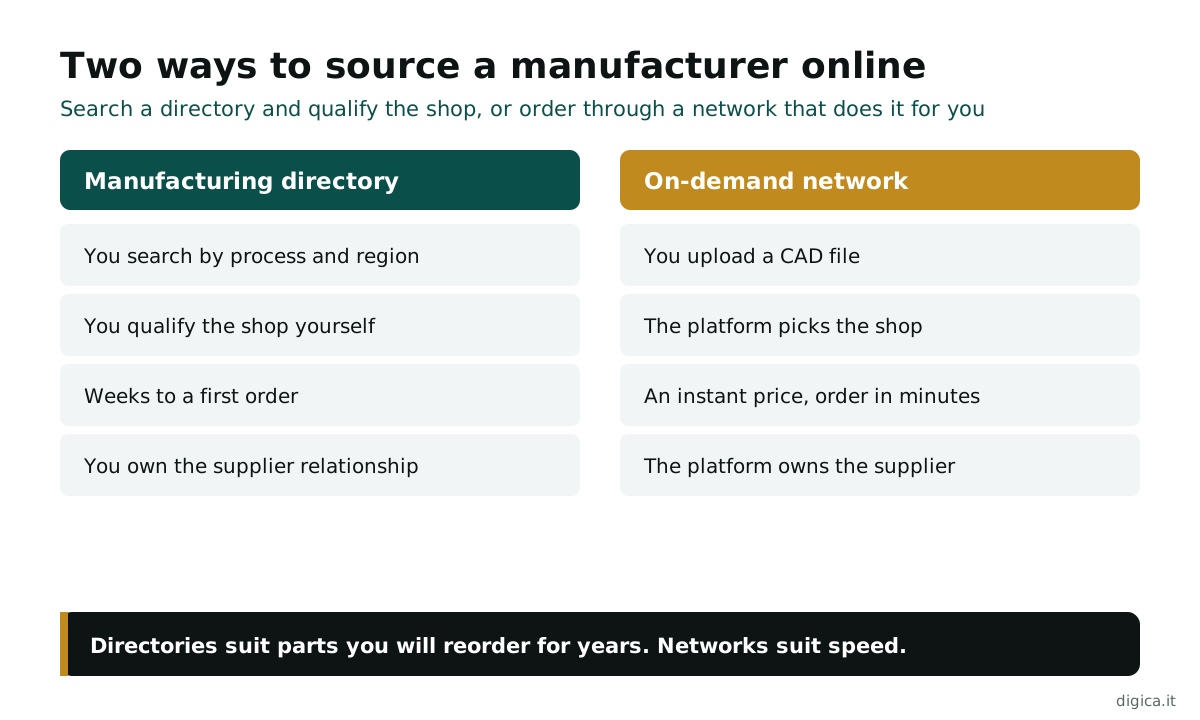
A directory such as Thomasnet, IndustryNet, Europages or Kompass hands you a list. You do the qualification: calls, samples, quality documents and often a visit. That takes weeks, but at the end you own the relationship and can negotiate it over years.
Growing a manufacturing directory or sourcing platform?
In 30 minutes we look at where your suppliers and buyers come from, and what it would take to be the directory engineers search first.
An on-demand network such as Xometry hands you a part. The platform qualifies the shop, holds the certifications and takes responsibility for the order. That takes minutes to quote, but the supplier is the platform's, not yours. MFG.com sits between the two: you see competing shops, but the RFQ process is run for you.
The decision usually comes down to the part's future. Prototypes, bridge production and parts you will order once or twice suit a network. Production parts you will reorder for years, with tooling you will own, suit a directory and a direct relationship.
How each manufacturer directory checks its suppliers
The short answer: checks range from on-site factory audits by named inspection firms to none described at all. Read what each badge actually confirms before you rely on it.
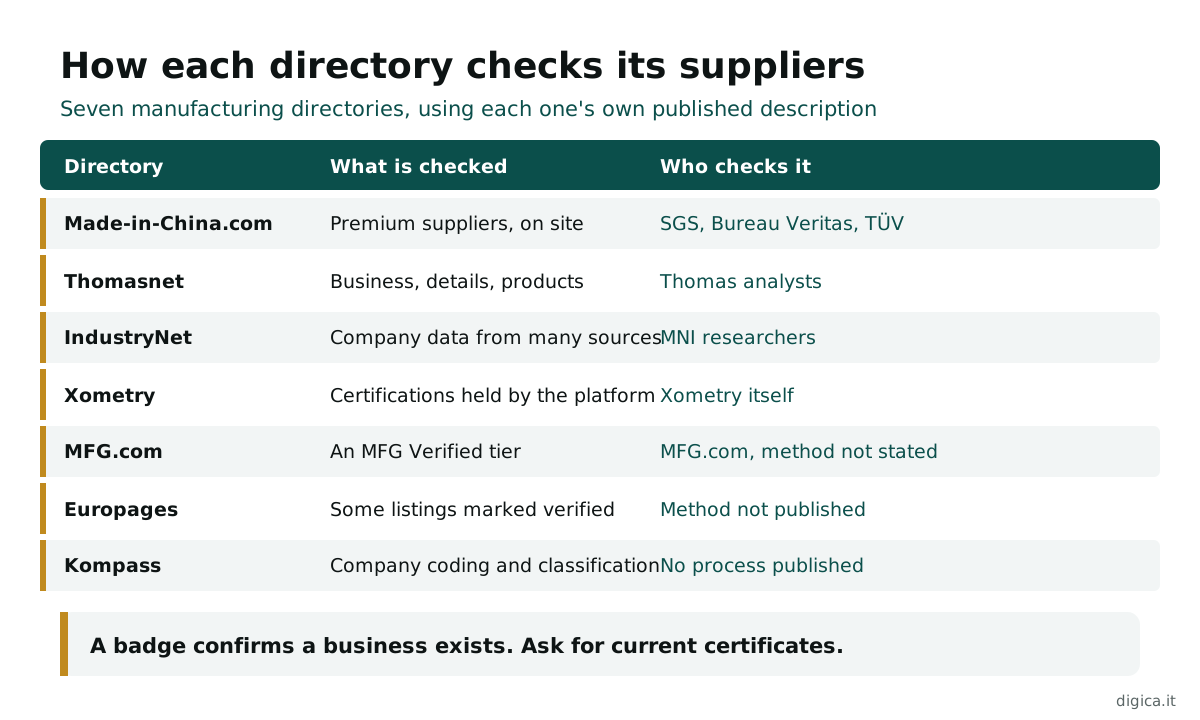
Made-in-China.com's premium suppliers are audited on site by third parties, and the reports are readable before contact. Thomasnet's Thomas Verified badge means its analysts have reviewed the business, its details and its products. IndustryNet's data comes from MNI's research team, which gathers it from hundreds of sources. MFG.com separates an MFG Verified tier. Xometry does not ask you to check the shop at all, because it carries the quality certifications and the order itself.
At the other end, Europages marks some listings as verified without describing the method, and Kompass codes and classifies companies but does not publish a supplier verification process. That does not make them unreliable. It means the checking is your job.
A badge is a starting point, not a quality system. A verified listing confirms the company exists and says what it does. It does not confirm it can hold your tolerance at your volume. Ask for certificates, sample parts and a reference customer in your industry before the first purchase order.
Three failure scenarios
These patterns recur when buyers source through a manufacturing directory without a qualification plan.
- The badge mistaken for a quality check. A medical device startup picks the top verified result for a machined component and places a production order. The listing was verified; the shop's ISO 13485 certificate had lapsed. Asking for the current certificate before the order would have taken a day. Requalifying a supplier after a failed batch took months.
- The single source nobody backed up. A distributor of industrial pumps sources one casting from a single overseas foundry it found on a sourcing platform. When tariffs shift, the landed cost rises and there is no second source. Deloitte's 2026 outlook expects sourcing challenges to persist amid ongoing supply chain volatility (Deloitte). Qualifying a second supplier in another region while the first was working would have kept the line running.
- The quote compared on price alone. An engineering team sends one RFQ to twelve shops and takes the lowest price. The winning shop quoted a lead time it could not meet. Comparing lead time, capability and on-time history alongside price, as RFQ marketplaces allow, would have cost a few hundred dollars more and saved six weeks.
Each team found suppliers quickly. None of them checked what the directory had and had not verified.
Which industrial directory to use: a decision framework
The short answer: match the directory to where the part will be made, how often you will reorder it and how much checking you can do yourself.
- If you need a US or Canadian supplier and can qualify it yourself, start on Thomasnet, filter to Thomas Verified suppliers and your required certification, and request quotes from the top five.
- If you are a US buyer on a tight budget, or a small US shop selling locally, use IndustryNet's single quote form, and as a supplier test its $264 Preferred listing in one category and state.
- If you need a custom part within two weeks and will reorder it fewer than three times, upload the CAD file to Xometry and take the instant price.
- If you want competing quotes on a drawing and to choose the shop, post the RFQ on MFG.com and compare lead time and capability, not price alone.
- If you source across several European countries, search Europages and post a request for quotes, then verify each supplier yourself.
- If you need a narrow product in a specific country, search Kompass by its 7-digit product code.
- If you are moving volume production to China, use Made-in-China.com, filter to audited suppliers and read the audit report before the first call.
Running an industrial or manufacturing B2B marketplace?
We help industrial and MRO marketplaces recruit the suppliers that make search worth using, and reach the engineers and buyers comparing them.
The number to take into your next sourcing review is the time from drawing to three credible quotes. On a directory without RFQ, that is often a week of calls and emails. On a platform with one-step RFQ or instant pricing, it can be a day or less. If your team sources 50 new parts a year and saves four days on each, that is 200 working days back, most of a full-time buyer's year. The biggest cost of doing nothing is a single-source part with no qualified backup when tariffs or lead times move.
FAQ
What is a manufacturing directory? A manufacturing directory is a searchable database of manufacturers and industrial suppliers, organized by product, process, certification and location. Buyers use it to find and shortlist suppliers; the better ones also handle requests for quote and show which suppliers have been verified.
What are the best Thomasnet alternatives? For North America, IndustryNet offers a similar directory with published listing prices. For quotes on a drawing, Xometry and MFG.com. For Europe, Europages and Kompass. For sourcing from China with audited factories, Made-in-China.com.
Is Thomasnet free to use? Buyers search Thomasnet for free. Qualified North American suppliers can create a free company profile, and paid programs that raise visibility in category searches are sold by quote.
What is the difference between a manufacturer directory and an industrial directory? The terms overlap. A manufacturer directory focuses on companies that make products, often searchable by process and certification. An industrial directory is broader and also lists distributors, service providers and MRO suppliers.
How do I verify a manufacturer found in a directory? Check what the directory's badge actually confirms, then ask the supplier for current quality certificates, sample parts and a reference customer in your industry. For overseas suppliers, a third-party factory audit report, such as those on Made-in-China.com, is a strong starting point.
Who owns Thomasnet? Thomasnet has been owned by Xometry, the on-demand manufacturing marketplace, since December 2021. Xometry describes Thomasnet as a database of more than 500,000 North American suppliers.
Related Articles
- Industrial and MRO marketplace growth
- Best supplier databases and directories for B2B in 2026
- Best B2B directories to list your business in 2026
- Best surplus and used industrial equipment marketplaces
- Best procurement marketplaces for B2B buyers in 2026
Where this connects
This article is part of our B2B marketplace growth series. Browse more on the Digica blog.