The best solar marketplaces and directories for installers in 2026, each with one award for the companies it covers
A solar marketplace is a B2B marketplace where installers, EPCs, distributors and manufacturers buy and sell panels, inverters and batteries, or find each other through a directory. The market it serves is large and crowded. The Solar Energy Industries Association reports nearly 299 gigawatts of solar capacity installed across the US and more than 10,000 solar companies across US states.
For an installer, the question is not which platform is biggest. It is which platform covers the suppliers, brands or customers it actually needs. A directory with 68,000 companies helps a distributor find installers in a new country. A wholesale marketplace with 500 sellers helps an installer source modules when its usual distributor runs short. A lead marketplace with 500 vetted installers helps a homeowner find one, and the installer pays for that reach.
This guide gives six solar marketplaces and directories one award each, judged on coverage: how many suppliers, installers, products or countries each one covers, and how it checks who it lists. Facts come from each platform's own pages and filings, checked on October 21, 2026. It is the coverage lens we use when we help energy and solar B2B marketplaces grow both sides of the trade.
Quick Navigation
- What coverage means for a solar marketplace
- Six solar marketplaces and directories compared
- Best global solar company directory: ENF Solar
- Best for cross-border wholesale buying in Europe: sun.store
- Best for US wholesale equipment deals: Sunhub
- Best for used and spare PV parts: Secondsol
- Best for US surplus trading between members: EnergyBin
- Best installer lead marketplace: EnergySage
- Why a company count is not coverage
- Three failure scenarios
- Where an installer should start
- FAQ
- Related Articles
What coverage means for a solar marketplace
The short answer: coverage is the share of the companies you need to reach that a platform actually lists, in the countries and product types you work in.
Solar platforms count coverage in different units. Directories count companies and products. Wholesale marketplaces count sellers, brands, warehouses and registered buyers. Secondary-market platforms count members and spare parts. Lead marketplaces count the installers in their network and the homeowners who request quotes.
Each unit answers a different question. A distributor entering Italy wants installer coverage by country. An installer short of a specific inverter wants seller and brand coverage, and stock near its sites. A small installer wanting more jobs wants homeowner coverage in its own state.
Verification is the second half of coverage. A listing nobody checks is coverage on paper. The platforms in this guide check members in different ways, from vetting sellers before they trade to requiring two years of installation experience before an installer joins a network. In our experience, the platforms that say exactly how they check members are also the ones whose counts hold up when you start calling.
Six solar marketplaces and directories compared
The short answer: ENF Solar covers the most companies, sun.store the most European sellers on one wholesale platform, Sunhub the deepest US wholesale network, Secondsol the most spare parts, EnergyBin a vetted US member base and EnergySage the most homeowners looking for installers.
Six solar marketplaces and directories compared by award, coverage claimed, geography, how listings are checked, main risk and best fit
| Platform | Award | Coverage claimed | Geography | How listings are checked | Main risk | Best for |
|---|---|---|---|---|---|---|
| ENF Solar | Global company directory | 68,300 companies; 90,600 products | Worldwide | "Checked, categorised and connected", method not published | No trading or buyer data | Distributors and manufacturers finding installers |
| sun.store | Cross-border wholesale, Europe | 500+ sellers, 200+ brands, 1,000+ warehouses | 25+ countries | Verified sellers and buyers | Europe only | Installers sourcing stock across borders |
| Sunhub | US wholesale deals | 250+ manufacturers and distributors | US | Chats with verified sellers | Method not explained | US installers buying in bulk |
| Secondsol | Used and spare parts | 60,000+ users; 250,000+ spare parts | Europe | Vetted providers; some features need business review | Mostly German market | O&M teams replacing failed parts |
| EnergyBin | US surplus between members | 1,000+ solar companies | US | Member-only network | Smaller listing volume | Distributors clearing surplus |
| EnergySage | Installer lead marketplace | 500+ providers; 1.5M+ shoppers | All 50 states and DC | Two years' experience, licensed, insured | Leads cost installers money | Residential installers |
Use the "how listings are checked" column alongside the coverage column. A platform with a smaller count but a clear check can be worth more than a larger one that publishes neither.
Best global solar company directory: ENF Solar
ENF Solar wins on breadth: no other platform in this guide lists as many solar companies in as many countries. Run by ENF Ltd since 2005, with an office in Coventry, UK, and another in China, it is a directory rather than a marketplace. It showed 68,300 companies and 90,600 products in its directory counters on October 21, 2026.
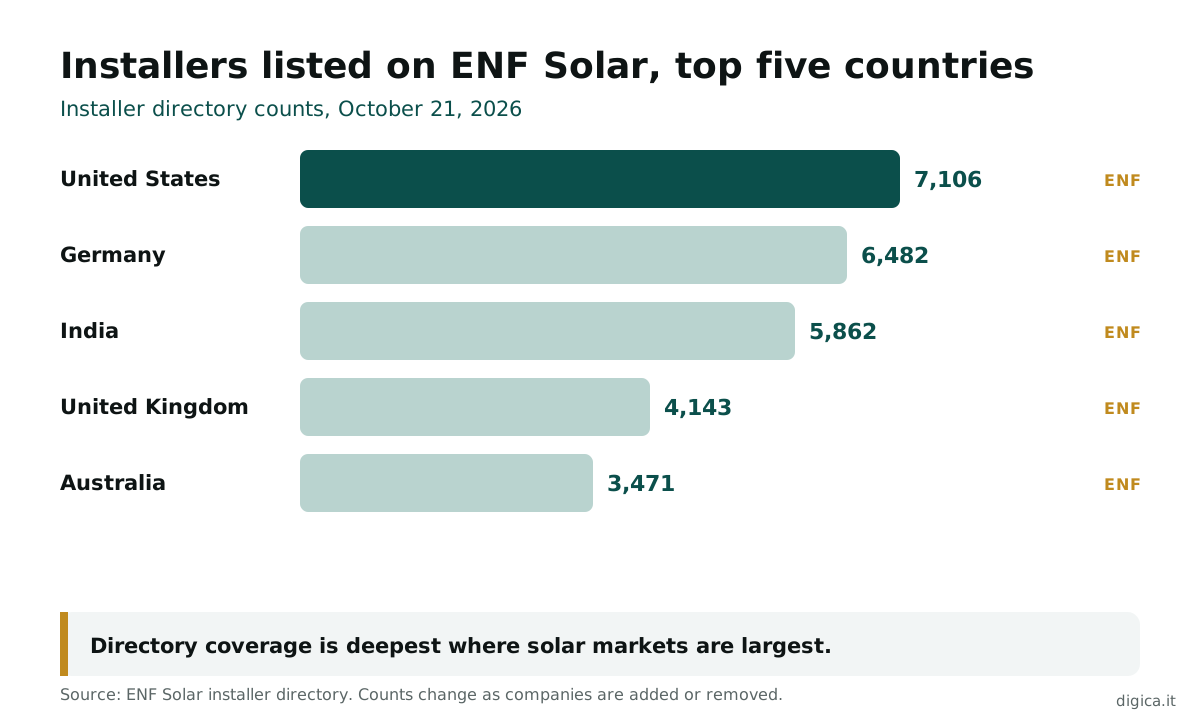
The installer directory is the part most installers and suppliers use. It lists 7,106 installers in the United States, 6,482 in Germany, 5,862 in India, 4,143 in the United Kingdom and 3,471 in Australia, followed by Italy, Spain and France. Its seller directory lists distributors and wholesalers by country, led by India and the United States.
ENF says the information is "checked, categorised and connected", but it does not explain the method. Counts also move between visits as companies are added and removed. Treat a listing as a lead to call, not as proof that a company is active.
Running a solar or energy B2B marketplace?
In 30 minutes we look at how installers, distributors and manufacturers search for platforms like yours, and why they find your competitors first.
Why it wins. For a manufacturer or distributor building a list of installers in a new country, ENF Solar has the widest coverage of any directory here. Pair it with a check of each company's own site before outreach. A directory this size is a starting map, not a buyer list: its value is that it shows where installers cluster, country by country, so a sales team can decide which markets deserve a local partner and which can be served from home.
Best for cross-border wholesale buying in Europe: sun.store
sun.store wins on seller coverage across Europe. Founded in 2023 and based in Warsaw, Poland, it closed a seed round in September 2025 led by investors including Contrarian Ventures. Co-founder and chief executive Agata Krawiec-Rokita runs it with co-founder Bartosz Majewski.
Its about page gives access to components from more than 500 sellers and more than 200 brands, stored in more than 1,000 warehouses across Europe. It reports more than 35,000 registered users and more than 2,500 unique buyers in more than 25 countries, and says it enables more than 1,000 transactions a month. It describes hundreds of verified sellers and buyers.
The figure that defines it is that 90% of its transactions cross borders. An installer in one country can buy modules sitting in a warehouse in another, which matters when local distributors run short or prices diverge between markets.
Why it wins. For European installers and EPCs who buy across borders, sun.store covers more sellers, brands and stock locations than any other wholesale marketplace in this guide.
Best for US wholesale equipment deals: Sunhub
Sunhub wins in the US. Based in Cleveland, Ohio, it began in 2020, founded by the team behind Yellowlite, an installer they started in 2007. Mitch Bihuniak is co-founder and chief executive.
In a sponsored July 2025 feature in Solar Power World, Sunhub said more than 250 manufacturers and distributors actively use it and that it engages more than 30,000 solar professionals each week. It reported that from 2023 to 2024 registrations grew 145%, registered sellers 184% and order volume 345%. Buyers negotiate in private chats with verified sellers, and its wholesale and bulk deals come from what it calls verified sellers.
Sunhub does not explain how sellers are verified. Its strength is that it was built by installers, so it is designed around how US installers buy: in bulk, quickly, from sellers who have stock now.
Why it wins. For US installers and EPCs buying modules, inverters and batteries in bulk, Sunhub has the broadest wholesale seller network in this guide. Ask a seller for references before a first large order.
Best for used and spare PV parts: Secondsol
Secondsol wins on spare parts. SecondSol GmbH, based in Meiningen, Germany, has run its trading platform since 2010 and is now majority owned by the Pfalzwerke group, which took a 60% stake. Its homepage reports more than 60,000 registered users in Europe and more than 250,000 PV spare parts in stock and in its network. Its industry directory has more than 1,500 entries.
Secondsol matters because solar systems outlive their components' production runs. An operations and maintenance team replacing a failed inverter in a ten-year-old array often cannot buy the original model new. A marketplace with a deep stock of used and discontinued parts keeps those systems running without a costly redesign.
Components come from vetted providers, and some trading features open only after a review of the user's identity or business. That makes it a safer place to buy used equipment than an open classified site.
Demand for that kind of maintenance work is growing with the installed base. The Interstate Renewable Energy Council's National Solar Jobs Census counts 280,119 solar workers in the US as of 2024, and every installed system they build will need parts over its lifetime.
Do installers find your solar marketplace first?
A growth audit maps how installers, EPCs and maintenance teams search for equipment and suppliers, on Google and in AI answers, and which of your pages they never reach.
Why it wins. For maintenance teams and installers in Europe replacing used or discontinued parts, Secondsol covers more spare parts than any other platform here. Check warranty terms on used equipment before you buy, because they vary by seller and are rarely the same as new stock. For an operator with a fleet of older arrays, a reliable source of discontinued parts is often worth more than a lower price on new equipment that would force a redesign.
Best for US surplus trading between members: EnergyBin
EnergyBin wins on trading between known members. Launched in September 2016 and based in Rochester, Minnesota, it is a subsidiary of Broker Exchange Network and was a recipient of US Department of Energy SunShot funding. It says more than 1,000 solar companies are members, including manufacturers, distributors, developers, EPCs, installers and operations and maintenance firms.
The member-only model is the point. Surplus and secondary equipment trades between companies that have joined the network, rather than through an open listing. That narrows coverage, but it means a buyer knows the kind of company on the other side.
Why it wins. For US distributors and EPCs clearing surplus stock, or installers looking for discounted equipment from known trade sellers, EnergyBin offers the clearest member-based coverage in this guide.
Best installer lead marketplace: EnergySage
EnergySage wins on homeowner coverage. Founded by Vikram Aggarwal and based in Boston, Massachusetts, it has been controlled by Schneider Electric since February 2022. It says more than 1.5 million shoppers have used it, and that more than 500 solar, HVAC and electrical providers are in its network across all 50 states and Washington, DC.
For installers, EnergySage is a lead channel rather than a supply marketplace. Homeowners request quotes, and vetted installers compete to win the job. The vetting is published: installers need more than two years of experience installing solar PV, must be licensed and insured, and need a reputation for good customer service and quality installations.
That bar is a cost and a benefit. A new installer cannot join until it has two years of work behind it. An established one gains a marketplace where homeowners already trust the installers on offer, which shortens the sales conversation.
Why it wins. For established residential installers who want more quote requests, EnergySage has the widest homeowner reach in this guide. Track cost per installed job, not cost per lead, before you scale your spending.
Why a company count is not coverage
Most mistakes in choosing a solar platform come from reading a company count as coverage of the companies you need. The diagram below shows how fast the number narrows in the US.
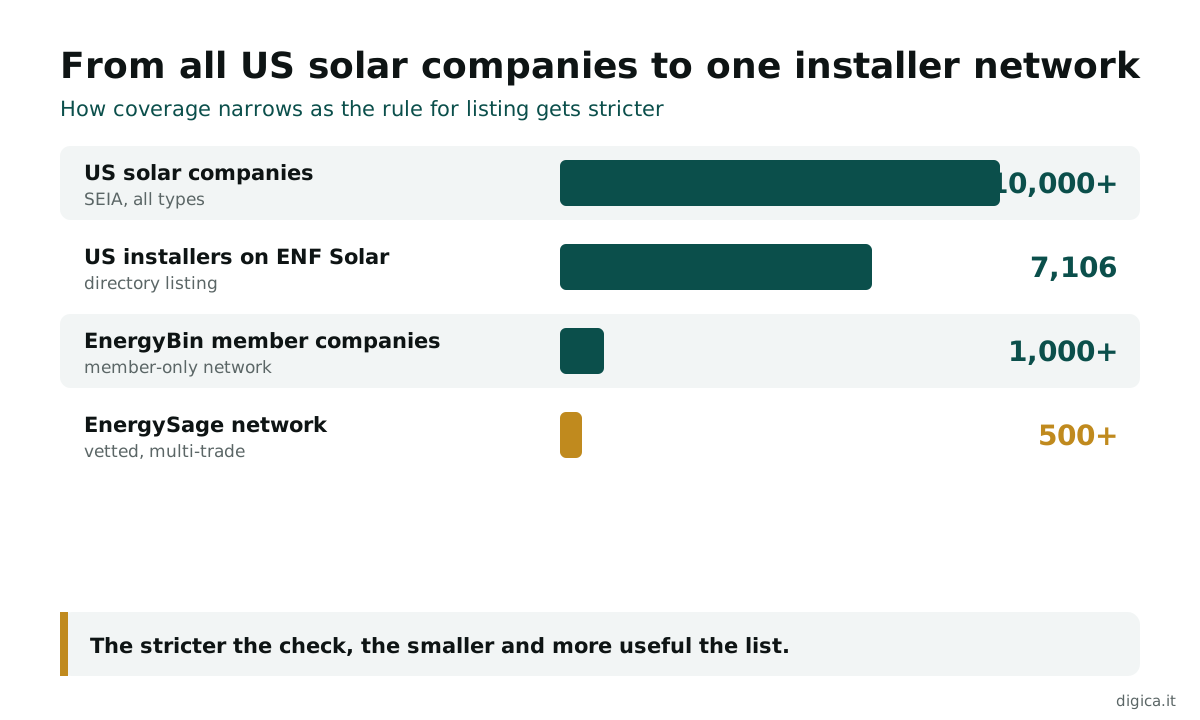
SEIA counts more than 10,000 solar companies across US states. ENF Solar lists 7,106 US installers. EnergyBin has more than 1,000 member companies. EnergySage's network holds more than 500 solar, HVAC and electrical providers. Each step is a smaller group, chosen by a stricter rule.
The right number depends on the job. A manufacturer looking for installers to sell to wants the widest list, and ENF's 7,106 is the place to start. A homeowner, or the installer competing for that homeowner, wants the smallest vetted group, and EnergySage's network is built for that. A distributor clearing surplus wants a known group of trade buyers, which is EnergyBin's member base.
The practical rule is to ask every platform two questions: how many companies of my type, in my region, are on it, and how were they checked? A platform that can answer both is giving you coverage. One that can only give a total is giving you a list.
Three failure scenarios
These are the patterns that recur when solar companies choose a platform on the headline number.
- The directory treated as a customer list. A battery manufacturer exports every installer in one country from a large directory and runs a cold email campaign. A large share of the companies have closed or no longer install. Checking each company's own site and recent activity first would have produced a shorter, far more responsive list.
- The cross-border deal without a stock check. An installer buys modules from the cheapest seller on a wholesale marketplace, in a warehouse two countries away. Delivery takes longer than the project allows. Filtering by warehouse location before price would have kept the job on schedule.
- The lead channel that ate the margin. A small residential installer joins a lead marketplace and buys every lead in its state. Many are outside its service area or comparing five quotes. Limiting leads to its own zip codes, and tracking cost per installed job, would have kept the channel profitable.
Each started from a real number. Each read the number as coverage of the companies or customers that mattered.
Where an installer should start
The short answer: decide what you need to cover, suppliers, spare parts, trade buyers or homeowners, then start with the platform that covers it best. These decision points make it specific.
- If you are a manufacturer or distributor entering a new country, start with ENF Solar's installer directory and check each company before outreach.
- If you install in Europe and buy stock from more than one country, use sun.store and filter by warehouse location first.
- If you install in the US and buy more than one pallet at a time, compare Sunhub's verified sellers with your usual distributor.
- If you maintain systems more than five years old, keep Secondsol for discontinued inverters and spare parts.
- If you hold surplus equipment worth clearing to trade buyers, list it on EnergyBin.
- If you are a residential installer with more than two years of experience, test EnergySage in your own service area and track cost per installed job.
Growing a solar or energy B2B marketplace?
We help energy and solar B2B marketplaces win the installers, distributors and buyers who make both sides of the trade worth joining.
The number to take into your next planning meeting is the size of the market these platforms connect. SolarPower Europe's Global Market Outlook reports a record 597 gigawatts of solar installed worldwide in 2024, a 33% increase on 2023. Every one of those gigawatts needed suppliers, installers and, later, spare parts. The biggest cost of doing nothing is relying on one channel while the platforms that cover your next supplier, buyer or customer sit unused.
FAQ
What is a solar marketplace? A solar marketplace is a B2B marketplace where installers, EPCs, distributors and manufacturers buy and sell solar equipment or find each other. Examples include sun.store and Sunhub for wholesale equipment, Secondsol and EnergyBin for used and surplus stock, and EnergySage for installer leads.
What is the largest solar directory? Of the platforms in this guide, ENF Solar lists the most companies, with 68,300 companies and 90,600 products in its directory counters on October 21, 2026.
Where can installers buy solar panels wholesale? In Europe, sun.store connects installers to more than 500 sellers and 200 brands across 25+ countries. In the US, Sunhub says more than 250 manufacturers and distributors use its marketplace.
Where can I buy used or spare solar parts? Secondsol reports more than 250,000 PV spare parts in stock and in its network in Europe. In the US, EnergyBin runs a member network of more than 1,000 solar companies trading surplus and secondary equipment.
How do installers join EnergySage? EnergySage requires installers to have more than two years of experience installing solar PV, to be licensed and insured, and to have a reputation for good customer service and quality installations.
How many solar companies are there in the US? The Solar Energy Industries Association reports more than 10,000 solar companies across US states.
Related Articles
- Energy and solar B2B marketplace growth
- The 7 biggest B2B marketplaces in 2026, measured by buyers and sellers
- Best wholesale marketplaces for retailers in 2026
- Best supplier databases and directories for B2B in 2026
- How to attract vendors to a B2B marketplace
This article is part of our B2B marketplace growth series. Browse more on the Digica blog.