The best startup directories and Product Hunt alternatives in 2026, compared on the launch traffic they actually send
A startup directory is a site where founders list a new product so that early users, investors and the press can find it. The best known is Product Hunt, which public Semrush estimates put at about 5 to 6 million visits a month in July and August 2026. The smallest launch sites on this list report around 2,000 visitors a day. Both are called startup directories, and founders often treat them as if one launch were as good as another.
It is not. A launch on Product Hunt now depends on its team choosing to feature you. A post on Show HN is free but most never leave the new-submissions page. A paid queue on a smaller directory guarantees a date but reaches a fraction of the audience. With the US Census Bureau's Business Formation Statistics counting 534,947 new business applications in September 2026 alone, every launch platform is crowded, and the right question is which one sends traffic you can use.
This guide compares the leading startup directories and Product Hunt alternatives head to head on one thing: launch traffic. That means visits each platform reports or that public estimates show, how a listing gets seen, how long the window lasts and what it costs to skip the queue. It is written for B2B founders and SaaS teams planning a launch. Facts come from each platform's own pages and public traffic data, checked on October 20, 2026. It is the lens we use when we help startup directories and launch platforms grow the audience their listings depend on.
Quick Navigation
- Seven startup directories, head to head
- How launch traffic actually works
- Product Hunt versus Show HN: the 24-hour launches
- BetaList versus Uneed: paying to skip the queue
- Peerlist versus Microlaunch: longer launch windows
- Crunchbase: the directory that works after launch day
- Three failure scenarios
- Planning a launch week: a decision framework
- FAQ
- Related Articles
Seven startup directories, head to head
The short answer: Product Hunt and Crunchbase have the largest audiences, Show HN reaches the most technical readers for free, Peerlist and Microlaunch give a longer window, and BetaList and Uneed sell a guaranteed slot to founders who cannot wait.
Seven startup directories and Product Hunt alternatives compared on launch traffic, window, cost to skip the queue, main risk and best fit
| Directory | Launch traffic | Launch window | Cost to skip the queue | Main risk | Best for |
|---|---|---|---|---|---|
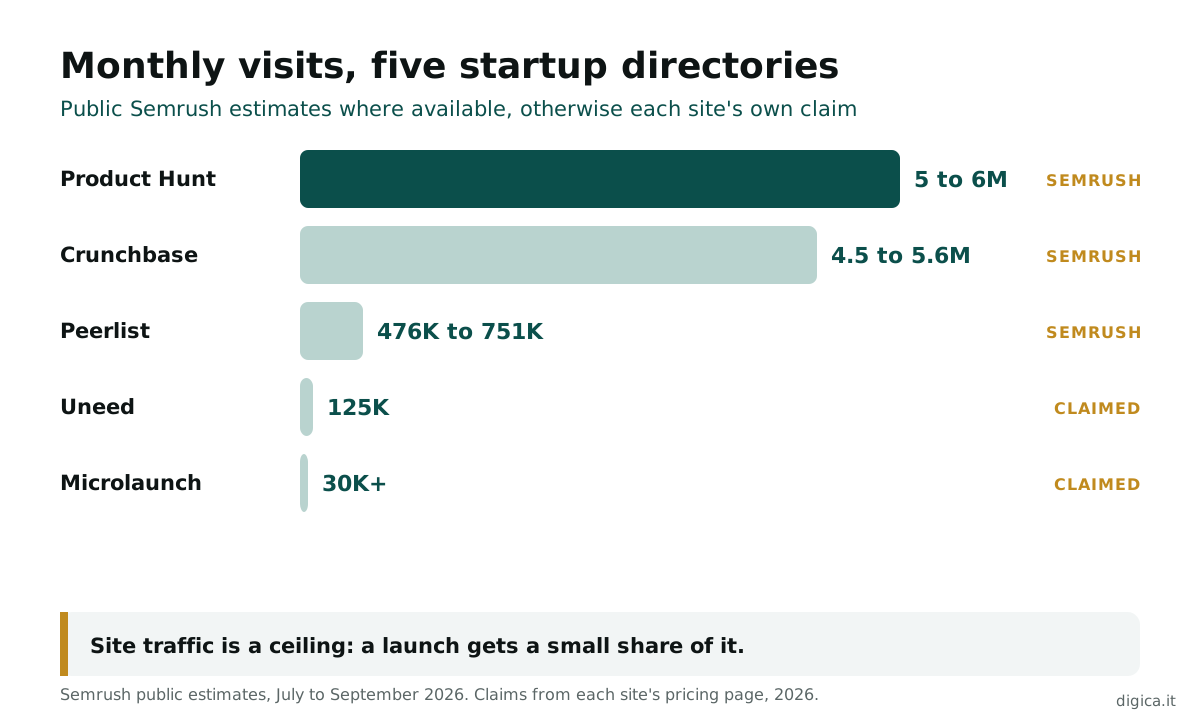
| Product Hunt | About 5 to 6 million visits a month (Semrush, Jul to Aug 2026) | 24 hours | Free; featuring chosen by the team | Not being featured | Polished products with a network ready on the day |
| Show HN | No official figure; front page sends thousands | Hours | Free; no paid placement | Most posts never reach the front page | Developer tools and open source |
| BetaList | 500,000+ pageviews a month, 70,000+ newsletter subscribers (claimed) | Feature day plus newsletter | Paid review only; boost $99 a week | Price shown only at checkout | Pre-launch waitlists |
| Uneed | 125,000 visitors a month (claimed) | One day | $29.99 to pick a date; $14.99 fast-track | Free queue runs up to 5 months | Indie SaaS on a budget |
| Peerlist Launchpad | 476,000 to 751,000 visits a month (Semrush, Aug to Sep 2026) | One week | Free; verified individuals only | Brands cannot launch | Side projects and dev tools |
| Microlaunch | 30,000+ unique visitors a month (claimed) | 30 days | $39 Launch Pro (promo price) | Small audience | Feedback and a month of exposure |
| Crunchbase | 4.5 to 5.6 million visits a month (Semrush, Jul to Sep 2026) | Permanent profile | Free profile; paid tiers for data | No launch spike at all | Being found by investors and buyers |
Two columns matter most. "Launch traffic" tells you the ceiling. "Main risk" tells you how often a launch gets nowhere near it. Most founders read the first and skip the second.
How launch traffic actually works
The short answer: a launch sends a short spike, not a steady stream, and the size of the spike depends far more on where your listing lands than on the size of the site.
Every launch platform has a front page and a back room. On Product Hunt the front page is the featured list; unfeatured launches sit in a feed few people browse. On Hacker News the front page is 30 links; every Show HN post starts on a "new" page that most readers never open. On BetaList and Uneed the front page is the day's featured slots, and the back room is the queue.
That is why site traffic overstates launch traffic. A platform with 5 million visits a month does not send 5 million visits to its launches. It sends most of its attention to the handful of products at the top of the day, and very little to the rest.
The second rule is decay. Founders who publish their launch data describe the same shape again and again: a spike on day one, a smaller day two, and a long tail of a few dozen visits a day within a week. The platforms that try to change this shape, Peerlist with a weekly cycle and Microlaunch with 30-day campaigns, trade a lower peak for a longer window.
The third rule is audience. A visitor from Show HN is likely to be an engineer. A visitor from BetaList is an early adopter looking for something new. A visitor from Crunchbase is often an investor, an analyst or a salesperson. The same number of visits can be worth very different amounts to a B2B product, depending on who is behind them.
Product Hunt versus Show HN: the 24-hour launches
Product Hunt and Show HN are both one-day launches, and both are free. The difference is who decides whether you are seen.
Product Hunt, founded in 2013 by Ryan Hoover and owned by AngelList since 2016, is still the largest launch platform. Public Semrush estimates show 5.32 million visits in July 2026 and 6.33 million in August. September showed 23 million, a jump of 265% that looks like a one-off spike rather than a new baseline.
Launches compete on a daily leaderboard that resets at 12:01 a.m. Pacific time. The number that matters is featuring. Product Hunt's team now chooses which launches appear on the homepage, and its chief executive has said publicly that the bar will rise. Tracking site hunted.space counted 555 featured launches in August 2026 and 710 in September. Winning the day took an average of 501 upvotes on a Tuesday in September, against 322 on a Saturday.
Running a startup directory or launch platform?
In 30 minutes we look at how founders and early adopters search for launch platforms in your niche, and why they find your competitors first.
Show HN, part of Hacker News, run by Y Combinator since 2007, works the other way. There is no featuring team and no paid placement. Its rules say a Show HN must be something people can try, not a landing page, a sign-up page or a newsletter, and asking friends to upvote is not allowed. Every post starts on the "show new" page and moves to the main Show HN list after it clears a small points threshold.
Show HN publishes no traffic figures. Founders' own write-ups describe a front-page post sending anything from a few thousand to nearly 10,000 visitors, with most of it gone within a week. Those are anecdotes, not benchmarks, and most posts never reach the front page at all.
The verdict. Pick Product Hunt for a polished B2B product with a network ready to engage in the first hours, and launch midweek only if you can compete with 500 upvotes. Pick Show HN for a developer tool or open source project that a reader can try in two minutes. Many teams do both, a few days apart.
BetaList versus Uneed: paying to skip the queue
BetaList and Uneed both sell time. The difference is what you get for the money.
BetaList, founded in 2010 by Marc Köhlbrugge in the Netherlands, is the oldest platform here built for startups before launch. Every submission is now paid, with a full refund if BetaList does not select you, and plans differ by how fast you are featured and whether newsletter inclusion is guaranteed. Prices appear only at checkout. Its advertising page claims more than 70,000 newsletter subscribers, more than 500,000 pageviews a month and more than 24,000 startups featured. A homepage and newsletter boost costs $99 a week.
Uneed, run by solo founder Thomas Sanlis and made in the EU, is the clearest example of a paid queue. A free launch joins a line, and the site says your date can be up to 5 months away. Skipping the line to pick your own date costs $29.99; a fast-track slot in about 14 days costs $14.99. Free launches need a minimum upvote score to stay published and a higher one to earn the backlink. Uneed reports 125,000 monthly visitors, 22,000 visitors a month sent to product sites and 26,000 newsletter subscribers.
Both platforms' audience numbers are their own claims. BetaList's advertising page even gives two different subscriber figures, 70,000+ and 60,000+, in different places. Treat them as an upper bound.
The verdict. Use BetaList when you have a waitlist page and want early adopters before launch. Use Uneed when you have shipped, want a fixed date and want a durable backlink for under $30. Neither replaces a launch on a larger platform; both are good second channels in a launch week.
Peerlist versus Microlaunch: longer launch windows
Peerlist and Microlaunch both reject the 24-hour sprint. They give each launch more time, at the cost of a smaller peak.
Peerlist, founded in Pune, India in 2021 by Akash Bhadange and Yogini Bende, is a professional network for builders with a weekly Launchpad. Launches open every Monday and run for a week. For the first two days, products are shown in random order so each gets equal exposure, and ranking then combines upvotes, comments, views and link clicks, with verified profiles carrying more weight. The top three each week are featured in Peerlist's emails and social channels. Only verified individual profiles can launch; company accounts cannot.
Do founders find your launch platform, or a competitor's?
A growth audit maps how founders search for places to launch, on Google and in AI answers, and which of your pages they never reach.
Public Semrush estimates show 476,070 visits to Peerlist in August 2026 and 750,510 in September, with an average visit of more than 12 minutes. Its audience skews towards developers and designers, which suits developer tools far better than a sales or finance product.
Microlaunch, run by Stimpack SAS in Paris since 2023, runs each launch as a 30-day campaign on a monthly leaderboard. Its own figures, updated in August 2026, claim more than 30,000 unique visitors a month, 70,000 monthly page views and more than 140,000 product clicks all time. Its homepage counted 154 products and 1,989 daily visitors in October 2026. Launch Pro, which lets you pick a date and adds boosts, costs $39 on a promotional price.
The verdict. Use Peerlist when the product is yours as an individual builder and your audience is technical. Use Microlaunch when you want a month of feedback from other makers more than a spike of traffic.
Crunchbase: the directory that works after launch day
Crunchbase is not a launch platform, and that is why it belongs here. Founded in 2007 and independent of AOL and TechCrunch since 2015, it is a database of companies, funding rounds and people. Public Semrush estimates show 4.54 million visits in August 2026 and 5.61 million in September, with visitors viewing more than 13 pages on average.
There is no spike. A Crunchbase profile is free to create and sits there permanently, and the people who find it are investors, analysts, acquirers and sales teams researching a market. In February 2025 Crunchbase relaunched as what it calls a predictive intelligence platform, using its data to forecast funding and acquisitions. It says a community of about 80 million users contributes and uses that data.
That matters more in a crowded funding market. The Startup Genome Global Startup Ecosystem Report 2026 found that global ecosystem value grew by $2.8 trillion, but two thirds of it went to just three US cities. Investors outside those hubs, and founders hoping to be found by them, rely on databases more than launch-day buzz.
The verdict. Every B2B startup should keep a complete, accurate Crunchbase profile. It will not send launch traffic, but it is where many of the people who matter after launch go to check you.
Three failure scenarios
Most launch mistakes come from reading a platform's total traffic as the traffic a launch will get. These are the patterns that recur.
- The unfeatured Tuesday. A B2B analytics startup launches on Product Hunt on a Tuesday because Tuesdays get the most traffic. It is not featured, so it sits in the full feed with a few dozen visits. Even if it had been featured, a Tuesday win needed about 500 upvotes. A Saturday launch, or a Show HN post with a working demo, would have had a better chance of being seen.
- The five-month queue. A founder submits to a free queue and plans the launch announcement around it. The assigned date lands four months later, after the product has changed. A $29.99 skip would have matched the launch to the product, and cost less than an hour of the founder's time.
- The launch with no second day. A team gets a strong day on one platform, then has nothing planned for day two. Traffic drops to a few dozen visits within a week, as it does for almost everyone. A staggered week, with a BetaList feature, a Peerlist or Microlaunch launch and a complete Crunchbase profile, would have kept people arriving.
None of these is a platform's fault. Each is a launch plan built on the headline number.
Planning a launch week: a decision framework
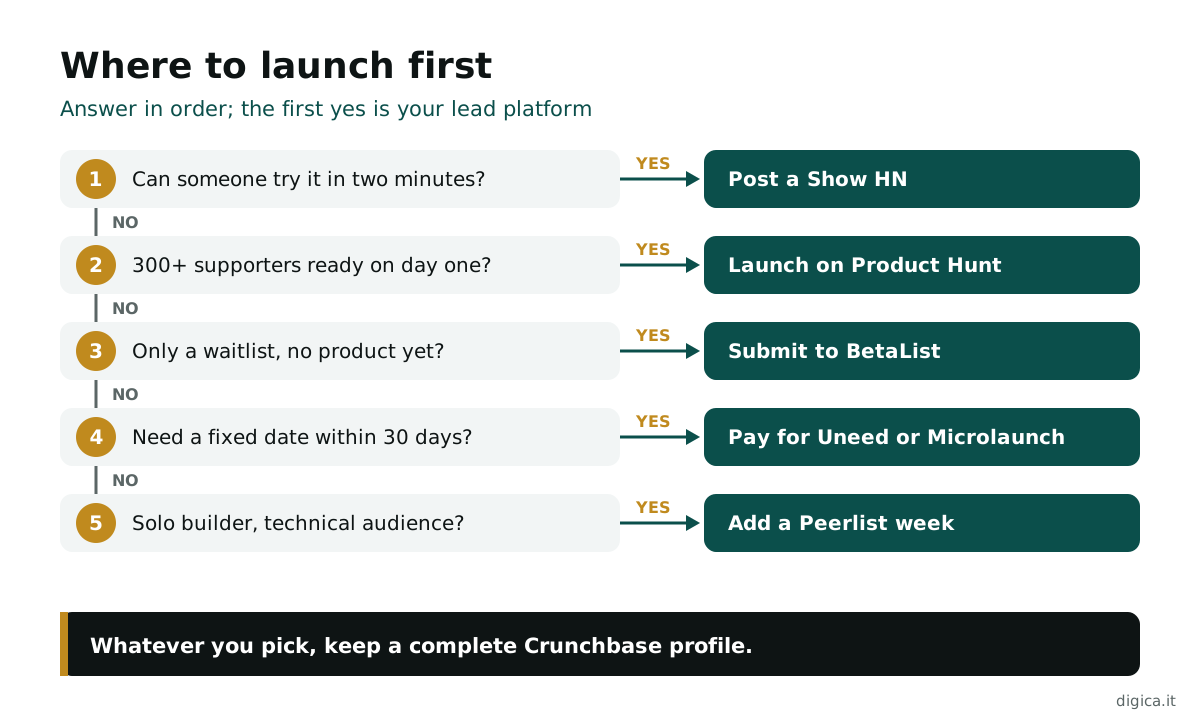
The short answer: launch on one large platform, add two smaller ones in the same fortnight, and keep one permanent profile that works after the spike. These decision points make it specific.
- If you can rally 300 or more genuine supporters in the first hours, launch on Product Hunt, and pick a weekend if you cannot reach 500.
- If a reader can try the product in under two minutes without signing up, post a Show HN on a different day from Product Hunt.
- If you have a waitlist page and no product yet, start with BetaList and use its newsletter for early adopters.
- If you need a fixed launch date within 30 days, pay for a Uneed skip or Microlaunch Launch Pro rather than wait in a free queue.
- If your users are developers or designers, add a Peerlist Launchpad week, launched from a verified personal profile.
- If you plan to raise money in the next 12 months, complete your Crunchbase profile before launch week, not after.
Growing a startup directory or launch platform?
We help startup directories and launch platforms grow the founders and early adopters who make each launch worth listing.
The cost of a full launch week is small next to what is at stake. A Uneed skip at $29.99, Microlaunch Launch Pro at $39 and a week of BetaList boost at $99 come to about $168, and Product Hunt, Show HN, Peerlist and Crunchbase are free. Against that, the Carta State of Private Markets report for Q1 2026 recorded $30.4 billion of startup funding, with more than 60% of venture dollars going to AI companies. Early traction is part of how a startup competes for that money. The biggest cost of doing nothing is a single 24-hour launch that nobody saw, with no second channel to fall back on.
FAQ
What is a startup directory? A startup directory is a site where founders list new products so early users, investors and the press can find them. Examples include Product Hunt, BetaList, Uneed, Peerlist, Microlaunch and Crunchbase.
What is the best Product Hunt alternative? It depends on the product. Show HN suits developer tools and open source, BetaList suits pre-launch startups with a waitlist, Peerlist suits individual builders, and Uneed and Microlaunch suit founders who want a fixed date for under $40.
How much traffic does a Product Hunt launch get? It depends on featuring. Product Hunt receives about 5 to 6 million visits a month on public estimates, but its team chooses which launches are featured, and winning the day took about 322 to 501 upvotes in September 2026.
Is BetaList free? No. Every BetaList submission is now paid, with a full refund if your startup is not selected. A homepage and newsletter boost costs $99 a week.
How long is the Uneed queue? Uneed says a free launch can be scheduled up to 5 months out. Skipping the line to choose your date costs $29.99, and a fast-track slot in about 14 days costs $14.99.
Should I launch on Product Hunt and Hacker News on the same day? Usually not. Launching a few days apart gives you two separate spikes, and each platform's audience reacts better to a launch built for it.
Do startup directories help with SEO? Some do. Uneed offers a backlink to launches that reach an upvote threshold, and Microlaunch's paid plans include a backlink. Treat links as a bonus, not the reason to launch.
Related Articles
- Startup directory growth
- Best SaaS directories to list your product in 2026
- Best AI tools directories in 2026, compared on traffic
- Best startup communities in 2026, ranked by members
- Best developer communities in 2026, ranked by activity
This article is part of our B2B marketplace growth series. Browse more on the Digica blog.