The best warehousing marketplaces in 2026, head to head on network size
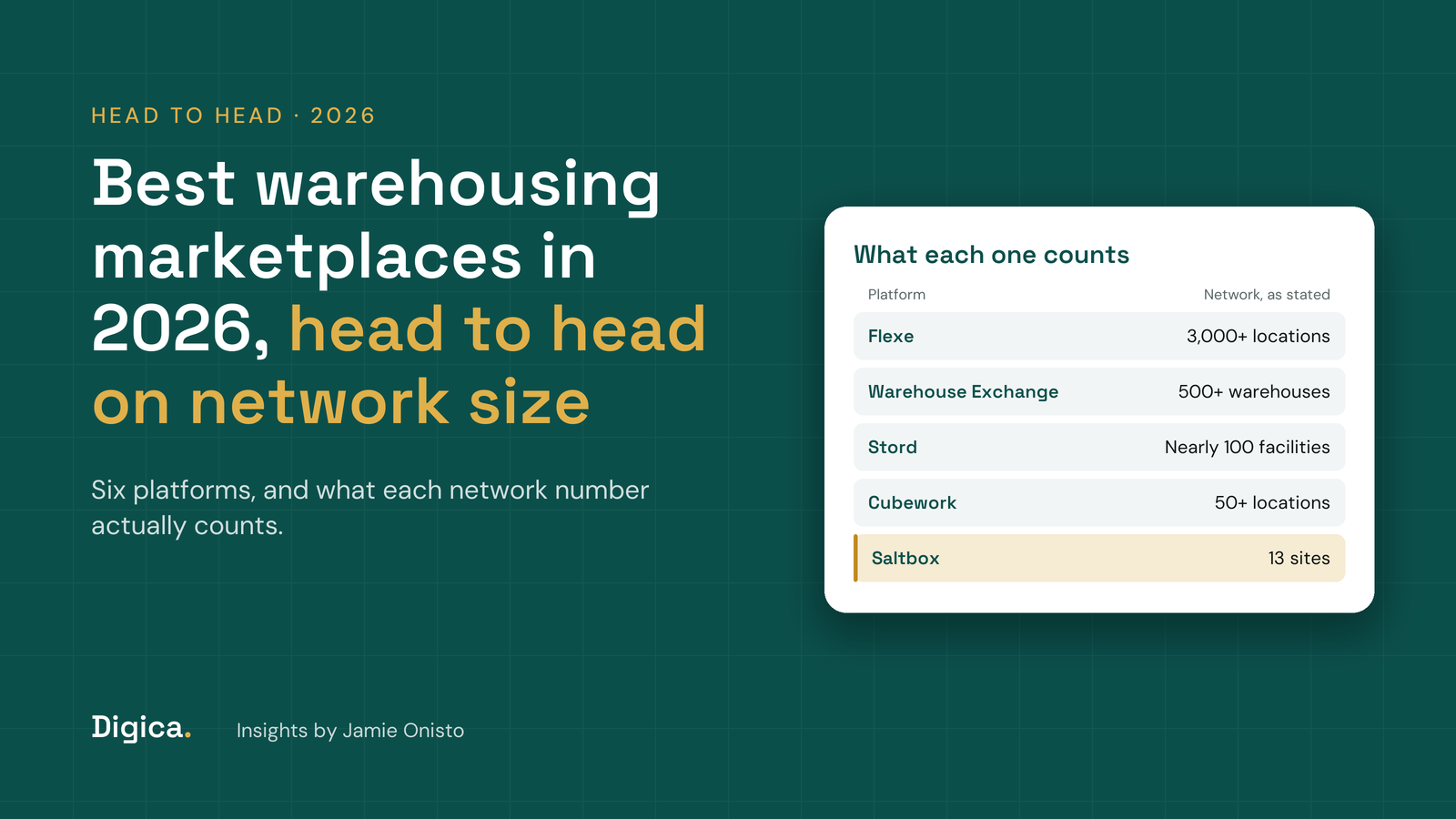
A warehousing marketplace sells you space and labor in a building you do not lease, and the size of its network decides whether there is a dock near your customers when you need one. The headline numbers look easy to compare: 3,000 locations, nearly 100 facilities, 500 warehouses, 50 sites. They are not. Each one counts something different, and the gap between them is where shippers make expensive mistakes.
The timing matters. US industrial vacancy fell to 6.4 percent in the third quarter of 2026, and net absorption reached 104.6 million square feet, the highest since late 2022 (CBRE). Space is being taken up again, so the network you can tap into without a five-year lease is worth more than it was a year ago.
This guide compares six warehousing marketplaces head to head on network size: what each number counts, who runs the buildings and which kind of shipper each one suits. It is written for brands, shippers and logistics leads buying flexible space, and for founders growing a freight and logistics B2B marketplace. Every figure is the company's own, checked on November 9, 2026.
Quick Navigation
- What a warehousing marketplace network number counts
- Six warehousing marketplaces side by side
- Flexe vs Stord: open network against hybrid network
- Flowspace vs Stord: two software-led fulfillment networks
- Warehouse Exchange vs Flexe: empty space against running operations
- Cubework vs Saltbox: flexible space you run yourself
- Why network size matters more in 2026
- Three failure scenarios
- Choosing a warehousing marketplace by footprint
- What the right network is worth
- FAQ
- Related Articles
What a warehousing marketplace network number counts
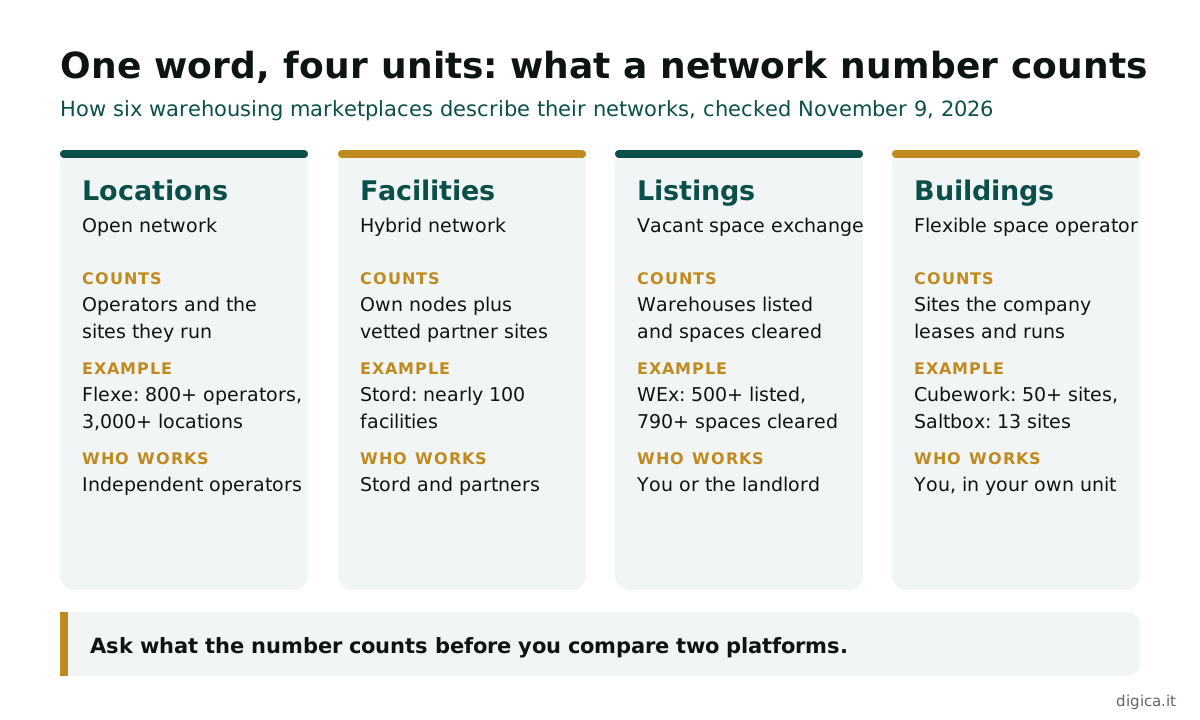
A network number tells you how many places a platform can put your stock, but only once you know the unit. We found four different units across six platforms, and none of them is wrong. They answer different questions.
The first is operators and locations. Flexe counts the independent companies in its network and the sites they run. The second is facilities, where Stord adds the nodes it operates itself to the partner buildings it has vetted. The third is listings and deals. Warehouse Exchange counts the warehouses listed with it and, separately, the spaces it has cleared. The fourth is buildings run, which is how Cubework and Saltbox describe themselves, since they lease and operate every site on their list.
The unit tells you who carries the risk. In an open network, an operator you may never meet handles your pallets, and the platform sets the standards. In a hybrid, part of your volume sits in the platform's own buildings. With a flexible space operator, you rent the room and do the work yourself.
Search results for "warehousing marketplace" mix old coverage of the first on-demand platforms with directories of third-party logistics providers. Those directories count listed profiles, often in the tens of thousands, and that is a fifth unit again. We left them out of this guide, because a directory helps you find a provider but does not give you space. Our guide to B2B logistics marketplaces covers the freight side of the same buying problem.
Our view: the biggest number is rarely the one that matters. The number that matters is how many usable sites sit within a day's drive of your customers, with space free in the month you need it.
Six warehousing marketplaces side by side
Flexe states the largest operated network, Stord the largest hybrid and Warehouse Exchange the largest pool of listed vacant space. Read the "Model" column first, because it decides who runs your inventory.
Six warehousing marketplaces compared on model, network size as stated, geography, who runs the work, main limit and best fit
| Platform | Model | Network, as stated | Geography | Who runs the work | Main limit | Best for |
|---|---|---|---|---|---|---|
| Flexe | Open network, owns no buildings | 800+ operators, 3,000+ locations | US and Canada | Independent operators | Operator quality varies by site | Enterprise overflow and new regions |
| Stord | Hybrid: own nodes plus partners | Nearly 100 facilities, 15 key nodes | North America, UK and Europe | Stord and vetted partners | A full outsourcing commitment | Brands outsourcing all fulfillment |
| Flowspace | Software-run partner network | No total published, about 34 US metros listed | US and Canada | Partner warehouses on its software | Network size not disclosed | Brands that want one system |
| Warehouse Exchange | Exchange for vacant space | 500+ warehouses, 44 states | US | You, or the landlord's team | Space, not services | Temporary or overflow space |
| Cubework | Own or leased buildings | 50+ locations, 22 states | US | You, in your own unit | Fewer markets | Small teams that need a room fast |
| Saltbox | Own or leased co-warehousing | 13 sites, 8 markets | US | You, with shared docks and staff | Smallest footprint | Ecommerce sellers starting out |
None of the six publishes a rate card, so we did not compare price. A larger network is also not a ranking. Each platform wins a different head-to-head below, and loses others.
Flexe vs Stord: open network against hybrid network
Flexe is the largest open warehousing marketplace here, and Stord is the largest hybrid. Pick Flexe when you want capacity in more places without handing over your whole operation. Pick Stord when you want one provider to run fulfillment end to end.
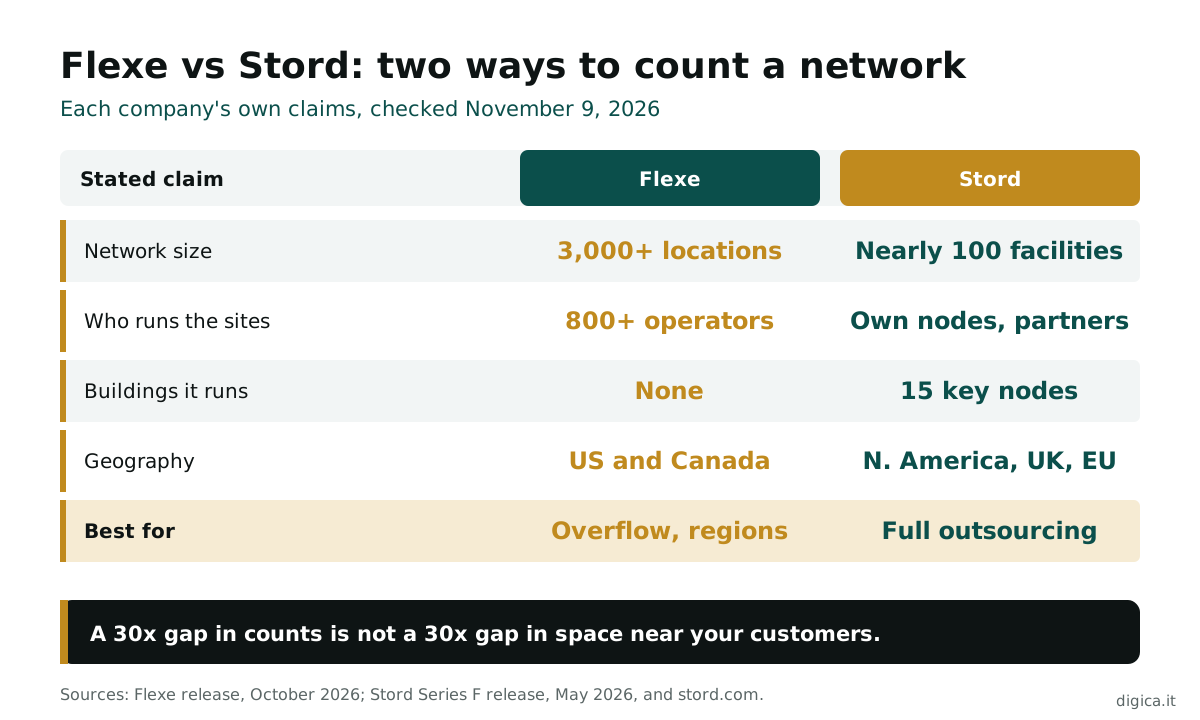
Flexe says it gives access to more than 800 warehouse operators and 3,000 locations across the US and Canada, without multi-year leases. It owns no buildings. Founded in 2013 and based in Seattle, it also publishes a Spot Warehousing Index that tracks spot rates and capacity across 21 US and Canadian markets. In October 2026 it said the index was cited in a Gartner guide to contracting short-term warehousing, and that the mean spot rate had been below asking rents in 17 of the 33 months since the end of 2023.
Stord grew its network by buying one. In May 2025 it acquired Ware2Go from UPS, adding 21 fulfillment centers and 2.5 million square feet to what it called an 11-node North American footprint. By May 2026, when it raised a Series F of nearly $250 million at a $3 billion valuation, it described nearly 100 facilities and $15 billion in annual gross merchandise value. Its homepage now splits that into fifteen key nodes and over 80 hand-selected partner facilities, with 99 percent coverage of the US in under two days.
The numbers differ by a factor of 30, and that does not mean Flexe is 30 times bigger. Flexe counts every site an operator could offer. Stord counts the buildings it routes orders through. For a shipper, the question is how many of those sites can take your product category, at your volume, near your customers. Ask both for that number in writing.
Flowspace vs Stord: two software-led fulfillment networks
Flowspace and Stord both sell fulfillment through a network run on their own software. The difference is disclosure. Stord publishes a facility count. Flowspace does not publish a total on its own site.
Flowspace, based in Los Angeles, describes coast-to-coast warehousing through partner warehouses that run on its order and warehouse management software, with no long-term contracts. Its US locations page listed about 34 metro areas when we counted on November 9, 2026, from Seattle to Miami. Higher totals for its partner network circulate in third-party coverage, but we could not confirm them on Flowspace's own pages, so we do not repeat them.
It competes for switching brands with money rather than a bigger number. In July 2026 it launched a Fulfillment Freedom Fund, offering up to $50,000 in transition support to brands moving from another provider. That tells you where Flowspace sees its market: brands that already outsource and are unhappy with their current provider.
Running a logistics or warehousing B2B marketplace?
In 30 minutes we look at how shippers and brands find platforms like yours, on Google and in AI answers, and where they drop off before they ask for space.
Stord's pitch is depth. Its own nodes give it more control of service standards, and the Ware2Go deal added buildings it had already been routing volume through. The trade-off is commitment. Stord is built for brands that hand over fulfillment as a whole, while Flowspace sells flexibility across partner sites.
Our view: an undisclosed network is not a small one, but it is a question you must ask before you sign. Request the list of sites that would take your stock, by city, and check two of them in person.
Warehouse Exchange vs Flexe: empty space against running operations
Warehouse Exchange sells empty space. Flexe sells operated capacity. If you have your own team and need a building for three months, the exchange is closer to what you want. If you need someone else to pick, pack and ship, it is not.
Warehouse Exchange says it matches businesses with flexible warehouse space across 44 states, with more than 500 warehouses, a 48-hour match and nothing to pay upfront. Its About page adds two numbers that show actual use: more than 790 spaces cleared and more than $25 million in lifetime volume. It is backed by real estate firms including LBA Realty and Xebec Realty, and now calls itself a clearinghouse for temporary logistics space.
The two counts measure different things. "500+ warehouses" is supply listed. "790+ spaces cleared" is deals done over the platform's life. Few warehousing marketplaces publish both, and the second is the more useful, because it shows the listings turn into leases.
Flexe's network counts operators who already run the work, with staff and systems in place. You buy a service level, not a floor plate. That costs more per pallet than an empty room, and it removes the hiring, the racking and the warehouse system from your list.
For a shipper, the choice comes down to who will be inside the building. If the answer is your own people, compare exchanges. If the answer is someone else's people, compare operator networks, and ask how many operators the platform has removed in the last year.
Cubework vs Saltbox: flexible space you run yourself
Cubework and Saltbox both lease buildings and rent them out in pieces, with short terms. Cubework has more locations and larger units. Saltbox has fewer sites, smaller spaces and more shared services.
Cubework, founded in 2018 in City of Industry, California, lists flexible warehouse, office, parking and yard space across more than 50 locations in 22 states, with no long-term lease. Units start at 200 square feet, it says you can move in within 48 hours, and it claims more than 2,000 operators as tenants. It is not a marketplace of third-party warehouses. Cubework runs the buildings, and you run your own stock.
Saltbox, based in Atlanta, opened its first site there in 2019 and announced its 12th location, across eight US markets, alongside a Series C led by Packard Capital in May 2026. Its homepage now lists 13 sites, including Chicago. Spaces run from 70 to 5,000 square feet, and its largest plan tier covers 3,930 to 19,510 square feet, or 246 to 1,219 pallets. Members share docks, equipment and, on some plans, staff.
Do shippers find your warehousing platform before a competitor's?
A growth audit maps how brands and logistics leads search for flexible warehouse space, on Google and in AI answers, and which city, service and capacity pages you are missing.
The network-size question here is simple: is there a site in your city? Cubework's 22 states give it the wider footprint. Saltbox's eight markets suit sellers who live near one and want a fulfillment base with neighbors, rather than a unit behind a roller door.
Both are the right first step for a growing ecommerce team that is not ready to outsource. Neither is the right answer once you need several regions at once. That is the point to move to an operator network.
Why network size matters more in 2026
Network size matters because flexible space buffers your business against a market it cannot control. When the market tightens, the platform with more sites near your customers is the one that still has a door open.
Two forces push in the same direction. Space is being absorbed again, as the CBRE figures above show, and fewer people are adding new capacity in the months a lease takes to sign. Labor is also a fixed cost of running a site. The US warehousing and storage industry employed about 1.84 million people in October 2026, and average hourly earnings reached $26.87 in September (BLS). A warehousing marketplace that already has staff in place sells you that labor by the order, rather than by the year.
Look at network size as a share of your own map. A platform with 3,000 locations that has none within 200 miles of your second largest customer cluster is a small network for you. A platform with 13 sites that has one in each city you sell into is a large one.
Our view: count the sites that matter, not the sites that exist. Draw your top five customer regions, then ask each platform how many active sites it has in each, with space free in the next 60 days.
Three failure scenarios
These are patterns that recur when shippers buy flexible warehousing on a headline number. The dollar figures are illustrative.
- The network that was mostly elsewhere. A brand chooses the platform with the largest location count to add an East Coast node. The sites with free space in the right month are 400 miles from its customers, and parcels cost more to ship than the warehouse saves. Asking for active sites by region before signing would have taken a day, and could have saved $40,000 or more in a year of extra shipping on a mid-size brand.
- Space bought when service was needed. A seller books cheap space on an exchange for peak season, assuming the landlord's team will handle picking. They do not, and temporary staff cost more than the fulfillment fee the brand avoided. Deciding first who would work inside the building would have pointed to an operator network.
- The partner site nobody checked. A shipper trusts a hybrid platform's vetting and sends stock to a partner building it never sees. A damaged inventory count costs a week of sales. Visiting two sites, and writing the inspection rights into the agreement, would have cost one trip.
In each case the platform did what it said. The mistake came from treating a network number like a promise of local service, when it only measures what exists somewhere.
Choosing a warehousing marketplace by footprint
Start with who will work in the building, then where your customers are, then how long you need the space. Most shippers will keep two of these platforms on file.
- If someone else must pick, pack and ship, in more than three regions, start with Flexe and ask for active operators near each of your top customer clusters.
- If you want to outsource fulfillment entirely to one provider, put Stord on the list, and ask which of its nearly 100 facilities would hold your stock.
- If you want partner warehouses on one software system and may switch providers, ask Flowspace for its site list by city, and for the terms of its switching support.
- If your own team will run the space for less than 12 months, compare listings on Warehouse Exchange, and check its cleared deals in your state.
- If you need under 5,000 square feet in one city and want shared docks, check whether Saltbox has a site there.
- If you need a room this week in one of 22 states and will run it yourself, look at Cubework's locations first.
- If you need more than 50,000 square feet for more than three years, a lease or a long-term third-party logistics contract usually beats any of these.
The thresholds are starting points, not rules. Our guides to load boards and procurement marketplaces cover the freight and buying controls around these choices.
What the right network is worth
The right network is worth the shipping you avoid and the lease you never sign. Both can be measured before you commit.
Logistics is already a large line in the US economy. Business logistics costs reached $2.40 trillion in 2025, or 7.8 percent of GDP, according to the 2026 State of Logistics report from CSCMP and Kearney (DC Velocity). Warehousing is one part of that cost, and the part where flexible terms change the most.
Growing a freight or warehousing B2B marketplace?
We help logistics B2B marketplaces win the operators and space owners that make them credible, and reach the shippers searching for them.
Run an illustrative case. Suppose a brand ships 200,000 parcels a year, and placing stock in a second region cuts the average parcel cost by $1.50 because orders travel fewer zones. That is $300,000 a year. If flexible space in that region costs $120,000 a year more than shipping everything from one building, the net saving is $180,000, before counting faster delivery, and a node set up on flexible terms pays back within the first year. The inputs are illustrative, so use your own parcel data.
The number to bring to your next operations review is the share of your orders that ship more than two days from your nearest stock. If it is above a third, a second node through a warehousing marketplace is worth testing. The biggest cost of doing nothing is paying long-zone shipping on every order while a site with free space sits near your customers.
FAQ
What is a warehousing marketplace? A warehousing marketplace is a platform that connects businesses needing storage or fulfillment with warehouses that have spare capacity, on short or flexible terms. Flexe and Warehouse Exchange are examples. Some platforms also run their own buildings.
Which warehousing marketplace has the largest network? On stated numbers, Flexe has the largest operated network, with more than 800 operators and 3,000 locations across the US and Canada. Warehouse Exchange lists more than 500 warehouses, and Stord describes nearly 100 facilities. Each counts a different unit.
What happened to Ware2Go? Stord acquired Ware2Go from UPS in May 2025. The deal added 21 fulfillment centers and 2.5 million square feet to Stord's network, and the Ware2Go site now redirects to Stord.
Is on-demand warehousing cheaper than a lease? Usually not per square foot, but it can be cheaper overall. You pay only for the space and months you use, and an operator network adds staff and systems you would otherwise hire. A long lease tends to win above about 50,000 square feet held for several years.
How do I compare warehousing marketplaces on network size? Ask each platform how many active sites it has within a day's delivery of your main customer regions, with space free in the next 60 days. Then confirm whether those sites are run by the platform, by partners or by you.
Do warehousing marketplaces publish prices? None of the six platforms in this guide publishes a rate card. Most quote by pallet, square foot or order after you describe your volume, so request quotes with the same inputs to compare them fairly.
Related Articles
- Freight and logistics marketplace growth
- Best B2B logistics marketplaces
- Best load boards for brokers and carriers
- Best procurement marketplaces for B2B buyers
- Best wholesale marketplaces
Where this connects
This article is part of our B2B marketplace growth series. Browse more on the Digica blog.