The best load boards in 2026, ranked by how much freight they carry
The best load board is the one with the most freight in your lanes. Everything else, the app, the price, the extras, comes second. Load boards are where spot freight gets found, and the spot market is not a niche: FTR's analysis of spot market truck loadings put it at around 30% of overall US truck freight.
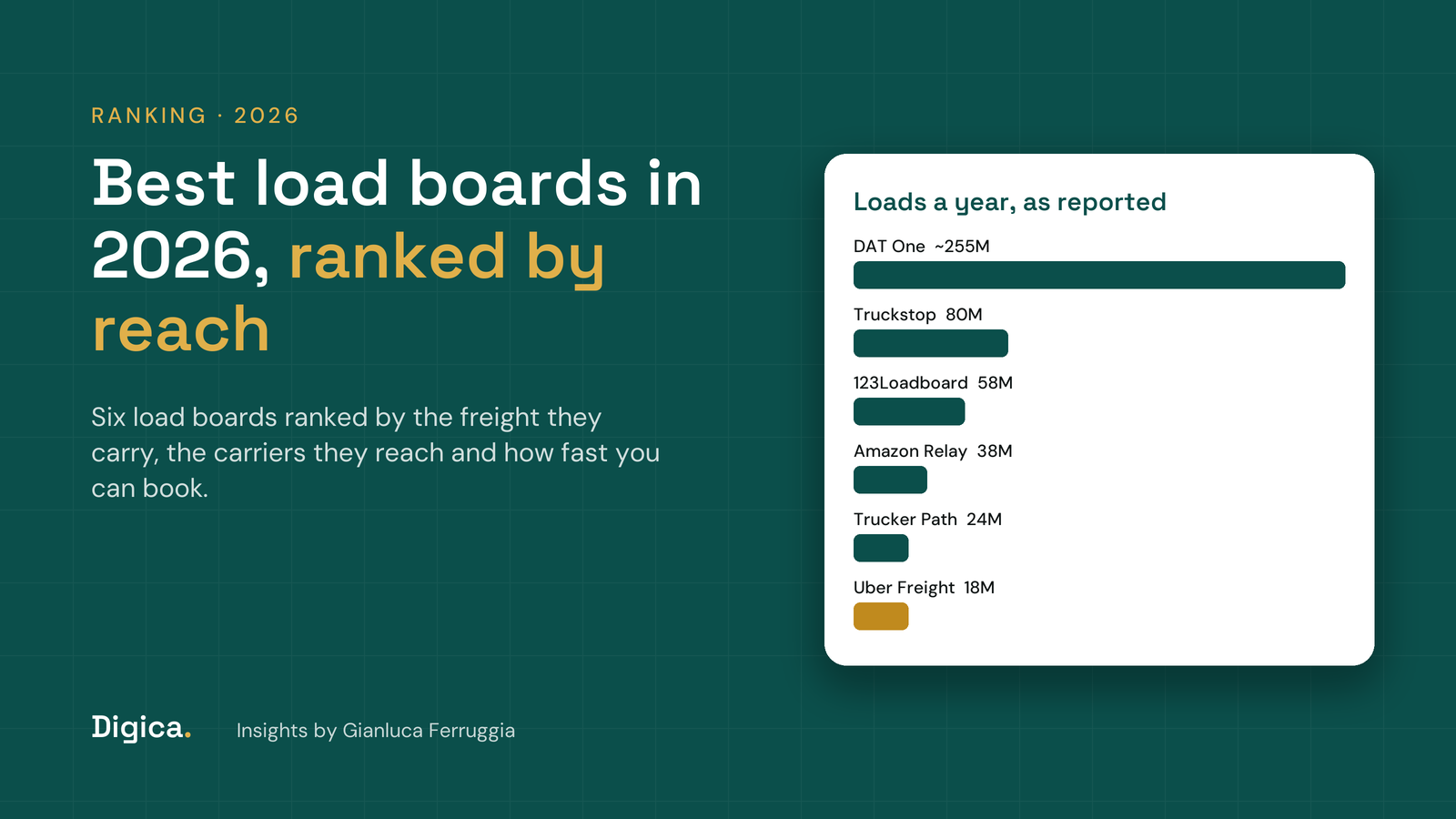
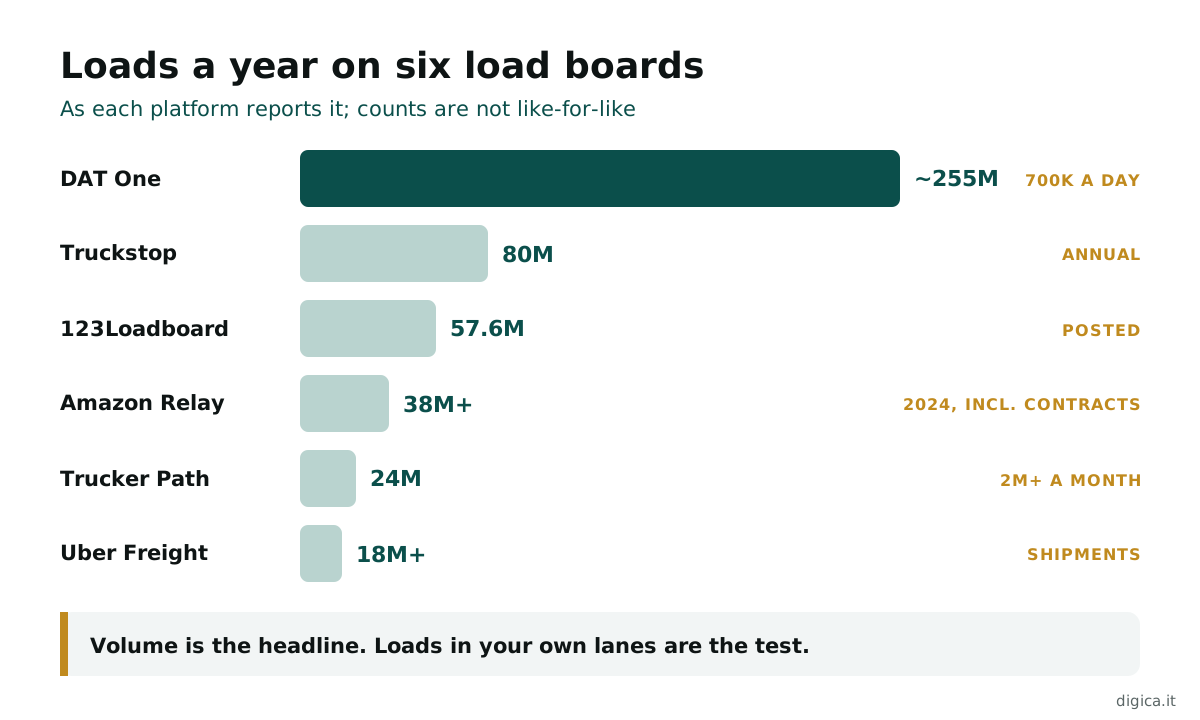
So we ranked the six biggest US load boards by the one thing carriers and brokers ask first: how much freight each one carries. The numbers are large. DAT reports more than 700,000 load posts a day. Truckstop reports 80 million loads a year. Amazon says Relay handled more than 38 million loads in 2024 across its board and contracts. But each platform counts differently, and the headline figure hides almost as much as it shows, which is why the second half of this guide explains how to read it.
Every figure below comes from the platform's own website, help center or press releases, checked on October 12, 2026. Alongside volume, we compare network reach, instant booking and equipment coverage, because a board with fewer loads that you can book in two taps can beat a bigger one that needs ten phone calls. Founders building a freight and logistics marketplace will recognize the pattern: the platform with the most liquidity wins, and liquidity is local.
Quick Navigation
- What makes one load board bigger than another
- The load board ranking at a glance
- 1. DAT One: the deepest pool of loads
- 2. Truckstop: volume plus specialized freight
- 3. 123Loadboard: big volume for small fleets
- 4. Amazon Relay: the biggest single shipper
- 5. Trucker Path: reach through the driver app
- 6. Uber Freight: contracted freight, booked instantly
- Why load board numbers mislead
- Which load board to start with
- The number that matters: loads in your lanes
- FAQ
- Related Articles
What makes one load board bigger than another
A load board is an online marketplace where shippers and freight brokers post loads and carriers search for freight that fits their truck, lane and dates. Size on a load board comes down to four things, and they do not always move together.
- Volume: how many loads get posted. This is the number every board advertises.
- Reach: how many brokers, shippers and carriers are active. More posters means more lanes covered; more carriers means loads get covered faster, which in turn attracts more posters.
- Booking speed: whether a carrier can book in the app at a listed rate, or has to call and negotiate. Instant booking turns a listing into a load moved.
- Coverage: which equipment types and lanes have real depth. A board can be huge in dry van and thin in flatbed.
We ranked the six boards by volume, using the figure each one publishes, then checked the other three. The ranking uses each platform's own count, so it is a ranking of reported scale rather than a like-for-like audit. Where a figure counts something different, such as shipments, contracts or loads plus trucks, we say so.
Volume is the right starting point because liquidity compounds. A board with more loads attracts more carriers, which gets loads covered faster, which attracts more brokers. It is the same flywheel we track in every two-sided market, described in our guide to the marketplace liquidity metric that compounds.
The load board ranking at a glance
DAT One leads on every measure of volume. The interesting differences sit further down the table: who can book instantly, who covers which equipment, and who reaches carriers where they already spend their day.
Six load boards ranked by reported loads, with network reach, instant booking and best fit
| Rank | Load board | Loads a year, as reported | Network reach | Instant booking | Best for |
|---|---|---|---|---|---|
| 1 | DAT One | About 255 million (700,000+ load posts a day) | 500,000+ freight companies | Book Now, in beta, for pre-approved carriers | The deepest spot market and lane data |
| 2 | Truckstop | 80 million | 250,000+ active users | Book It Now | Heavy haul and specialized freight |
| 3 | 123Loadboard | 57.6 million posted | 265,418 carriers | Not yet; bidding on selected loads | Small fleets in van, flatbed and reefer |
| 4 | Amazon Relay | 38 million+ in 2024, including contracts | Approved carriers only | Yes, at the listed all-in price | Power-only and dry van fleets |
| 5 | Trucker Path | 24 million (2 million+ a month) | 800+ brokers, 100,000 carriers, 1 million+ monthly app users | Partner loads only | Drivers already using the app |
| 6 | Uber Freight | 18 million+ shipments | 1 in 3 Fortune 500 shippers | Yes | Contracted freight with upfront rates |
Running a freight marketplace that needs more loads in key lanes?
In 30 minutes we map where your load density is thin and which side to recruit first.
Read the table by lanes, not totals. A carrier running reefer from California to Texas cares how many reefer loads post on that lane each morning, not how many loads a board carries nationally. Every board in the list will let you search a lane before you pay, through a free trial or a free tier, and that search tells you more than any headline number.
1. DAT One: the deepest pool of loads
DAT One is the largest load board in North America by any published measure. DAT reports more than 700,000 load posts a day, which is about 255 million a year on our arithmetic, and says its network covers more than 500,000 freight transportation companies. Its pricing page also cites 291 million loads and trucks posted annually, a figure that counts truck posts alongside loads.
Depth is DAT's edge. It covers almost every equipment type, from dry van and reefer to step deck, lowboy, RGN, hotshot and Conestoga, and in September 2025 it added power only, cargo van and box truck categories. Carriers see broker credit scores and average days to pay; brokers can check a carrier's authority, safety rating and insurance through CarrierWatch.
Booking is catching up. DAT's Book Now feature lets carriers book at a fixed rate inside the app, but it is in beta and limited to carriers pre-approved by participating brokers. Real-time results, which surface new loads the moment they post, come with the Select and Office plans.
Strongest at: lane depth across nearly every equipment type, plus rate and broker credit data. Cost: carrier plans from $59 to $339 a month.
2. Truckstop: volume plus specialized freight
Truckstop reports 80 million loads a year and more than 250,000 active users, which makes it the clear second by published volume. It has run a load board since 1995 and lists flatbed, van, reefer, heavy haul, specialized and partial loads, with hotshot available as a search type.
Its booking tool is more mature than DAT's. Book It Now lets carriers book from any device in a few clicks, including outside broker hours, on loads where the broker has switched it on. Broker ratings with days to pay and credit history come with the Pro and Advanced plans, and Truckstop has owned the carrier compliance business RMIS since 2021.
Its reach also extends beyond its own app. Since April 2026, Truckstop loads appear inside Trucker Path's load board, a partnership Trucker Path said would expand its available loads more than tenfold.
Strongest at: heavy haul and specialized freight, and instant booking on participating loads. Cost: a dry van board from $35 a month; other plans quoted on request.
3. 123Loadboard: big volume for small fleets
123Loadboard's homepage counts 57.6 million truckloads posted a year and 265,418 carriers, and a February 2026 partnership announcement put its users above 325,000. That is a large pool for a board that positions itself on simplicity and low entry cost.
Is your freight marketplace growing loads or growing liquidity?
A growth audit maps load density, carrier coverage and booking speed lane by lane.
Coverage centers on the three core equipment types, van, flatbed and reefer. Carriers see broker credit scores and days to pay, sourced from TransCredit, and a 2026 partnership with eCapital adds debtor data from a factoring company directly into the board.
Instant booking is the gap. 123Loadboard announced a Book Now feature as coming soon in 2022, and we found no sign it is live. Load bidding exists, but only on loads where the broker has enabled it, and the broker still follows up by phone.
Strongest at: a large load pool for owner-operators and small fleets on the core equipment types. Cost: carrier plans from $39 to $79 a month for fleets of up to 10 trucks.
4. Amazon Relay: the biggest single shipper
Amazon Relay is different from every other board on this list: most of its freight comes from one shipper, Amazon, increasingly joined by third-party freight moved through Amazon Freight. In September 2025 Amazon said Relay had grown from 3 million loads to more than 38 million across its load board and contracts in 2024, more than 500,000 loads a week.
It is the fastest booking experience in the group. Spot loads can be booked at the listed all-in price, the board refreshes with new matches every 30 seconds, and high-performing carriers get first access to loads. The equipment mix is narrower: the majority of Relay loads are power only, with 53-foot dry van and reefer, box trucks and containers, and no flatbed.
Entry is selective. Amazon's carrier requirements include authority active for at least 180 days, an acceptable safety rating and set insurance levels, and onboarding takes one to three weeks.
Strongest at: high-volume power-only and dry van freight with instant booking and no broker. Cost: free for approved carriers.
5. Trucker Path: reach through the driver app
Trucker Path reaches carriers where they already are. Its navigation and parking app reports more than 1 million monthly active users and 11 million downloads, and its free load board says it carries more than 2 million loads a month from over 800 broker companies, used by 100,000 carriers.
That reach is why Truckstop chose it as a distribution partner in April 2026. For a load board, being inside the app a driver opens every day for routing and parking is a supply channel no advertising budget can easily replicate.
Building lane-level liquidity, not just load counts?
We grow supply and demand for freight and logistics marketplaces, one corridor at a time.
Native booking is limited. Trucker Path's own pages do not describe an instant booking feature, and earlier partner integrations offered instant or bid prices only on partner loads. Broker credit scores and days to pay are shown on the board.
Strongest at: daily reach among drivers, and a free entry point that now includes Truckstop loads. Cost: the load board is free; paid tiers add filters and data.
6. Uber Freight: contracted freight, booked instantly
Uber Freight is a licensed freight broker whose carrier app works as a load board for its own freight. The company says it moves more than 18 million shipments a year, manages more than $17 billion of freight and serves 1 in 3 Fortune 500 shippers.
Its strength is certainty. Carriers book instantly with upfront linehaul and fuel rates and no negotiation, across dry van, flatbed, reefer and power-only loads. Because the freight comes from contracted shipper relationships, it suits carriers who want repeatable lanes rather than the open spot market.
Strongest at: instant booking on contracted freight from large shippers. Cost: free for carriers.
Why load board numbers mislead
Load board volume figures are real, but they are not comparable, and some loads in every count were never available to book. Four distortions matter.
The same load is posted on several boards. As FreightWaves reported in Load boards are broken, posting to multiple boards is standard practice at many large brokerages, and brokers rarely take postings down once a load is covered. The result is ghost loads: listings that inflate volume statistics and waste carriers' calls.
Platforms count different things. DAT's 291 million figure counts loads and trucks together. Amazon's 38 million counts load board and contract freight. Uber Freight counts shipments moved, not loads posted. 123Loadboard has published both 72 million and 58 million a year on different pages.
Fraud pads the total. In 2025, attackers who took over a broker's account posted 19,000 fake loads on a single board. Verification and credit data exist precisely because volume without trust is noise.
National totals hide local gaps. A board can lead nationally and still be thin on your lane and equipment. In the freight marketplaces we audit, unmatched loads cluster in a minority of lanes, which is where the real competition between boards happens.
For anyone building a freight marketplace, the lesson is that freshness and trust are part of volume. A board that removes covered loads quickly and verifies its posters shows a smaller number and delivers more bookable freight, and carriers notice.
Which load board to start with
Start with the board that fits your authority age, equipment and appetite for negotiation, then test it on your own lanes before committing. These rules of thumb come from our experience, not from published benchmarks.
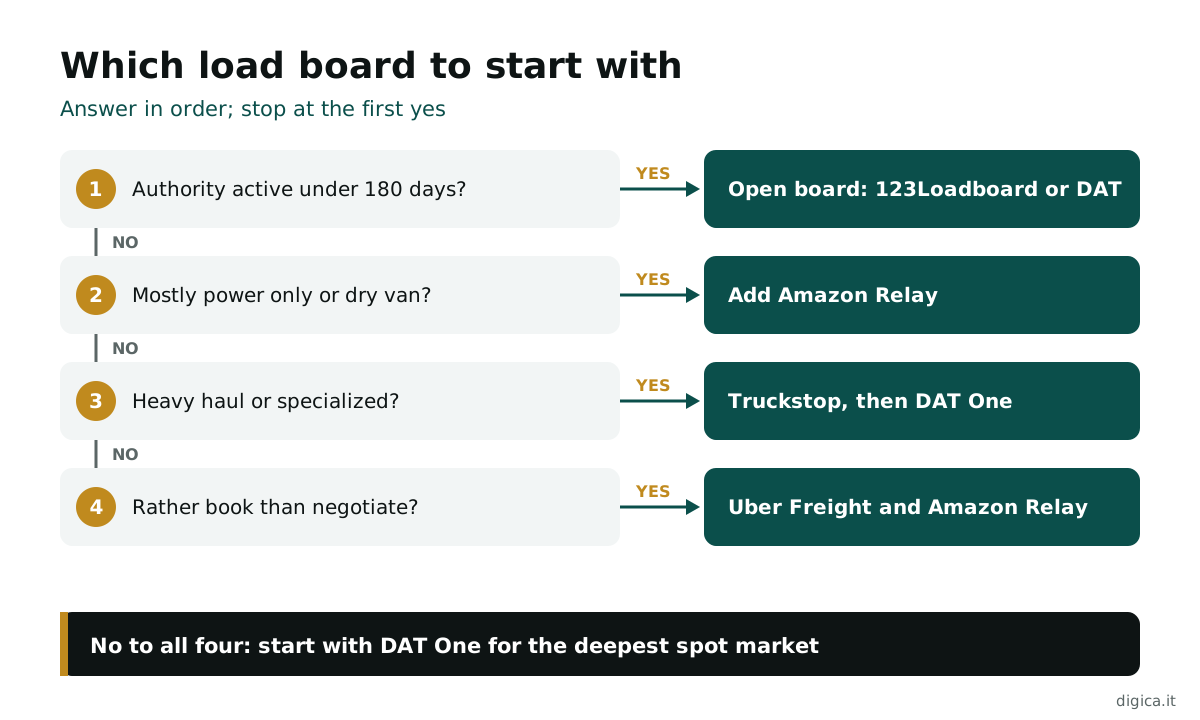
- Authority active for less than 180 days: under the Amazon Relay carrier requirements, Relay is closed to you. Start with an open board such as 123Loadboard or DAT One, using a free trial on your three main lanes.
- Mostly power only or 53-foot dry van: add Amazon Relay as soon as you qualify. Its volume is concentrated in exactly that equipment.
- Heavy haul, flatbed or specialized: compare Truckstop and DAT One on your lanes; specialized loads concentrate on the two largest open boards.
- You would rather book than negotiate: use Uber Freight and Amazon Relay alongside one open board, and benchmark their rates against the open market.
- Already running Trucker Path for navigation: use its free board first. With Truckstop loads now inside it, the free tier covers more than it did a year ago.
Most carriers end up on two boards, not one: one open board for depth and one instant-booking board for speed. Brokers usually post on several, which is exactly why ghost loads exist. For founders, the same logic applies in reverse: our guide to marketplace vendor onboarding covers how to turn a newly signed-up carrier into an active one.
The number that matters: loads in your lanes
DAT One leads the ranking with more than 700,000 load posts a day, and Truckstop follows with 80 million loads a year. But the number worth taking from this guide is the one no board publishes for you: how many bookable loads post on your three most-run lanes, in your equipment, before 9 a.m. Count that on two boards for one week. The board that wins that count is the best load board for your business, whatever its national total. The cost of doing nothing is paying $59 to $339 a month for a board that does not cover the lanes you actually run.
FAQ
Which load board has the most loads? DAT One has the most published volume, with more than 700,000 load posts a day and 291 million loads and trucks posted a year. Truckstop is second, reporting 80 million loads a year, followed by 123Loadboard at 57.6 million truckloads posted.
Which load boards offer instant booking? Amazon Relay and Uber Freight let approved carriers book instantly at a listed rate. Truckstop's Book It Now works on loads where the broker enables it. DAT One's Book Now is in beta for carriers pre-approved by participating brokers. 123Loadboard does not offer instant booking yet.
What is the best load board for new carriers? New authorities should start with an open board such as 123Loadboard or DAT One, because Amazon Relay requires authority active for at least 180 days. A free tier such as Trucker Path's load board is a useful second source while you build history.
Are load board load counts accurate? They are real but not comparable. Brokers often post the same load on several boards and leave postings up after loads are covered, creating ghost loads. Platforms also count different things, from loads and trucks together to contracts and shipments.
What is the best load board for power only? Amazon Relay, where the majority of loads are power only. Uber Freight and DAT One also list power-only loads; DAT added a dedicated power only category in September 2025.
Is there a free load board? Yes. Trucker Path's load board is free and now includes Truckstop loads, and Amazon Relay and Uber Freight are free for approved carriers. DAT One, Truckstop and 123Loadboard charge monthly subscriptions, with free trials.
Related Articles
- Freight and logistics marketplace growth
- Best B2B logistics marketplaces in 2026: top 5 compared
- Best B2B marketplaces in 2026: 7 examples by industry
- The marketplace liquidity metric that compounds
- How to attract vendors to a B2B marketplace
This article is part of our B2B marketplace growth series. Browse more on the Digica blog.