Ranking the best independent branding agencies in London for 2026: 8 studios
A brand identity is one of the longest lived assets a company buys. The Royal Institute of British Architects ran the same identity for a quarter of a century before Johnson Banks redrew it in 2025. Whatever you commission now will sit on your product, your sales deck and your recruitment page for the next decade, and every campaign you run will either build on it or work around it.
The commercial case for getting it right is not soft. Kantar's BrandZ research has tracked a portfolio of strong brands for 20 years and reports that it has consistently outperformed both the S&P 500 and the MSCI World index. Strong brands do not appear by accident. They are usually the result of one good brief, one well chosen agency and years of disciplined use.
This ranking covers eight independent branding agencies in London, from partner owned Pentagram to employee owned DNCO. For each one you get what it is known for, what kind of brief it fits, what to check before you sign, and what branding work typically costs, so you can build a shortlist you can defend.
Key takeaways
- London's independent branding agencies split into three groups: global studios, institutional and public brand specialists, and challenger brand studios.
- The ranking reflects breadth of current named work and award record. The right pick for your brief can sit anywhere on the list.
- Budget for rollout, not only design. Applying a new identity across products, signage and sales material often costs as much as creating it.
- Ask who will lead your project. At partnership studios you are hiring one partner's team, not the whole firm.
- A brand system should carry you for five to ten years. Judge proposals on how the system will be used, not only on the first logo you see.
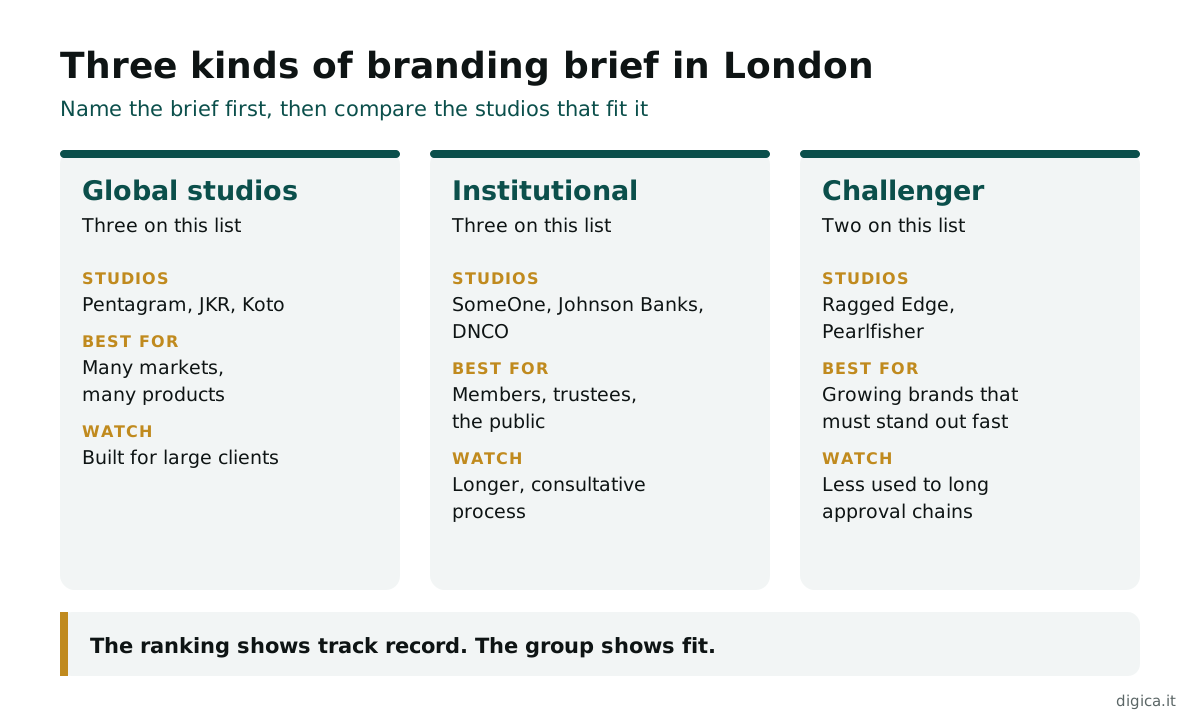
The three groups answer different questions. Global studios carry a brand across dozens of markets and thousands of touchpoints at once. Institutional and public brand specialists handle organizations with members, trustees or the public to answer to, where consultation matters as much as design. Challenger brand studios work with founders and growth teams who need a brand that earns attention fast. Start by naming which question your brief is really asking.
Quick Navigation
- How we ranked the best independent branding agencies in London
- The 8 best independent branding agencies in London at a glance
- Global studios
- Institutional and public brand specialists
- Challenger brand studios
- What a branding agency in London costs
- Three ways a rebrand goes wrong
- Where to start: a decision framework
- FAQ
- Related Articles
How we ranked the best independent branding agencies in London
Every studio here is independent, has its main studio in London and shows named, current branding work. We ranked them on two things we can check: the breadth of named work for well known organizations, and recognition from the design industry. Neither measures fit, which is why the groups below matter more than the numbers.
Four filters came first:
- Independent. Not owned or majority controlled by WPP, Omnicom, Publicis, IPG, Havas, Dentsu or another network. Partner, founder, employee and private equity ownership all qualify. That rules out several famous London names, including Made Thought, now part of WPP.
- Branding first. Identity, naming, brand strategy and brand systems are the core offer, not a side service of a campaign or digital marketing agency.
- London studio. The work is led from London, even where the studio has offices elsewhere.
- Named, current work. Every fact about each agency comes from its own site or from trade press such as Design Week, Dezeen and Creative Boom.
Our view, from years of sitting on both sides of agency selection: the most famous studio is rarely the best answer to a first rebrand. The best answer is the team that has solved your kind of problem recently and will put senior people on it.
The 8 best independent branding agencies in London at a glance
The table ranks the eight studios and compares type, standout work, typical engagement, main risk and best fit. Budgets are industry estimates by agency type, not quotes from the agencies.
Eight independent branding agencies in London ranked and compared by engagement model, typical budget, main risk and best fit.
| Agency | Type | Known for | Typical engagement and budget | Main risk | Best for |
|---|---|---|---|---|---|
| 1. Pentagram | Global studio | London Design Festival, St Paul's Cathedral, BFI London Film Festival | Project led by one partner, upper end of the market | You hire one partner's team, not the firm | Cultural institutions and design led companies |
| 2. JKR | Global studio | Heinz masterbrand, Burger King rebrand | Project plus ongoing design, typically six figures for a masterbrand | Built for very large consumer brands | Consumer packaged goods at scale |
| 3. Koto | Global studio | Fanta for Coca-Cola, Glassdoor, Discord | Project, brand and digital together | Fast growth through acquisition | Technology and digital first brands |
| 4. SomeOne | Institutional and public | Co-op, Eden Project, Motability | Project, $20k to $65k for a mid size identity, more for a system | Long, consultative process | Member and public facing organizations |
| 5. Johnson Banks | Institutional and public | RIBA, Shelter, Science Museum | Project, identity and guidelines | Small studio capacity for rollout | Institutions, charities and universities |
| 6. DNCO | Institutional and public | London Overground line names for TfL | Project, research led, priced by scope | Place and property focus | Places, developments and public bodies |
| 7. Ragged Edge | Challenger studio | Wise, Granola, Papier | Project, $20k to $65k for an identity, more with rollout | Strongest with founder led businesses | Fintech and tech scale ups |
| 8. Pearlfisher | Challenger studio | Absolut, Green & Black's, Innocent | Project including packaging, priced per range | Packaging heavy portfolio | Food, drink and consumer challengers |
The budget column uses industry estimates. UK guides put a full brand identity from a mid size agency at about $20,000 to $65,000, while a complete brand system with rollout for a larger business can reach $250,000. Global studios working on masterbrands sit above that range. Ask each agency for a scoped estimate that separates strategy, design and rollout before you compare them.
Run a branding agency and want buyers to find you first?
We help independent agencies win more of the searches and AI answers their clients use to build shortlists.
Use the table to rule studios in or out, then read the sections below for the detail. Each entry closes with a Best for line and a Watch line. The Watch lines are the questions a finance or procurement lead will raise, and answering them before the first meeting saves a round of follow ups and keeps the shortlist honest.
Global studios
Global studios run brands that live in many markets at once. They bring the systems thinking, production discipline and senior design talent that a masterbrand or a multi market rollout needs. The trade off is scale: they are built for large clients, and a small account can struggle to get the attention it expects.
1. Pentagram
Pentagram is a partner owned design studio, founded in London in 1972, in which each partner runs an independent practice inside a shared firm. The London studio has around ten partners. Recent London work includes the London Design Festival identity, which Domenic Lippa's team has designed since 2007, a new identity for St Paul's Cathedral, and Marina Willer's identity and campaign for the 2026 BFI London Film Festival.
Best for: cultural institutions and design led companies that want a senior partner to lead the work personally.
Watch: you are hiring one partner and their team, not the whole firm. Choose the partner whose recent projects are closest to your brief, and meet them before the pitch.
2. JKR
JKR, founded in London in 1990 as Jones Knowles Ritchie, is an independent, design led creative company with studios in London, New York and Shanghai. Its best known work is for very large consumer brands: the first global masterbrand for Heinz, covering logo, identity and packaging, and Burger King's first full rebrand in about 20 years, created by its London and New York teams together.
Best for: consumer packaged goods brands that need one system to work across hundreds of products and many markets.
Watch: the portfolio is built on household names. For a smaller brand, ask for a recent project of comparable size and budget.
3. Koto
Koto was founded in London in 2015 by James Greenfield, Caroline Matthews and Jowey Roden and now has studios in London, Berlin, Los Angeles, New York and Sydney. Its early break was a Fanta rebrand for Coca-Cola, and its client list now runs across technology and consumer brands including Airbnb, Discord, Glassdoor and Spotify. It is independent of holding groups, backed by private equity investor WestBridge since 2025, and bought Stereo Creative in 2026.
Best for: technology and digital first brands where the identity has to work in product, in motion and on screen as much as in print.
Watch: the studio is growing quickly through investment and acquisition. Ask which studio and which creative lead will run your project.
Institutional and public brand specialists
These studios work for organizations that answer to members, trustees, staff or the public. That changes the job. Research, consultation and the politics of approval take as much effort as the design, and a good studio in this group is as skilled at bringing a board along as at drawing a mark. Expect longer timelines and a heavier strategy phase.
4. SomeOne
SomeOne is a London brand consultancy founded in 2005 by four partners, covering strategy, identity, naming and brand guardianship. It created the London 2012 pictograms, and its current work includes the Co-op identity, developed over a four year relationship and launched in 2024 with a symbol broken into five pieces to stand for members, as well as rebrands for the Eden Project and the Motability Scheme.
Best for: member owned, public facing and consumer organizations with many audiences to satisfy.
Watch: SomeOne's process is consultative and research heavy. Build the time for stakeholder sessions into your plan from the start.
5. Johnson Banks
Johnson Banks is a founder led London studio, independent since 1992, known for identity work with institutions, charities and universities, including Shelter, the Science Museum and University College London. In 2025 it delivered the first new identity for the Royal Institute of British Architects in a quarter of a century, covered in detail by Dezeen, with a rollout starting from a redesigned RIBA.org.
Best for: institutions, charities and universities that need an identity rooted in their history and built to last.
Watch: it is a small studio. For a large rollout across many sites or sub brands, agree early who produces the artwork at volume.
6. DNCO
DNCO is a London creative agency specializing in places, developments and public organizations, and has been 100% employee owned since 2019. It won Transport for London's tender to name the six London Overground lines, running a public engagement program across the network that produced names including the Lioness, Suffragette, Windrush and Liberty lines.
Best for: place brands, property developments, transport and public bodies where naming and public engagement matter.
Watch: the strongest work sits in place and property. For a product or corporate brand, ask for the closest comparable case study.
Is your branding agency missing from AI shortlists?
We check where your agency appears in AI answers and search for your category, and who appears instead.
Institutional work rewards patience and process. The last group runs at a different speed. Challenger brand studios work with founders and growth teams who need a brand that gets noticed now and can scale with the business, often while it is raising money or entering new markets. Speed is the selling point, so the questions to ask are about how the brand will hold up once the company is three times the size.
Challenger brand studios
Challenger brand studios build brands for companies that are growing fast and competing against bigger, older rivals. They are comfortable with founders in the room, short timelines and identities that have to work in a product, an app store listing and a funding announcement in the same month. Their risk is the mirror of the institutional group: less experience of long, multi stakeholder approval chains.
7. Ragged Edge
Ragged Edge is a London branding agency run by its two founders that works with challenger brands across technology, finance and consumer goods. It led the global rebrand of Wise, rolled out across 175 countries, rebranded the stationery brand Papier for its move into the US, which won a D&AD Wood Pencil, and rebranded the AI notepad Granola with a launch campaign across San Francisco, New York and London.
Best for: fintech, software and consumer scale ups that need a brand ready for their next stage of growth.
Watch: the portfolio leans to founder led businesses. In a large corporate with formal procurement, ask how the team adapts its process.
8. Pearlfisher
Pearlfisher is an independent, strategy first brand design agency and B Corp, founded in London in 1992 by Jonathan Ford, Karen Welman and Mike Branson, with studios in London, New York, San Francisco and Copenhagen. Its work for food, drink and consumer brands includes Absolut, Green & Black's, Innocent and Waitrose, and packaging is central to most of its projects.
Best for: food, drink and consumer challengers where the pack on the shelf is the brand's main media.
Watch: the portfolio is packaging heavy. For a service or B2B brand, ask for work outside the shelf.
That completes the eight. The rest of this guide covers what branding costs, where rebrands fail and how to pick the right group for your brief before you compare names.
What a branding agency in London costs
Branding agencies in London price in three ways, and the pricing model shapes what you get as much as the number does. These figures are industry estimates by agency type.
- Identity project. A fixed fee for strategy, identity and core guidelines. UK guides put a full identity from a mid size agency at about $20,000 to $65,000. Global studios working on a masterbrand typically charge well into six figures.
- Brand system and rollout. Applying the identity across products, packaging, signage, digital and sales material. For a larger business this can reach $250,000 and often matches or exceeds the design fee.
- Naming and verbal identity. Often scoped separately. Budget for trademark searches and legal clearance in every market you trade in.
- Ongoing guardianship. A smaller retainer to keep the brand consistent as new teams and agencies use it.
The bigger cost is what happens after launch. Les Binet and Peter Field's analysis of IPA effectiveness data found that the most effective budgets put around 60% into long term brand building. A brand that is hard to use gets used badly, and that investment leaks away in every campaign.
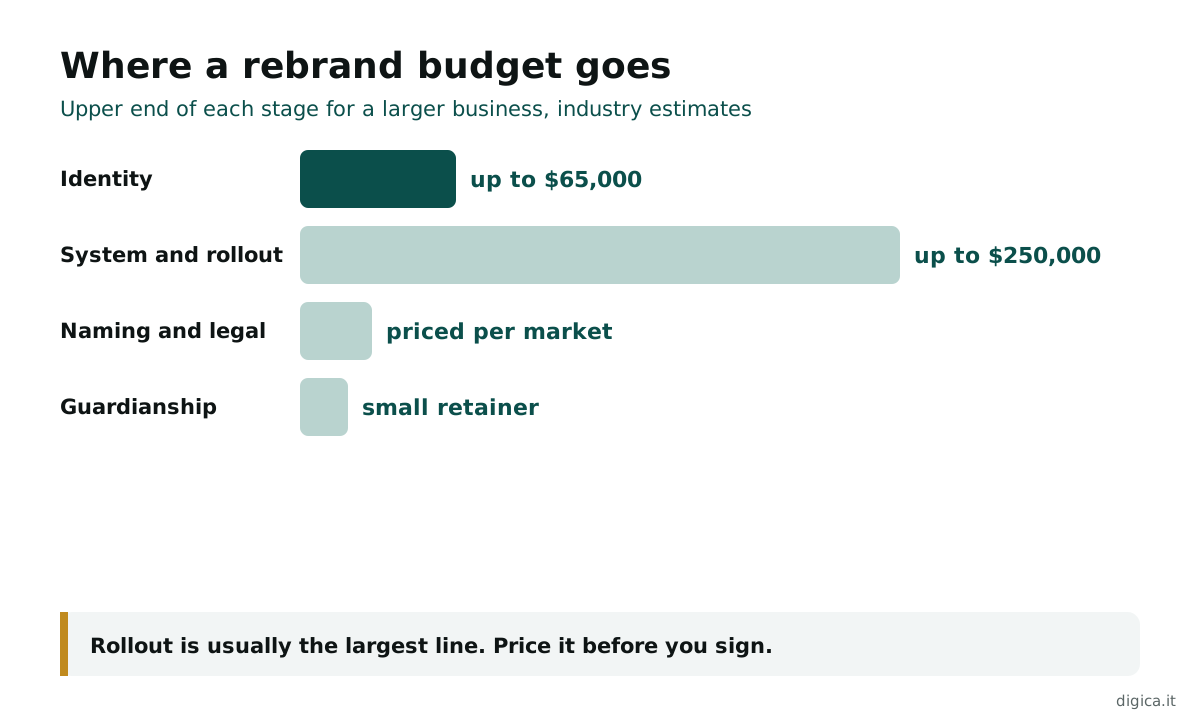
The diagram shows where the money goes. The identity itself is usually the smallest line once a business has more than a handful of products, sites or markets. Ask every agency to price rollout and guardianship in the same proposal, so you compare the full cost of the brand rather than the cost of the first presentation.
Three ways a rebrand goes wrong
Most rebrands that disappoint fail on the brief or the rollout, not on the design. These are three patterns that recur, with what each one costs.
- The brief is really a campaign problem. A business commissions a $65,000 identity because sales have stalled, when the issue is the offer or the message. The new brand launches, sales stay flat, and the next year's budget goes on a campaign agency anyway. A two week strategy phase would have shown the brand was not the problem.
- Rollout is not budgeted. The identity costs $50,000, but applying it across packaging, signage and the website costs another $150,000 that nobody approved. The old and new brands run side by side for 18 months, and customers see two companies instead of one.
- The wrong group for the brief. A member organization hires a challenger studio for speed. The work is sharp, but the board was never consulted and rejects it at the last stage. Six months and the full design fee are lost, and a second agency starts again from research.
Where to start: a decision framework
Name the job before you name the agency. These rules use the size of the rollout and the shape of your organization to point you to the right group.
Match the group to the brief:
- If the brand must work across more than five markets or more than 100 products, start with the global studios.
- If more than three groups of stakeholders must approve the brand, such as members, trustees, staff or regulators, start with the institutional and public specialists.
- If you are raising money, launching a product or entering a new market within the next 12 months, start with the challenger brand studios.
- If your total budget, including rollout, is under $75,000, leave the global studios off the list and look for a smaller studio with recent work in your category.
Then run a short, defensible process:
- Write a one page brief covering the business problem, the audiences, the rollout scope and the budget for both design and application.
- Shortlist three studios, never more than four.
- Ask each to show one recent project of similar scope and to name the lead designer.
- Agree how the brand will be judged, such as recognition, consistency or sales, before work starts.
- Decide within six weeks so the best studios stay available.
Want to be the agency brands shortlist first?
Digica runs the same growth engine for independent agencies that we run for B2B marketplaces.
The bottom line for your next budget meeting: price the brand as identity plus rollout plus guardianship, and a larger business should expect up to about $315,000 in total, not the $20,000 to $65,000 on the first proposal. The cost of doing nothing, or of skipping the rollout budget, is a brand that runs in two versions for a year and a half and a second rebrand within five years. Budget the full figure once and the brand pays back across every campaign that follows.
FAQ
What is an independent branding agency? A branding agency that is not owned or controlled by a holding company such as WPP, Omnicom, Publicis, IPG, Havas or Dentsu. Independents can be partner owned, founder owned, employee owned or backed by private investors.
Which are the best independent branding agencies in London? Our 2026 ranking is Pentagram, JKR, Koto, SomeOne, Johnson Banks, DNCO, Ragged Edge and Pearlfisher. The best choice depends on whether your brief is global, institutional or challenger led.
How much does a branding agency in London cost? As an industry estimate, a full identity from a mid size London agency costs about $20,000 to $65,000. A brand system with rollout for a larger business can reach $250,000, and global masterbrands cost more.
How long does a rebrand take? A focused identity project usually takes three to six months. Institutional rebrands with wide consultation and large rollouts can take a year or more.
What is the difference between a branding agency and a creative agency? A branding agency builds the identity and the system behind it. A creative agency uses that brand to make campaigns. Many businesses need both, briefed in that order.
Should I pay a branding agency to pitch? If you want original thinking in the pitch, yes. A paid pitch usually gets more senior attention, and many independent studios now decline unpaid creative pitches.
Related Articles
- The 7 best independent creative agencies in London in 2026, and what each is best at
- The best B2B agencies in 2026, ranked by specialty
- Top independent digital marketing agencies for 2027: which pricing model and payment terms fit your business
- The best agency directories in 2026, ranked on verified reviews and buyer traffic
- The best design marketplaces for businesses, grouped by how they vet designers
Where this connects
This article is part of our agency growth series. More guides on the Digica blog.