The best design marketplaces for businesses, grouped by how they vet designers
A design marketplace lets a business hire a designer without running a recruitment process, and the quality of what you get depends on one thing the homepage rarely explains: who was let in. One platform in this guide says fewer than 3 percent of applicants make it. Another lets anyone open a profile and leaves the filtering to you. Both call their designers great.
The stakes are real for a small team. A logo, a website or a product interface is usually bought once and lived with for years. In the US, graphic designers earned a median of $62,960 in May 2025, and 20 percent of them were self-employed (US Bureau of Labor Statistics). That is a large pool of independent talent, and a wide spread of quality inside it.
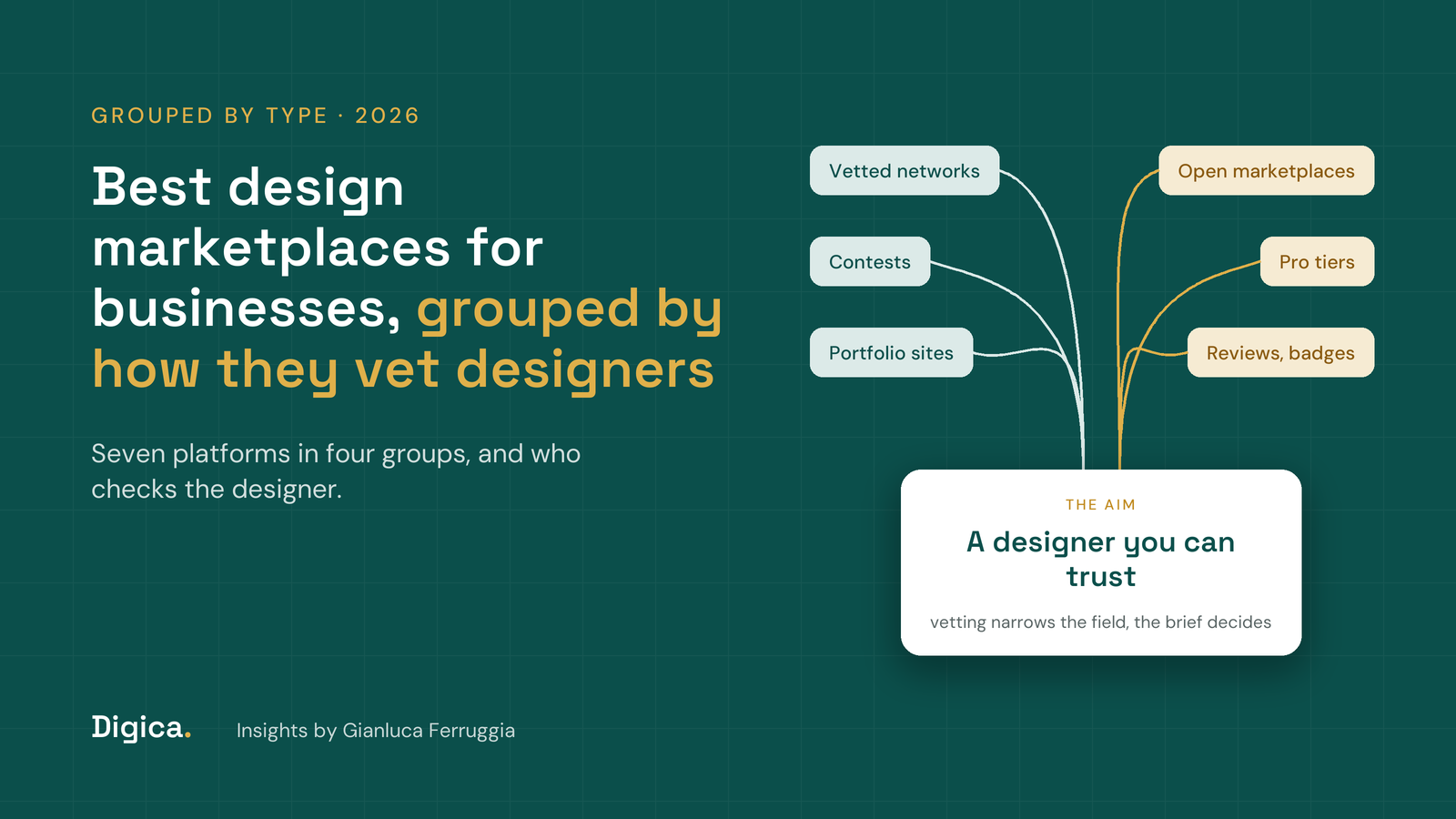
This guide groups seven design marketplaces by how they vet designers: vetted networks, contest platforms, portfolio communities that hire, and open freelance marketplaces. It is written for founders, marketing leads and operations teams hiring for brand, web and product design, and for operators growing a freelance or creative B2B marketplace. Every claim comes from the platform's own pages or filings, checked on November 9, 2026.
Quick Navigation
- What a design marketplace is, and what it is not
- How we judged talent quality
- Seven design marketplaces at a glance
- Vetted talent networks: Toptal
- Design contest platforms: 99designs and DesignCrowd
- Portfolio communities that hire: Dribbble and Behance
- Open freelance marketplaces: Fiverr Pro and Upwork
- What vetting proves, and what it does not
- Three failure scenarios
- Choosing a design marketplace for the job
- What a better design hire is worth
- FAQ
- Related Articles
What a design marketplace is, and what it is not
A design marketplace, in this guide, is a platform where a business hires a designer or a design team for its own project. The term is also used for asset stores that sell templates, fonts and mockups, and those pages rank well for the same search.
We left asset stores out on purpose. A template helps you ship a slide deck this afternoon. It does not give you a brand that nobody else can buy for the same price. When the job is a logo, a website or an interface your customers will use every day, you are hiring judgment, and judgment is what the vetting question is about.
The seven platforms here sell that judgment in four ways. Vetted networks screen designers before they join and then match you with one. Contest platforms let many designers answer one brief, so you choose from finished concepts. Portfolio communities let you browse work first and hire the person behind it. Open freelance marketplaces let anyone sell, and give you reviews and badges to sort them.
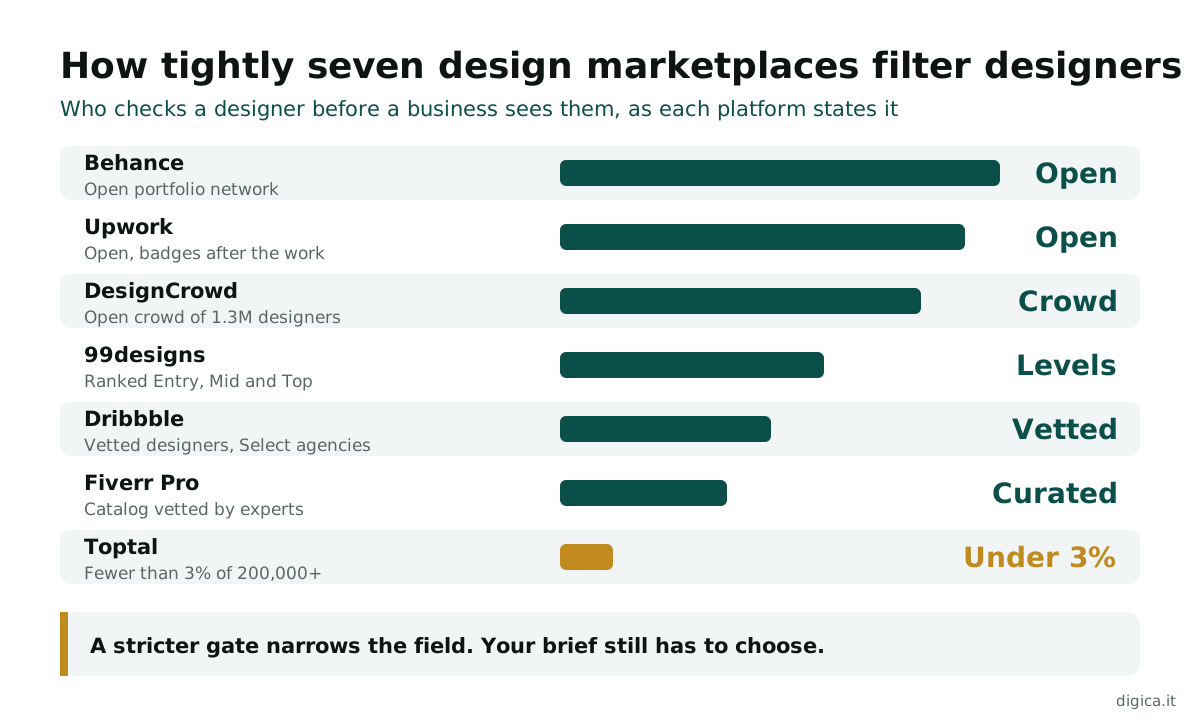
Our view: the model matters more than the brand name. Two platforms with the same number of designers can give you very different results if one screens at the door and the other screens after the job.
How we judged talent quality
We asked four questions of each platform. Who checks a designer before a business sees them? What is the check, in the platform's own words? What happens after joining, such as levels, badges or removals? And what protects the buyer if the work is not good enough?
We read each answer on the platform's own pages or in its filings. Where a page would not load for us, we used the company's filings or left the claim out. That is why some popular figures, such as acceptance rates for curated tiers that the platforms themselves do not publish, are missing here.
We also kept price out of the ranking. Every platform here can be cheap or expensive depending on the brief, and a low price on a weak designer is the most expensive outcome of all. If cost is your main question, our guide to Upwork alternatives covers fees across freelance platforms.
Our view: a guarantee is not a substitute for vetting. A refund returns your money, not the three weeks you spent waiting for a logo you cannot use.
Seven design marketplaces at a glance
Toptal states the strictest entry filter, 99designs runs the clearest ranking system after entry, and Behance and Upwork leave the most filtering to the buyer. Read the "Who checks the designer" column first.
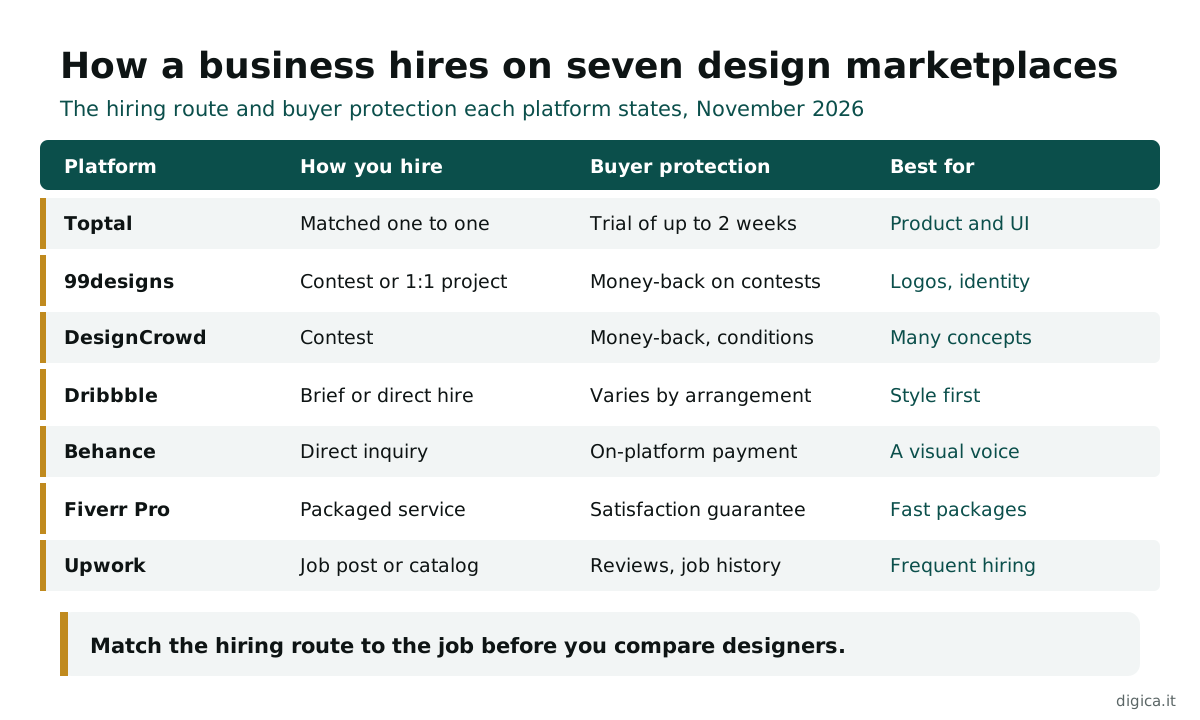
Seven design marketplaces compared on type, who checks the designer, the stated check, how a business hires, buyer protection, main risk and best fit
| Platform | Type | Who checks the designer | The check, as stated | How you hire | Buyer protection | Main risk | Best for |
|---|---|---|---|---|---|---|---|
| Toptal | Vetted network | Toptal, before joining | Fewer than 3% of 200,000+ applicants a year | Matched 1:1 | Trial of up to two weeks | Small pool for niche styles | Senior product and UI design |
| 99designs | Contest and 1:1 | A quality team, after joining | Entry, Mid and Top levels | Contest or direct project | Money-back guarantee on contests | Entry designers in open contests | Logos and brand identity |
| DesignCrowd | Contest | The buyer, from entries | No vetting stated | Contest | Money-back guarantee, conditions apply | Volume over depth | Many concepts on a small budget |
| Dribbble | Portfolio community | Dribbble, for Select agencies | "Vetted" designers and agencies | Brief or direct hire | Varies by arrangement | Portfolio may not match process | Browsing style first |
| Behance | Portfolio community | The buyer | Open network | Direct inquiry | On-platform payments | No screening at all | Finding a specific visual voice |
| Fiverr Pro | Curated tier | Industry experts | "Fully vetted" catalog | Packaged service | Satisfaction guarantee page | Acceptance rate not published | Fast, packaged design work |
| Upwork | Open marketplace | The buyer, with badges | Reviews and track record | Job post or catalog | Reviews and job history | Quality varies widely | Ongoing work you manage |
The groups below follow the table. Each one has a clear strength, and each fails a buyer who wants the strength of a different group.
Vetted talent networks: Toptal
Toptal is the clearest example of vetting before a business ever sees a designer. It says that of the more than 200,000 people who apply to join its network each year, fewer than 3 percent make the cut, and it also screens for language and interpersonal skills.
You do not browse. You speak to an adviser, describe the work and get matched with a hand-selected designer. Toptal states an average time to match of under 24 hours. Its protection is a trial of up to two weeks: if you are not satisfied, you are not billed. It also reports a 98 percent trial-to-hire rate, which is its own measure of how well the matching works.
The strength is senior design for product work, such as an interface, a design system or a redesign that has to ship with engineers. These jobs need someone who can defend a decision in a review, not just make a nice screen.
Running a design or creative B2B marketplace?
In 30 minutes we look at how businesses find platforms like yours, on Google and in AI answers, and where they leave before they post a brief.
The weakness is the same filter. A strict entry gate selects for a profile, usually senior and product-minded. If you need a hand-lettered logo or an illustration style, you may find more range in a contest or a portfolio community. And the page does not describe a design-specific test, so ask what the screening involved for your designer's discipline.
Our view: pay for a vetted network when a weak hire would cost you a quarter, not a week. For a one-off asset, the filter is more than you need.
Design contest platforms: 99designs and DesignCrowd
Contest platforms reverse the order. Instead of vetting the designer and then seeing work, you see the work first and pick the designer who made it. The two biggest differ on what happens before a designer can enter your contest.
99designs by Vista says a dedicated quality team ranks its designers as Entry, Mid or Top Level, judged on design principles, concept, technical skill and client communication. Designers can only apply to move up during set application periods, and the review includes their portfolio and account history. Entry Level designers are limited to 10 contests a month, while Mid and Top designers have no limit. It offers a money-back guarantee on contests, and shows an average of 4.8 out of 5 from 37,649 reviews. It says its creators have earned more than $300 million on the platform since 2008.
DesignCrowd shows the open version of the same model. It lists 1,345,378 freelance designers, more than 100,000 businesses and 537,682 completed projects, and says a project receives 25 to more than 100 designs. We found no vetting step stated on its homepage. Quality comes from volume: many designers answer, and you choose. It offers a money-back guarantee, with conditions.
The difference shows up in the shortlist. With levels, you know who is ranked where before you choose. With an open crowd, you get more concepts and must filter them yourself, which takes time and a trained eye.
Contests suit logos and visual identities, where seeing ten finished options teaches you what you want. They suit product design poorly, because an interface needs research and iteration that no contest pays for.
Portfolio communities that hire: Dribbble and Behance
Portfolio communities start from the work a designer chose to publish. You browse, find a style you like and contact the person. The two largest differ on whether anyone checks the designers you are browsing.
Dribbble began in 2009 as a small, invite-only space for designers to share work, and its hiring page now describes vetted freelance designers and developers. Its Dribbble Select agencies are described as vetted for high-quality work and proven results on large projects. Businesses can post a project brief and receive proposals, or filter for designers who are available for work, hold a Pro plan or respond quickly. Pro plans remove Dribbble's platform fee on designer payouts.
Behance, owned by Adobe, is an open portfolio network with no entry screening. A business sends an inquiry from a designer's profile, the designer replies with a proposal and can ask for an upfront payment, and payment runs on the platform. Its own freelance guide, published in May 2025, says that when a designer has a Pro membership, both the designer and the client pay 0 percent platform fees on freelance jobs.
The strength of both is visible taste. A portfolio is real evidence of what a designer makes when the choice is theirs. The weakness is that a portfolio shows finished work, not the process, the brief or the deadline behind it.
Open freelance marketplaces: Fiverr Pro and Upwork
Open freelance marketplaces are the largest in this guide, and design is one category among many. Both add a filter on top of the open market, and that filter is what a business should use.
Fiverr describes Fiverr Pro, in its 2025 annual report, as a carefully curated freelancer catalog that is fully vetted by industry experts. Fiverr does not publish an acceptance rate for Pro, so treat third-party percentages with caution. The wider marketplace had 2.4 million active buyers at the end of September 2026, down from 3.3 million a year earlier. Services are sold as packages, which makes scope clear and suits defined design tasks.
Upwork's filings describe access to more than 10,000 skills in over 130 categories of work, including design and creative. It reported 717,000 active clients and $914.1 million of gross services volume in the third quarter of 2026. Its open marketplace does not screen designers before they join. Quality signals come from job history, reviews and talent badges, so the vetting effectively happens after the work.
The open model favors buyers who hire often and can judge work quickly. If you post three design jobs a month and know what good looks like, an open marketplace gives you the most choice. If you hire once a year, the filtering burden lands on someone without the practice to do it well.
What vetting proves, and what it does not
Vetting proves that a designer passed someone else's test on the day they applied. It does not prove they suit your brief, your industry or your deadline. A good platform narrows the field. It does not choose for you.
The demand side is changing what "good" means. Web and digital interface designers in the US earned a median of $104,000 in May 2025, and employment for web developers and digital designers is projected to grow 5 percent from 2025 to 2035 (US Bureau of Labor Statistics). Graphic design employment, by contrast, is projected to fall 2 percent. More of the work businesses buy is digital and product design, where skill is harder to judge from a static image.
Do businesses find your design platform before the big marketplaces?
A growth audit maps how buyers search for designers by discipline and industry, on Google and in AI answers, and which category and proof pages your platform is missing.
That shift makes the vetting model more important. A logo can be judged on sight. An interface has to be judged on how it works, which favors platforms that test process, or a buyer who asks for a short paid task before committing.
Three checks work on any platform. Ask for one project in the designer's portfolio that matches your job, and the brief behind it. Ask what they would need from you in the first week. And run a paid test of a day or two before any project longer than a month.
Three failure scenarios
These are patterns that recur when businesses hire designers through a marketplace without matching the platform to the job. The dollar figures are illustrative.
- The contest logo that could not scale. A startup runs a logo contest, picks the favorite concept and later finds it fails at small sizes and has no rules for color or type. A second designer rebuilds the identity six months on, at perhaps $8,000 including the lost launch materials. A brief that asked for a small brand system, not a single mark, would have attracted designers who build one.
- The beautiful portfolio, the wrong process. A team hires from a portfolio community for a product redesign, based on striking visuals. The designer has never worked with engineers or user research, and handoff takes twice as long as planned. A paid one-day test on a real screen would have shown the gap for a few hundred dollars.
- The open marketplace hire nobody checked. A marketing lead hires the cheapest strong-looking profile on an open marketplace for a website, without checking past work in the same industry. The site launches late and needs rework, costing perhaps $15,000 in agency fixes. Filtering by relevant history, or using a curated tier, would have cost a day.
Each platform did what it promised. The mistake was buying the platform's strength for a job that needed a different one.
Choosing a design marketplace for the job
Start with the job, then how often you hire, then how much filtering you can do yourself. Most businesses will use two of these platforms for different work.
- If the job is product or interface design that must ship with engineers, start with a vetted network such as Toptal, and use the trial.
- If you need a logo or visual identity and want to see options first, run a contest on 99designs, and ask which designer levels your package opens the brief to.
- If your budget is tight and you want many concepts quickly, DesignCrowd gives the widest field, and you must filter it yourself.
- If you know the visual style you want, browse Dribbble or Behance and contact designers whose published work matches it.
- If the work is a defined package, such as a set of social graphics, and you need it this week, use Fiverr Pro.
- If you hire designers more than twice a month and can judge work quickly, Upwork gives the most choice, and its badges help sort it.
- If the project runs more than three months or covers several disciplines, a design agency may suit you better than any marketplace.
Our guides to freelance marketplaces and talent marketplaces cover the wider hiring platforms these sit within. If you run one of these platforms, our guide to creator communities shows where designers gather outside them.
What a better design hire is worth
A better design hire is worth the rework you avoid, and it pays back the extra cost of a stricter platform on almost any project that lasts more than a month.
Design is also a large and growing part of the economy, and most of it is bought by businesses that are not design firms. The UK design economy employed 2.27 million people in 2025, up 15 percent since 2020, and 80 percent of designers work in industries outside design (Design Council). That is the buyer this guide is for: a business that needs design but does not hire it every day.
Growing a freelance or design B2B marketplace?
We help freelance and creative B2B marketplaces win the vetted talent that makes them credible, and reach the businesses searching to hire it.
Run an illustrative case. Suppose a product redesign costs $30,000 through an open marketplace and $40,000 through a vetted network. If the cheaper route has a one-in-three chance of a $25,000 rework, its expected cost is about $38,300, close to the vetted route before counting the delay. The inputs are illustrative, so use your own.
The number to bring to your next planning meeting is the cost of redoing your last design project. If it is more than a quarter of the original fee, pay for vetting next time. The biggest cost of doing nothing is a launch that waits on a second designer fixing the first one's work.
FAQ
What is a design marketplace? A design marketplace is a platform where businesses hire designers for projects such as logos, websites and product interfaces. Some vet designers before they join, some run contests and some let anyone sell. The term is also used for stores that sell design templates.
Which design marketplace has the best designers? On stated entry standards, Toptal is the strictest, saying fewer than 3 percent of more than 200,000 annual applicants are accepted. 99designs ranks designers into Entry, Mid and Top levels after they join. The best fit still depends on the job.
Are design contests worth it for businesses? Contests work well for logos and visual identities, where seeing many finished concepts helps you decide. They work poorly for websites and product design, which need research and iteration. Check the money-back terms before you launch one.
Is 99designs or DesignCrowd better? 99designs ranks its designers into Entry, Mid and Top levels and limits how many contests Entry designers can enter. DesignCrowd offers a larger open crowd, with 1,345,378 designers listed, and more concepts per project. Choose 99designs for control and DesignCrowd for volume.
Can I hire a designer on Dribbble or Behance? Yes. Dribbble lets you post a project brief or contact designers and vetted agencies directly. Behance lets you send an inquiry from a designer's profile and pay on the platform, with 0 percent platform fees when the designer has a Pro membership.
Is Fiverr Pro vetted? Fiverr describes Fiverr Pro as a curated catalog fully vetted by industry experts. It does not publish an acceptance rate, so review each designer's portfolio and past work in your industry before you buy.
Related Articles
- Freelance marketplace growth
- Best freelance marketplaces for businesses
- Best talent marketplaces
- Best Upwork alternatives
- Best creator communities
Where this connects
This article is part of our B2B marketplace growth series. Browse more on the Digica blog.