Fractional CMO Cost vs a Growth Consultant vs an Agency: What a B2B Marketplace Should Pay For
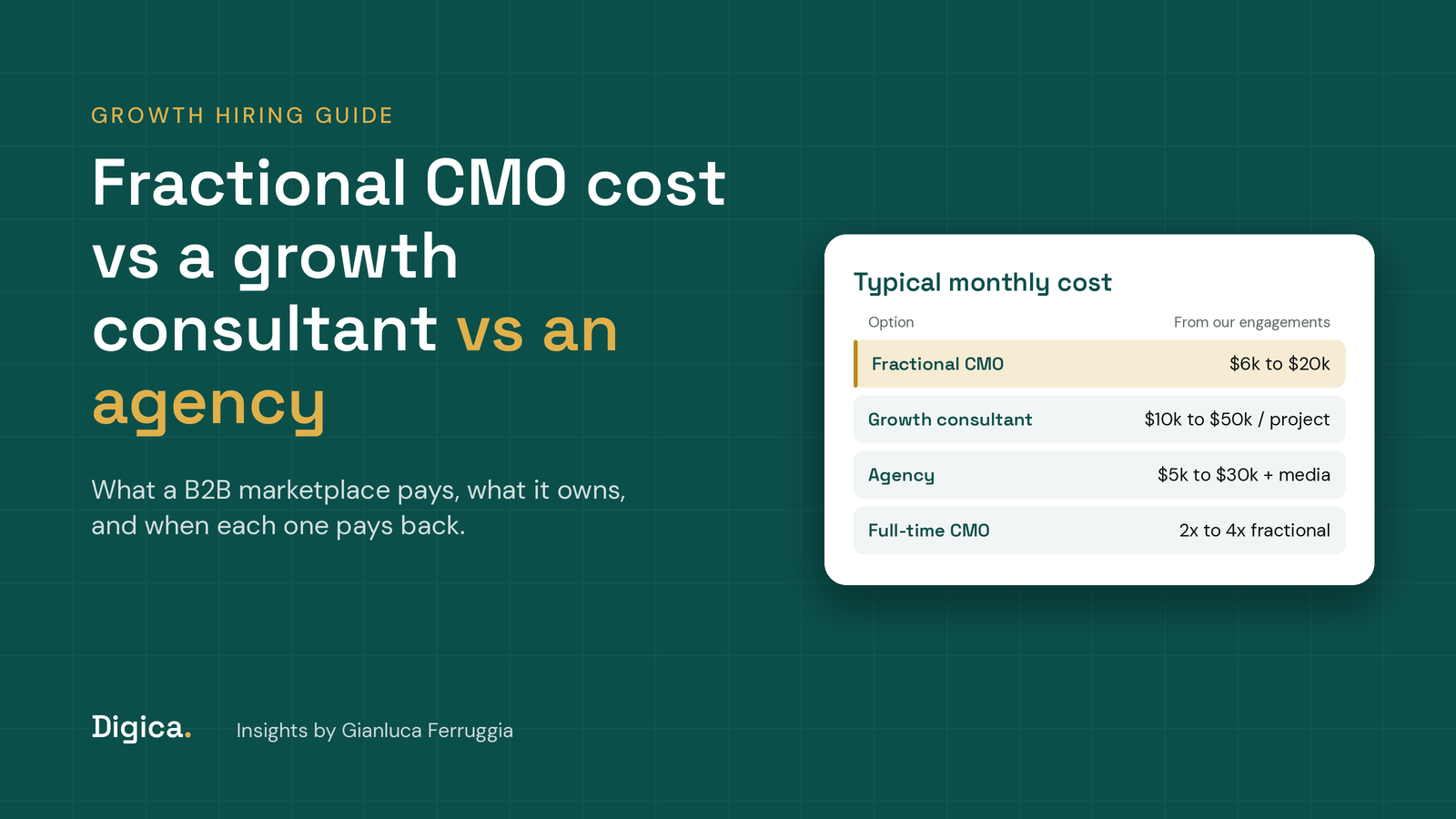
Most B2B marketplaces compare a fractional CMO with an agency on the monthly fee, and that is the wrong comparison. From the engagements we see, a fractional CMO costs $6,000 to $20,000 a month and an agency $5,000 to $30,000 a month before media. The prices overlap. What you get for them does not.
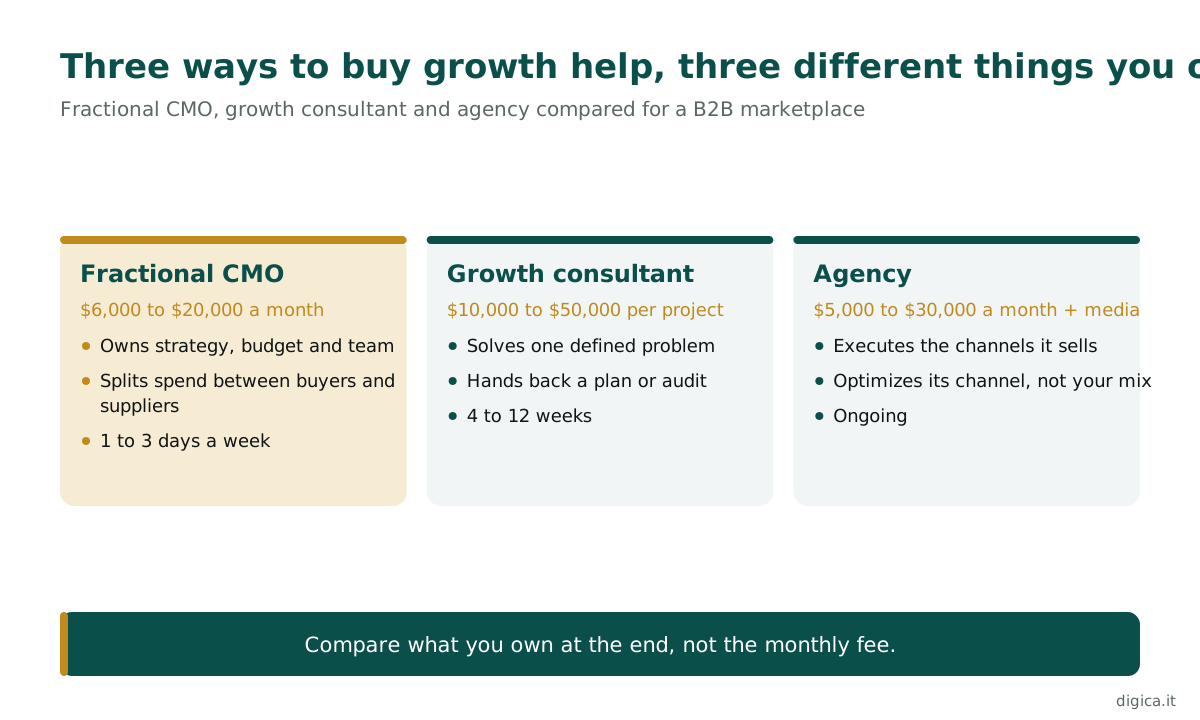
A fractional CMO owns the plan, the channel mix and the people executing it. An agency executes the channels it sells. A growth consultant solves one defined problem and leaves. Founders who buy an agency when they needed an owner end up paying for activity with nobody accountable for the outcome, and founders who hire a fractional CMO with no budget for execution end up paying for a strategy nobody ships.
This guide compares fractional CMO cost with a growth consultant and an agency for a B2B marketplace: what each costs, what you own at the end, where each fails, and a 12-month cost model you can take to the board. For a deeper look at how consultants structure fees, see our guide to growth consultant pricing models.
Quick Navigation
- What a fractional CMO, a growth consultant and an agency actually do
- Fractional CMO cost: what you pay and what you get
- Why marketplaces test the CMO role fractionally first
- Fractional growth help for marketplaces, ranked
- Three failure scenarios
- Where to start: a decision framework
- A worked example: 12 months of growth help, priced
- What a fractional CMO is worth on the same budget
- FAQ
- Related Articles
What a fractional CMO, a growth consultant and an agency actually do
A fractional CMO is a senior marketing leader who works part time, usually one to three days a week, and owns marketing strategy, budget and team as if they were on staff. A growth consultant is hired to solve a defined problem, such as a channel audit or a pricing test, and hands back a plan. An agency executes specific channels, such as SEO, paid media or content, against a scope.
The difference that matters is ownership:
- A fractional CMO owns the outcome. They set targets, decide the channel mix, hire and brief agencies or freelancers, and report to the CEO.
- A growth consultant owns a deliverable. The audit, the plan, the experiment design. What happens afterward is yours.
- An agency owns its channel. It will optimize what it runs. It will rarely tell you to move budget to a channel it does not sell.
For a B2B marketplace, the ownership question has a second layer: which side of the market? Buyer acquisition and supplier acquisition need different messages, channels and metrics. Someone has to decide how budget splits between them each quarter, based on where liquidity is short. Agencies rarely make that call; consultants make it once. A fractional CMO makes it every month, which is the main reason marketplaces hire one.
Our guide to go-to-market when both sides are customers covers that split in depth.
Fractional CMO cost: what you pay and what you get
From the engagements we see, a fractional CMO costs $6,000 to $20,000 a month, a growth consultant $10,000 to $50,000 per project or $4,000 to $15,000 a month on retainer, and an agency $5,000 to $30,000 a month before media spend. These are ranges from proposals and contracts marketplace founders share with us; no reliable public benchmark exists.
Fractional CMO, growth consultant, agency and full-time CMO compared by cost, time commitment, main risk and best fit.
| Option | Typical cost | Time commitment | What you own at the end | Main risk | Best for |
|---|---|---|---|---|---|
| Fractional CMO | $6,000 to $20,000 a month | 1 to 3 days a week | A strategy, a channel mix, a team that runs without them | Needs an execution budget to deliver | Marketplaces from launch to Series B |
| Growth consultant | $10,000 to $50,000 per project | Defined scope, 4 to 12 weeks | A plan or audit | Plan sits unshipped | One specific problem with an owner in house |
| Agency | $5,000 to $30,000 a month plus media | Ongoing execution | Campaigns and channel assets | Optimizes its channel, not your mix | Executing a channel strategy already set |
| Full-time CMO | Typically two to four times a senior fractional retainer, fully loaded (our experience) | Full time | A permanent leader | Long search, high cost of a wrong hire | Marketplaces past product-market fit on both sides |
What moves fractional CMO cost: days per week, seniority and marketplace experience, whether the role covers both buyer and supplier acquisition, and whether it includes hands-on execution or only leadership. Retainers at the low end usually mean one day a week of advice. At the high end, they mean a leader running a team.
Two pricing structures deserve a closer look. Fixed monthly retainers are the norm and the easiest to budget. Retainer plus performance links part of the fee to targets such as requests or active suppliers; it aligns incentives, but only if the tracking behind the targets is clean. If it is not, fix measurement first.
Do you need an owner, a plan or execution?
We will tell you which of the three your marketplace needs in a 30-minute call.
A useful test before you compare prices: write down the three decisions you want this person or firm to make in the next 90 days. If the list is about channels, you need an agency. If it is one diagnosis, you need a consultant. If it is about where the budget goes and who executes, you need a fractional CMO.
Why marketplaces test the CMO role fractionally first
Marketplaces test the CMO role fractionally because the full-time role is expensive to get wrong and hard to define early. HBR research by Kimberly Whitler and Neil Morgan found that 80% of CEOs say they do not trust or are unimpressed by their CMOs, and that CMOs have the briefest tenure in the C-suite, with much of the problem traced to poorly designed roles.
In a B2B marketplace, the role is harder still. The CMO has to grow two audiences with different motivations, decide which side gets budget each quarter, and work with product on supply quality, because a weak category page loses buyers no matter how good the campaign was. Few candidates have done that. Many have run single-funnel B2B marketing.
A fractional engagement lets the company learn what the role should be before hiring for it. After six to twelve months, the founder knows which channels work, how the budget should split between sides, and what a full-time hire needs to own. That is exactly the trade an early marketplace needs: senior judgment now, a permanent commitment later.
The fractional route also limits the cost of a bad fit. A month's notice is cheaper than unwinding a full-time executive hire after a long search, a relocation and an equity grant.
Fractional growth help for marketplaces, ranked
For a B2B marketplace that needs a growth owner, the strongest option is a fractional lead who has grown two-sided platforms and runs top-of-funnel growth on both sides. We are Digica, so we rank ourselves first; here are the criteria so you can test the ranking.
We ranked six options on four criteria: two-sided marketplace experience, ownership of outcomes rather than activity, ability to direct execution across channels, and cost relative to stage.
Fractional growth options at a glance, ranked for B2B marketplaces.
| Rank | Option | Model | Published cost | Main risk | Best for |
|---|---|---|---|---|---|
| 1 | Digica | Fractional growth leadership for B2B marketplaces | Not published, scoped after a call | Small senior team, limited capacity | Marketplaces that want traffic, authority and audience owned on both sides |
| 2 | Independent fractional CMO with marketplace experience | Monthly retainer | Rarely published | Single person, limited bandwidth | Founders who want one senior owner |
| 3 | Fractional CMO platform or network | Matched placement | Some platforms publish typical ranges | Marketplace experience varies by match | Fast access to vetted generalists |
| 4 | Growth consultant | Project | Varies | Plan without execution | A single diagnosis |
| 5 | Full-service agency | Retainer plus media | Varies | Optimizes its own channels | Executing a set strategy |
| 6 | Full-time CMO | Salary and equity | Not applicable | Long search, costly mis-hire | Scale on both sides |
1. Digica
We build the top-of-funnel growth engine for B2B marketplaces: traffic, earned authority and audience, for both buyers and suppliers. Our founder works as a fractional CRO and CMO for B2B marketplaces, so the engagement includes the decisions a CMO owns, plus the SEO, GEO and earned media work that drives the funnel. We will tell you honestly if your marketplace is not ready for this yet.
Best for: marketplaces from launch to Series B that need a growth owner who has done two-sided acquisition before.
Watch: we take a small number of marketplaces at a time.
2. Independent fractional CMO with marketplace experience
A senior independent with marketplace history can be an excellent owner, especially if they bring their own network of specialists.
Best for: founders who want one person, one relationship.
Watch: ask how many other clients they carry; three is typical, five is a warning.
3. Fractional CMO platform or network
Platforms that place vetted fractional marketers are fast. At least one publishes typical pricing of $7,000 to $10,000 a month for senior fractional marketers.
Best for: speed to a vetted candidate.
Watch: filter explicitly for two-sided experience; most candidates will not have it.
4. Growth consultant
Right for a defined question: why supplier activation stalls, which channel to cut, how to price a new side.
Best for: one diagnosis, with someone in house to execute.
Watch: plans that arrive with no owner for the first 90 days.
5. Full-service agency
Agencies execute well inside a strategy someone else owns.
Best for: scaling channels you have already proven.
Watch: budget drifting toward the channels the agency sells.
6. Full-time CMO
The right end state once both sides of the marketplace grow predictably.
Best for: marketplaces past product-market fit on both sides.
Watch: hiring before you can describe what the role owns.
Want a fractional growth lead who has done both sides?
We will walk through your buyer and supplier funnels and tell you honestly if we are the right fit.
Whichever option you shortlist, ask the same three questions on the first call. Which side of a marketplace have you acquired before, and how? What would you change in our budget split in the first 30 days? What will you need from us each week to ship? Good fractional leads answer the first two with specifics and the third with a short list. Vague answers on any of them are the cheapest warning you will get.
Three failure scenarios
These are patterns we see across B2B marketplaces. Figures are representative, not a specific account.
Scenario 1: the agency without an owner. A procurement marketplace signs a $15,000 a month full-service agency to "own growth". Twelve months and $180,000 later, paid campaigns are well run and buyer requests are up 20%, but supplier coverage in the top categories has not moved, so match rates fall. Nobody decided how budget should split between sides, because the agency's scope was buyer acquisition.
The right call: put a fractional owner above the agency to set the split between buyers and suppliers each quarter.
Scenario 2: the fractional CMO with no hands. A marketplace hires a $9,000 a month fractional CMO and gives them no execution budget. The CMO writes an excellent plan in month one and spends the next five months waiting for the founder to approve freelancers. Six months and $54,000 later, little has shipped.
The right call: budget execution alongside the retainer, typically 1 to 2 times the fractional fee, from day one.
Scenario 3: the full-time hire too early. A seed-stage marketplace hires a full-time CMO after a five-month search. The hire has run single-funnel B2B marketing and spends most of the first year on brand and buyer demand. Supplier growth stalls. The company parts ways after 14 months, with the search, salary, equity and lost time all spent.
The right call: run the role fractionally for six to twelve months, then hire against a job description written from what actually worked. HBR's research on fractional leaders describes the model as a way to benefit from senior leadership without the expense and commitment of a full-time hire.
Where to start: a decision framework
Choose by stage, revenue and what you can execute in house. These thresholds come from our engagements; adjust to your runway.
- If annual net revenue is under $1 million and nobody owns growth full time, hire a fractional growth lead at one to two days a week, plus specialist execution.
- If you have one clearly defined problem and an in-house owner, hire a growth consultant for a 4 to 12 week project instead.
- If strategy is set and proven, and you need volume in one channel, hire an agency for that channel, reporting to your growth owner.
- If one side of the market is more than 3x harder to acquire than the other, make sure whoever you hire has acquired supply before, not just demand.
- If annual net revenue is above $5 million and both sides grow predictably, start the full-time CMO search, using the fractional lead's results as the brief.
- If you cannot fund execution at least equal to the fractional fee, buy a consultant's plan now and the fractional lead later.
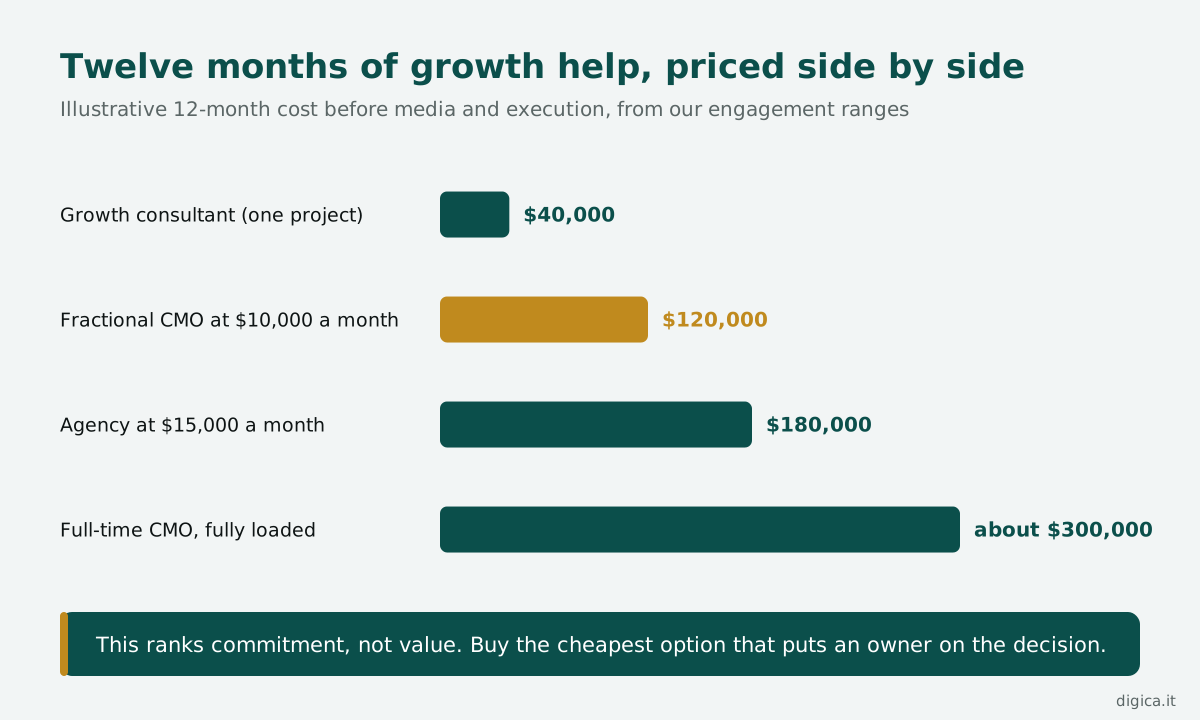
The chart is not a ranking of value; it is a ranking of commitment. The right option is the cheapest one that puts an accountable owner on the decision your marketplace most needs made. For most marketplaces before Series B, that decision is how to split growth spend between buyers and suppliers, category by category.
A worked example: 12 months of growth help, priced
Put the options on the same 12-month basis and price them against what one buyer request is worth. Monthly fees alone hide the difference, because each option needs a different amount of extra work from you before it delivers. Take a B2B marketplace with these numbers (illustrative):
- Request to transaction rate: 40%
- Net revenue per transaction: $200, so each request is worth 40% × $200 = $80
Twelve-month cost of each option (illustrative, before media and execution):
- Growth consultant: one $40,000 project
- Fractional CMO: $10,000 × 12 = $120,000
- Agency: $15,000 × 12 = $180,000
- Full-time CMO: about $300,000 fully loaded, plus recruiting
Two costs sit outside these figures. Execution: a fractional CMO or consultant needs people to ship the plan, typically 1 to 2 times the fractional fee in freelancers, tools or agency time. Recruiting: a full-time search through a retained firm commonly adds a fee on top of first-year pay, plus several months without an owner while the search runs. Add both before you compare, or the full-time option will look cheaper than it is and the fractional option will look like it can deliver alone.
Break-even, in extra requests a month:
- Fractional CMO: $10,000 ÷ $80 = 125 extra requests a month
- Agency: $15,000 ÷ $80 = about 188 extra requests a month
- Full-time CMO: $25,000 a month ÷ $80 = about 313 extra requests a month
Now test the assumptions. If your request-to-transaction rate is 25% instead of 40%, each request is worth $50 and the fractional break-even rises to 200 requests a month. If net revenue per transaction is $400, it falls to about 63. The option that looks expensive at one take rate can look cheap at another, which is why the per-request value belongs on the first page of any proposal you compare.
How many requests would each option need to deliver?
Our growth audit sets the break-even target for any growth hire on your real numbers.
The point is not that the cheapest option wins. A fractional CMO who moves budget from an underperforming channel and fixes supplier coverage in three categories can clear 125 requests a month without new spend. An agency that runs one channel well may clear its own break-even and still leave the marketplace short on supply. Price each option against the decisions it will make, not just the work it will do.
What a fractional CMO is worth on the same budget
On the same budget, a fractional CMO is worth the requests it adds above an agency or consultant, plus the cost of the mistakes it avoids. In the example, a fractional lead that adds 250 requests a month on a $10,000 retainer creates $20,000 of net revenue a month, or $240,000 a year, against $120,000 of fees. The engagement pays back in about six months once the lift arrives.
Investors read the same story through acquisition efficiency. a16z's marketplace metrics framework expects that, in a given market, CAC should decrease and the organic share of users should grow over time. A growth owner who builds compounding organic channels on both sides is buying exactly that curve. The cost of doing nothing is a marketplace that keeps renting demand from paid channels, and a growth line that gets harder to explain in diligence.
The number to take into your next leadership meeting: at $80 per request, a $10,000 a month fractional CMO needs 125 extra requests a month to pay back, while a $25,000 a month full-time CMO needs about 313.
FAQ
How much does a fractional CMO cost? From the engagements we see, a fractional CMO costs $6,000 to $20,000 a month for one to three days a week. Price moves with seniority, days per week, whether the role includes hands-on execution, and whether it covers both sides of a marketplace.
Is a fractional CMO cheaper than an agency? Monthly fees overlap: agencies typically charge $5,000 to $30,000 a month before media. The real difference is what you buy. A fractional CMO owns strategy and directs execution; an agency executes its channels. Many marketplaces need both, with the agency reporting to the fractional lead.
What is the difference between a fractional CMO and a growth consultant? A fractional CMO is an ongoing, part-time leader who owns outcomes, budget and team. A growth consultant is hired for a defined project, such as an audit or a channel plan, and hands back a deliverable. Use a consultant for a diagnosis and a fractional CMO for ownership.
When should a marketplace hire a fractional CMO? Usually between launch and Series B, when nobody owns growth full time and the budget split between buyers and suppliers needs a decision every quarter. Below $1 million in annual net revenue, a fractional lead plus specialist execution is typically the best value.
How many days a week does a fractional CMO work? Most work one to three days a week per client and carry two to four clients. One day a week usually means advice and reviews; two to three days means running the plan and the people executing it.
When should a marketplace replace a fractional CMO with a full-time hire? When both sides grow predictably, the channel mix is proven, and the workload needs someone every day. For many marketplaces, that point arrives somewhere above $5 million in annual net revenue. Use the fractional lead's results to write the job description.
Related Articles
- Growth consultant cost: pricing models and what to expect
- The 7 best B2B marketplace growth consultants in 2026
- Marketplace go-to-market when both sides are customers
- How to grow a B2B marketplace: a stage-by-stage guide
Where this connects
This article is part of our B2B marketplace growth series.