How to grow a B2B marketplace: a stage-by-stage guide from first transactions to a category you own
Network effects are the reason B2B marketplaces are worth building, and the reason so many stall. NFX's study of 1,411 unicorns concluded that about 70% of the value created in tech comes from network effects (NFX, 2022). A B2B marketplace that gets them working becomes harder to compete with every month. One that does not stays a directory with a payment button.
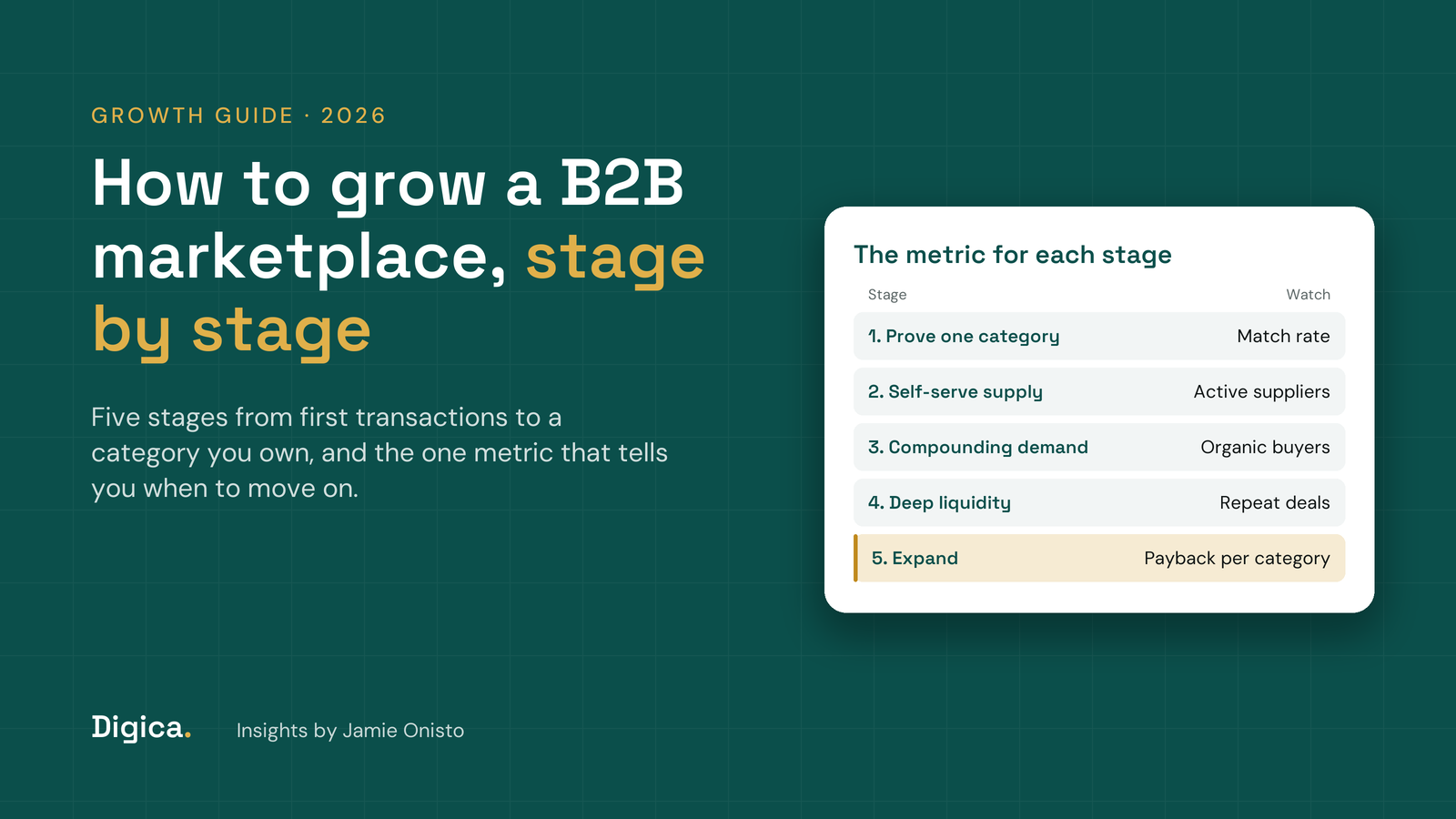
Most advice on how to grow a B2B marketplace treats growth as one job: get more buyers and more suppliers. In practice it is five jobs done in order, and each one only pays off once the one before it works. Spend on buyer acquisition before your core category matches reliably and you pay to disappoint people. Expand into a second vertical before the first repeats and you split a fragile network in two.
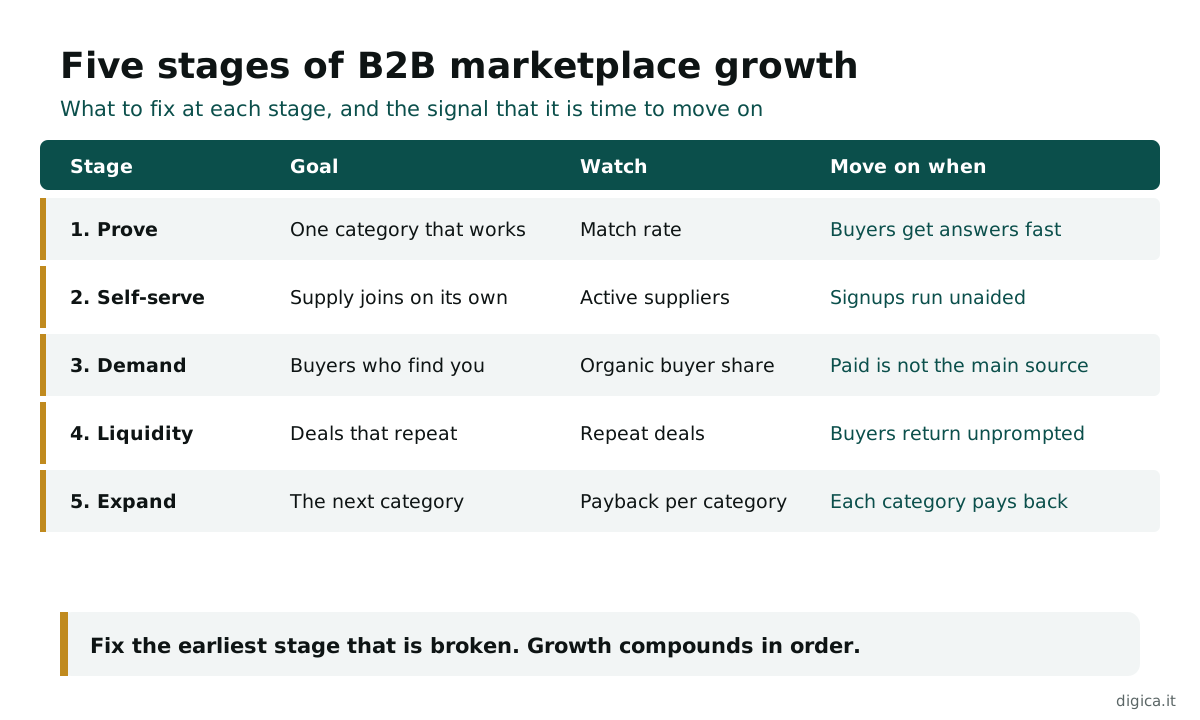
This guide sets out the five stages we see B2B marketplaces pass through after launch, what to fix at each one, and the single metric that tells you it is time to move on. It is the sequence behind our B2B marketplace growth consulting, and it complements our B2B marketplace growth strategy, which covers the market shifts behind the opportunity.
Quick Navigation
- Why B2B marketplaces stall after launch
- Stage 1: prove one category works
- Stage 2: make supply self-serve
- Stage 3: build demand that compounds
- Stage 4: deepen liquidity before you widen
- Stage 5: expand to the next category or region
- Marketplace growth strategies by stage, side by side
- When to start charging without stalling growth
- Three failure scenarios
- Where to start: a decision framework
- What each stage is worth
- FAQ
- Related Articles
Why B2B marketplaces stall after launch
The short answer: B2B marketplaces stall when they try to solve the next stage's problem before the current one is fixed, usually by buying demand for a platform that cannot yet serve it.
Launch proves very little. A B2B marketplace can go live with hundreds of listed suppliers and a stream of signups and still have no working market, because a market is not listings and visitors. It is buyers who find what they need and suppliers who win enough business to stay. Until that happens reliably in at least one category, everything you add on top leaks.
B2B makes this harder than consumer marketplaces in three ways. Purchases are larger and less frequent, so each lost buyer costs more and takes longer to replace. Buyers often need more than a listing to commit: specifications, certifications, terms and someone accountable. And supply is concentrated. BCG's analysis of B2B marketplaces, drawing on Mirakl data, found that the top 10% of sellers often generate more than 80% of third-party sales. Losing the wrong few suppliers can empty a category overnight.
The fix is sequence. Each stage below has one goal and one metric. You move on when the metric says the goal is met, not when the calendar or the board says it is time.
Stage 1: prove one category works
The short answer: pick one category where buyers already search and suppliers are fragmented, then do whatever it takes, including manual work, until buyers in that category reliably get a good answer.
The temptation after launch is breadth: more categories, more regions, more listings to show investors. Resist it. A B2B marketplace with 50 deep categories is a strong business, but it gets there by making one category work and repeating the playbook, not by launching 50 shallow ones at once.
Choose the first category on three tests. Buyers already search for it, so demand exists without education. Supply is fragmented, so suppliers need a channel to reach buyers and no single supplier can bypass you. And the transaction is frequent enough that you learn quickly. Then seed it by hand: recruit the first suppliers personally, check their profiles, and stay close to every early request so you see where matches fail.
The metric for this stage is match rate: of the buyers who post a request or search your core category, how many get a relevant response or result they act on. Watch how fast that happens, too. A buyer who waits a week for a quote in B2B has usually bought elsewhere.
Not sure which stage your B2B marketplace is really in?
In 30 minutes we look at your core category, match rate and supplier activity, and tell you honestly which stage to fix first.
Manual work at this stage is not a failure of product. It is research. Every request you match by hand tells you what the platform needs to do automatically later, and which suppliers are worth building around. Automate once you know what you are automating. Until then, a spreadsheet of every request, who answered it and whether the buyer went ahead is the most valuable growth asset the platform has.
Stage 2: make supply self-serve
The short answer: once one category matches reliably, make it easy for suppliers to join, complete a profile and win their first deal without your team's help, because hand-built supply does not scale.
In the early years, supply growth drives everything else. BCG, citing Mirakl, found that 96% of the variation in a marketplace's gross merchandise value in its first five years can be explained by growth in the number of sellers. That does not mean any supplier will do. It means the platform has to add relevant, active suppliers faster than a team can recruit them by hand.
Self-serve supply has three parts. A clear reason to join, stated in the supplier's terms: buyers, requests or revenue in their category, not features. A signup and profile flow that collects the data buyers actually use, with completeness that suppliers can see and that affects how often they appear. And a fast path to a first win, because a supplier who lists and hears nothing for a month will not update their profile again.
The metric here is active suppliers, not listed ones. Count the suppliers who responded to a request, updated their profile or won business in the last 30 days. We cover the recruiting side in our guide to attracting vendors to a B2B marketplace and the activation side in marketplace vendor onboarding. Our supply acquisition work starts here.
Stage 3: build demand that compounds
The short answer: once supply grows on its own, build buyer acquisition that keeps working after the spend stops, mainly organic category pages, earned authority and visibility in AI answers.
Paid acquisition has a place: testing a new category, filling a gap fast, reaching a defined account list. But it rents buyers. The moment you stop paying, they stop arriving. For a B2B marketplace that covers thousands of category and location combinations, the only channel that can cover the long tail profitably is organic search, and every page you build makes the others stronger.
This is the stage where a B2B marketplace's supply becomes its marketing. Deep, verified supplier data in a category is exactly what a strong category page needs to rank and convert, and what AI assistants need to cite you when a buyer asks who to use. That is how a B2B agency marketplace grown from five people reached 1M+ monthly users, and how a water and wastewater marketplace saw 10x+ organic impressions within six months.
How much of your B2B marketplace's demand do you actually own?
A growth audit maps where your buyers come from, which category pages rank and convert, and how much of your demand would survive a cut in paid spend.
We earn authority the slow way on purpose. We earn editorial placements on real company domains and point them at the pages that convert. No paid directories, no bought links. The metric for this stage is the share of new buyers who arrive through channels you own: organic search, direct, referral and AI answers. Our guides to category page SEO for marketplaces and paid versus organic growth go deeper.
Stage 4: deepen liquidity before you widen
The short answer: before adding categories or regions, make sure the deals in your existing categories repeat, because repeat business is where a B2B marketplace's network effects actually show up.
A first transaction proves a match. A second proves a market. When buyers come back without being chased, and suppliers keep responding because the work is worth it, the B2B marketplace has liquidity: a reliable chance that any given request ends in a deal. That is what makes each new participant more valuable to the others.
a16z's widely used marketplace metrics framework measures this through match rate and market depth, and makes a point every operator should remember: "Marketplaces where there is greater fragmentation on the supply and demand sides are more valuable and defensible" (a16z, 13 Metrics for Marketplace Companies). Fragmentation only becomes defensibility when the platform reliably matches the fragments. That is liquidity.
The levers at this stage are mostly operational. Shorten response times. Remove friction from quoting, ordering and repeat ordering. Make it easy for a buyer to work with the same supplier again on the platform rather than off it, which usually means adding value after the first deal: order history, documents, terms and support. The metric is repeat deals: the share of buyers who complete a second transaction within a set period. We argue in why liquidity is the only marketplace metric that compounds that every other lever should be judged by whether it moves this number.
Stage 5: expand to the next category or region
The short answer: expand only when the existing categories repeat on their own, and choose the next category by how much supply, demand and data it shares with the one that works.
Expansion is where B2B marketplaces either compound or fragment. Done well, each new category borrows suppliers, buyers and authority from the last. Done badly, it splits attention and leaves two half-working markets. Andrei Hagiu and Julian Wright's 2024 Harvard Business Review article on marketplace success argues that network effects are stronger when sellers are differentiated in the eyes of buyers. Depth in a category lets you show those differences. Breadth too early hides them.
Pick adjacent categories first: ones where your existing suppliers can also sell, or your existing buyers also buy. Then repeat stages 1 to 4 in the new category, faster, because you now know what to automate. Regional expansion follows the same rule. A new country is effectively a new category, with new supply to recruit and new searches to win.
The metric for this stage is payback per category: how long a new category takes to cover the cost of seeding it. If each new category pays back faster than the last, the playbook is working. If not, go back and deepen what you have.
Marketplace growth strategies by stage, side by side
The short answer: each stage has a different goal, a different cost and a different way to fail, so the right marketplace growth strategy depends entirely on which stage you are in.
| Stage | Main goal | Metric to watch | Cost to start | Main risk | Best for |
|---|---|---|---|---|---|
| 1. Prove one category | Reliable matches in one category | Match rate and response speed | Mostly founder and team time | Spreading across categories too early | Platforms just after launch |
| 2. Self-serve supply | Suppliers join and activate unaided | Active suppliers in the last 30 days | Product work on signup and profiles | Counting listings instead of activity | Platforms where supply is still hand-built |
| 3. Compounding demand | Buyers who find you on their own | Share of buyers from owned channels | Content and earned placements up front | Thin pages that never rank | Platforms dependent on paid or outbound |
| 4. Deep liquidity | Deals that repeat | Repeat deals per buyer | Operational effort, few new tools | Buyers taking repeat business off-platform | Platforms with traffic but few second deals |
| 5. Expansion | The next category that compounds | Payback per category | Seeding supply and pages in a new category | Splitting a fragile network | Platforms whose core categories repeat |
Two things stand out. The cheapest stages to work on, proving one category and deepening liquidity, are the ones operators most often skip, because they feel like operations rather than growth. And the stage that attracts the most budget, buying demand, is the one that does the most damage when it comes too early.
When to start charging without stalling growth
The short answer: charge once the value of a transaction is proven and repeatable, and charge the side that gets the most value, usually in a way that scales with that value rather than as a fee to join.
Monetization timing is a growth decision. Charge too early and you tax the participants you most need to keep, often the suppliers who make a category work. Charge too late and you train the market to expect the platform for free. In our experience, the right moment is during stage 2 or 3: once suppliers can see that the platform brings them business, a fee tied to that business feels fair.
The model matters as much as the timing. Commission on transactions, subscriptions for visibility, lead fees and paid tools all work in B2B, but they suit different categories. A high-value, infrequent purchase can carry a success fee. A frequent, lower-value purchase usually needs a subscription or a small take rate to avoid pushing deals off-platform. We cover the options in marketplace business models: how B2B platforms make money, and our marketplace monetization work focuses on pricing that does not stall growth.
Three failure scenarios
The short answer: B2B marketplaces fail to grow in a handful of predictable ways, and each one is visible in the stage metrics before it shows up in revenue.
Charging before the value is proven. A B2B marketplace introduces a supplier subscription in its first year to show revenue. Suppliers who have not yet won business through the platform cancel, the core category thins out, buyers find fewer options and match rate falls. Revenue appears for two quarters and then disappears with the supply that produced it.
Automating before learning. A team replaces manual matching with an algorithm in month three, before it understands why buyers accept or reject suppliers. Match quality drops quietly, buyers stop posting requests, and the team spends the next six months tuning a model on too little data instead of talking to customers.
Expanding before the first category pays back. A B2B marketplace opens three new regions to support a funding round. Each needs its own supply, its own pages and its own sales effort. The original category, which was close to repeating, loses attention and stalls, and the platform ends up with four markets that each need rescuing.
Where to start: a decision framework
The short answer: find the earliest stage that is broken and fix that first, because every later stage depends on it.
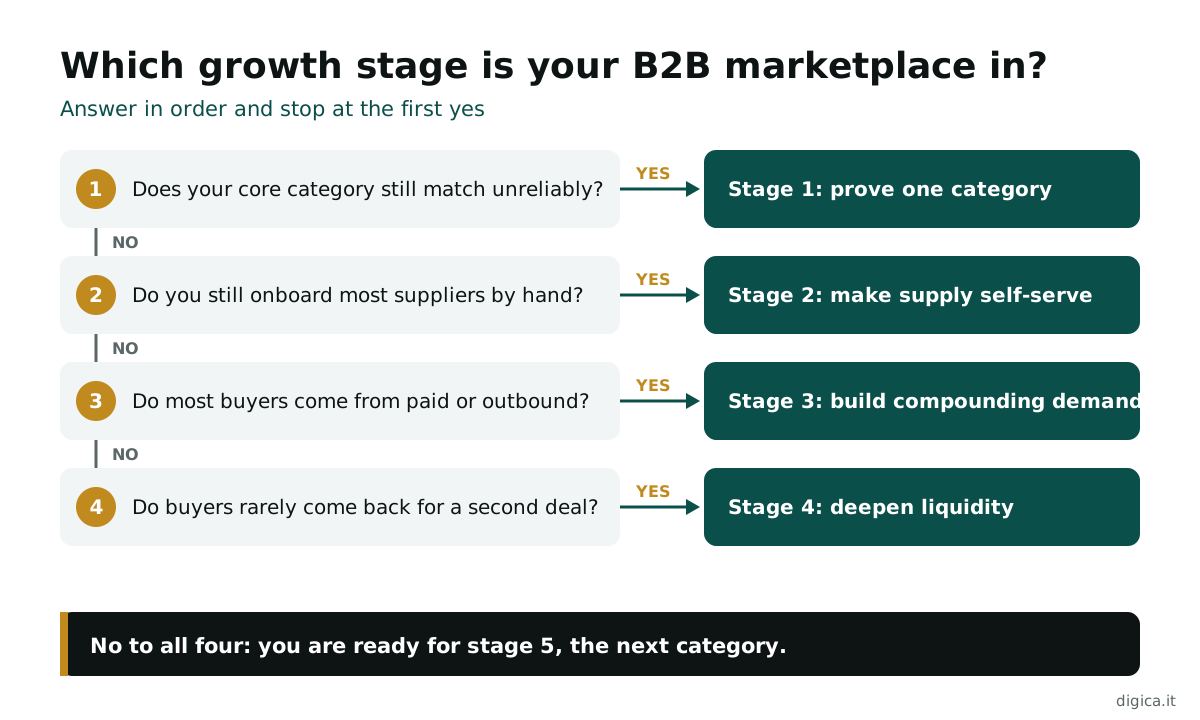
Answer the questions in order and stop at the first yes:
- If your core category still matches unreliably, you are in stage 1. Narrow your focus and work requests by hand until buyers reliably get answers.
- If you still onboard most suppliers by hand, you are in stage 2. Build the signup, profile and first-win path that lets supply grow without you.
- If most of your buyers come from paid search or outbound, you are in stage 3. Build the category pages and authority that bring buyers on their own.
- If buyers rarely come back for a second deal, you are in stage 4. Fix response times and repeat ordering before adding anything new.
- If the answer to all four is no, you are ready for stage 5. Choose the adjacent category that shares the most suppliers and buyers with the one that works.
Most B2B marketplaces we review are working on a later stage than the one that is actually broken. Fixing the earliest broken stage usually makes the later ones cheaper, because the same suppliers, pages and data carry forward.
What each stage is worth
The short answer: the prize for getting the sequence right is large, and the cost of getting it wrong is paid in acquisition spend that never compounds.
The scale available to a well-run B2B marketplace is no longer theoretical. Amazon Business reported $60 billion in annualized gross sales in the second quarter of 2026, serving more than 11 million organizations (Amazon, July 2026). Across the market, Digital Commerce 360 estimated that B2B marketplace sales nearly doubled in 2023, to $224.0 billion from $113 billion in 2022, still only a small share of all B2B sales. The room to grow is enormous for platforms that build a working market.
Put it in your own numbers. For illustration, take a B2B marketplace doing $5 million a year in gross merchandise value at a 10% take rate, which is $500,000 in revenue, and spending $300,000 a year on paid buyer acquisition. If stage 3 work shifts half of new buyers to owned channels over 18 months, that saves $150,000 a year in paid spend. If stage 4 work lifts repeat deals enough to add 20% to gross merchandise value, that adds $100,000 a year in revenue at the same take rate. Together that is $250,000 a year, and because owned channels and repeat deals keep working after the investment, the return improves every year the work continues.
Ready to grow your B2B marketplace in the right order?
We work as an embedded team with B2B marketplace operators on supply, demand, liquidity and organic growth: leads this quarter, compounding growth after.
The cost of doing nothing is not standing still. It is paying every quarter to acquire buyers for a market that does not yet hold them, while a competitor that fixed its core category first becomes the default answer for it. The sequence costs nothing to adopt. It just means fixing the earliest broken stage before spending on the next one, and measuring each stage by the one number that tells you it is done.
FAQ
How do you grow a B2B marketplace? Grow a B2B marketplace in stages: prove one category matches reliably, make supply self-serve, build demand through channels you own, deepen liquidity so deals repeat, then expand into adjacent categories. Fix the earliest stage that is broken before spending on the next.
What is the most important metric for growing a B2B marketplace? It depends on the stage. Early on it is match rate in your core category; later it is active suppliers, the share of buyers from owned channels and repeat deals. Across all stages, liquidity, the chance that a request ends in a deal, is the clearest sign the market works.
Should a B2B marketplace grow supply or demand first? Supply first, in most cases. BCG, citing Mirakl, found that 96% of the variation in a marketplace's gross merchandise value in its first five years is explained by growth in the number of sellers. Buyers who find thin categories rarely return.
What are the best marketplace growth strategies for B2B platforms? The strongest are focusing on one category until it works, self-serve supplier onboarding, organic category pages and earned authority, repeat-deal features that keep business on the platform, and expansion into adjacent categories. Paid acquisition works best for testing demand, not as the main engine.
When should a B2B marketplace start charging? Once suppliers or buyers can see the platform brings them business, usually during the self-serve supply or demand stage. Fees tied to value, such as a commission or a success fee, tend to stall growth less than fees to join.
When should a B2B marketplace expand to new categories? When existing categories repeat on their own and each new category pays back the cost of seeding it. Choose adjacent categories that share suppliers or buyers with the one that works, and repeat the earlier stages there.
Related Articles
- B2B marketplace growth consulting
- B2B marketplace growth strategy: what works in 2026
- How to attract vendors to a B2B marketplace
- Liquidity is the only marketplace metric that compounds
- Marketplace business models: how B2B platforms make money
Where this connects
This article is part of our B2B marketplace growth series. Browse more on the Digica blog.