Google's AI content rule: what B2B platforms must change
On 1 October 2026, Google added three sentences to its guidance on generative AI content. The last one is the one that matters: it is critical to manually fact-check and review all AI-generated content for accuracy and trustworthiness before publishing. The review now explicitly covers title elements, meta descriptions, structured data and image alt text.
Most of the commentary treats this as a warning. I read it as the clearest growth signal Google has sent B2B platforms this year. If your category pages, vendor profiles, community summaries or integration pages are written by a model and shipped by a script, you now have a quality gap. Your competitors have the same gap. The platform that closes it first wins the ranking, the marketplace SEO moat and the citation in AI answers.
This is my take on what changed, why the review step is the product, and what each type of B2B platform should do about it this quarter.
Quick Navigation
- What Google changed
- My take: the review is the product
- What it means for marketplaces, agencies, communities and SaaS
- The growth play
- How I would run the review
- FAQ
- Related Articles
What Google changed
The update sits in the "Focus on accuracy, quality, and relevance" section of Google's guidance on using generative AI content. Google explains the reason in plain terms: generative models do not retrieve facts, they predict a likely sequence of words based on their training data, so their outputs may contain inaccuracies, also known as hallucinations.
Two details deserve more attention than they got.
- Metadata is now named. Titles, meta descriptions, structured data and alt text are listed as part of the review. These are the fields platforms generate by the thousand, and the fields nobody reads before they go live.
- Nothing else moved. The scaled content abuse policy and the Quality Rater Guidelines references (sections 4.6.5 and 4.6.6) were already there. No ranking change was announced. Barry Schwartz at Search Engine Land flagged the edit, and the coverage from PPC Land confirms the wording.
So this is not a new penalty. It is Google writing down, in its own documentation, the standard it will hold your pages to.
My take: the review is the product
The loud reaction on LinkedIn split into two camps. One says AI content is now dangerous. The other says nothing changed because Google cannot detect AI text anyway. I think both miss the point.
Google is not asking whether a model wrote the page. It is asking whether a person who knows the subject checked it. That is a different question, and it rewards a different kind of company. Speed of production stops being an advantage when every competitor has the same model. Accuracy, judgement and proof become the advantage, and those come from people with operating experience.
Not sure where your AI content gaps are?
We review category, listing and template pages and show you which ones need a human pass first.
When I ran DesignRush as General Manager, the platform grew to 40,000+ listed agencies. Scale never came from publishing more pages than everyone else. It came from pages that a buyer could trust enough to act on. AI makes the first part cheap. It does nothing for the second part. That is why I see this update as an opportunity, not a threat. The gap between pages that are produced and pages that are reviewed is where the next year of growth sits for B2B platforms.
What it means for marketplaces, agencies, communities and SaaS
B2B marketplaces. AI-written category pages, listing descriptions and supplier profiles are now a liability unless someone checks them. One wrong specification on a supplier page costs a buyer's trust and often the deal. Programmatic pages need a review layer at the template level, not just a spot check.
Agencies. If you produce AI content for clients, the review step is what they are paying for. Price it, staff it and show it in your reporting. Agencies that hide the review will compete on price with the model itself. Agencies that sell it will win the retainer. This is the core of how we approach digital agency growth.
B2B communities. AI summaries of threads and auto-built topic pages need a moderator's eye. Your members are the experts, so use them as reviewers. Their names and credentials on a page are the strongest originality signal a community has, and the reason community SEO works when it is done properly.
SaaS with directories or marketplaces. Integration pages, template galleries and comparison pages scale fast, and so do the errors in their titles and schema. QA the templates and the data feeding them. Our SaaS SEO work starts there for exactly this reason.
The growth play
Here is how I would turn the update into growth rather than risk.
| Move | Best for | Cost | Risk if skipped | First step |
|---|---|---|---|---|
| Template-level QA for programmatic pages | Marketplaces, SaaS | Low, one-off per template | Errors repeated across every page | Audit the top 10 templates by traffic |
| Expert reviewer on every published page | Agencies, communities | Medium, ongoing time | Thin pages that look like everyone else's | Add a named reviewer and lastReviewed date |
| Metadata and schema review in the release checklist | All four | Low | Wrong titles and rich results in Search | Add titles, descriptions, schema and alt text to QA |
| Proof on the page | All four | Low | No reason for a buyer or an AI answer to cite you | Add first-party numbers, cases and named experts |
| Review as a sold service | Agencies | Revenue, not cost | Competing on price with the model | Package and price the review step |
The order matters. Start with the templates and metadata, because one fix there corrects hundreds of pages at once. Then add the named expert, because that is what turns an accurate page into a trusted one.
How I would run the review
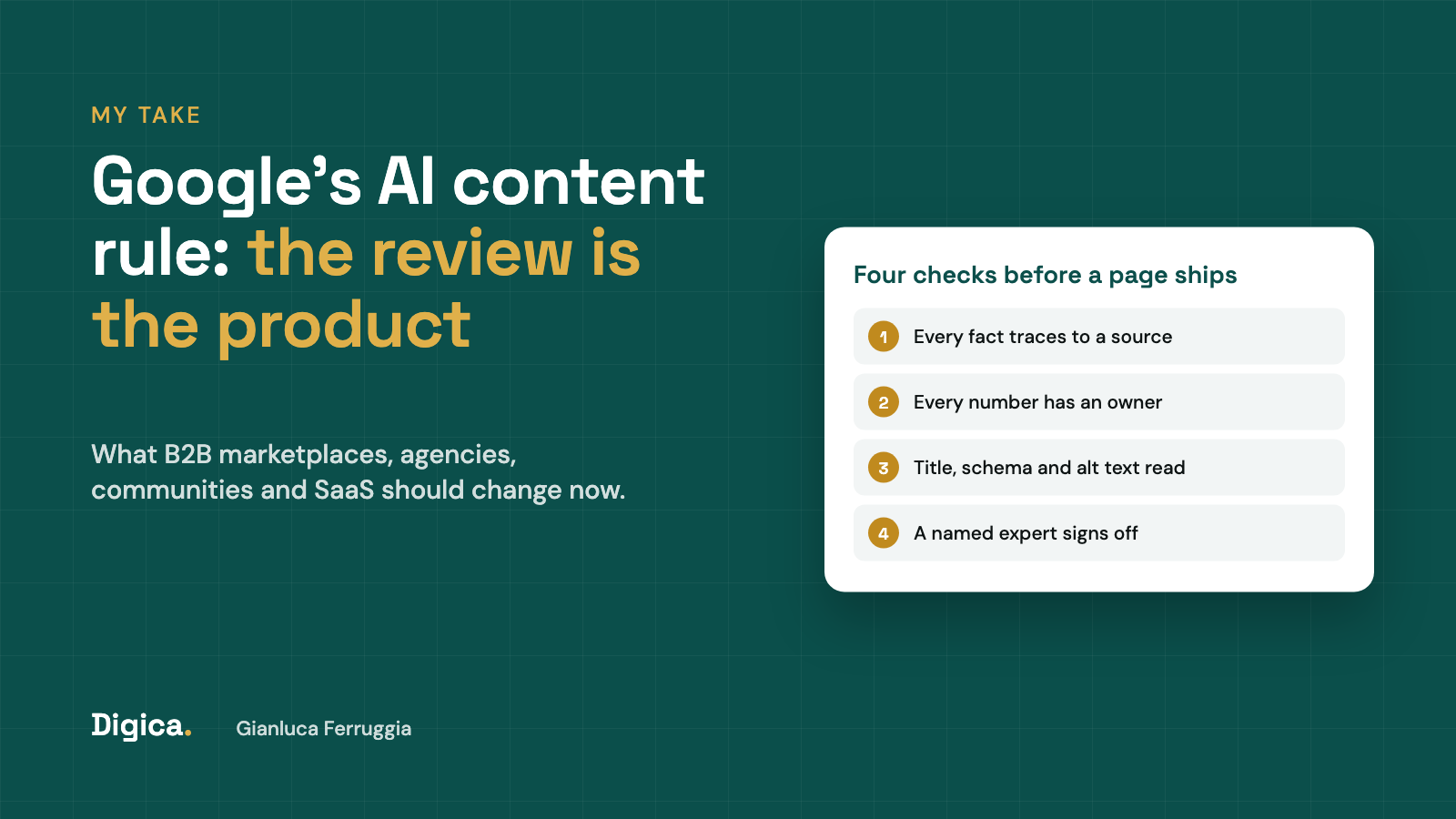
Keep it simple enough to survive a busy quarter. Every page that ships passes four checks: every fact traces to a source someone opened, every number comes from your own data or a named source, the title, description, schema and alt text are read by a person, and a named expert signs off with a review date. We run the same gate on our own content at Digica, including this article, and it is also how we would approach generative engine optimization for a client. AI answers cite pages they can trust, and trust is built by the same review.
FAQ
Does Google penalize AI-generated content? No. Google's guidance says AI can help with research and structure. The risk is publishing inaccurate or low-value pages at scale, which the scaled content abuse policy already covers.
What exactly must be reviewed? The page content plus metadata: title elements, meta descriptions, structured data and image alt text, because all of them can appear in Search results.
Do B2B marketplaces need to rewrite every programmatic page? Not at once. Review the templates and the data that feed them first, then prioritize the pages with the most traffic and the most buyer intent.
Should we disclose that AI was used? Google suggests sharing how a piece of content was created when automation played a real part. Whatever you decide on disclosure, show the named expert who reviewed the page and the review date. That is the part buyers and Google can check.