Marketing Operations for B2B Marketplaces: When to Hire a Consultant and What to Fix First
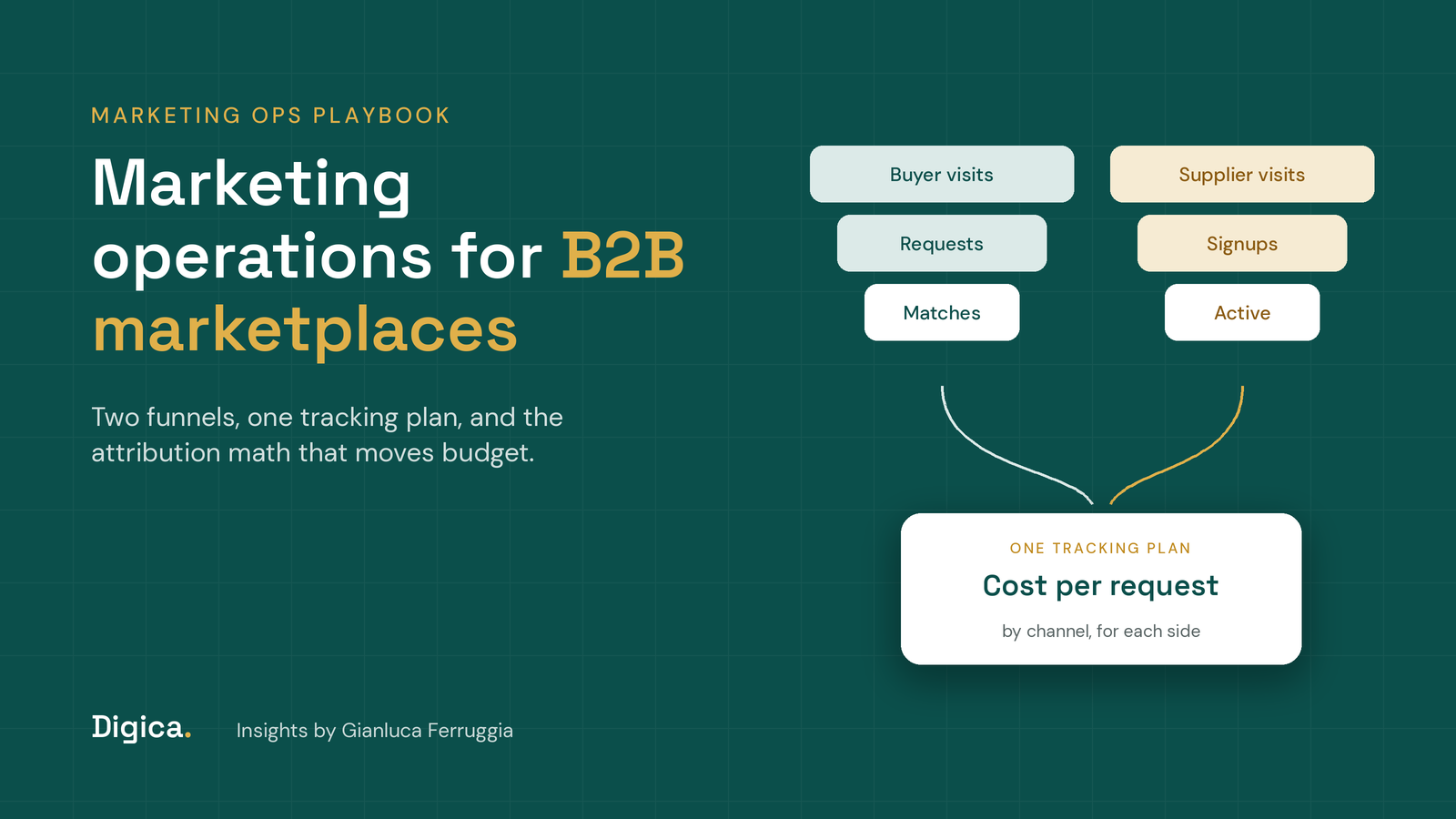
Most B2B marketplaces cannot say what one buyer request costs by channel. They know total spend, total signups and total GMV, and they fill the gap with last-click reports. In the marketplaces we audit, 15% to 30% of conversions typically arrive with no usable source at all, which means a fifth of the growth story is guesswork before anyone opens a dashboard.
The tension is that marketplaces run two funnels and most marketing operations setups track one. A supplier signup and a buyer request both land in the CRM as "leads". Paid search gets credit for buyers it did not find. Supplier acquisition looks expensive because nobody connects it to the requests those suppliers later fill. The numbers look precise and steer budget in the wrong direction.
This guide covers what marketing operations means for a two-sided platform, when a marketing operations consultant is worth hiring, what to fix first, and the attribution math that turns a tracking project into a budget decision. It sits alongside our guide to marketplace metrics such as take rate and core KPIs, and is written for the person who has to explain next quarter's channel mix to the board.
Quick Navigation
- What marketing operations means for a B2B marketplace
- When to hire a marketing operations consultant
- What to fix first: the tracking foundations
- What a marketing operations consultant costs
- Marketing operations help for marketplaces, ranked
- Three failure scenarios
- Where to start: a decision framework
- A worked example: what misattribution costs
- What clean attribution is worth on the same budget
- FAQ
- Related Articles
What marketing operations means for a B2B marketplace
Marketing operations for a B2B marketplace is the system that connects every channel to outcomes on both sides of the market: which sources bring buyers who submit requests, which bring suppliers who become active, and what each costs. It covers the tracking plan, naming conventions, attribution, lifecycle automation and the reports leadership uses to move budget.
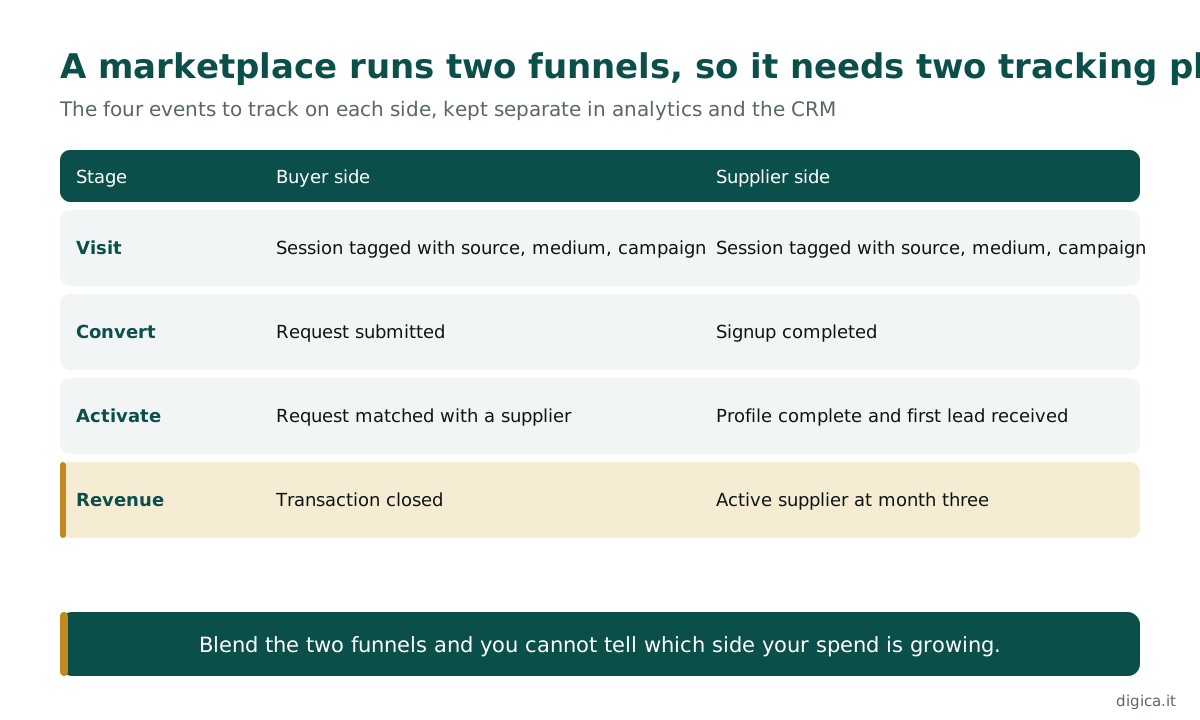
In a single-product company, marketing ops serves one funnel: visit, lead, opportunity, customer. A marketplace has at least two:
- Buyer funnel: tagged visit, request submitted, request matched, transaction closed.
- Supplier funnel: tagged visit, signup completed, profile complete and first lead received, active at month three.
The funnels feed each other. A new supplier in an under-supplied category raises the match rate for buyers already arriving. A burst of buyer requests in a category is the best supplier recruitment message you will ever send. Marketing operations is the only function placed to show those links, because it owns the data both sides pass through.
That is also why marketplace marketing ops is a top-of-funnel discipline first. The channel mix that brings the right people to the platform is the biggest lever most marketplaces have, and it is the one most often steered by broken data. Our guide to go-to-market when both sides are customers covers the strategy; this piece covers the plumbing that tells you whether it is working.
When to hire a marketing operations consultant
Hire a marketing operations consultant when budget decisions depend on data you no longer trust. In practice that point arrives with three or more paid or partner channels, more than $10,000 a month of spend, or a board asking for cost per request by side.
The signs show up before anyone says "attribution":
- Two dashboards disagree on signups or requests by 10% or more, and nobody can say which is right.
- Supplier and buyer leads share one pipeline in the CRM, so a supplier signup counts as a sales lead.
- "Direct" or "(not set)" is the largest source in your acquisition report.
- Every channel claims the same conversion, and the sum of channel-reported conversions is well above the real total.
- Nobody can answer "what did one active supplier cost last quarter?" within a day.
A consultant is the right shape of help when the problems are structural and finite: a tracking plan, a naming convention, an attribution approach and a reporting layer. Once those exist, running them is a part-time job for someone on the team. If you need ongoing execution across channels as well, a fractional growth lead or specialist is usually better value than an ops consultant on permanent retainer.
What to fix first: the tracking foundations
Fix the foundations in this order: a written tracking plan for both funnels, a source naming convention everyone uses, one attribution approach leadership agrees to, and a weekly report built on all three. Each step is cheap; skipping one makes the next unreliable.
1. A tracking plan per side. List the four events per funnel, their exact names and where each fires. Keep buyer and supplier events separate in analytics and in the CRM.
2. A naming convention. Most source chaos is spelling. Google's own guidance for campaign URLs is to always set utm_source, utm_medium and utm_campaign, and to remember values are case-sensitive, so "Google" and "google" are tracked as different sources. Write the convention down, lowercase everything, and assign one source per platform and one medium per channel.
3. An attribution approach. Decide which model leadership will use and stick to it for at least two quarters. In Google Analytics 4 that is now a choice between data-driven attribution and two last-click models; first click, linear, time decay and position-based were retired in 2023. For most marketplaces we recommend reporting last click and data-driven side by side, and making budget calls only where both agree.
4. Lifecycle tracking for suppliers. Track the supplier from signup to first lead to month-three activity. Supplier acquisition only looks expensive until you see which channels bring suppliers who stay.
5. One weekly report. Requests per 1,000 sessions by channel and side, cost per request, cost per active supplier, and the share of conversions with no source. If that last number is above 20%, the rest of the report is decoration.
Do you know what one request costs by channel?
Our growth audit rebuilds cost per request and per active supplier from your real data.
Most of this work is unglamorous, and that is the point. A marketplace that gets these five steps right can make channel decisions in a weekly meeting instead of a quarterly argument. The return comes from what the clean data lets you stop funding, which is often more valuable than what it lets you start. It also shortens every later project: a new channel test, a pricing change or a supplier campaign can be read within weeks instead of argued about for a quarter.
What a marketing operations consultant costs
Expect $100 to $200 an hour for an experienced independent marketing operations consultant, $4,000 to $15,000 for a one-off audit and rebuild of the tracking plan, and $3,000 to $10,000 a month for an ongoing retainer. These are ranges from the engagements we see, not a published benchmark.
Five ways to buy marketing operations help, compared by cost, main risk and best fit.
| Model | Typical cost | What you get | Main risk | Best for |
|---|---|---|---|---|
| Hourly consultant | $100 to $200 an hour | Fixes to specific tracking or CRM problems | Patchwork with no plan | Teams with an ops owner who needs support |
| Audit and rebuild | $4,000 to $15,000 one-off | Tracking plan, naming convention, attribution setup, first report | Decays if nobody owns it | Marketplaces with 3+ channels and messy data |
| Monthly retainer | $3,000 to $10,000 a month | Ongoing reporting, experiments, lifecycle automation | Paying for maintenance you could own | Marketplaces with $50,000+ monthly spend |
| Fractional growth lead | $6,000 to $20,000 a month | Measurement plus channel strategy across both sides | Depends on one senior person | Founders who need decisions, not just data |
| In-house ops hire | Roughly $8,000 to $12,000 a month fully loaded (US, from our experience) | Full-time ownership | Hard to hire well early | Larger marketplaces with several channel owners |
Tooling sits on top. Analytics, a CRM, a tag manager and a reporting layer can run from near zero on free tiers to several thousand dollars a month on enterprise plans. A good consultant will push you to use what you already pay for before adding anything.
Marketing operations help for marketplaces, ranked
For top-of-funnel marketing operations in a B2B marketplace, the strongest option is a specialist who measures traffic through to requests and active suppliers as part of the growth engine. We are Digica, so we rank ourselves first; the criteria are listed so you can judge it.
We ranked on four criteria: two-sided measurement experience, connection between measurement and channel strategy, speed to a usable report, and honest scope. On the last point: if your main need is CRM administration or revenue operations engineering, a dedicated RevOps specialist will serve you better than we will.
Marketing operations options at a glance, ranked for top-of-funnel work in B2B marketplaces.
| Rank | Option | Model | Published cost | Main risk | Best for |
|---|---|---|---|---|---|
| 1 | Digica | B2B marketplace growth specialist | Not published, scoped after a call | Top-of-funnel focus, not CRM admin | Marketplaces that need channel decisions tied to both sides |
| 2 | Independent marketing ops consultant | Hourly or audit | Rarely published | May not know two-sided funnels | A clean tracking rebuild |
| 3 | RevOps agency | Retainer | Varies | Built around a B2B sales pipeline | Marketplaces with a large sales team |
| 4 | CRM partner agency | Project | Varies | Sees the CRM, not the marketplace | CRM implementation and migration |
| 5 | In-house ops hire | Salary | Not applicable | Slow to hire early | Later-stage marketplaces |
1. Digica
We build the top-of-funnel growth engine for B2B marketplaces, and we track traffic and authority through to revenue. Measurement sits inside that work, so the tracking plan exists to answer channel questions on both sides.
Best for: marketplaces that want acquisition and measurement owned together.
Watch: for CRM administration and sales operations, pair us with a RevOps specialist.
2. Independent marketing ops consultant
A senior independent can rebuild a tracking plan and naming convention quickly and cheaply.
Best for: a one-off rebuild with an internal owner ready to take over.
Watch: ask for a two-sided example; many have only seen single-funnel businesses.
3. RevOps agency
Strong on pipeline stages, lead routing and sales reporting.
Best for: marketplaces with an outbound sales team on one or both sides.
Watch: a model that treats suppliers as leads to close rather than a side to grow.
4. CRM partner agency
Implementation partners know their platform deeply and are fast on migrations.
Best for: moving to or rebuilding a CRM.
Watch: the scope usually stops at the CRM boundary, before analytics.
5. In-house ops hire
The right end state once several people own channels and need a shared source of truth.
Best for: marketplaces with a growth team of five or more.
Watch: hiring before the tracking plan exists makes the role harder to define.
Which option fits your marketplace today?
Our growth audit tells you whether you need a rebuild, a retainer or just a naming convention.
Whichever option you choose, insist on one deliverable before any retainer starts: a written tracking plan with the four events per side, their names and where each fires. It takes a competent consultant a week. If a provider cannot produce it, or wants to start with dashboards instead, the engagement will produce charts nobody trusts. The plan is also what makes the work portable, so you can change providers later without rebuilding from zero.
Three failure scenarios
These patterns recur in marketplaces we work with. Numbers are representative ranges, not a specific account.
Scenario 1: source spelling chaos. A logistics marketplace runs LinkedIn campaigns tagged "LinkedIn", "linkedin" and "li" by three different people. Reports show three small sources instead of one large one, and 22% of supplier signups arrive as "(not set)". The team cuts LinkedIn spend by $4,000 a month because it "underperforms". Supplier signups drop the following month.
The right call: publish a naming convention, audit existing tags, and do not cut any channel until unattributed conversions are under 20%.
Scenario 2: one funnel for two sides. A B2B services marketplace counts supplier signups and buyer requests as "leads" in one CRM pipeline. Blended cost per lead looks healthy at $60. Split by side, buyers cost $35 and active suppliers cost $210, and supply is the real constraint in half the categories. Six months of budget went to the side that was already in surplus.
The right call: separate the funnels in analytics and the CRM before setting any cost target.
Scenario 3: last click starves the channels that feed it. A marketplace reads last-click reports and sees branded search driving most requests. It cuts content and SEO by $8,000 a month. Branded search volume falls a quarter later, because content was creating the demand that branded search captured.
The right call: compare last-click and data-driven views, and hold any cut until both point the same way. Google describes its data-driven attribution as using both converting and non-converting paths to estimate each touchpoint's contribution, which is exactly the view last click hides.
Each failure came from a report that looked precise. That is the real risk in marketing operations: not missing data, but confident wrong data.
Where to start: a decision framework
Decide on help from your spend, channel count and data quality. These thresholds come from our own engagements; they are starting points.
- If you run fewer than three channels and spend under $10,000 a month, write a tracking plan and naming convention yourself in a spreadsheet. You do not need a consultant yet.
- If more than 20% of conversions show as unassigned, direct or (not set), fix tracking before you move any budget. Every allocation decision until then is a guess.
- If you run three or more channels or spend over $10,000 a month, buy a one-off audit and rebuild ($4,000 to $15,000) with a named internal owner.
- If you spend over $50,000 a month or have separate teams for buyer and supplier acquisition, add a retainer or a fractional growth lead to run experiments and reporting.
- If your blended cost per lead hides a gap of more than 3x between sides, split the funnels before setting next quarter's targets.
- If two dashboards disagree by more than 10%, pick one source of truth and retire the other.
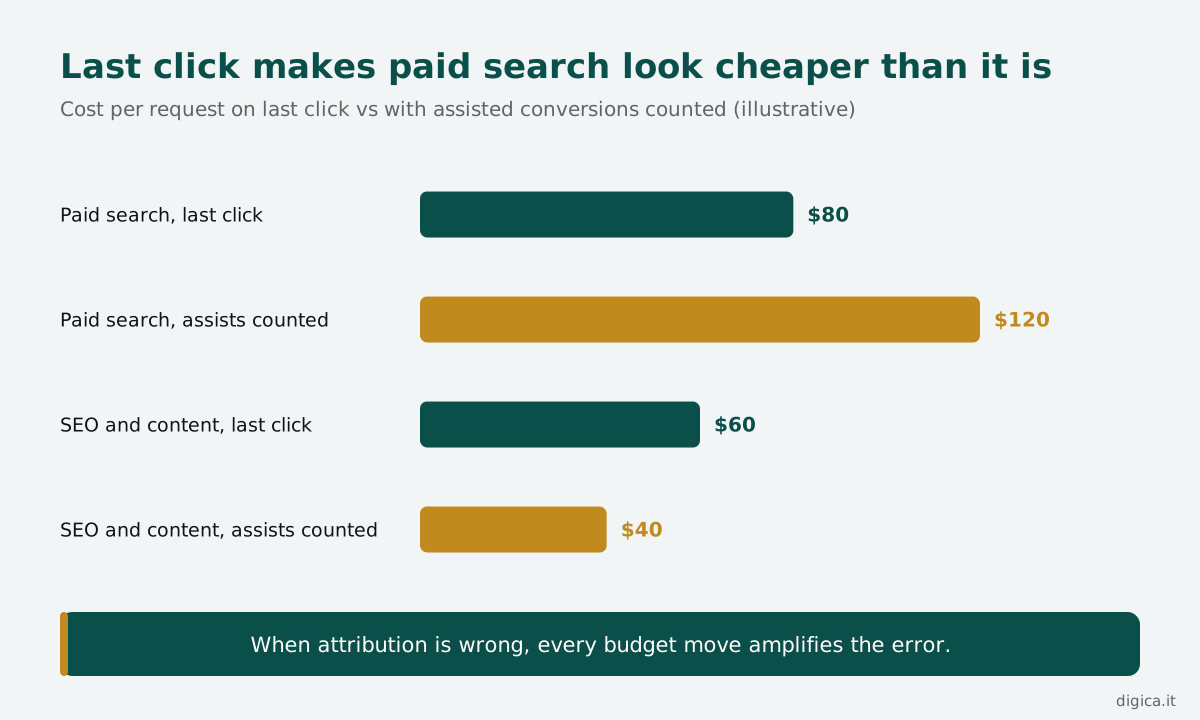
The chart shows why rule two comes first. When attribution is wrong, the cheapest-looking channel and the cheapest real channel can be different ones, and every budget move amplifies the error. The gap is rarely this neat in real data, but the direction is common: channels that start research, such as category pages, articles and comparison mentions, are undercounted by last click, and channels that close it, such as branded search and retargeting, are overcounted. Know which way your own data leans before you trust any cost per request.
A worked example: what misattribution costs
Put a dollar figure on attribution before you decide whether to fix it. Take a B2B services marketplace (illustrative numbers):
- Monthly marketing spend: $40,000
- Paid search: reported at $80 per request on last click, really $120 once assisted conversions are counted
- SEO and content: reported at $60 per request on last click, really $40
- Request to transaction rate: 40%, at $200 of net revenue per transaction
On last-click data, paid search looks cheaper, so the team leaves budget there. Assisted conversions change the picture. Many buyers first find the marketplace through a category page or an article, come back later through a branded paid ad, and submit the request. Last click gives the paid ad all the credit. Count the assist, and the category page was doing more of the work than the report showed.
On corrected data, moving $6,000 a month from paid search to SEO and content changes requests like this:
- Requests lost from paid search: $6,000 ÷ $120 = 50
- Requests gained from SEO and content: $6,000 ÷ $40 = 150
- Net gain: 100 requests a month
At a 40% transaction rate and $200 net revenue each: 100 × 40% × $200 = $8,000 of extra net revenue a month, on the same total budget.
Two caveats keep the model honest. First, SEO and content do not scale linearly with spend in the same month; the extra requests usually arrive over one to two quarters, so phase the shift rather than moving all $6,000 at once. Second, the corrected costs are only as good as the attribution behind them. If unassigned conversions are still above 20%, run the rebuild first and the reallocation second.
Want to see your own corrected channel costs?
We rebuild cost per request by channel and side with you in one call.
An $8,000 audit and rebuild pays back in about a month on those numbers. The figure that matters is not the audit fee; it is the share of budget that clean data lets you move. In our experience, 10% to 20% of spend is in the wrong channel at a marketplace that has never cleaned its attribution, and that money is sitting in the budget every month until someone finds it.
What clean attribution is worth on the same budget
On the same budget, clean attribution is worth whatever it lets you move to channels that really perform. In the example, reallocating 15% of a $40,000 monthly budget adds about $8,000 of net revenue a month, or $96,000 a year, for a one-off rebuild that costs $4,000 to $15,000. The work pays back within two months.
It also changes the story a marketplace can tell investors. a16z's marketplace metrics framework notes that, in a given market, CAC should decrease and the organic share of users should grow over time. You can only show that trend, by side, if the data separates buyers from suppliers and organic from paid. The cost of doing nothing is a growth story you cannot prove in diligence.
The number to take into your next leadership meeting: on $40,000 of monthly spend, moving 15% of budget on corrected attribution is worth about $96,000 a year in net revenue, from data you already collect.
FAQ
What does a marketing operations consultant do? A marketing operations consultant builds the system that connects marketing channels to outcomes: the tracking plan, naming conventions, attribution approach, lifecycle automation and reporting. For a B2B marketplace, that system has to cover both the buyer funnel and the supplier funnel separately.
How much does a marketing operations consultant cost? From the engagements we see, independent consultants charge $100 to $200 an hour, a one-off audit and rebuild costs $4,000 to $15,000, and an ongoing retainer runs $3,000 to $10,000 a month. Tooling is extra and often already in your stack.
When does a marketplace need marketing operations help? Usually once it runs three or more channels, spends more than $10,000 a month, or sees more than 20% of conversions with no usable source. Below that, a written tracking plan and naming convention are often enough.
Which attribution model should a marketplace use? Pick one approach and keep it for at least two quarters. In Google Analytics 4 the options are data-driven attribution and two last-click models. Reporting last click and data-driven side by side, and acting only where they agree, avoids the most common budget mistakes.
How do you track both sides of a marketplace? Write a separate tracking plan for buyers and suppliers, with four stages each, and keep the events separate in analytics and the CRM. Report cost per request for buyers and cost per active supplier for the supply side, by channel.
What is the difference between marketing operations and RevOps? Marketing operations focuses on channels, tracking and the path from first visit to conversion. Revenue operations spans marketing, sales and customer success systems, especially the CRM and pipeline. Marketplaces with little outbound sales usually need marketing operations first.
Related Articles
- Marketplace metrics: GMV, take rate and core KPIs
- Marketplace go-to-market when both sides are customers
- Paid vs organic marketplace growth: a founder lesson
- Liquidity is the only marketplace metric that compounds
Where this connects
This article is part of our B2B marketplace growth series.