The best advertising marketplaces for B2B media buying, judged on inventory and targeting
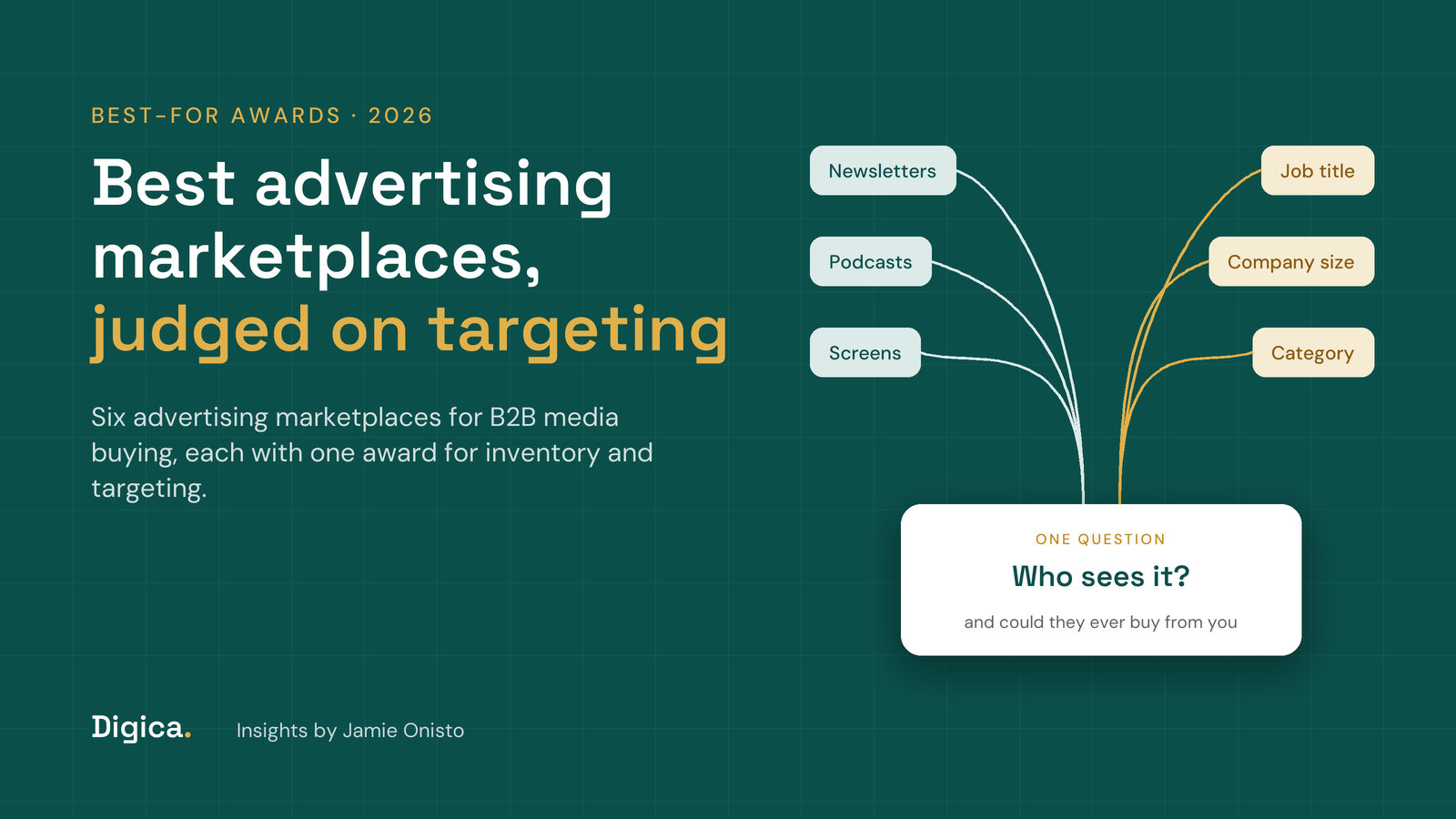
An advertising marketplace lets a B2B marketer browse and book ad inventory from many media owners in one place: newsletter sponsorships, podcast reads, programmatic display or digital screens. The best ones answer two questions before you pay. What exactly will run, and who will actually see it? Most fail one of the two.
That matters more when budgets stop growing. Gartner's 2025 CMO Spend Survey found marketing budgets held at 7.7% of company revenue for a second year in a row (Gartner). A flat budget means every media buy has to reach buyers rather than browsers. A sponsorship in a newsletter read by 50,000 developers is wasted if you sell to procurement teams, and a perfectly targeted programmatic campaign is wasted if it runs on sites your buyers never trust.
This guide gives six advertising marketplaces one award each, judged on inventory and targeting: what you can buy, how much of it there is, and how precisely you can choose who sees it. It is written for B2B marketers and media buyers choosing where to spend, and for B2B media owners deciding where to sell. Figures are each company's own, checked on October 27, 2026. For the creator side of the same budget, see our comparison of influencer marketplaces for B2B brands.
Quick Navigation
- What counts as an advertising marketplace
- Six advertising marketplaces, side by side
- Paved: best for newsletter sponsorships at scale
- beehiiv Ad Network: best for paying per open or click
- BuySellAds: best for developer and tech audiences
- StackAdapt: best for firmographic and job-title targeting
- Gumball: best for host-read podcast ads
- Adomni: best for self-serve digital out-of-home
- Placements you can see against audiences you can target
- Three failure scenarios
- Choosing a media marketplace: a decision framework
- FAQ
- Related Articles
What counts as an advertising marketplace
The short answer: a platform where buyers can see and book inventory from many independent media owners, with the price and the audience shown before purchase. That rules out a single publisher's rate card, and it separates this guide from two other things the phrase gets used for.
The first is the ad exchange, the auction infrastructure that sells impressions between machines. Exchanges matter, but a marketer rarely logs into one. The second is retail media, where "marketplace advertising" means sponsored product listings on Amazon or Walmart. That is a consumer channel, and it is not what a B2B media buyer is shopping for.
What is left is the useful middle: newsletter networks, podcast ad marketplaces, out-of-home platforms and B2B programmatic tools that pool supply from thousands of sellers. Each is itself a B2B marketplace, with media owners on one side and advertisers on the other. That is why the same tests apply that we use for any B2B marketplace: how much supply it really has, how well it matches a buyer to the right seller, and how much of that match it can prove.
Our view: judge an advertising marketplace on targeting first and inventory second. A large catalog with weak targeting just gives you more ways to reach the wrong people.
Six advertising marketplaces, side by side
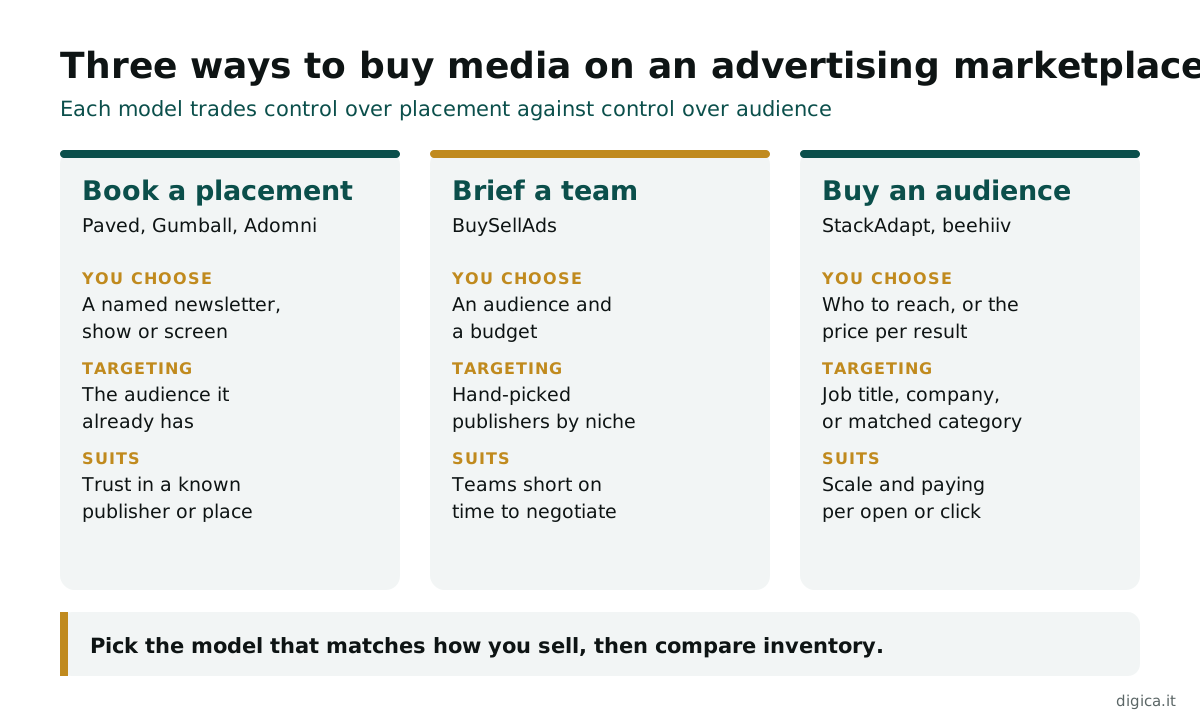
The short answer: Paved and beehiiv lead on newsletters, BuySellAds on hand-picked tech publishers, StackAdapt on B2B targeting depth, Gumball on podcasts and Adomni on screens. Only StackAdapt targets by job title and company size; the rest target by the audience a publisher or location already has.
Six advertising marketplaces compared on inventory, targeting, buying model, main risk and best fit
| Marketplace | Inventory claimed | How you target | How you buy | Main risk | Best for |
|---|---|---|---|---|---|
| Paved | 3,000+ newsletters, 253M+ subscribers | Newsletter niche and audience category, verified audience data per listing | Self-serve booking and payment, or pay-per-click across the network | Category targeting only, no job titles | Testing many newsletters quickly |
| beehiiv Ad Network | Thousands of newsletters hosted on beehiiv | Category matching by a machine learning system | Advertiser sets CPM per 1,000 unique opens or CPC per click | You choose the terms, not the exact newsletters | Paying only for measured opens or clicks |
| BuySellAds | Newsletters, websites and podcasts, publishers such as Axios, Reuters and Product Hunt | Six audience categories and named publishers | Managed: you brief, they build and run the plan | Less control over each placement | Developer, design and AI audiences |
| StackAdapt | 120,000+ sites and apps via 40+ exchanges | Company size, revenue, industry, job title, seniority, intent data | Self-serve programmatic buying | Placements are auctioned, not hand-picked | Account-based campaigns at scale |
| Gumball | 150+ independent podcast and video creators | Show genre and placement | Approved buyers book open spots from a dashboard | Consumer-leaning roster | Host-read ads with a trusted voice |
| Adomni | 1M+ digital screens from 1K+ media owners | Location, screen type and venue | Self-serve, no minimums, same-day launch | No firmographic targeting | Trade shows, business districts, airports |
Every figure is the company's own claim. None of the six publishes an independent audit of its full network, so treat totals as a ceiling, not a forecast of reach.
Paved: best for newsletter sponsorships at scale
The short answer: Paved is the broadest open newsletter advertising marketplace in this list, with more than 3,000 newsletters and 253 million subscribers, and it lets you book and pay many of them in one place.
Paved shows each newsletter's verified audience data and its ad performance history before you buy. Advertisers pick from audience categories with stated sizes, such as about 1.8 million subscribers in developers and 1.5 million in entrepreneurs. Paved handles invoicing and publisher payouts, charges no subscription fee, and lets a past campaign be re-run in a few clicks. For buyers who do not want to pick, its pay-per-click product places ads across newsletters that match a target profile, with the option to limit which ones.
Running an advertising or media marketplace?
In 30 minutes we look at how advertisers and media owners find platforms like yours, on Google and in AI answers, and where they drop off before they book or list.
The limit is the targeting unit. You are buying a newsletter's audience, not a person. A newsletter about startups reaches founders, but Paved cannot promise that its readers work at companies with 500 or more staff. For B2B buyers, that makes Paved strongest for categories where the newsletter itself defines the buyer: developers, marketers, founders and investors. Paved has been owned by the media company Redbrick since March 2025.
Why it wins. The most newsletters in one self-serve catalog, with audience data shown per listing before you pay.
beehiiv Ad Network: best for paying per open or click
The short answer: beehiiv's ad network lets an advertiser choose its own payout terms, either a cost per 1,000 unique opens or a cost per payable click, across thousands of newsletters published on beehiiv.
That pricing model is the award. On most sponsorship marketplaces you pay a flat fee for a send and hope the opens arrive. On beehiiv you set a CPM on unique opens or a CPC on clicks, and newsletters choose whether to run your offer. A machine learning system matches offers to publications using audience, content category, sending history and past performance. beehiiv vets every advertiser before a campaign goes live, and its live counter says creators have earned $37,872,727 from the network so far.
The trade-off is control. You are buying an outcome across a pool, not a placement in a named newsletter. beehiiv does not publish a count of newsletters in the network, only that it spans thousands. For a B2B team that knows its cost per click from other channels, that is a fair deal: you can compare the price per click directly. For a team that wants its brand next to one specific trusted writer, a direct booking on Paved or a managed plan on BuySellAds gives more say over where the ad appears.
Inventory is also limited to newsletters hosted on beehiiv. That is a large and growing pool, but it is one platform's customers, not the whole newsletter market.
Why it wins. The clearest way to pay only for measured opens or clicks in newsletters.
BuySellAds: best for developer and tech audiences
The short answer: BuySellAds runs managed campaigns across premium newsletters, websites and podcasts, with a publisher roster strong in developer, design and AI audiences, including Product Hunt and Smashing Magazine alongside Axios and Reuters.
BuySellAds has operated since 2008. Its campaign form lists named publishers across six audience categories: business, AI, design, developers, finance and consumer. You send a brief, and BuySellAds handles the publisher conversations, creative requirements and delivery. That is the opposite of Paved's self-serve model, and it suits a different buyer: one who knows the audience but does not have the time to negotiate with ten publishers.
For B2B software companies selling to engineers, that roster is the point. Developers are a hard audience to reach with display ads. A sponsorship in a newsletter they chose to read is one of the few formats that gets through. The risk is that a managed plan gives you less placement-by-placement control, so ask for the publisher list and the expected reach per placement before you approve it.
Targeting is contextual, by publisher niche, not by job title or company. That works when the niche is narrow, such as frontend developers, and less well when your buyer is a role spread across every industry, such as a head of procurement.
Why it wins. The strongest hand-picked publisher roster for developer, design and AI audiences, run for you.
StackAdapt: best for firmographic and job-title targeting
The short answer: StackAdapt is the only platform here that targets B2B buyers by company size, revenue, industry, job title and seniority, across more than 120,000 sites and apps reached through 40+ exchange partners.
StackAdapt is a programmatic platform rather than a sponsorship catalog, but it works as a media marketplace for B2B teams: it pools supply from dozens of exchanges and sells it through one self-serve buying tool. Its B2B targeting draws on data partners including Dun & Bradstreet, Lead Forensics, Bombora and ZoomInfo, and accepts first-party account lists from tools such as HubSpot, LiveRamp and Snowflake. Channels include native, display, video, connected TV, audio, in-game and digital out-of-home. The company raised $235 million in February 2025 and says it has more than 1,300 staff serving 19 markets.
This is where most B2B digital ad money now goes. The IAB's full-year 2025 report put US internet advertising revenue at $294.6 billion, up 13.9%, with programmatic advertising at $162.4 billion, up 20.5% (IAB). Programmatic is growing faster than the market as a whole.
The risk is the flip side of the reach. You choose an audience, and the auction chooses where the ad runs. Firmographic matching is only as accurate as the data behind it, so test match rates on a known account list before you scale. Ask how StackAdapt excludes low-quality sites, and check the placement report after the first week.
Why it wins. The deepest B2B targeting of the six, for account-based campaigns that need scale.
Gumball: best for host-read podcast ads
The short answer: Gumball describes itself as a marketplace for advertisers to buy host-read ads directly from podcasters, and it supports more than 150 independent creators across podcasts and video.
Gumball was created by the comedy podcast network Headgum. Approved advertisers browse shows by genre and book open spots from a dashboard, which is far faster than negotiating with each host. In June 2025 it launched Adaptive Ads, which generate a contextually relevant read for each episode and deliver it through a standard ad tag. It has since extended the model to YouTube creator integrations, so the same buyer can book a podcast read and a video mention side by side.
Host-read ads work because the listener trusts the host. That trust is hard to buy any other way. IAB's 2025 report put US podcast and audio advertising at $2.9 billion, up 17.6%, growing faster than digital advertising overall.
The catch for B2B buyers is the roster. Gumball's creators lean toward comedy, entertainment, lifestyle and wellness, with business shows a smaller share. If your buyer is a chief financial officer, check the business titles available before you assume the inventory fits. For a B2B brand selling to a broad professional audience, such as small business owners, the fit is better.
Why it wins. The simplest way to book host-read podcast and creator ads without negotiating show by show.
Adomni: best for self-serve digital out-of-home
The short answer: Adomni sells digital out-of-home advertising across more than 1 million screens from over 1,000 media owners, with no campaign minimums and same-day launch.
Out-of-home rarely appears in B2B media plans, but it has three strong uses: screens around a trade show, screens in business districts and airports, and screens near a competitor's office or a target customer's headquarters. Adomni makes that buyable without an agency. It says it covers more than 40 screen types and over 100 billion monthly impressions, and has delivered more than 60,000 campaigns. Accounts open instantly and campaigns are paid by card. In August 2025 it opened an AI-assisted setup that it says gets a campaign live in about five minutes. Measurement runs through a LiveRamp partnership that links ad exposure to outcomes.
Targeting is by place, not by person. You choose locations, radius and screen type. That is a strength for event-led campaigns, where the place defines the audience for a few days, and a weakness everywhere else. Adomni also sells connected TV and online video, which gives a B2B team a second channel in the same account.
Do advertisers find your media marketplace before a rival's?
A growth audit maps how media buyers and media owners search for platforms like yours, on Google and in AI answers, and which of your inventory and category pages they never reach.
For most B2B companies, Adomni is a campaign tool, not an always-on channel. Plan it around the two or three events a year where your buyers gather in one place, and measure footfall to your stand against the same event without screens. Book the screens that sit on the routes between the venue, the nearest hotels and the transport hub, rather than the busiest screens in the city, because a delegate passes those several times a day while the event runs.
Why it wins. The lowest barrier to entry in out-of-home, with no minimums and a self-serve launch.
Placements you can see against audiences you can target
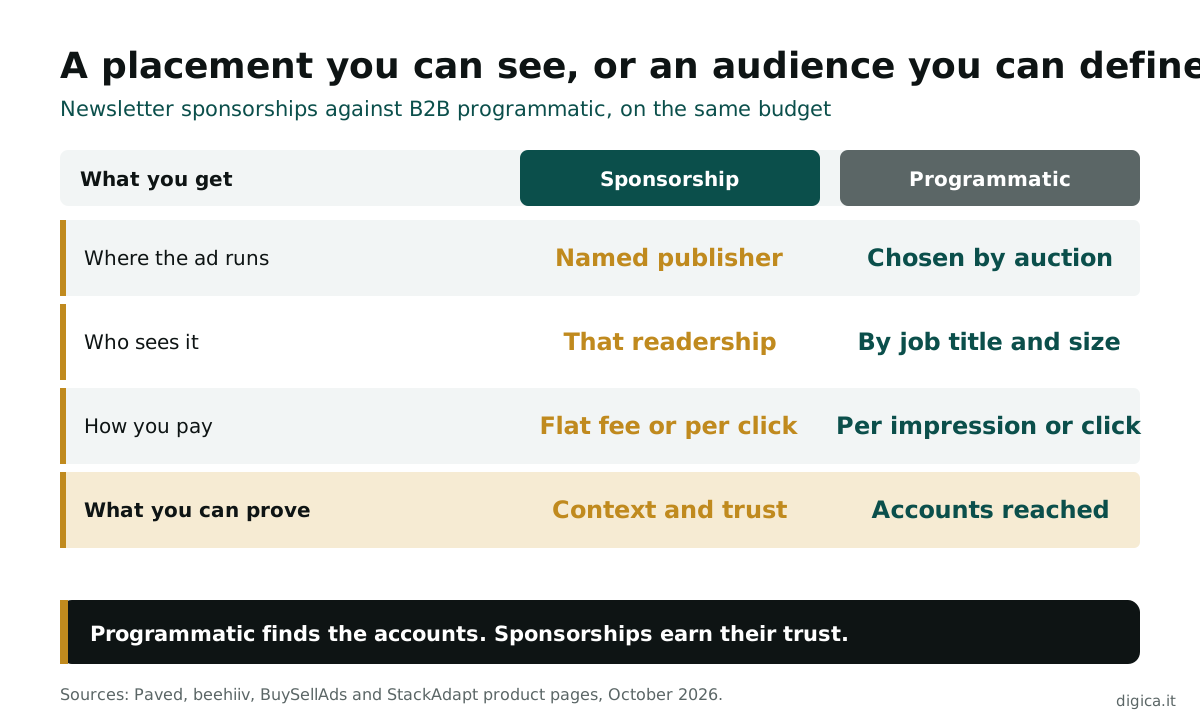
The short answer: sponsorship marketplaces sell a placement you can see, programmatic marketplaces sell an audience you can define, and very few do both. Choosing between them is the most important decision in B2B media buying.
A newsletter sponsorship on Paved or BuySellAds tells you exactly where the ad runs and next to what. You can read the newsletter, judge its tone and decide whether your buyers trust it. What you cannot do is limit it to people at companies of a certain size. A programmatic campaign on StackAdapt does the reverse: it can reach heads of finance at companies with 1,000 or more employees, but on sites the auction picks.
Podcasts and screens sit closer to the sponsorship side. Gumball sells a named show. Adomni sells a named place. Both rely on context to stand in for targeting.
The practical answer is to use both, for different jobs. Programmatic finds the accounts. Sponsorships build trust with the people in them. A B2B team with one budget should start with whichever matches its sales motion: account-based selling to a named list favors programmatic, and category building in a defined community favors sponsorships.
Three failure scenarios
These are the patterns that recur when B2B teams buy media through an advertising marketplace without a plan.
- The big catalog with the wrong audience. A data security company books ten newsletter sponsorships in one afternoon because the catalog made it easy. The newsletters reach developers, but the buyer is the chief information security officer. Clicks look healthy, pipeline does not move. Starting from the buyer's job title, and picking only the newsletters that title actually reads, would have cut the list to two.
- The targeting nobody checked. A software company runs a programmatic campaign at "finance leaders at mid-market companies" and never reviews the placement report. Half the impressions land on sites it would never choose. Reviewing placements after the first week, and excluding the weak ones, would have moved that budget to sites its buyers trust.
- The channel bought for the wrong reason. A manufacturer buys out-of-home screens across a city because the minimum was low. Its buyers gather in one place twice a year, at two trade shows. The same budget, spent on screens around those venues during the shows, would have reached the same buyers at the moment they were shopping.
Each team found inventory easily. None of them matched it to the buyer first. With WARC forecasting global ad spend to grow 11.9% to $1.34 trillion in 2026 (WARC), more inventory is coming to every channel, and the cost of buying it without a buyer in mind rises with it.
Choosing a media marketplace: a decision framework
The short answer: start from who your buyer is and how you sell, then choose the advertising marketplace whose targeting unit matches it.
- If you sell to a named list of fewer than 2,000 target accounts, start with StackAdapt and an account list, and test the match rate before you scale.
- If your buyer reads a niche newsletter you can name, book that newsletter directly on Paved, and add two similar titles from its catalog.
- If you know your cost per click from other channels and want to compare like for like, run a beehiiv Ad Network offer at a CPC at or below that number.
- If you sell to developers, designers or AI teams and do not have time to negotiate, brief BuySellAds and ask for the full publisher list before approving.
- If your buyers trust a podcast host more than an ad, book host-read spots on Gumball, and check the business shows before the comedy ones.
- If your buyers gather at fewer than five events a year, use Adomni screens around those venues on those dates, and nowhere else.
- If a platform cannot show you inventory and audience data before you pay, do not use it for a first test.
Building a media or advertising marketplace?
We help advertising and media marketplaces recruit the media owners that make inventory worth browsing, and reach the advertisers comparing them.
The number to take into your next budget meeting is cost per qualified account reached, not cost per impression. For example, a $10,000 newsletter test that puts your brand in front of 400 people at target accounts costs $25 per account. A $10,000 programmatic test that reaches 2,000 target accounts at a lower match quality costs $5 per account, before you check the placements. Run both against the same account list and compare pipeline after 90 days. The biggest cost of doing nothing is a media plan that rolls over every quarter without anyone checking whether the people who saw it could ever buy.
FAQ
What is an advertising marketplace? An advertising marketplace is a platform where advertisers browse and buy ad inventory from many media owners, such as newsletters, podcasts, websites or screens, with prices and audience data shown before purchase. Media owners use it to sell inventory they could not sell on their own.
What is the difference between an advertising marketplace and an ad exchange? An ad exchange is the auction system that trades impressions automatically between buying and selling platforms. An advertising marketplace is where a marketer chooses what to buy, either by booking named placements or by setting an audience for programmatic buying.
What is a media marketplace? A media marketplace is another name for an advertising marketplace: a platform that brings buyers and sellers of media together. In B2B, the most active media marketplaces sell newsletter sponsorships, podcast reads, programmatic display and digital out-of-home.
Which advertising marketplace is best for B2B targeting? Among the six here, StackAdapt offers the deepest B2B targeting, by company size, revenue, industry, job title and seniority, using data partners such as Dun & Bradstreet, Bombora and ZoomInfo. Newsletter and podcast marketplaces target by the audience a publisher already has.
How do newsletter ad networks charge? It varies. Paved sells direct sponsorships booked and paid in its catalog, and also offers pay-per-click across its network. The beehiiv Ad Network lets the advertiser choose a cost per 1,000 unique opens or a cost per click.
Are newsletter sponsorships good for B2B? They work well when your buyer reads a newsletter you can name, because the reader chose it and trusts it. They work less well when your buyer is a role spread across every industry, where programmatic targeting by job title reaches more of them.
Related Articles
- Advertising and media marketplace growth
- Best influencer marketplaces for B2B brands in 2026
- Best B2B data providers in 2026: data brokers compared
- Best B2B marketplaces in 2026: 7 examples by industry
- Liquidity is the only marketplace metric that compounds
Where this connects
This article is part of our B2B marketplace growth series. Browse more on the Digica blog.