The best B2B data providers in 2026, compared on coverage, sourcing and compliance
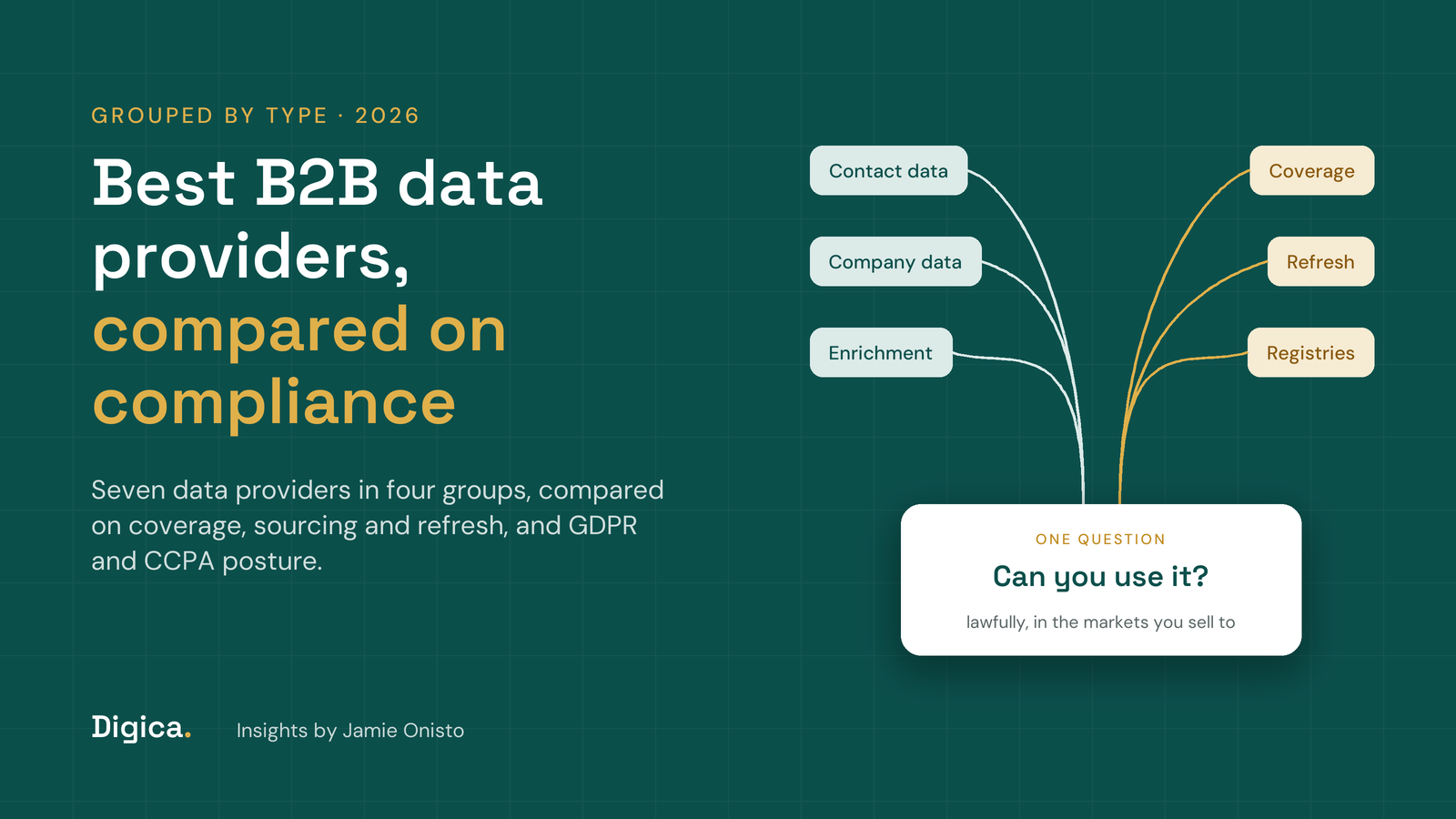
B2B data providers all claim huge numbers. ZoomInfo lists 500M+ contacts, Lusha 515M+ and People Data Labs 1.5 billion person profiles. Those counts are the first thing a sales or marketing team sees, and the least useful when choosing. What decides whether the data is worth paying for is how it was collected, how often it is checked, and whether you can legally use it in the countries you sell to.
That last question has become harder to ignore. California now runs a public register of data broker companies and, from August 2026, a single deletion mechanism that every registered broker must honor. In Europe, B2B contact data still falls under GDPR. A provider that is cheap but weak on compliance moves the risk to you.
This guide groups seven of the best B2B data providers by type: all-in-one sales intelligence, compliance-led European contact data, company data, and enrichment APIs. It compares them on coverage by region, sourcing and refresh, and compliance posture. Figures are each provider's own, checked on October 24, 2026. If you are looking for places that sell datasets more broadly, see our ranking of data marketplaces.
Quick Navigation
- What a B2B data provider actually sells
- Seven B2B data providers compared
- All-in-one sales intelligence: ZoomInfo, Apollo.io and Lusha
- EU-compliance-led contact data: Cognism
- Company and firmographic data: Dun & Bradstreet
- Enrichment APIs: People Data Labs and HubSpot Breeze Intelligence
- How data vendors source and refresh their records
- Data broker companies and the law
- Three failure scenarios
- Which B2B data provider fits your team
- FAQ
- Related Articles
What a B2B data provider actually sells
The short answer: B2B data providers sell access to records about businesses and the people who work in them, usually names, job titles, work emails, phone numbers and company details, plus the signals that show when those records change.
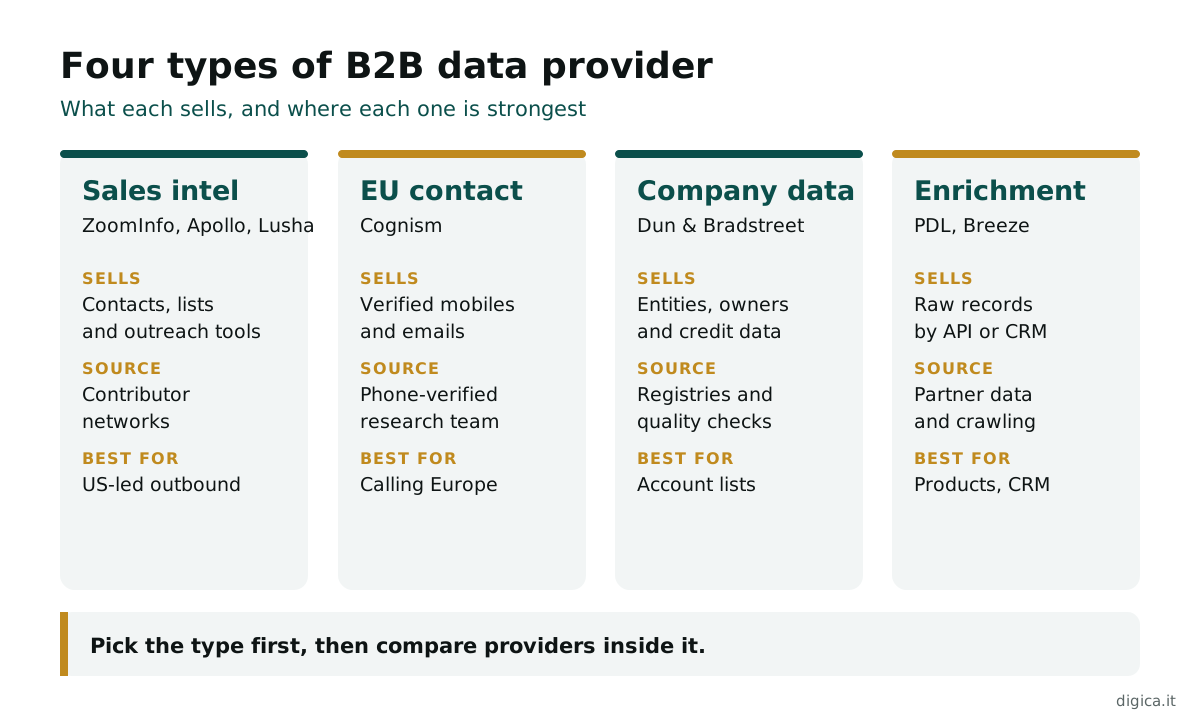
Most data vendors fall into one of four groups. Sales intelligence platforms bundle contact data with search, prospecting lists and outreach tools. Compliance-led providers focus on verified contact data in regulated markets, mostly Europe. Company data providers sell firmographics: legal entities, ownership, size, industry and financial health. Enrichment providers sell the raw records through an API, so you can fill gaps in your own CRM or product.
The record count tells you size, not quality. A database of 500 million contacts can still be wrong about the 2,000 people you care about this quarter. People change jobs, companies rename, and phone numbers move. So the questions that matter are where each record came from, when it was last checked, and how the provider handles the people in it.
Our view: buy B2B data the way a procurement team buys any input. Start with the regions and roles you sell to, test a sample against records you already know, and read the compliance pages before the pricing page.
Seven B2B data providers compared
The short answer: ZoomInfo and Lusha claim the largest contact databases among sales platforms, Cognism leads on European compliance, Dun & Bradstreet on company records, and People Data Labs on raw scale for developers.
Seven B2B data providers compared on type, claimed coverage, sourcing, refresh claims, compliance and best fit
| Provider | Type | Coverage claimed | How data is sourced | Refresh claim | Compliance stated | Main risk | Best for |
|---|---|---|---|---|---|---|---|
| ZoomInfo | Sales intelligence | 500M+ contacts, 100M+ companies | Contributor network plus research | Not stated as a cycle | ISO 27001, ISO 27701, SOC 2 Type II | Contributed contact books | Large US-led sales teams |
| Apollo.io | Sales intelligence | 240M+ contacts, 30M+ accounts | 2M+ contributors, web crawling, partners | Signal-led plus monthly sweep | SOC 2 Type II, ISO 27001 | Accuracy outside the US | Fast-growing outbound teams |
| Lusha | Sales intelligence | 515M+ contacts, 29M+ companies | Contributors, licensed directories, public data | Weekly for contact fields | ISO 27001, ISO 27701, SOC 2 Type II | Conflicting refresh claims | Simple self-serve prospecting |
| Cognism | EU-compliance-led | 200M+ European contacts | Phone-verified research team | 95% of director level every 30 days | ISO 27001, ISO 27701, SOC 2 Type II, DNC in 16 territories | Smaller US coverage | Calling into Europe |
| Dun & Bradstreet | Company data | 650M+ entities | Registries and 60B+ monthly checks | Continuous checks | California registered broker | Not a contact tool | Supplier, credit and account data |
| People Data Labs | Enrichment API | 1.5B person profiles, 71.4M+ companies | Data Union of partners plus crawling | Monthly | ISO 27001, SOC 2 Type 2 | Needs engineering work | Products built on B2B data |
| HubSpot Breeze Intelligence | Enrichment in CRM | 200M+ company and buyer profiles | Clearbit data, now in HubSpot | Continually refreshed | HubSpot compliance program | HubSpot only | Teams already on HubSpot |
All seven appear on California's data broker register (California Privacy Protection Agency), which is one reason the table includes a compliance column. Coverage claims use different units, so compare them only within a group.
All-in-one sales intelligence: ZoomInfo, Apollo.io and Lusha
The short answer: ZoomInfo is the broadest platform for large teams, Apollo.io the most widely adopted by growing teams, and Lusha the simplest to start with, and all three build their databases partly from contributors.
ZoomInfo claims 500M+ contacts and 100M+ companies. Much of its contact data comes from a contributory network, ZoomInfo Lite, formerly Community Edition, where users connect a business email account and share contact details from their address books and email signatures in return for free credits. It holds ISO 27001, ISO 27701, TRUSTe and SOC 2 Type II certifications, and added ISO/IEC 42001 for AI management in 2026. Its Nasdaq ticker changed from ZI to GTM in May 2025, alongside the launch of its GTM Studio product, but the company remains ZoomInfo Technologies.
Apollo.io claims 240M+ contacts and 30M+ accounts, and says over 600,000 companies use it. It combines data from more than 2 million contributors, public web crawling and third-party providers. Records refresh when signals such as bounced emails or job changes come in, with a monthly sweep of the whole database, and it claims 98% email accuracy. It holds SOC 2 Type II and ISO 27001.
Selling data to B2B sales and marketing teams?
In 30 minutes we look at how buyers compare data providers and data marketplaces like yours, on Google and in AI answers, and where you lose them.
Lusha claims 515M+ verified contacts and 29M+ companies, including 132M contacts in the US, with coverage across North America, Europe, Asia Pacific and Latin America. It sources from a contributor community, licensed business directories, public business information and its own email-pattern inference. Its pages disagree on refresh: one FAQ says daily, while its data page says contact fields refresh weekly. It holds ISO 27001, ISO 27701 and SOC 2 Type II, validated by TrustArc and ePrivacyseal.
The contributor model is what lets these three grow so fast, and it is also the point to check. A record that arrived from someone's address book was shared by a user, not by the person in it. That is lawful in many markets with the right notices, but it is the first thing a European privacy team will ask about.
Pick within the group. Choose ZoomInfo for depth and workflow tools at scale, Apollo.io for an all-in-one outbound stack, and Lusha for quick self-serve lookups.
EU-compliance-led contact data: Cognism
The short answer: Cognism is the B2B data provider built around European compliance, with phone-verified mobile numbers and do-not-call screening across 16 territories.
Cognism, based in London, sells contact data with a focus on Europe. Its campaign pages claim 200M+ European contacts and around 70 million mobile numbers. Its premium tier, Diamond Data, is mobile numbers verified by a research team calling them, and it says 95% of director-level and above contacts are refreshed every 30 days.
Its compliance work is unusually specific. It relies on legitimate interest under Article 6(1)(f) of GDPR as its legal basis, and says it tells the people in its database that they are there. It screens numbers against do-not-call lists in 16 territories, including the UK's TPS and CTPS and the lists of the US, Australia, Germany, France, Spain and others. That screening matters because the UK regulator expects business numbers to be checked against the TPS and CTPS before any live sales call (ICO). It holds ISO 27001, ISO 27701 and SOC 2 Type II. Cognism also owns Kaspr, a lighter prospecting tool it bought in 2022.
The trade-off is coverage. Cognism is strongest where its compliance matters most, in Europe, and thinner in North America than the US-led platforms. For a team calling into Germany, France or the UK, that is the right trade.
Why it is here. The clearest choice for teams that call European prospects and need to show how each number was checked.
Company and firmographic data: Dun & Bradstreet
The short answer: Dun & Bradstreet is the reference source for company data, covering 650M+ entities, and is used for credit, supplier and account decisions rather than for finding a person to email.
Dun & Bradstreet says it holds data on 650M+ business entities and runs 60B+ quality checks each month. Its D-U-N-S Number is used as a company identifier across procurement and credit systems, which makes its records useful for matching accounts, checking suppliers and building a clean account list before anyone looks for contacts.
It changed ownership in 2025. Clearlake Capital completed its acquisition of Dun & Bradstreet on August 26, 2025, at $9.15 a share in a deal valued at about $7.7 billion, and the company left the New York Stock Exchange.
For sales teams, Dun & Bradstreet is the foundation rather than the whole house. It tells you which companies exist, how they are related and how big they are. It is not the fastest way to find a direct dial. We cover its role for buyers in our ranking of supplier databases.
Why it is here. The most widely used company identifier and the strongest choice for account and supplier data.
Enrichment APIs: People Data Labs and HubSpot Breeze Intelligence
The short answer: People Data Labs sells raw B2B data at scale through an API for teams building their own products, while HubSpot Breeze Intelligence enriches records inside HubSpot without any engineering.
People Data Labs claims 1.5 billion unique person profiles and 71.4M+ companies, refreshed each month. Most of its data comes from what it calls a Data Union, customers and data partners sharing data with each other, plus web crawling, and it adds about 45 million records a month. It holds ISO 27001 and SOC 2 Type 2. In October 2026 it added executive-movement data in its version 36 release. It is built for developers: you query it from code and store what you need.
HubSpot Breeze Intelligence is the former Clearbit, which HubSpot bought in 2023. HubSpot describes it as over 200 million company and buyer profiles that are continually refreshed, used to fill in CRM records and shorten forms. It is only available inside HubSpot.
The two sit at opposite ends of the same job. People Data Labs gives you the most control and the most work. Breeze gives you the least of both. If you are building a product that runs on B2B data, the API route wins. If you want cleaner CRM records next week, the built-in route does.
Pick within the group. Choose People Data Labs to build on B2B data, and Breeze Intelligence to enrich a HubSpot CRM.
How data vendors source and refresh their records
The short answer: B2B data is collected in four ways, from contributors, from the web, from partners and registries, and from human verification, and the more of the last one a provider does, the fresher and more expensive its records tend to be.
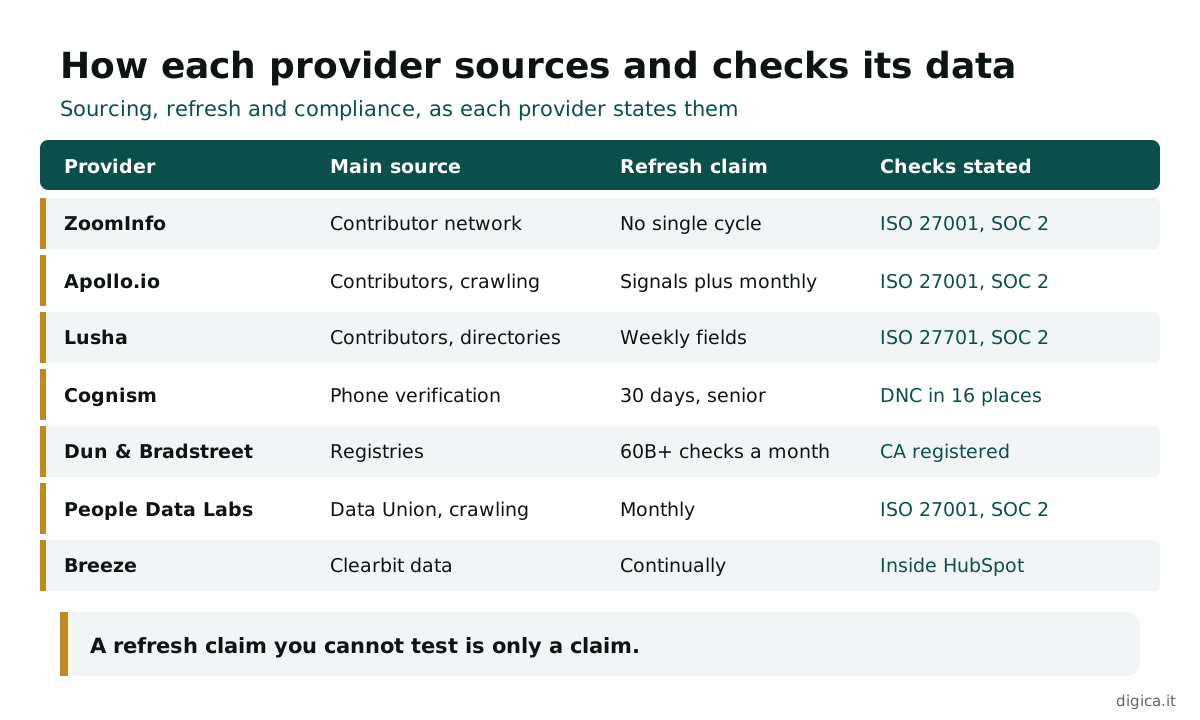
Contributor networks are the engine of the large sales platforms. ZoomInfo, Apollo.io and Lusha all gather data from users who share their contacts. People Data Labs runs a similar exchange between companies. Web crawling fills in job titles and company pages. Partners and public registries supply company records, which is where Dun & Bradstreet is strongest. Human verification is the slowest and most expensive method, and the one Cognism uses for its phone-verified mobile numbers.
Refresh claims vary as much as sourcing. Cognism promises a 30-day cycle for senior contacts. People Data Labs refreshes monthly. Apollo.io refreshes on signals and sweeps monthly. Lusha says weekly on one page and daily on another. ZoomInfo does not publish a single cycle. A claim you cannot test is a claim, so test it: pull 200 records you can check against LinkedIn or your own CRM and count the errors.
Our view: the best B2B data providers publish their sourcing in detail because it is a selling point. Vague answers about where data comes from are usually a sign that the answer would not help the sale.
Data broker companies and the law
The short answer: B2B data is personal data in Europe and California, so the data broker companies that sell it must register, honor deletion requests and support lawful use, and buyers carry part of the risk.
California runs a public data broker registry, and every company in this ranking is on it. Brokers must register each year between January 1 and 31, and the register file listed 603 brokers when we counted it. Since January 1, 2026, Californians can use a single tool, DROP, to ask every registered broker to delete their data, and brokers had to start processing those requests on August 1, 2026, checking the system at least every 45 days.
Do data buyers find your platform when they compare providers?
A growth audit maps how B2B data buyers search, on Google and in AI answers, and which of your coverage and compliance pages they never reach.
In the UK, the rules for B2B marketing are often misread. The Information Commissioner's Office says the email marketing rule in PECR does not apply to corporate subscribers, but that UK GDPR still applies to B2B marketing, that sole traders count as individuals, and that business numbers must be screened against the TPS and CTPS before live calls. The ICO notes its guidance is under review after the Data (Use and Access) Act.
For a buyer, this means two things. Ask each provider which legal basis it relies on and how it notifies people in its database. And check whether it screens against do-not-call lists in your markets, or leaves that to you. Cognism, for example, screens in 16 territories.
Three failure scenarios
These are the patterns that recur when teams pick a data provider on record count alone.
- The European campaign on US data. A US company expands into Germany and loads contacts from its existing US-led platform. Mobile numbers are thin, several are on do-not-call lists, and a complaint reaches a regulator. Testing European coverage and DNC screening before the campaign would have pointed to a compliance-led provider for that market.
- The CRM that decays. A marketing team enriches 50,000 CRM records once and never again. A year later, a large share of job titles and emails are out of date, and email bounce rates rise enough to hurt deliverability. A provider with a monthly refresh and a scheduled re-enrichment would have kept the list usable.
- The account list with no structure. A sales team buys contact data before it has a clean list of target accounts. Subsidiaries and parent companies are treated as separate prospects, and reps call the same group three times. Starting from company data with clear corporate relationships would have fixed the account list first.
Each team bought a lot of data. None of them bought the data their market or their process needed.
Which B2B data provider fits your team
The short answer: choose by region first, then by what you are doing with the data, then by how much compliance evidence your legal team needs.
- If more than a third of your prospects are in Europe and your team calls them, start with Cognism for phone-verified numbers and DNC screening.
- If you sell mainly into North America with a team of 20+ reps, compare ZoomInfo and Apollo.io on a 200-record test of your own target accounts.
- If you need a quick self-serve tool for a handful of sellers, try Lusha first.
- If you need clean account, credit or supplier data before contacts, start with Dun & Bradstreet.
- If you are building a product or data pipeline on B2B records, use People Data Labs through its API.
- If your CRM is HubSpot and you mainly need form shortening and record enrichment, use Breeze Intelligence before buying another tool.
Running a data or B2B data B2B marketplace?
We help data B2B marketplaces recruit the data providers that make a catalog worth searching, and reach the buyers comparing them.
The number to take into your next budget meeting is the cost of bad data. Gartner research puts the average cost of poor data quality at $12.9 million a year for an organization. If you test a sample before you buy and re-enrich on a schedule, you avoid most of the waste in bounced emails, wrong numbers and duplicate accounts. And since August 2026, every registered broker must check California's DROP system at least every 45 days (California Privacy Protection Agency). The biggest cost of doing nothing is a database you cannot prove you are allowed to use.
FAQ
Who are the best B2B data providers in 2026? The best B2B data providers in 2026 include ZoomInfo, Apollo.io and Lusha for sales intelligence, Cognism for compliance-led European contact data, Dun & Bradstreet for company data, and People Data Labs and HubSpot Breeze Intelligence for enrichment.
What is the difference between a data vendor and a data broker? Most B2B data vendors are also data brokers in legal terms, because they sell personal data about people they have no direct relationship with. California requires such companies to register, and all seven providers in this ranking are on its register.
Is buying B2B contact data legal under GDPR? It can be, if the provider and buyer have a lawful basis such as legitimate interest, tell people their data is held and honor objections. The UK ICO says UK GDPR still applies to B2B marketing, so check each provider's legal basis before using its data.
Which B2B data provider has the best European data? Cognism is the strongest choice for European contact data. It claims 200M+ European contacts, phone-verifies mobile numbers and screens against do-not-call lists in 16 territories.
How often do data providers refresh their data? It varies. Cognism says 95% of senior contacts are refreshed every 30 days, People Data Labs refreshes monthly, Apollo.io refreshes on signals plus a monthly sweep, and Lusha says weekly for contact fields.
How do I test a B2B data provider before buying? Ask for a sample of 200 records from your own target accounts and check them against records you already trust. Count wrong emails, wrong titles and missing phone numbers, and compare providers on the same sample.
What is the largest B2B data provider? By claimed records, People Data Labs is the largest, with 1.5 billion person profiles. Among sales platforms, Lusha claims 515M+ contacts and ZoomInfo 500M+, while Dun & Bradstreet covers 650M+ business entities.
Related Articles
- Data marketplace growth
- Best data marketplaces in 2026: 10 platforms compared
- Best supplier databases and directories for B2B
- Best places to buy datasets for AI training
- Best places to sell data in 2026: brokers and platforms
Where this connects
This article is part of our B2B marketplace growth series. Browse more on the Digica blog.